Several Futures of Nuclear Power
A sixty-year-old design still rules the world's reactors. A wave of challengers is finally asking whether it should.
For much of the nuclear age, the industry's central debate was how to build reactors. A more basic question is now surfacing: should the reactors that dominate the world's fleet have been the destination at all?
It is a strange question to raise about a proven technology. Pressurized-water and boiling-water reactors generate roughly a tenth of the world's electricity and nearly a quarter of its low-carbon power. They have logged thousands of reactor-years of operation, built vast industrial supply chains, and outlasted generations of regulatory scrutiny. By almost any measure they are among the most successful energy technologies ever fielded.
Yet consider the history from another angle. The designs that run modern grids were conceived in the 1950s and 1960s. Their fuel is pressed into ceramic pellets, sealed in metal tubes, and cooled by water held at roughly 150 times atmospheric pressure. The details have improved, but the underlying architecture would be instantly familiar to the engineers who built the first commercial reactors more than half a century ago.
The striking fact is not that engineers keep proposing alternatives. It is that after sixty years of advances in materials science, computational modeling, manufacturing, and chemistry, the industry remains overwhelmingly wedded to a single family of designs—a field that has reinvented almost everything except the machine at its center.
The explanation is not stagnation. It is that the most successful technology is rarely the most elegant. It is usually the one that accumulates the largest ecosystem.
The first nuclear age did not lack ideas. Engineers explored gas-cooled, sodium-cooled, heavy-water, breeder, and molten-salt concepts, among others. But light-water reactors enjoyed a decisive combination of luck and momentum: they rode the coattails of naval propulsion, drew heavy government investment, banked operating experience early, and became the template around which regulators, utilities, fuel suppliers, and universities organized themselves. Once that ecosystem existed, a rival design was no longer competing against another reactor. It was competing against an entire civilization of accumulated expertise.
Today a growing roster of companies and research programs is reopening questions that looked settled. They offer not one vision of the future but several, each aimed at a different weakness of the present.
One camp argues that the reactor was never the problem. On this view the industry's troubles are about construction cost and project execution, and the fix is not to reinvent nuclear power but to simplify it. GE Hitachi, Holtec, and others are building smaller light-water reactors that keep much of the existing fuel cycle, regulatory framework, and operating philosophy while chasing the savings of standardization and modular manufacture. Here the future of nuclear power looks much like its past, only more compact and easier to build.
A second camp focuses on fuel. Conventional reactors extract less than one percent of the energy locked in mined uranium before the fuel is pulled from service. This is a choice, not a flaw: the once-through cycle buys simplicity and predictability. Fast reactors challenge that bargain. By running on higher-energy neutrons, they can wring far more energy from the same fuel while shrinking the inventory of long-lived transuranic waste. TerraPower's sodium-cooled Natrium belongs largely to this tradition, as did the many breeder programs before it.
A third camp questions the architecture itself. Why should nuclear fuel sit as solid pellets inside metal rods? Why must the coolant run under extraordinary pressure? Why not a molten salt that stays liquid at atmospheric pressure and far higher temperatures?
Those questions trace back to the Molten Salt Reactor Experiment at Oak Ridge National Laboratory in the 1960s, which showed that a reactor fueled by liquid salt could run. The idea then lay largely dormant for decades. It has returned with force. Most modern descendants use fluoride salts—notably FLiBe, a mix of lithium and beryllium fluorides—which run hot, hold their liquid state under conditions that would defeat a conventional reactor, and promise a safety case built on chemistry rather than on water stored under pressure. For their advocates the appeal is not only efficiency but elegance.
Even within the molten-salt world, though, there is disagreement about what comes next.
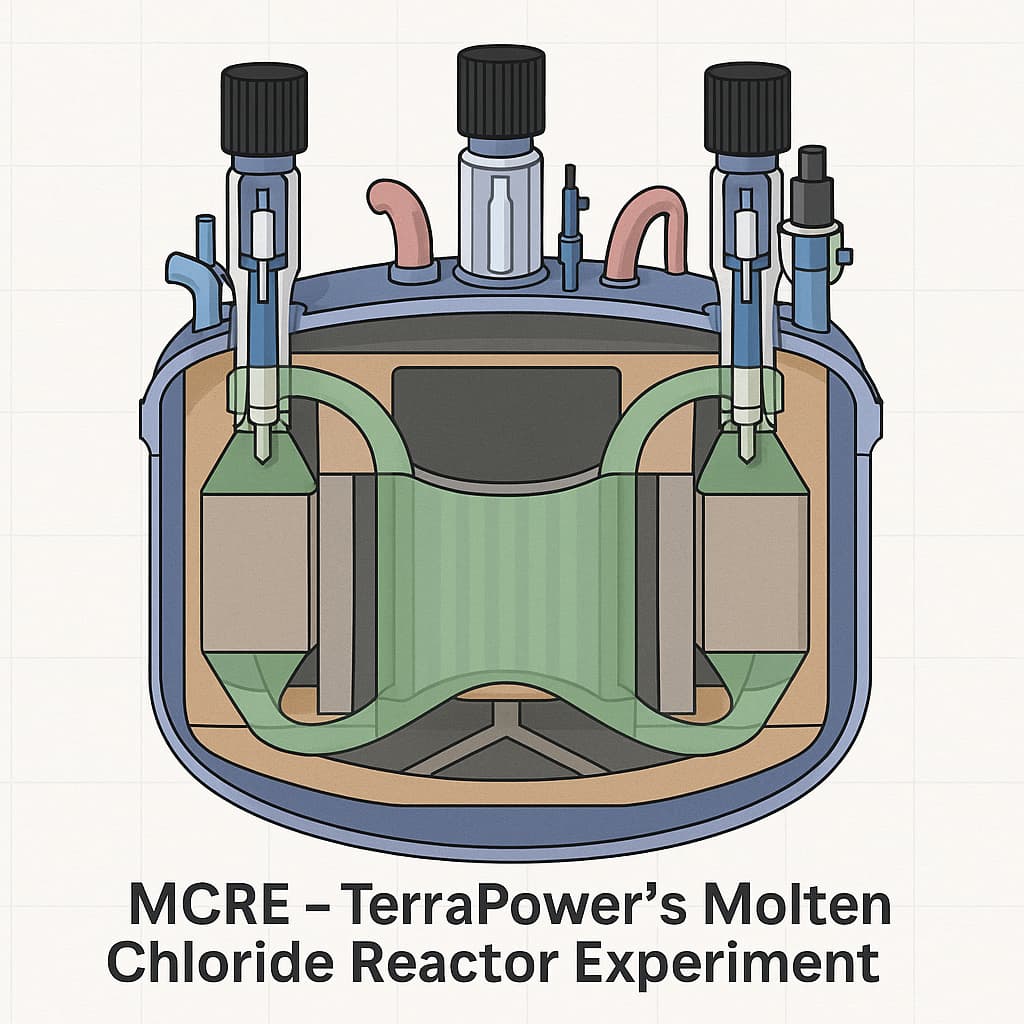
That brings us to one of the more ambitious efforts now under way: the Molten Chloride Reactor Experiment, or MCRE—a collaboration led by Southern Company with TerraPower, CORE POWER, and America's Department of Energy, and being assembled at Idaho National Laboratory. Where most salt concepts pair a thermal neutron spectrum with fluoride salts, MCRE pursues a fast spectrum using chloride salts. To a bystander the distinction sounds obscure. To a reactor designer it marks a different set of priorities: fluoride salts inherit the Oak Ridge vision; chloride salts try to extend it.
A fast chloride system promises to fold several attractive traits into one design—the high temperatures of molten salt together with the fuel economy of a fast reactor. In principle it could burn material now treated as waste, reduce stockpiles of long-lived transuranics, and squeeze far more value from uranium.
The phrase "in principle" deserves the weight.
What makes MCRE interesting is not what its engineers believe it can do, but what they admit they do not yet know. Whether a chloride reactor can sustain a chain reaction is not in doubt; physics settled that long ago. The open question is whether the surrounding ecosystem can be made to work. Hot chloride salts are savagely corrosive to structural metals. Fuel fabrication is still being invented—only recently did the Idaho team produce the first batches of chloride fuel salt ever made for a fast reactor, with dozens more required before the experiment can even reach criticality. Some designs lean on chlorine-37, an isotope that barely exists in commercial quantities. Instruments must survive conditions unlike anything in a conventional core, and regulators must judge a technology with almost no operating precedent.
In that sense MCRE is among the more honest projects in advanced nuclear energy. It is a sub-scale, time-limited experiment in materials, chemistry, and proof of concept—not a power station in waiting—and it does not pretend the answers are already in hand. It exists precisely because they are not.
The deeper lesson is that societies celebrate invention and underrate the harder work of building the ecosystem around it: the metallurgy, the chemistry, the supply chains, the licensing frameworks, and the operating procedures, any one of which can sink an otherwise sound idea.
The future of nuclear power is therefore unlikely to be one winner against a field of losers. The approaches are not solving the same problem. Light-water reactors offer proven reliability; small modular reactors promise something easier to build; fast reactors wring more energy from the same uranium; thermal-spectrum salt reactors chase a simpler architecture; fast-spectrum salt reactors try to fuse advantages that have always lived in separate worlds.
Some will fail. Some will succeed only in niches. A few may remake the industry. For now nobody knows which design lands in which category—and that uncertainty is not a sign of failure. It is a sign that nuclear power has entered another era of experimentation.
For decades the defining question was how to build reactors better. Increasingly it is whether to build different reactors at all. The answer will decide not just the future of nuclear power, but whether the next sixty years of reactor development look anything like the last.
This work is licensed under a Creative Commons Attribution 4.0 International License. CC BY 4.0
Feel free to share, adapt, and build upon it — just credit appropriately.