Capability: The Real Opportunity of Frontier Tools
The point of frontier tools is not to do old work faster, but to attempt what once lay beyond a single person's reach.
Almost every conversation about artificial intelligence begins with speed: write the report faster, research faster, generate the slide deck in a minute instead of an hour. New tools are always understood this way at first, as quicker versions of the thing they replace — the automobile was a horseless carriage, the early website a brochure that happened to glow. The gains are real and worth having. But they are the smallest version of what these tools do, and the internet did not change the world by producing better brochures.
The larger story is about capability, and it starts with a fact we rarely state plainly: for most of history, ambition was rationed by it. People did not abandon worthwhile projects because their ideas were poor, but because the expertise, labor, capital, or time required lay out of reach. A teacher who dreamed of educating thousands ran into the walls of a classroom. A historian with a lifetime of knowledge to preserve lacked the skills or the money to build anything that would outlast her. The would-be founder of a museum concluded, correctly, that museums need institutions, not individuals. So the projects went unattempted — not for want of imagination, but because capability acted as a governor on ambition, and people learned, mostly without noticing, to want only what they could plausibly do.
That governor is loosening.
The productivity trap
Productivity is seductive because it can be measured. A task that took four hours now takes one; the saving is obvious, and a manager can put it on a slide. But measurable is not the same as important.
Hand two astronomers a more powerful telescope. One studies familiar stars with greater precision. The other discovers objects that could not previously be seen, gathers data that could not previously be collected, and begins asking questions that could not previously be answered. Both have better instruments; only one has expanded the frontier of inquiry.
Generating ten articles instead of one is greater precision. Building a multilingual archive, an interactive museum, or a research project that once required a department is frontier expansion. The significance lies not in speed but in reach. New tools do more than increase output; they enlarge the set of ambitions that appear realistic. Once people discover they can attempt larger things, they often begin to want them.
From outputs to architecture
For most of the digital era, producing the thing was the achievement. An article, a video, a working website each cost enough effort that finishing one was a milestone. As production gets cheap, scarcity moves. The hard part is no longer making information but organizing it, connecting it, preserving it, and keeping it useful over time.
A single article teaches a reader for an afternoon; a body of interconnected, well-kept knowledge teaches for years and becomes something others can build on. The opportunity, then, is not more content but better architecture — systems that accumulate value rather than merely generate output. A lone historian can now attempt what once took a foundation: pulling research, design, translation, and engineering into one durable, navigable resource and tending it as it grows. The skills that were once separate professions are available on call. What cannot be delegated is the judgment that decides what is worth assembling, and the vision that holds it together.
The catch
None of this is automatic, and abundance has a failure mode. A tool that lets one person attempt more also lets one person produce far more of the mediocre, the unread, the not-quite-thought-through. If some future system can write a thousand competent novels in an afternoon, the feat is the number; the question is whether any of them needed to exist. Capability without judgment does not raise the ceiling. It floods the floor.
Which is the argument turned over. As making things grows easy, the scarce inputs become the human ones — taste, discernment, and the nerve to ask not "what can I now produce?" but "what is now worth attempting?" The tools widen the range of plausible ambitions; they do not choose among them. That part is still ours.
The new constraint
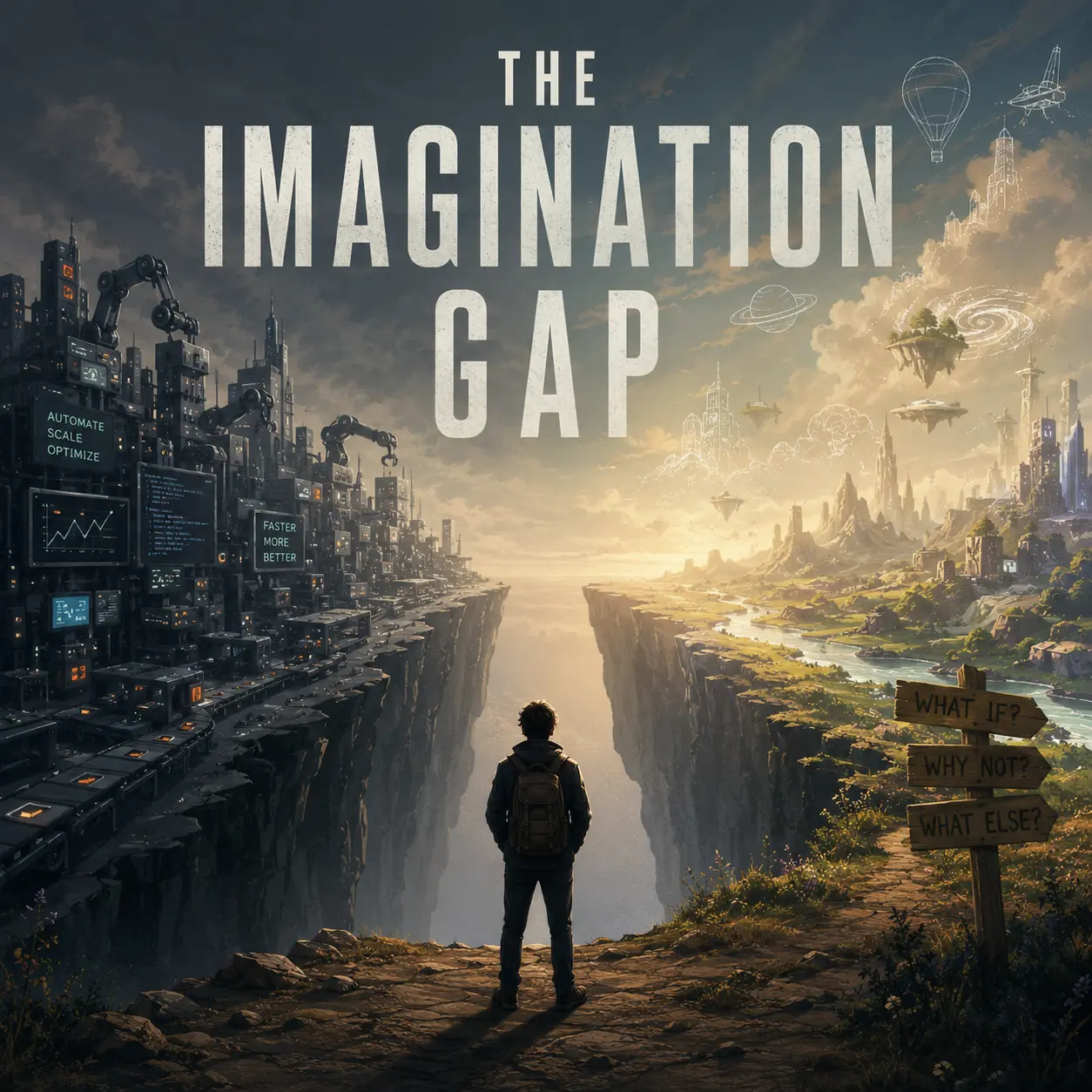
For most of history we trimmed our ambitions to fit our capabilities, which was the only sensible thing to do. The unfamiliar problem now runs the other way: capability is outpacing ambition. The binding constraint is no longer what we can build, but what we can imagine is worth building.
The frontier was never about doing old things faster. It is about picturing what has just become possible — and picturing, it turns out, is the harder skill.
This work is licensed under a Creative Commons Attribution 4.0 International License. CC BY 4.0
Feel free to share, adapt, and build upon it — just credit appropriately.