The Imagination Gap
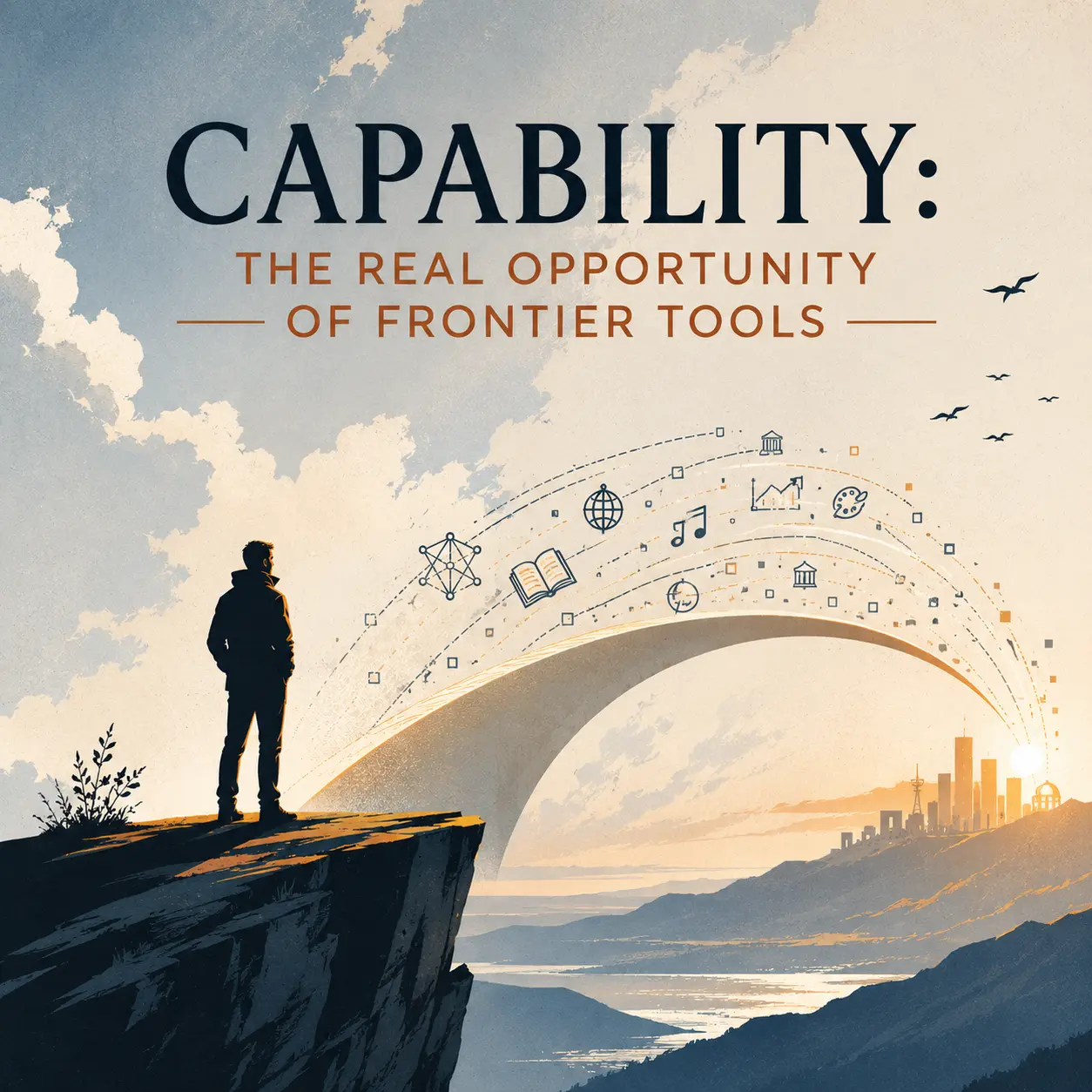
Capability has outrun ambition. The constraint behind both is rarer still — the imagination to conceive what is now worth attempting.
One reversal sets the terms: for most of history we trimmed our ambitions to fit our capabilities, and now capability has begun to outrun ambition. But ambition is not the floor. Beneath it sits something slower to grow and easier to lose — imagination, the capacity to conceive of what does not yet exist. The hands have become superhuman. The mind that tells them what to make has not.
We are slow to notice this, because it does not feel like a limit. A limit announces itself: the budget you lack, the skill you never learned, the hours that ran out. Imagination fails silently. You do not feel the projects you never thought to attempt, and the space of the unconceived leaves no gap in the calendar. So as the old constraints fall away — expertise, labor, capital, time — we are left in front of an open field, reaching by reflex for the nearest familiar thing.
The tool trains the hand
The familiar thing is what the tools quietly recommend. The trap is that the new capability arrives dressed as productivity. It is sold, demonstrated, and rewarded as a way to do the old work faster — more code, more copy, more decks, in less time. The grammar of the tool becomes the grammar of its user. Handed an instrument that could build something unrecognizable, we use it to pave the cow-paths: the same old routes, now in asphalt. The machine capable of the highway is marketed as a faster shovel, and we believe the marketing, because imagining the highway is harder than imagining a quicker dig.
A skill, not an endowment
There is a further difficulty. Imagination is not a fixed gift but a skill, and skills that go unused decay. We have already learned to offload memory to our devices and arithmetic to our software, mostly without regret. But the generative act — the conjuring of the not-yet-real — is a strange thing to hand over, because a machine can only recombine what it has seen, and what it has seen is the past. Let it do the imagining as well as the typing and you risk a closed loop: a tool trained on yesterday, proposing variations on yesterday, to a user who has forgotten how to want anything else. The real hazard of these tools was never that they would think for us. It is that we would stop.
The arithmetic of the gap
And the arithmetic is unforgiving. Capability compounds; it roughly doubles on a schedule. Imagination, at best, grows the slow human way — by reading, arguing, traveling, and failing — and past a certain age, for many of us, it does not grow at all; it narrows. Two lines, then: one steepening, one nearly flat. The widening distance between them is the defining gap of the era. The question is no longer what the tools can do, but how little of it we can picture using.
Daring to imagine
The response is not a trick but a discipline, and it runs against instinct. It means treating "that's impossible for one person" as a hypothesis to test rather than a fact to accept, because the sentence was true last year and may not be this one. It means asking, before "how do I do this faster," the older and harder question: what would I attempt if the usual limits were gone — and then noticing how many of them already are. The unachievable is worth picturing now precisely because the line between the achievable and the absurd is moving, quickly, in our favor. The people who define what comes next will be the ones who rehearsed the absurd before it turned obvious.
We spent most of history learning to imagine within our means. The unlearning is the work now. The tools will keep getting better at building; the decisive, irreducibly human act is deciding what is worth building — and daring to picture what a machine, trained on what already exists, could never have proposed.
This work is licensed under a Creative Commons Attribution 4.0 International License. CC BY 4.0
Feel free to share, adapt, and build upon it — just credit appropriately.