The Miller's Son
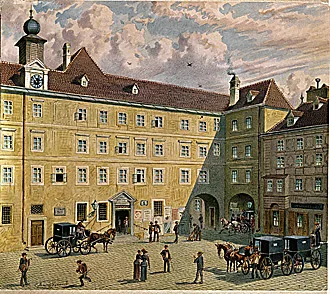
At three in the afternoon on the last day of September the courtyard of the Konvikt was full of boys, and one of them did not match. The others wore the uniform of the Imperial chapel choir: a dark coat with gold lace at the collar and cuffs, a small three-cornered hat, buckled shoes, the whole costume of a court official in miniature. The boy nearest the gate wore grey. It was a decent coat, brushed and mended, the kind a schoolmaster's wife on the edge of the city keeps going through three sons in turn, and in that courtyard it stood out like a flour sack in a jeweller's window. He was eleven years old. He was short even for eleven, round in the face, and he wore spectacles, steel-rimmed, with round lenses, which he pushed back up his nose with one finger whenever he looked up.
The choirboys had a name for him before he had opened his mouth. The miller's son, one of them said, and the rest took it up: the pale coat, the dust, the country cousin come to town. It was not a cruel joke as such jokes go, and it was told long after by men who had stood in that courtyard as boys and had gone on to be lawyers and priests and clerks of the Court, and who remembered the grey coat better than anything they had themselves done that autumn.
He does not seem to have answered. Nothing in the record says he did, and nothing anyone wrote about him in thirty years suggests he would have. He stood with his hands at his sides and looked at the door he had been told to go through, a tall door under the arcade on the far side of the courtyard, and beyond it three men sat at a table with a list, waiting to hear him sing. The wind that afternoon came off the glacis and blew leaves and grit across the flagstones. The light was flat and white, like skimmed milk, the light of a Vienna autumn once the sun has gone behind the University church and will not come out again before dark.
He had been born eleven years and eight months earlier, in a house called the Red Crab, in the Himmelpfortgrund, which is a suburb and was then a poor one: outside the walls of Vienna, outside the broad grass slope of the glacis that kept the city's guns clear, but inside the outer wall that kept the excise men's business tidy. The house stood on the road out to Nußdorf and the vineyards. One storey, five windows to the street, and behind it a long courtyard flanked by two wings, with open wooden galleries running along the upper floor, so that every household's washing, cabbages, quarrels and children were in plain view of every other. The Schuberts had a kitchen and one room. The school was in the house too.
He arrived at about half past one in the afternoon on the thirty-first of January 1797, in the dead of the winter, the twelfth child of Franz Theodor Schubert, schoolmaster, and Elisabeth his wife. He was baptised the next day in the parish church of Lichtental, a few minutes' walk down the road, under the fourteen holy helpers to whom the church is dedicated, and his godfather was his uncle Karl, another schoolmaster, so that the child was handed at the font from one teacher to the next. Nothing was written about the occasion beyond the line in the register. There was no reason it should be.
His father was thirty-three. He had been born a peasant's son in the village of Neudorf in Moravia, and he had climbed out of the fields by the one ladder available to a clever poor boy in the Emperor's lands, which was the schoolroom: assistant to his brother in the Leopoldstadt at twenty-one, master of the Lichtental parish school at twenty-three, and by the time of this twelfth child a man of small standing and large responsibility, the district's officer for poor relief as well as its teacher, which meant that the families who could not pay him for their children's letters came to him also for bread.
He was strict, pious, careful with money because he had never had any, and ambitious for the kind of respectability that comes from doing a modest thing well for a very long time. He played the cello, not well, in the evenings.
He kept a family register in his own hand, in which he entered each birth and each death, and there were a great many deaths.
His mother was forty. Elisabeth Vietz had come to Vienna from Zuckmantel in Silesia, a locksmith's daughter, and had been a cook in service before she married. She was quiet, reserved and God-fearing, which is all that anyone who knew her thought worth recording, and with fourteen children, nine of whom died small, she can have had little time to be anything else. Five lived: Ignaz, who was nearly twelve when Franz was born; Ferdinand, who was two; Karl, who was one; Franz; and, four years on, a sister, Maria Theresia. The others went into the register and into the churchyard, and their mother went back to the stove.
The city beyond the glacis was a walled place of a quarter of a million people, the capital of an empire at war with France, and it was full of music in the way other capitals were full of money. Old Haydn lived across the town in Gumpendorf, famous in every country of Europe, at work on an oratorio about the creation of the world. A young man from Bonn called Beethoven, twenty-seven that year, had been five years in the city and was already being talked about, chiefly for his piano playing and his manners. None of this reached the Himmelpfortgrund except as names. When the French reached it, in November of 1805, marching in through the suburbs to occupy the city, Franz was eight, and the school stayed open.
By then the family had moved. In the spring of 1801 the father bought a house of his own a few hundred paces away, in the lane called the Säulengasse: the Black Horse, a schoolhouse built for the purpose, for which he paid three thousand two hundred florins, three thousand of them borrowed. It was a large debt for a man in his position, and it was the kind of debt a man takes on when he means to stay. The classroom was on the ground floor, dark and cramped, the windows set too high to see out of, and into it, over the years that followed, the schoolmaster packed some three hundred children of the neighbourhood — weavers' children, dyers' children, the children of carters and market women — in shifts, taught by himself and, as each came of age, by his sons. Above it the family lived. Franz grew up with the noise of a school under his feet.
He learned his letters from his father at five, at the kitchen table, in the hour before the classroom filled. He went into the school itself at six, one of three hundred, and there is no sign that he was treated any differently from the other two hundred and ninety-nine.
At seven or eight the music began, and it began as work. His father taught him the violin, the rudiments, scales and bowing, with the same patience he brought to the alphabet. Ignaz, the eldest brother, by then a young man of twenty and an assistant in the school, took him on at the piano. Ignaz remembered how that went, in his own words: "He told me, a few months after we began, that he had no need of any further instruction from me." Ignaz was not offended, or said he was not. He seems to have been the sort of man — free-thinking, tired of schoolmastering, twelve years older than his pupil — who found it funny.
There is a story his sister told, sixty years on, of a joiner's apprentice, a relation of the family and a Schubert himself, who took the small boy with him into the city, to a warehouse where pianos were sold, and let him try the instruments. It is the kind of thing a sister remembers and a brother forgets. What the boy wanted was a keyboard larger than the one at home, and somebody let him at one.
Then Holzer. Michael Holzer had been choirmaster at the Lichtental church since 1794, a stocking-maker's son from the parish who had studied with old Albrechtsberger in the city and come home to run the music of a suburban church for the rest of his life. The schoolmaster sent Franz to him for singing lessons, and Holzer, finding what he had, taught him everything else as well: the piano, the organ, and figured bass, which is the grammar of harmony written as numbers under a bass line, the thing a church musician needs in order to accompany anything at sight.
The father told, in his own account of these years, what Holzer said to him: "Whenever I wanted to teach him something new, I found he already knew it." Holzer used to say that he had not so much given the boy lessons as sat and watched him, as though he had been sent a pupil who had already had the lessons somewhere else.
That is the most that anyone in the Himmelpfortgrund said about Franz Schubert before he was eleven. It was a good deal, from a man who had trained under Albrechtsberger and knew what a lesson was.
The choir loft at Lichtental is at the back of the church, over the door: a narrow gallery with the organ of 1774 in the middle of it and room on either side for a dozen singers and a few fiddles. On Sundays and feast days, from the time he was eight or so, Franz was up there, and before he was eleven he was the first soprano, the voice the others tuned to, and he played the violin solos in the services when a Mass called for one.
A woman kneeling below, among the weavers and their wives, would have heard the ordinary music of a suburban parish — Haydn's Masses, some of them, the ones every choirmaster in the empire had copied out by hand; the plainer Masses of local men; Holzer's own — done with more care than the parish had any right to expect, and over it a boy's voice, clear and small and exactly in tune, coming from somewhere behind and above her head.
She would not have turned round. Nobody turns round in church.
At home the music was a quartet. The father took the cello; Ferdinand, the second son, the first violin; Ignaz the second violin; and Franz, once his arms were long enough, the viola, which is the instrument nobody chooses and everybody needs, the inner voice that fills the chord like mortar between bricks and is heard only when it stops.
They played in the schoolroom after the children had gone, among the benches and the smell of chalk and wet wool, by candlelight in winter, with the door to the lane shut against the carts.
Ferdinand told a story about those evenings: that the smallest player would stop them in the middle of a movement and say, "Herr Vater, something must be wrong there," and that when they looked, something was — a wrong note in the cello part, a misprint in the copy, a slip of the father's bow — and that the father, who did not care to be corrected by his children, took it, because the boy was right.
On the twenty-eighth of May 1808 the Wiener Zeitung, the official newspaper, carried a notice that two places had fallen vacant among the choirboys of the Imperial Court Chapel. Candidates would be examined on the thirtieth of September at three in the afternoon, at the Imperial and Royal Konvikt on the Universitätsplatz. A boy must have completed his tenth year. He must be fit to enter the first grammar class of the Gymnasium. A second notice, in August, added a further condition, and it is worth hearing in the plain voice of the office that issued it: the boy must prove that he has already had the smallpox.
It is hard, now, to hear how that notice sounded in a schoolhouse with three hundred pupils and a mortgage. A choirboy of the Court Chapel was fed, housed and clothed at the Emperor's expense. He was schooled, for nothing, at the Akademisches Gymnasium, alongside the sons of officials and the lesser nobility, and he went on, if he kept his marks up, to the University. He wore the gold-laced coat. He sang, on Sundays, in the chapel of the Hofburg, a few yards from the Emperor. When his voice broke he could stay on as a scholarship boy and become — the schoolmaster would have finished the sentence himself — a lawyer, a priest, a civil servant, a man who did not need to teach three hundred children in a dark room to pay off three thousand florins. Franz was eleven, and his was the best voice in the Lichtental loft. His name went forward.
The three men at the table were Antonio Salieri, first Kapellmeister to the Emperor; Joseph Eybler, his deputy; and Philipp Korner, the singing master of the chapel. Salieri was fifty-eight that autumn. He had come to Vienna from Legnago, near Verona, as an orphan of sixteen, brought there by the composer Gassmann, and had been taken up in time by Gluck and made his heir in the opera house and the chapel; he had known Mozart and outlived him; he had taught Beethoven; he had written forty operas and directed the music of the court for twenty years. He was small, dark, quick, courteous, and Italian to the marrow in a German city, and he had heard, in forty years of auditions, a very great many little boys sing.
What happened in the room, nobody wrote down. The boys were called in, one at a time or in a group; each sang; Korner will have tried their range at the keyboard, and Eybler will have asked a question or two about the notes. What was written down is Salieri's verdict, in Italian, in his own hand, on the paper that went up to the Lord Chamberlain's office: "Among the sopranos the best are Francesco Schubert and Müllner." Francesco. The director of the Konvikt countersigned. On the eighth of October the Court approved the admission of two sopranos, Schubert and Franz Müllner, and an alto called Weisse, and Franz Schubert, aged eleven years and eight months, of the Himmelpfortgrund, became a choirboy of the Imperial Chapel and a boarder of the Imperial and Royal Konvikt, with a bed, a table, a chair, a chest that locked, and a coat with gold lace on it.
That was a week away. On the afternoon of the thirtieth he came out through the tall door into the courtyard, where the wind was still blowing grit across the flagstones and the choirboys had lost interest in him, and he walked home. It is a little under an hour on foot from the Universitätsplatz to the Säulengasse: out through the Schottentor, across the glacis with the wind at his back, up the Alser road past the great hospital, and along the lanes of the suburb as the light went. He had nothing in his hands.
Whether anyone had told him what the Italian at the table had written, nobody says; the paper went up to the Court, and the Court took a week. So there was nothing to tell them at the house except that he had sung, and what he had sung, and who had been at the table, and that the small man in the middle had listened with his head on one side and then picked up his pen. His mother was at the stove. His father was in the schoolroom. Ferdinand and Ignaz wanted to know everything and got, from Franz, who was never a talker, very little.
He hung the grey coat on its nail.