The Summer of 1825
The lake at Gmunden is long and narrow and very deep, and the town sits at the end of it where the water finds a way out and becomes a river again.
Across the lake, close enough to seem to lean over the roofs, stands the Traunstein, a single grey wall of mountain with its top in cloud most mornings and bare rock in the afternoon sun.
In June of 1825 the merchant Ferdinand Traweger had a house in the Traungasse, a short walk from the shore, and in the house a grand piano which Schubert described to his parents as splendid, and at the piano, on a good many evenings, a round man with a small boy climbing onto his knee.
The boy was Traweger's son Eduard. He called the visitor Onkel Schubert, and the visitor let him stay there while he played, and Eduard remembered it himself, when he was old and the visitor had been dead for half a century: a small, round man who did not mind a child on his knee.
Vogl was already there. Vogl had left Vienna at the end of March for Steyr, his own town, to be first in the country. Schubert had followed on the twentieth of May by the mail coach and spent four days at Steyr — the two rivers, the iron, the Schellmann household with its daughters, all as he had left them six summers before — and then come on with the singer to the lake. He would not be home until October, and nobody in Vienna, least of all the man himself, had expected the trip to run so long. He was twenty-eight, he had a bag of music paper and a new sonata, and he had been asked. The record of those four and a half months is a handful of letters, and they are the happiest things he ever wrote.
At Gmunden they stayed six weeks. Traweger gave them board and the piano and asked nothing; Schubert, writing home, called him "a great worshipper of my littleness," which is a phrase a man only uses when he is being made much of and enjoying it.
Every day they dined with Hofrat von Schiller, the senior official of the district, whom Schubert called "the monarch of the entire Salzkammergut," and who kept a table where the composer was expected and the singer was fussed over.
In the evenings there was music, Vogl standing at the piano with his great head still and his hands folded, Schubert accompanying, the Trawegers and their guests on the chairs, the windows open onto the summer and the lake going dark beyond them. The new songs from Walter Scott were sung there for the first time to anyone outside Vienna, and were wanted again the next night.
On the days when the Hofrat's dinner ran long there were boats on the lake, and a small town's worth of people who had never had a composer among them and meant to make the most of one.
The mornings were his own, as they were everywhere. He was at the piano or the table by seven, in his shirt, and nobody in a house of that kind disturbed a guest who was working.
What he was working on that summer, on those mornings at Gmunden and again in the mountains later, was a symphony. It was the big one; the friends called it the Gmunden–Gastein symphony, after the two places where they knew it had been written, and the world calls it the Great.
It begins with a horn, alone, playing a tune of a few bars that sounds like something a shepherd might play on a hill and turns out to be the seed of an hour of music; the woodwind take the tune up, then the strings, and it grows, and when the whole orchestra comes in at last on the fast part it is as if a door had been opened onto a road. He finished it the next year and went over it again in the last spring of his life.
He never heard it in a concert hall.
In the middle of July they left the lake for Linz, and for eight days Schubert was passed from house to house like a parcel everyone wanted to sign for.
He stayed with the Spauns, in the house he had first come to with Vogl six summers before. Spaun himself was still away at his desk, and it was his mother and his brother who did the honours; the composer wrote to him there on the twenty-first, "Since May 20 I have been in Upper Austria," and gave him the whole itinerary, so that the absent friend should at least have it on paper.
From Linz he went down the Danube a few miles to Steyregg, where Countess Sophie Weissenwolff had a castle on the cliff above the river. The Countess sang. She was, he reported, "a great worshipper of my poor gifts; she has all my songs," and it is hard to think of another house in the empire, that summer, of which the second half of that sentence was true.
The seven songs from The Lady of the Lake — Ellen's three songs, a boat song, a lament for the dead, Norman's song and the captive huntsman's — had been written that spring and finished on the road, and when they were printed the next April her name was on the front.
He wanted the English words printed under the German, he told his parents, "to make me better known in England," which shows how far a man may look from a castle in Upper Austria with a countess turning his pages.
The monks had him too. At St Florian, the great baroque abbey in the fields south of Linz, and at Kremsmünster, whose towers and observatory you see from the post-road half an hour before you reach it, he sat down at the abbey pianos and played them his new sonata. He gave them the slow variations in the middle of it, which are a tune walking down a corridor and coming back changed each time. Vogl had been a schoolboy at Kremsmünster. The fathers received him as a former pupil become famous and his composer as a curiosity worth hearing, and heard him, and the composer wrote home what they said: "some assured me that the keys under my hands sounded like singing voices." He set that down without comment, which was his way with praise, but he set it down.
On the twenty-fifth of July, back at Steyr, he wrote to his parents. It is a long letter, and unlike most of his it is a letter written to please, by a son who knows that his father will read it aloud in the Rossau to whoever is in the room and would like it to be read well. He gave them the towns and the hosts and the dinners, and then he gave them the news that mattered in a schoolmaster's house. "My new songs from Walter Scott's Lady of the Lake were very warmly approved," he wrote. "My audience expressed great delight at the solemnity of my hymn to the Blessed Virgin; it seems to have infected the minds of listeners with a spirit of piety and devotion. I believe I have attained this result by never forcing on myself religious ecstasy, and never setting myself to compose such hymns or prayers except when I am involuntarily overcome by the feeling."
That is the whole of his theory of sacred music, in three sentences, in a letter to his father, and he never wrote a better account of how he worked.
The hymn is Ellens Gesang III — Ellen's third song — and the listener in the drawing room at Gmunden or Steyregg would have heard this. A piano figure rises and falls like slow breathing, and over it a voice begins on the words Ave Maria and goes on, in German, with a Scottish girl's prayer, from a cave in the hills, to be hidden from her enemies. The girl is Ellen Douglas; the poem is Scott's; the words are Adam Storck's translation. Later the world laid the Latin prayer over the tune and forgot the girl, and it has been the Ave Maria ever since, sung in churches by people who would be surprised to learn it was written for a soprano in a summer parlour, in the voice of a highland outlaw's daughter. In 1825 nobody in the room was surprised. They asked for it again.
The same letter has the other sentence that everyone who writes about these two men has borrowed since. "The way Vogl sings and I accompany, so that for the moment we seem to be one, is something quite new and unheard-of to these people." He was not boasting; he was reporting, and what he reported was true. The singer was fifty-six and had been retired four years; his voice had lost its top and gained something else, and he no longer moved on the platform at all, so that everything he did was in the shading of a word; the man at the piano had written every note and knew where the singer would breathe before he did. They had been doing this together for eight years. In the villages of Upper Austria it was a thing nobody had heard.
And at the end of the letter, after the piety and the triumphs, a postscript from a man who has to live somewhere in October: would his father be so good as to find him a lodging in the city, near the Karlskirche, for about twenty-eight florins. The letter that carries the Ave Maria to the world also carries a request for a cheap room. He would have seen nothing odd in that, and there was nothing.
In the middle of August they went west. From Steyr by Kremsmünster again to Salzburg, where they arrived on a wet evening with the towers of the town standing up out of the rain and the fortress above them.
The account of what they saw is in the long letter he wrote to Ferdinand that September, begun at Gmunden on the twelfth and finished at Steyr on the twenty-first, and it should be read in his words.
Salzburg was a decayed city then, an archbishop's capital that had lost its prince-archbishop and been handed between three governments in twenty years, and he noticed the grass growing between the paving stones of the squares.
The cathedral he called "a miniature St Peter's." They climbed to the Nonnberg convent and looked down on the valley spread out "like a garden several miles in extent," with the river winding through it. They dined well.
And in the church of St Peter's, under the cliff, they went looking for the memorial of Michael Haydn, Joseph's younger brother, who had spent forty years of his working life in this town writing masses and teaching boys, and whose masses were sung in every choir loft in Austria; and they found it, as he wrote, "badly placed in an obscure corner."
He stood in front of it. "May thy pure and peaceful spirit hover around me, dear Haydn," he wrote to Ferdinand, and then: "Sad tears fell from my eyes." He was not a man who cried in letters; this is almost the only time. What moved him, one may guess — a modest master badly placed in an obscure corner — he did not say.
Then south, up the valley of the Salzach, towards the mountains. Hallein, the salt town, he disposed of in a sentence that his brother must have laughed at: "uncommonly dirty and dismal; all the inhabitants look like ghosts." Then Golling; then Werfen, with its castle hung on the rock above the road; and then the gorge, where the river he called "angry, chafing" comes down between walls of stone and the road is cut into the cliff. He described all this to Ferdinand with the care of a man who has been asked to and is doing his duty, day by day, town by town — and then, at Werfen, with the best still ahead of him, he put down his pen in the middle of the page and wrote: "Gracious heaven! it's an awful business having to describe one's travels." And there the account stops. Ferdinand never got Gastein.
So the narrator must supply it, and say so. Bad Gastein is a spa at the top of a valley so narrow that the village is built in tiers on either side of a torrent, and the torrent, in the middle of the village, drops in stages, hundreds of feet, with a noise you can hear from every window and stop hearing after a day. Rock walls on both sides; snow on the peaks above them in August; hot springs coming out of the mountain, which was why the place existed and why the people who could afford it came.
They stayed about three weeks, in weather that changed every hour, the cloud coming down over the walls of the valley by noon and lifting again to show the snow.
He told Bauernfeld, when he was back at Steyr, that Salzburg and Gastein "surpass in beauty the boldest flights that fancy ever took," and that is his last word on the valley; what he thought of the waterfall, whether he walked up to it or sat by it, whether it went into anything, there is no page to say.
What there is from Gastein is a sonata, dated August 1825, in which one may hear the mountains if one likes. It opens at a gallop, both hands hammering, as if the piano had been let off a leash.
The last movement is built on a little tune that yodels — it hops up and comes down again, exactly as the herdsmen's calls do across an alpine valley in the evening — and it treats that tune, for ten minutes, with the greatest good humour.
And there was a poet at the baths. Johann Ladislaus Pyrker, Patriarch of Venice, was a Hungarian priest of great dignity who had climbed the Church and written epics on the way up and was taking the waters that summer for his health. He and the composer met, and two of his poems went into Schubert's bag. One became Das Heimweh — Homesickness — the lament of a mountain boy taken down to the plains, which was a subject on which the composer of the Zseliz letters had opinions. The other became Die Allmacht — the Almighty — a hymn as large as its title, with the thunder of God in the piano's left hand and the voice riding over it, and it became one of the great pieces in Vogl's baggage.
They came back down the valley in September, the way they had gone up, and the letter to Ferdinand was finished at Steyr among the iron and the daughters. From Steyr Schubert went to Linz once more, and it was from Linz, in the first days of October, that he came home. Vogl did not come with him. The singer's gout had been bad all summer and he was going south to Italy to bake it out, and would come back in the spring and marry — a fact which surprised the friends more than anything he had ever sung. The composer's travelling companion for the last stage was Josef von Gahy, a civil servant from the circle and his favourite partner at four hands, who was also in Linz and had the same road to travel. They hired a one-horse chaise between them and set off along the Danube, and it took three days.
It is a road that keeps company with the Danube without often touching it — the river showing now and then on the left, broad and brown, and at Melk the abbey standing up yellow on its rock above the water — with orchards on the slopes, and in early October the leaves turning and mist lying in the valleys until nine.
A one-horse chaise does not hurry, and a hired one hurries less. Two men in it who have known each other for years, and who between them have played every duet in the language, have a great deal to say and no obligation to say any of it, and I do not know what they talked of; nobody wrote it down.
What is known is what was in the chaise. There was a bag of manuscript that had left Vienna in May with a sonata in it and came back with seven songs, two more songs, a second sonata, the first sheets of a symphony.
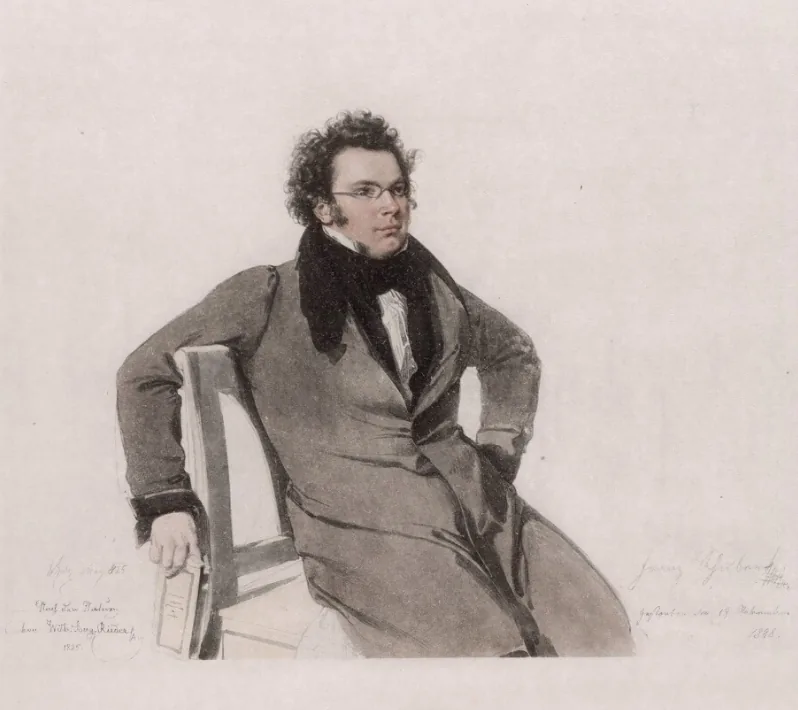
There was a man who had been asked to play in every house he entered for four and a half months and had never been asked to do anything else, and who had been well the whole time. In May, before he left, the painter Rieder had made a watercolour of him, spectacles and all, and it is the face the world knows; the man in the chaise in October was the same man, browner.
They came in through the Linienwall on the third afternoon with the towers of the city ahead, and the chaise was paid off, and the bag went up to whatever room the father had found near the Karlskirche. Schwind was there before the first evening was out. He was twenty-one that year and had written more letters to Upper Austria than the post could carry, and he wanted everything — the songs, the sonata, the Patriarch, the countess who owned all the songs, the child on the knee. He wanted it played, now, tonight. Schubert sat down at whatever piano the room had and gave it to him, beginning with Ellen.