The Road to the Grand Symphony
Eight music stands stood in a half-circle in Count Ferdinand Troyer's drawing room, and behind the first of them the servants had set the widest chair in the house, because Schuppanzigh was coming. He came. Ignaz Schuppanzigh was forty-seven that spring, enormously fat and enormously famous, the violinist who had played Beethoven's quartets to Vienna before anyone else would go near them, back from seven years in Russia and giving subscription concerts again as if he had never been away; Beethoven called him Falstaff to his face, and he took it well. He lowered himself into the chair, tuned, and looked round at the rest of the band: a second violin, a viola, Linke at the cello, a double bass, a horn, a bassoon, and the Count himself, standing by the window with his clarinet.
Troyer was chief steward to the Archduke Rudolf and an amateur of the serious kind, the kind who practises. What he had wanted, and had asked for, was a companion to Beethoven's Septet — the piece every drawing room in Vienna had worn thin over twenty years, until Beethoven himself could hardly bear to hear it named — for the same band with one more violin, and with a good deal for the clarinet to do.
What he had been given was an hour of music in six movements, and the clarinet led it.
It begins slowly, the whole band feeling its way, and then the clarinet gives the tune and the violins pick it up and run with it. The slow movement is the clarinet's alone for a long while, a song without words over the strings, the horn coming in under it late like a second thought.
There is a scherzo, all bounce. There is a set of variations on a duet from an opera of his that nobody had staged, Die Freunde von Salamanka — the Friends of Salamanca — which the players took at a good clip and the Count's guests could have danced to.
There is a minuet, and then the last movement, which does not begin like a last movement at all: the cello and the bass shudder on one low note, a slow chord hangs over them, the room goes cold for a moment, and then a march sets off and everything is well again.
The Count played his part and sat down. The last page of the score was dated the first of March 1824. The composer had written the whole of it in February.
He had written two quartets in the same weeks, and one of them had been heard in public. On the fourteenth of March Schuppanzigh's quartet played it at one of their subscription evenings in the Musikverein's rooms, the first time a string quartet of his had been played anywhere but in a family parlour.
It opens with the second violin alone, rocking, two notes and two notes and two notes, and the cello putting down a slow step under it, and over that, when it comes, the first violin's tune is a lament — a long line that keeps trying to rise and keeps being drawn back.
In the slow movement the audience heard something they knew, and could not at first have said from where: the walking tune from between the acts of Rosamunde, from the play that had lasted two nights in December, now given to four strings and turned over at leisure.
In September it was printed, dedicated to Schuppanzigh, and it was the only quartet of his that was printed while he lived.
The other quartet he kept. It was written in March, and it begins with a blow — all four instruments together, a long note and three quick ones flung after it — and for the length of the first movement the hammering does not let up. Then the slow movement, and the reason the quartet has the name it has: the chords that Death sang in the song of 1817, Der Tod und das Mädchen, slow, level, almost on one note, laid out for the four strings exactly as the piano had them, and then varied — the first violin decorating them, the cello singing them, the whole quartet whispering them, the whole quartet shouting them — and at the end returned to as they were, level and kind. The last movement is a tarantella that does not stop for breath. No audience heard any of it that year. It went into the drawer with the rest, and was first played, in a friend's house, two years on.
Leopold Kupelwieser was in Rome, painting, and letters reached him at the Caffè Greco in the Via Condotti, where German painters collected their post. The one that reached him in April was addressed, in Schubert's hand, to Signor Leopoldo Kupelwieser, German painter, care of the Caffè Greco, and was dated the thirty-first of March 1824. It is in two halves that do not seem at first to belong to the same man.
"I feel myself the most unhappy, most wretched man in the world. Think of a man whose health will never be right again, and who from despair over this makes things worse instead of better; think of a man, I say, whose most brilliant hopes have come to nothing, to whom love and friendship offer nothing but pain at most, whose enthusiasm for the beautiful threatens to vanish, and ask yourself whether he is not a wretched, unhappy man. 'My peace is gone, my heart is heavy, I shall find it never and nevermore' — so I may well sing every day now, for every night when I go to sleep I hope never to wake again, and every morning brings back to me the grief of yesterday." The words in the quotation marks are Gretchen's, from the song he set at the schoolhouse table when he was seventeen, and he knew that Kupelwieser would know it.
Then the letter turns, without a paragraph break to warn the reader, to news. The reading circle was finished — Schober gone to Breslau, Kupelwieser to Rome, and the evenings, he said, gone under from "the reinforcement of the coarse crew addicted to beer-drinking and sausage-eating," so that he had stopped going. And then: "I have composed two quartets for violins, viola and violoncello and an octet, and I intend to write another quartet; thus I hope to pave the way to a grand symphony. The latest news in Vienna is that Beethoven intends giving a concert, at which he is to produce his new symphony, three pieces from the new Mass, and a new overture. God willing, I intend also to give a similar concert next year."
Whatever else is in that letter, the plan is in it: two quartets and an octet already done, a third quartet to come, a grand symphony at the end of the road, and a concert of his own, like Beethoven's, with his own name on the bill. He was twenty-seven and had never had a concert. He kept the plan. Not the next year, as it turned out, but four years on, almost to the day, there was such a concert in Vienna, with his name on the bill and nobody else's; and this story will come to it in its time.
Beethoven's concert was on the seventh of May, at the Kärntnertortheater, and it was the new symphony that people talked about afterwards, the one that ends with a choir and four solo singers standing up in the middle of an orchestra and singing Schiller. Beethoven was on the platform, deaf, beating time for a performance he could not hear, while the theatre's own conductor kept the players together from beside him, and at the end he was still bent over his score, turning pages, when the noise began; somebody turned him round so that he could see the house on its feet and the handkerchiefs going. There is no record that Schubert was in the theatre that night, and it is hard to believe he was not. He had told Kupelwieser five weeks before that he meant to do the same thing.
At the end of May he went to Hungary again. Six years had passed since the coach full of wheat-dust and the passport that gave his height, and the place was as he had left it: the long cream-coloured house with the columns, the park running down to the slow Hron, the inspector's house across the way where the estate people lived and where he was once more given a room, and the geese, which had not forgotten him either. Count Esterházy was as he had been. The Countess was as she had been. It was the daughters who had changed, because that is what daughters do in six years, and the music master, who had known them at sixteen and twelve, found them at twenty-two and eighteen, and himself twenty-seven, and better at four hands than at words.
Of Karoline there is not much on the record. She played the piano well; she sang contralto, like her mother; she had a birthday in September, while he was there, and turned nineteen. Eduard von Bauernfeld, the newest of the friends and the one who wrote things down on the day, said when he was an old man that Schubert had been "head over heels in love with one of his pupils, a young Countess Esterházy." That is one remark. The other is Schönstein's, and the story is told that when she once asked him why he had never dedicated anything to her, he answered, "Why dedicate anything to you? Everything is dedicated to you anyway." That is two remarks, from two friends, and, in time, one dedication. The summer's music says the rest, and it was written for two people at one keyboard.
What the estate heard through the wall that summer was bigger than what it had heard in 1818. In June he wrote a sonata for four hands that is not really a sonata for four hands at all: four movements, three-quarters of an hour, tunes that want horns and get them from the secondo's left hand, a slow movement that walks like the andante of a symphony and a finale that gallops like one.
Schumann, who came to it long after, said what everyone who plays it thinks — that it is a symphony in disguise — and people have been trying to score it for an orchestra ever since.
He wrote a set of variations on a tune of his own, for the same two pairs of hands. He wrote six grand marches. He wrote a prayer for the family's four voices, the Count on the bass, the Countess and Karoline on the contralto line, Marie on top, so that for once the whole house could make the music instead of listening to it.
And he wrote the piece that carried more of Zseliz out of Zseliz than anything else, a long divertissement in the Hungarian style, with the drooping intervals and the stamping dance rhythms and the cimbalom imitated in the piano, whose main tune, Schönstein swore, Schubert had heard a kitchen maid singing at the stove.
In the middle of July he wrote to Ferdinand, in Vienna, and the letter is the older brother of the cheerful ones from 1818. Don't think me ill, he says, before Ferdinand can; he is well. But he is in the middle of Hungary, "without one single person to whom I could say a sensible word," and it shows. In 1818 he had been homesick in the second month like a boy at school, and had made lists of the servants to pass the time. Now he was homesick and made no lists. He was not unhappy; he says so, and there is no reason not to take him at his word. He missed his friends, who were scattered — Kupelwieser in Rome, Schober in Breslau, Spaun in Linz, Schwind writing to him from Vienna, three pages where one would have done — and he missed the city, and he counted the weeks.
The summer itself was a hot one. The wheat came in early, in the last week of July, and for a fortnight the lane past the inspector's house was full of carts at first light, and the dust from them came in at his window and settled on the music paper, so that he wrote with the shutter half to and the room in stripes.
He kept the hours he kept everywhere: the table from waking until the early afternoon, then across the yard and through the park to the big house, where the piano was, and the daughters, and the lesson.
In the evenings there was the estate people's dinner, at which he was by now an old acquaintance rather than a curiosity, and afterwards the long light on the plain, which goes on in that country until nearly ten. Twice that August a storm came up out of the south-west in the late afternoon, stood over the park, and emptied itself in a quarter of an hour; the geese took each one as a personal affront.
A lesson, then, since a lesson is what the record allows. The piano in the big house stood where it had stood; the afternoon light came in from the park side, across the parquet, and lay on the keys.
Two people sat on one bench. She sat to the right, in the treble, where the tune usually is; he sat to the left, in the bass, where the pedal is and the tune usually is not, and his left hand did the work of an orchestra's cellos and basses while his right kept out of her way.
That is the whole of four-hand playing: two people who must breathe together, and who cannot see each other's hands.
When a page had to be turned, whichever of them had a free hand turned it, and the other went on. When she came in late he did not stop; he waited, one bar, two, and folded the bass back under her where she was. When they got to the end of a movement they sat a moment, as players do, and then went back to the place that had gone wrong and played it again.
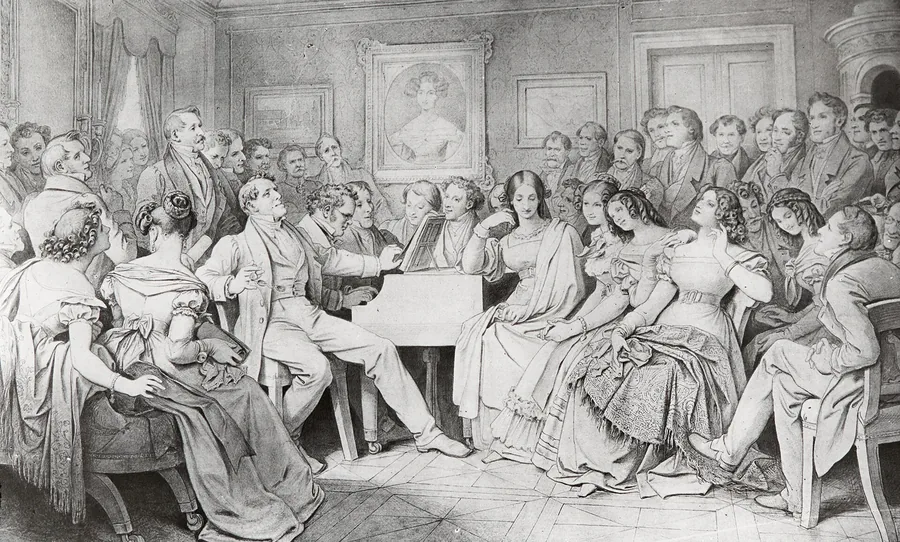
The music exists, and it was written for that bench. Forty-two years afterwards, when Moritz von Schwind was an old man in Munich and sat down to draw from memory the great evening at Spaun's in 1826 — Schubert at the piano, Vogl singing, the whole circle in a half-light round them — he put a portrait on the wall above the piano, and it is hers.
The family went back to Vienna in the middle of October and the music master went with them, as before, over the flat country with the ricks standing in the stubble and the roads dry. The towers came up out of the plain the way they always do, the Stephansturm first, and then the rest of it, and the coach went in under the Linienwall and through the streets he had counted the weeks for. He was twenty-seven and had a trunk full of four-hand music and a plan in his head with a grand symphony at the end of it. The Schubertiaden had lapsed in the spring and not yet been taken up again; the reading circle was dead; half his friends were in other cities. In the mornings he wrote.
In November a Viennese instrument-maker's new invention came to his notice, by way of a guitarist named Vincenz Schuster who had taken it up: a guitar with six strings and frets, held between the knees and played with a bow, which its maker called the arpeggione and which was going to be the coming thing. Schubert wrote it a sonata — three movements, a long singing first tune, a slow movement that drifts, a finale that dances — and that is very nearly the last anyone heard of the arpeggione. It did not become the coming thing. Within a few years nobody was making one and within a few more nobody could play one, and the instrument went the way of the glass harmonica and the serpent, leaving behind it, for cellists and viola players to quarrel over ever since, one sonata, which is the only reason anyone now knows the word.