The Year of Songs
Every window of the schoolhouse in the Säulengasse had a candle in it, and over the door hung a sentence that added up to a number. The Emperor had come home from Paris that day, the sixteenth of June, 1814, with Napoleon put away on Elba and the long war over, and the whole of Vienna had been told to light up; the suburbs did what they could with tallow. Franz Theodor Schubert, schoolmaster and poor-relief officer of the district, did rather more. He composed a Latin greeting — franCIsCo Magno, VICtorI reDeVntI, to Francis the Great, the victor returning — and painted certain letters taller than the rest, so that anyone who knew the old game could read the capitals as Roman numerals, add them up, and arrive at the year. Then he hung it where the whole lane could see. It was exactly the sort of thing he did well: correct, loyal, a little laborious, and quietly delighted with itself.
Somewhere behind the lit windows was his fourth son, seventeen, who had been writing a Mass since the middle of May. The Kyrie had taken two days and the Gloria two more; he was now inside the Credo, which had been going on since the end of the month and would need another week. He had left the Konvikt the previous autumn with a second-class mark in mathematics and a symphony, and had spent the winter at St Anna learning how to be a schoolmaster, which is to say learning how to become his father.
The Mass was for the Lichtental church, which would be a hundred years old in September, and it was the largest thing he had yet attempted: choir, soloists, an orchestra of some sixty players, and a soprano part written for one voice in the parish in particular. That evening, with the candles burning down and the lane full of neighbours reading the door, he was almost certainly at the table with the Credo.
Nobody thought to record it. It was a Thursday.
Three months after the illumination the sovereigns of Europe arrived to divide up what Napoleon had left. From September until the following June the city held a Congress that was mostly a party: the Tsar of Russia and the King of Prussia lodged in the Hofburg as the Emperor's guests, with kings of Denmark, Bavaria and Württemberg and a couple of hundred lesser princes in the houses round about, and Metternich in the middle of it all, arranging the dances.
There were balls in the Redoutensaal for thousands at a time, a tournament in the Riding School, a great sleigh-ride through the snow to Schönbrunn with the sovereigns wrapped in furs, and in late November Beethoven himself, stone deaf, standing before an enormous orchestra in the Redoutensaal to conduct Wellingtons Sieg — Wellington's Victory — for the crowned heads, with real drums for the cannon. On the nights of fireworks the Lichtental could see the sky over the Prater go green and gold beyond the roofs, and hear the bangs arrive a moment behind the light.
A mile away, that was all the Congress came to: a glow over the rooftops, and the price of bread going up.
The small room was a ground-floor classroom on the Säulengasse, low and dark even at noon, with a stove in one corner and benches worn smooth by twenty years of small boys. In the autumn of 1814 Franz Schubert became assistant teacher of its youngest class — the ABC class, the six-year-olds, letters on slates — for his board and about eighty florins a year.
He was seventeen and he was not good at it. His sister remembered him as strict and short-tempered, a young man who kept his hands in practice on the children's ears, and it is easy enough to believe her; he wanted to be somewhere else, and the somewhere else was six inches away, in the drawer of the desk, on ruled paper.
For the next two years the pattern of his days was fixed. Mornings and afternoons the alphabet. Twice a week the walk into the city to Salieri in the Seilergasse with his exercises rolled under his arm. And in the gaps — before school, after school, at the desk while forty children chanted — the paper.
The Mass was finished on the twenty-second of July and sung on the twenty-fifth of September, the centenary Sunday, in the church where he had been baptised. He conducted it himself. His brother Ferdinand, nineteen, already organist of the parish, sat at the organ; Holzer, who had once given up trying to teach the boy anything because he already knew it, had trained the choir; the father, one imagines, stood at the back and did not sit down. The soprano was Therese Grob.
She was a silk-weaver's daughter from the parish, a year younger than he was and not yet sixteen, and the Grob house on the far side of the church was a step or two higher in the world than the schoolhouse: her mother ran the family business after the father's death, there was a piano, and there was music-making in the evenings, and Franz Schubert had the run of the place.
Her old schoolfellow Holzapfel, who was not in love with her, described her afterwards with a fairness that is almost cruel: no beauty, but well-formed, rather plump, with a fresh, childish round face, and a beautiful soprano voice. It was a bell of a voice, clear to the top of the staff and a little above it, and he had written the Mass around it.
When she stood up in the choir loft for the Benedictus the parish below heard their choirmaster's old pupil, who taught the infants now, putting notes into the mouth of the weaver's girl from the corner, and both of them entirely sure of what they were doing. The Mass was repeated a few weeks later in the Augustinian court church in the city, with Ferdinand again at the organ.
It is said that Salieri was in the church, and that afterwards the old Italian embraced his pupil and told him, "Franz, you are my pupil, and you will do me great honour." The man who told the story was one Doppler, who said he had been at Schubert's christening, which makes him either a very good witness or a very old one. Ferdinand said, for his part, that their father was so pleased with the Mass that he bought Franz a piano of five octaves — not a large instrument, but his own, and the first he had ever had.
About Therese the record is thin, and this book will keep it thin. Early in the new year he wrote to Holzapfel and told him he loved her. The letter is lost; so is Holzapfel's reply, which tried, Holzapfel said, to talk him out of it. Nothing else was written down at the time. Years later, in another city, Schubert told Anselm Hüttenbrenner about her, and Anselm, who had a long memory and a loose one, wrote down what he said thirty years after that. That is nearly all there is. She sang in his church; he was at home in her house; he loved her and said so to one friend. Leave it there for now, where he left it.
On the nineteenth of October, three weeks after the Mass, he opened Goethe's Faust in the schoolroom and set the song Gretchen sings at her spinning wheel.
What comes out of the piano is the wheel. The right hand turns it, a small figure going round and round without a break, and under it the left hand works the treadle, a soft thump on the beat, so that before the girl has sung a note you can hear the room she is in and the thing her hands are doing while her mind is somewhere else. "Meine Ruh ist hin," she begins — my peace is gone, my heart is heavy — and the wheel turns. She thinks of him: his walk, his bearing, the smile of his mouth, the pressure of his hand. The turning gets faster, the voice climbs, and then she reaches the memory of his kiss — "und ach, sein Kuss" — and the wheel stops dead. Silence, with her hand in the air.
Then, haltingly, one note at a time, the foot finds the treadle again and the wheel starts to turn, slowly, and the whole thing begins once more from the beginning, because that is what happens when you are seventeen and cannot stop thinking.
He was seventeen. He wrote it in a room that smelled of chalk and wet wool, in the same fortnight as a set of exercises for Salieri, and put it in the drawer. Looking back from a long way off, people have called that afternoon the birth of the German song; nobody in the Säulengasse called it anything.
The children came in at eight the next morning and he taught them their letters.
In the first week of December Spaun came to the schoolhouse with a poem in his pocket.
Spaun was twenty-six now, out of the Konvikt and in a government office, as steady and as formal as he had been at twenty, and still the friend who bought the paper. The poem was called Am See — By the Lake — and it was by a man he knew, a law student and former novice named Johann Mayrhofer, who wrote verse in a dark vein and showed it to almost nobody. Schubert set it on the seventh of December. Within a few days Spaun took him and the song into the city to meet the poet.
Mayrhofer lived in the Wipplingerstraße, at number 420, on the third floor, in a lane so narrow and a house so hemmed in by the big building opposite that the light gave up before it reached the window. The ceiling had begun to bulge. There was a worn-out piano, a shabby bookstand, a bed, and a great many books in no order, and a few years before there had been a young poet from Dresden named Theodor Körner in this same room, who had gone off in the spring of 1813 to fight the French and been killed by August.
Mayrhofer was twenty-seven. He was tall, thin, austere, and convinced that he was ill; he had spent three years at St Florian deciding not to be a monk and several more in the law faculty, which he finished, and his friends agreed that they had never seen him smile or heard him joke.
He did not smile now. He looked at the short young man in spectacles whom Spaun had brought up three flights of stairs and said something to the effect that he had not expected the composer of his poem to be a schoolboy.
"I am a schoolmaster," said Schubert.
Spaun, who did not like a silence, said that Franz would play it, if Herr Mayrhofer would allow, and Schubert sat down at the bad piano and played and sang Am See, which is a slow, still song about a lake and the dead, with the water moving in the left hand.
When it was done Mayrhofer said nothing for a while. Then he asked, in the tone of a man complaining, how long it had taken to write. The answer did not please him: he said that it had taken him a good deal longer to write the poem, and that he was not sure that was fair.
It was as near to a joke as he came, and it was the beginning of the closest friendship in Schubert's life after Spaun's — the gloomy man who was transfigured by nothing on earth except these songs, and the boy who could write one before dinner. Spaun took him home through the dark to the Lichtental with the manuscript under his coat, and the hard cold of that December coming up off the paving stones.
Then came 1815, which is not a year so much as a fact of nature.
In twelve months, while teaching the ABC class every day and going to Salieri twice a week, he wrote about a hundred and forty-five songs, two symphonies, two Masses, four works for the stage, a string quartet, piano sonatas, and a quantity of church music and dances — over twenty thousand bars, someone has counted, which is fifty-odd bars a day, every day of the year, on top of the alphabet. The number is the least interesting thing about it, and it is given here once so that it need not be given again. What matters is what one of those days looked like.
Take the nineteenth of August, a Saturday. It was hot; the Säulengasse stank a little, as it did in August; school was out for the harvest, and the schoolroom belonged to him. He had Goethe open on the desk. Before the day was done he had set seven poems, one after another, each headed with its title, the date and Frz. Schubert mpia in his small square hand — and four days earlier, on the fifteenth, he had set eight.
Among the seven of the nineteenth was Heidenröslein, the little rose on the heath: a boy sees a rose, the rose says it will prick him if he picks it, he picks it anyway, and it pricks him, and that is the whole of the story. Goethe's poem is three verses and a refrain, and Schubert gave it a tune that any child could sing after hearing it once, the same tune for each verse, with a skip in the piano between them, and a little turn at the end of each refrain that lifts and settles like a bird choosing a branch.
It is over in two minutes. It has never stopped being sung. It went into the drawer with the six others, and on Monday he went back to the exercises.
Two months earlier, in the middle of all this, the war had ended for the second time. Napoleon had come back from Elba in March and the Congress had gone on dancing, a little faster; on the eighteenth of June he was beaten at Waterloo, and the news reached Vienna about a week after, with the sovereigns already leaving and the ballrooms being swept. In the schoolhouse the summer of Waterloo produced a Symphony and a batch of songs. On the twenty-fifth of August his father applied for the mastership of the school attached to the Schotten abbey in the city, listing his four sons in the schools of Vienna and adding that Franz was studying composition under the first Court Kapellmeister, Herr von Salieri, "with happy success." The abbey gave the post to somebody else.
One more thing had happened that spring, and it ought to be planted now. In April a young man of twenty from Graz named Anselm Hüttenbrenner had arrived in Vienna to study with Salieri, and had met, on the old man's stairs in the Seilergasse, a fellow pupil two years younger, shorter, in spectacles, who did not say much. They became friends. Anselm would be in the story to its last page and beyond, and not always to his credit.
The last of the year's songs — or the first of the next; the manuscript is not dated, and the year rests on Spaun's word — was the one that made his name, and Spaun told the story of its writing so often, over forty years, that it became the story everyone knows. It is worth telling as his.
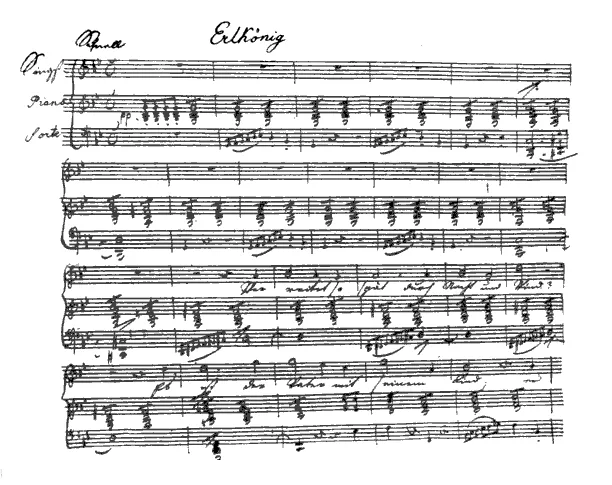
One afternoon late in the year, Spaun said, he and Mayrhofer walked out to the Säulengasse to call, and found Franz in his room "all aglow," walking up and down with a book in his hand, reading Goethe's Erlkönig aloud to himself. He read it through several times more while they stood there. Then he sat down, and in the shortest possible time, Spaun said, it was on paper — the whole ballad, the father and the child on the horse, the Erlking in the mist. The three of them took it that same evening into the city, to the Konvikt, where there was a piano and an audience that would understand, and there, in the old practice room with the cold coming up through the floor, Schubert sang it first, accompanying himself, and then Holzapfel sang it, with Schubert at the keyboard.
What the room heard was a horse. The right hand starts it before anyone sings — the same note struck three times to a beat, over and over, as fast as the arm can go, and under it in the left hand a figure that rears and drops like the ground going by.
Then one voice becomes four. The narrator, level and quick: who rides so late through night and wind? The father, low and steady, holding the boy and answering him. The child, high and frightened: father, do you not see the Erlking? And the Erlking himself, who is the only one who sings a proper tune — wheedling, sweet, in a sunlit major that has no business in that forest — promising games on the shore and golden robes and his daughters to rock him to sleep. Each time the child cries out to his father the cry comes a step higher than the last, and the horse never slackens.
Then the Erlking stops wheedling. Ich liebe dich, mich reizt deine schöne Gestalt; und bist du nicht willig, so brauch ich Gewalt — and the boy's last cry, "Mein Vater, mein Vater, jetzt fasst er mich an," my father, now he is seizing me, breaks over a chord that grinds against itself, three notes that should not be sounding together and are.
The father rides harder; the piano is nearly out of control. Then, at the courtyard, the galloping stops. The last line is not sung. It is spoken, almost, on two plain chords, with the accompaniment fallen away to nothing: In seinen Armen das Kind war tot. In his arms the child was dead. Two chords more, and it is over.
The Konvikt liked it and did not know what to make of it. Faces were pulled, Spaun remembered, at the place where the boy is seized and the chord grinds, and there was some muttering about whether such a thing was allowed; and old Ruzicka, who had taught most of the room its figured bass, got up, went to the piano, played the passage through by itself, and undertook to explain to the doubters why the discord was there and why it was right.
Spaun told all this a long time on, when the song had been sung across Europe and he was an old man, and the earliest manuscript that survives is a fair copy in a steady hand, so the afternoon may have been a little longer than he remembered, and the aglow young man may have carried the ballad in his head for a week before Spaun climbed the stairs.
It does not much matter. The song was in the world by the end of 1815, and it had been written in a schoolmaster's back room by an assistant teacher of the alphabet who was eighteen years old.
They walked home. Mayrhofer turned off at the Wipplingerstraße to his bulging ceiling; Spaun and Schubert went on through the Schottentor and out along the dark road to the Lichtental, with the wind off the Danube meadows in their faces and the manuscript, its ink a few hours old, buttoned inside the composer's coat. It was a long walk and a cold one, and by the time the schoolhouse came in sight, unlit now, no candles, no sentence over the door, there was a lamp still burning in the classroom where the slates were stacked for the morning.