Opus One
Vogl's hands were the first thing the house saw. He came out to the front of the Kärntnertor stage with nothing behind him, because on Ash Wednesday there is no opera and the scenery had been flown, and he stood with his hands open at his sides like a man waiting to be handed something heavy, and behind him Anselm Hüttenbrenner set his right arm going in the piano, and the horse began to run.
The house knew the poem. Every schoolchild in the empire knew it: the father riding through the night, the boy in his arms, the thing in the mist that only the boy can see.
They had not heard it like this. Vogl was fifty-two that winter, gouty and grey, in what would prove his last season on that stage, and he had spent a quarter of a century teaching Vienna what Orestes looked like when the Furies came. He did not act the ballad. He let four people take turns in his face.
The father kept his voice level for the child's sake. The child cried out, and each time a step higher. The Erlking wheedled, sweet and coaxing, and Vogl's mouth went small and kind for it, and people in the boxes felt the cold come off the stage.
Under all of it Anselm's arm went on, the octaves hammering in threes, the arm that publishers had been told was the reason the song could never sell. Then the horse stopped. The last line was spoken, not sung, and there followed the silence that is the best sound a theatre makes, and then the noise.
Spaun called the applause rapturous, and Spaun was not a man who reached for words like that.
The composer was not at the piano. That was the odd thing about the evening, had anyone stopped to think about it: a song that had lain in a schoolhouse drawer since a boy of eighteen wrote it, sung at the Court Opera by the most famous baritone in the city, at a charity concert on the seventh of March 1821, with a friend from Graz at the keyboard — and the man who had written it somewhere in the building, unrecognised by nine people in ten. How the song had got from the drawer to that stage is the story of that winter, and it begins with a room that would not take no for an answer.
The publishers had said no in December. Leopold Sonnleithner, who was twenty-three, a doctor of law, and had once sung in a Schubert cantata as a student, carried the no back to his father's flat in the Gundelhof and treated it as a lawyer treats an obstacle: he went round it. He and the young clerk Gymnich, who had sung the song on the first of December, paid to have the plates engraved themselves. At the next of Ignaz von Sonnleithner's evenings the copies were laid out in the great room, and before the guests went home a hundred of them had been spoken for. A hundred subscriptions, signed in a lawyer's drawing room, from people who had heard the thing once. Cappi and Diabelli, who would not risk a florin of their own, were willing to let the song lie on their counter and take a commission on what it sold. On the twenty-fifth of January Gymnich sang it again, at one of the Musikverein's evenings, and this time the composer played.
There was another kind of room that winter, and it was smaller. On the twenty-sixth of January fourteen men climbed the stairs to Schober's, and one of them, Josef Huber, wrote four days later to tell someone what had happened: songs of Schubert's "which lasted until after ten," and then punch, and "it was three before we parted." Nobody thought to give the evening a name. The name came in November, in a letter from St Pölten, and once it existed it seemed always to have existed: a Schubertiade.
The form was fixed from the first. Schubert at the piano, in spectacles, saying almost nothing. Vogl singing if Vogl was there; if not, whichever friend could hold a tune. Somebody reading aloud. Charades. And when the reading was done and the singing was done, dancing — Schubert at the keyboard again, throwing off waltzes and Ländler for hours, one out of the last, none of them written down, so that the friends who danced to them are the only people who ever heard most of them.
He would play until the room gave out. He did not dance.
The Fröhlich sisters kept a second such room in the Singerstraße, four unmarried women in one flat, and it was a salon because Anna, the eldest, taught singing and could fill a parlour with sopranos, and because Kathi, the third, had lately become engaged to Franz Grillparzer and would remain so, in a manner of speaking, all her life, so that the best poet in Austria was always to be found on one of the chairs. Schubert had written a setting of the twenty-third psalm for Anna's pupils in December, four women's voices and a piano, the green pastures walking along under them. He was becoming, without a post, a title, or a decent coat, a man that Vienna's music went to.
On the first of April 1821 Erlkönig was published, with a number on the title page. Opus One. It was dedicated to Count Moritz Dietrichstein, who had charge of the court's music and had already put his name to a testimonial for its composer. At the end of April came Gretchen am Spinnrade, Opus Two, and through the year the rest followed at the friends' commission account, three and four songs to a number: Der Wanderer, Heidenröslein, and in November Der Tod und das Mädchen. Eight hundred copies of Erlkönig were sold. The songs realised some two thousand florins in that first year — Zseliz had paid two hundred for his first weeks there, journey money included, and he had written home about it as riches. He was twenty-four. He had been writing songs for ten years, since the winter he was fourteen and set a poem about Hagar in the desert, and this was the first time a stranger had been able to walk into a shop and buy one.
In July the circle went to the country. Atzenbrugg was a monastery estate in the flat farmland of the Tullnerfeld, a day west of Vienna, and its manager was Schober's uncle, which meant that for three days each summer the big house belonged to Schober's friends.
The heat of those Julys stood in the courtyard like water in a basin. They played ball on the lawn in front of the house; there is a drawing of one of those afternoons, and in the foreground, on the grass, sit Schubert and a boy.
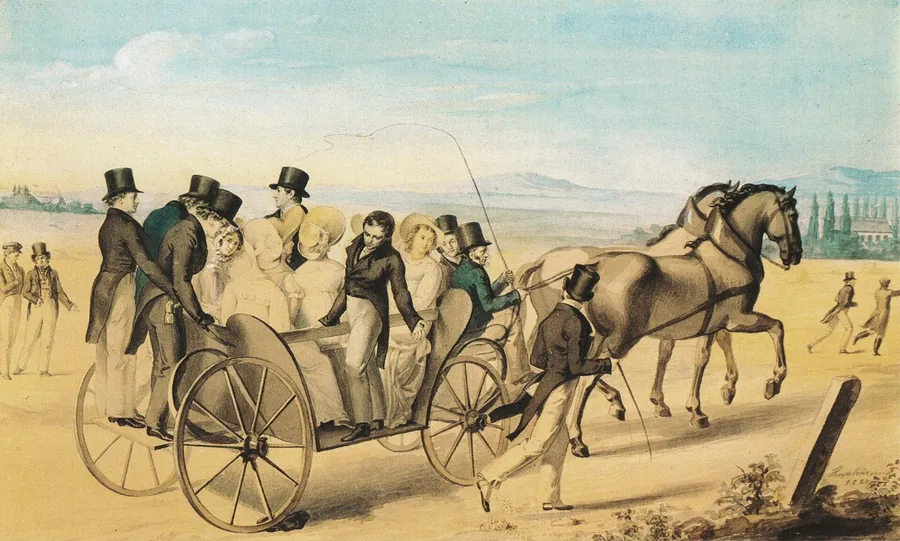
They rode out in a farm cart to the mill at Aumühl, a dozen of them piled in with their hats and their parasols and Schubert wedged among them, and Leopold Kupelwieser, a painter who had come in with Schober and watched everything, painted the cart with the horses' heads down and the whole party laughing at something outside the frame.
In the evenings there were charades. Kupelwieser painted one of those too: the Fall of Man, staged in the drawing room, with Schober, who could not be expected to play Adam, coiled round the tree as the serpent, and Schubert at the piano in the corner providing the music of the Garden.
On the tenth of July Kupelwieser sat him down and drew his face in pencil: the round cheeks, the spectacles, the hair curling over the ears, the mouth with a joke held in it. He also, at Atzenbrugg, did something he almost never did with dances, which was to write some of them down; the sheet is dated July 1821.
The boy on the grass was new that year. Moritz von Schwind was seventeen, born in the January of 1804, a painter already though nobody had told him so, quick, funny, and adoring in the way that only a seventeen-year-old can be adoring, without embarrassment and without measure.
He played the violin. He played Schubert's waltzes on it, a friend said, enchantingly. Schubert's first question about any newcomer, asked so often that the friends had made a nickname of it, was "Kann er was?" — can he do anything? — and Schwind could.
Within months the order of things had changed: every new song, every new piano piece, went first to Schwind, before Schober, before Vogl, before anyone. Schubert called him, with a straight face, his beloved. Schwind, for his part, behaved like a boy who has been given the run of a sweet shop.
"Again," he would say when a song was done, before the last chord had stopped. "Once more. I was not listening properly the first time." He had been listening perfectly well; he wanted it twice.
That autumn Schober took him to St Pölten, to the bishop's house and to the country place at Ochsenburg, to write an opera. Schober had written the libretto — Alfonso und Estrella, a tale of usurpers and lovers in old Spain — and the plan was that the two of them, out of Vienna and out of reach, would set it in a burst.
They very nearly did. The first act is dated the twentieth of September, the second the twentieth of October; the third waited until the following February.
There were Schubertiaden in St Pölten too, in the bishop's rooms, and it was from there, in November, that the word was first written down.
Vogl retired from the Court Opera that same year, at fifty-three, on his own terms and with his gout, and the loss was larger than it looked, because the house that had let him sing Erlkönig on its stage in March now had no Vogl inside it to press for an opera by his friend — and under Barbaja, who had leased the theatre and filled it with Rossini, there was no room to spare for a Spanish opera by a Viennese songwriter in any case.
That year, too, Spaun left. He was posted to Linz, to a desk in the excise office of his own home town, and he would be gone for five years. The steadiest friend was now a correspondent. Letters went out to him with the news, and the news, that winter and the next, was mostly good.
By the early weeks of 1822 Schubert was living with Schober again, in the Göttweiger Hof in the Spiegelgasse, a few doors from the Fröhlichs. It was here that the reading circle settled into its habit: three evenings a week, poems and plays read aloud, argument, then the piano. In the spring Carl Maria von Weber passed through Vienna, whose Freischütz had taken the town that winter, wolf's glen and all, and the two men met and liked each other. And in April there was Beethoven.
The Variations on a French song, the four-hand piece from the first Zseliz summer, came out on the nineteenth of April as Opus Ten, and on the title page they were dedicated to Ludwig van Beethoven by "his admirer and worshipper, Franz Schubert." A copy had to be delivered.
Three people told three stories of how it was. Schindler, Beethoven's factotum, said that Schubert went to the house with Diabelli, was shown in, and when the deaf man pushed the conversation book across the table for him to write in could not bring himself to write a word; that Beethoven turned the pages of the Variations, put his finger on a slip in the harmony, said something mild, and Schubert lost his nerve and fled.
Josef Hüttenbrenner said that Beethoven was simply out, and the music was left with a servant. Spaun had a third version.
Nobody who was there agreed afterwards about what happened, which is a fair description of most encounters with Beethoven. The likeliest truth is the dullest: that in 1822 the two men did not meet at all, and that Schubert, who could see the great man any afternoon in the street and did not dare cross it, went on not daring.
September brought the end of the Mass begun three years before, the long one, the one that had gone with him from Mayrhofer's dark room to Schober's bright one and had been picked up and put down between operas; the last page is marked as finished in September 1822.
In November a rich amateur named Liebenberg, a pupil of Hummel's, wanted a big piano piece and was prepared to pay for it, and got, in a few weeks, the Fantasy that the world calls the Wanderer. It is one rhythm, the striding rhythm from the old song, driven through four movements that run into one another without a break, and in the slow movement the song itself appears, the tune of "the sun seems so cold to me here," turned over and over.
The last movement was beyond him. The story is told, and it is Kreissle's, that he broke down in it at a friend's house, stood up from the piano and said, "Let the devil play the stuff!" Whether or not he said it, he could not play it.
In the same month Peters of Leipzig, the first great publisher outside Vienna to be asked, wrote to Josef Hüttenbrenner declining, with compliments, to take anything of Herr Schubert's for the present.
But the strangest thing of that autumn had been dated a fortnight earlier, on the thirtieth of October, in the room at Schober's. He wrote the date at the top of the first page of a symphony, the way he wrote a date on everything, and began.
It begins so low and so soft that in a hall you are not sure it has begun. The cellos and basses have a phrase to themselves, down in the dark, eight bars of it, and then the violins come in shivering, and over the shiver an oboe and a clarinet, in unison, sing a long tune that does not seem to want anything except to go on.
Then it stops, and the horns hold a note, and the cellos play the other tune, the one every person who has ever been in a concert hall can hum, the one that sounds like a waltz remembered in bed, and the whole orchestra takes it up and is happy with it for a while, and then the floor gives way.
Two movements. The second is slow and in a bright key, walking, with the woodwind talking to each other across the strings. Then a third movement is begun, a scherzo, sketched out at the piano through to the trio, and the first two pages of it are scored for the orchestra, and there the manuscript ends.
Not a torn edge, not a blot. Just the last stave, and nothing after it.
In the spring of 1823 the Musikverein at Graz, where Anselm Hüttenbrenner was a man of some weight, elected Schubert an honorary member, and when the diploma reached him in the autumn he wrote to thank them and promised, in return, "one of my symphonies." What went to Graz, by the hand of Josef Hüttenbrenner, was the score of these two movements. It went to Anselm. Anselm put it in a drawer. He kept it there, and said nothing about it to anyone who might have wanted to hear it, for forty-two years, until he was an old man past seventy and a conductor from Vienna came to Graz and talked it out of him; and on the seventeenth of December 1865 an audience in Vienna heard the cellos and basses begin, thirty-seven years after the man who wrote them had died. Why Anselm kept it, why Schubert stopped, whether there was ever a page more than the two we have — nobody knows, and nobody who says otherwise is doing more than guessing.
In December the reading circle met three evenings a week as usual, and one evening that month, with the others gone, he sat down to write to Spaun in Linz. He had a great deal to tell. He told him about the circle, and who came, and that the Variations had gone out into the world with Beethoven's name on them. He told him about the opera, finished at last, and about Vogl.
And he told him about the Mass, which he had a mind to dedicate to the Emperor or the Empress, "for it has turned out well." He wrote that without a flourish, in the middle of a paragraph about other things, as a man reports on the weather in his own district.
It had turned out well. It had taken three years, and it had turned out well, and he thought it was worth a sovereign's name on the front. Then he sealed the letter for the Galician post, and the two movements of the symphony lay where he had put them, among the papers on the table in the Spiegelgasse, and in the morning he began something else.