What the Drawer Held
Anna Fröhlich got the hall. She taught singing at the Conservatory, the eldest of the four sisters whose flat in the Spiegelgasse had been a salon for years, and she was a practical woman: a gravestone costs money, and the estate had come to sixty-three florins. So on the thirtieth of January 1829, ten weeks after the funeral, there was a concert in the Musikverein's rooms, with Vogl singing and the Trio from the concert played, and the takings went to the stone. Schober drew the design. Grillparzer, who was not a man for compliments, wrote the words that were cut into it: Die Tonkunst begrub hier einen reichen Besitz, aber noch viel schönere Hoffnungen — Music has buried here a rich treasure, but still fairer hopes.
Schumann, standing in front of it ten years later, thought the second half grudging, and one sees his point.
The music, meanwhile, had begun to leave the drawer, in the order publishers found convenient and no other. Haslinger had brought out the second half of Winterreise on the thirtieth of December, from the proofs corrected in bed. In May he printed the Rellstab and Heine songs, with the carrier-pigeon song at the end, under a title of his own, Schwanengesang — the swan song — which Schubert had never given them and which stuck. The Trout Quintet was engraved that same year. And in October, at the Trinity church on the Alser road, Ferdinand stood up in front of the choir and conducted, for the first time, the Mass his brother had written for that church the summer before he died.
Ferdinand kept the rest. It lay in the flat in the Neue Wieden where his brother had died, in piles — songs, sonatas, masses, quartets, the symphonies in their wrappers, a thousand pages of an opera nobody had staged — and Ferdinand, who had a wife and children and a schoolmaster's salary, sold it to Diabelli a few pieces at a time, and Diabelli issued what he had bought in instalments, fifty of them over twenty years, like a serial in a newspaper. The big things he did not want. Nobody wanted an hour-long symphony from a composer known for songs.
On New Year's Day 1839 a young man of twenty-eight climbed the stairs. Robert Schumann had come to Vienna for the winter; he had already been out to Währing to stand at the two graves, and had picked up from Beethoven's a steel pen that someone had dropped there, and kept it.
Ferdinand let him into the room with the piles. "On gazing at the piles of music before me," Schumann wrote, "I positively trembled with excess of joy; I did not know where to begin or where to end."
He began with the symphony in C major, the one begun at Gmunden and judged too long in Vienna, and he did not end until it was on its way to Leipzig.
On the twenty-first of March Mendelssohn conducted it at the Gewandhaus, with cuts, and the next year Schumann wrote the essay that gave it the phrase it has carried ever since: its "heavenly length … like a thick novel in four volumes."
In London in 1844 the Philharmonic's players laughed aloud at the last movement's repeated notes in rehearsal, and Mendelssohn took it off the programme. In the same year as Leipzig, Diabelli printed the three last sonatas and dedicated them to Schumann, because Hummel, whom Schubert had wanted, was two years dead.
The symphony in B minor took longer, because it was in Graz. Anselm Hüttenbrenner had it — two movements complete and two pages of a third, dated October 1822 — and he had had it for more than forty years, latterly on a farm at Ober-Andritz outside the town, where he had gone to grow old. In May 1865 Johann Herbeck, who conducted the Gesellschaft's concerts in Vienna and had heard that something was there, went out to see him. Anselm was seventy. Herbeck offered to put one of Anselm's own overtures on a Vienna programme, and he came back to the city with the two movements in his bag. On the seventeenth of December 1865 the cellos and basses began, almost inaudibly, in the great Redoutensaal of the Hofburg, forty-three years after the date on the first page.
Why Anselm kept it in the drawer all that time, nobody knows.
Two Englishmen came in October 1867. George Grove was forty-seven, an engineer by training and the secretary of the Crystal Palace, and he was gathering material for a dictionary of music. With him was a composer of twenty-five named Arthur Sullivan, who would one day write The Mikado. They had come for the symphonies. For days they copied at the publisher Spina's, and then at the house of Dr Eduard Schneider, the son of Schubert's sister, who had what the family still owned. On their last evening they were allowed to look once more, and found, "at the bottom of the cupboard, and in its farthest corner, a bundle of music-books two feet high, carefully tied round, and black with the undisturbed dust of nearly half a century." It was the orchestral parts of Rosamunde, tied up after the second night in December 1823 and not opened since.
They copied until two in the morning, Grove says, and then played leap-frog.
And the rest came, door by door. The quartet with Der Tod und das Mädchen in its slow movement was printed in 1831; the one whose first movement had opened the concert at the Red Hedgehog, in 1851. The Grand Duo from the second Zseliz summer appeared ten years after his death. The Quintet with two cellos, offered to Probst in the October letter and declined, was played for the first time in Vienna in 1850, twenty-two years after it was written, and printed three years after that. Then the early symphonies in the order Grove had copied them, the big Mass of 1822, some of the operas, the boxes of dances, and the songs, which went on arriving for the rest of the century until there were more than six hundred of them and people had stopped being surprised.
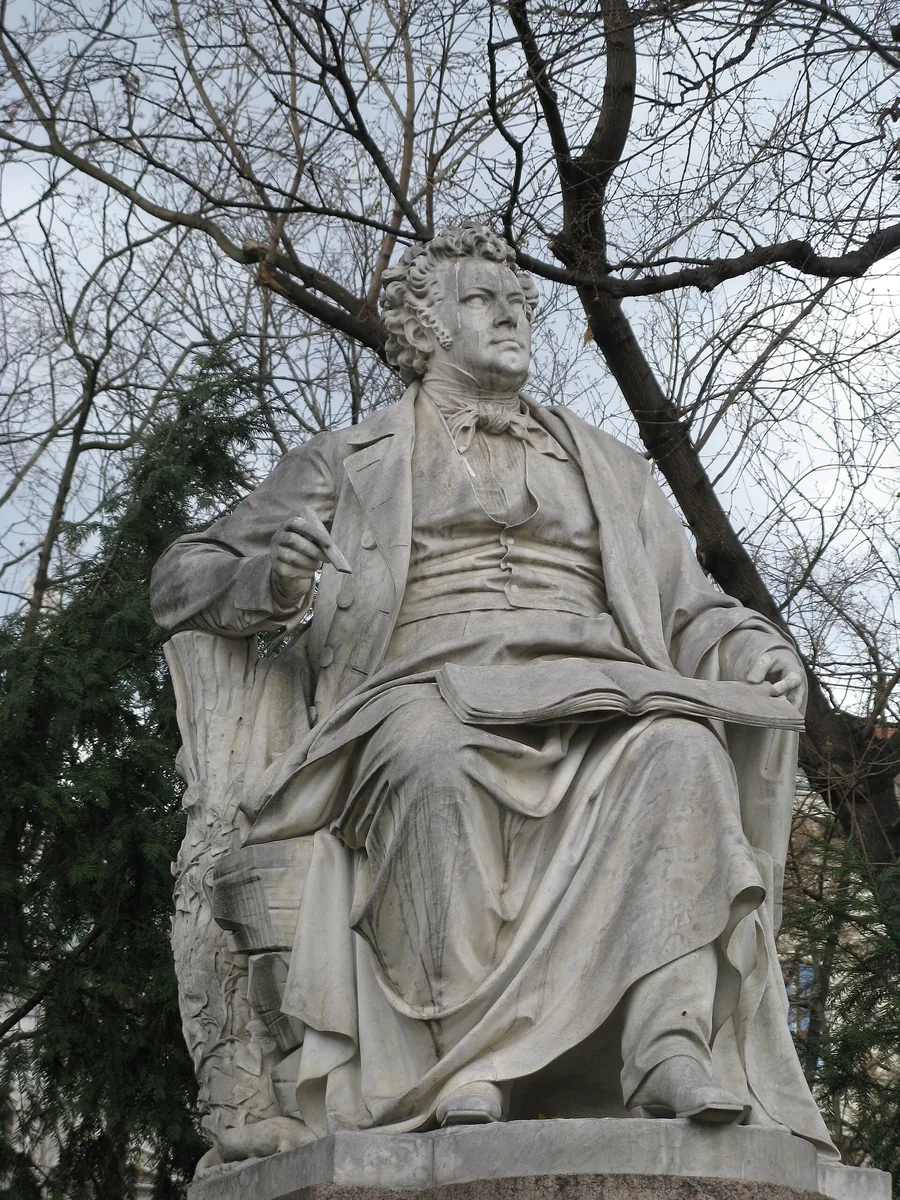
They put him in the Stadtpark in 1872: a seated marble Schubert by Kundmann, raised at the men's choral society's urging, a pencil in his hand and his face turned a little upward, which is not how anyone who sat at a table with him described him, though it was Schwind who stood over the sculptor and passed it. Sixteen years later the city gathered its famous dead into a row of honour at the great new cemetery out beyond Simmering, and went to Währing for the two of them. Beethoven was moved in June. On the twenty-third of September 1888 Schubert's coffin was carried in from the village churchyard through the city, past the Votivkirche and across the Schillerplatz, with two thousand singers walking behind it, and laid in the row beside Beethoven's — not three graves off this time, but the next plot. The old stones were left standing where they were, among the trees, and the churchyard is a small park now that carries his name.
The friends went on without him, some of them for a very long time.
Mayrhofer died in 1836. Vogl outlived his composer by twelve years and died on the nineteenth of November 1840, the same day of the same month. Ferdinand kept the piles in the flat in the Neue Wieden and sold them off to Diabelli in instalments for twenty years, and died in 1859, a schoolmaster to the end, like their father. Anselm Hüttenbrenner died in 1868, three years after Vienna finally heard what had been in his drawer.
Spaun missed it by three weeks. He went on being exactly what he was, and wrote his account of Schubert twice, a generation apart, and it is the best evidence anybody has; and he died at his daughter's house at Linz on the twenty-fifth of November 1865, twenty-two days before an orchestra in Vienna played the two movements nobody had known were there.
Schwind became a great painter and died in 1871. Schober, who had been seventeen and dazzling when he first read those songs at a piano in Linz, died in 1882. And Bauernfeld, who had written things down on the day they happened because that was the habit he had, outlasted all of them and died in 1890, sixty-two years after the afternoon in the Neue Wieden.
There is one more date. In 1951 an Austrian scholar living in London, Otto Erich Deutsch, who had spent his life gathering every document with Schubert's name on it, published a catalogue of everything he had written, in the order he wrote it, and gave each piece a number; which is why every song and symphony of his, ever since, has carried a D.
Spaun had bought the paper by the ream, out of his allowance, for a boy in a grey coat who wanted a roll and a couple of apples and had nowhere to write down what was in his head. Deutsch's numbers run to nine hundred and ninety-eight. The clerk had it at ten florins.
The end