The Inn Below the Castle
Below the castle at Nelahozeves, on a railway laid along the river a few dozen metres from the door of the village inn, the festival train came through on the eighth of April 1851. It was the ceremonial opening of the line that ran from Prague through Kralupy to Podmokly, and according to the village's own history there was a luxurious carriage in it with Archduke Albrecht aboard, among others, while people crowded the new station that had been built beside the church and stood along the track to see it go by. The day was cold in the valley, with a hard blue sky and a wind coming down the water.
The line had been six years in the building. The work had brought thousands of people from the furthest corners of the Austrian monarchy into a village of fewer than five hundred, and several houses in the settlement under the castle had been pulled down to make room for the track. It was not the first train on the rails. The first trains had come the spring before, carrying soldiers, divisions of the Austrian army, and the goods trains had followed them; the eighth of April 1851 was the day with the Archduke in it.
The innkeeper's eldest son was nine. The village history supposes that he was somewhere in the crowd.
The inn was the house numbered 12, two storeys high, standing right opposite the church of St Andrew. The village called it Engelhardt's, after the family who owned it, and in the spring of 1841 František Dvořák had taken the lease from the widow, Anna Engelhardt, to bring in money beside what he made as a butcher. The ground floor seems to have held the taproom and three other rooms, and the family lived in the house as well.
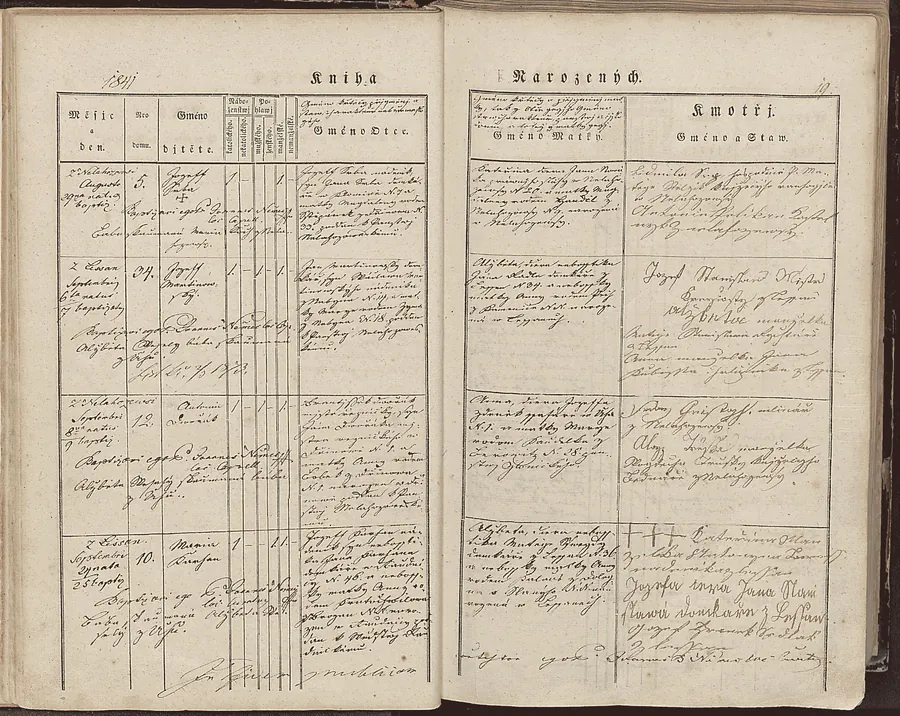
František was a certified master butcher, born in 1814, from a spreading family whose branches ran to butchers and tavern-keepers all round Kralupy and Kouřim. Near the end of 1840 he had married Anna Zdeňková, a farm steward's daughter from Uhy, who was born in 1820, and brought her to Nelahozeves. Their first child was born in the house on Wednesday the eighth of September 1841, and the next day he was christened across the road at St Andrew's, which was not yet a parish church of its own but was served from the parish at Minice nearby, by the priest, Jan Němec, with František Christoph, the village miller, standing godfather and Aloisie Trusková, the wife of the village cooper, standing godmother. The boy was given the name Antonín.
A brother, František, came two years after him, and by 1851 there had been five more children.
The village he was born into had forty-six buildings and four hundred and thirty-eight people: peasant cottagers, orchard-keepers, a few craftsmen, labourers on the Lobkowicz farm, and the schoolmaster. It stood on the Vltava, the river German maps call the Moldau, downstream from Prague, and it was the office of a Lobkowicz estate. The Renaissance castle on the hill had been built in the sixteenth century and bought in 1623 by Princess Polyxena Lobkowicz, whose family still held it, and although the Lobkowiczes kept their seat at Roudnice, on the Elbe, it was in the castle at Nelahozeves that the estate's business was managed and that one of the family's officials sat with the power to judge. Below it, besides the farm, there were a brewery, a distillery, a mill, a smithy and a ferry across the river, and at the edge of the village a gamekeeper's lodge, a sheep shed and a knacker's yard. The river mattered as much as any of them. It was the way goods moved, and its fish filled out the living of people who otherwise lived from the fields.
The detailed modern chronology of his son's life says that František carried on both his trades in the house numbered 12. The village's history puts the butcher's shop in another house, No. 24, which his own father had run since 1818, with František's older brother Josef helping; the old man lived there until he died, in 1842.
Dvořák's own version has both trades in one place. Václav Juda Novotný, a Czech composer and critic who travelled with him in the autumn of 1884 and later made a book of his recollections of it, wrote that he pointed out the village with the long name, and a low building under the castle, and said: “that's where my father had his inn and at the same time carried on his trade of butcher. It was in that little house that I was born and here in this lovely countryside that I spent my poor childhood.”
At home the music was his father's. František played the zither, often with his brothers, who were good on the violin and the trumpet, in taverns round about and in his own taproom, where the village held its dances. On Sundays there was Mass across the road, and the man at the organ was the village schoolmaster.
On the first of October 1847, a few weeks after his sixth birthday, Antonín went into that schoolmaster's school. It was a single room in the house numbered 3, with one class and one teacher, and the teacher was Josef Spitz. Spitz composed, mostly music for the church. In the village he was said to be able to play every instrument, and according to his daughter the players in the church resented the way he scolded them for wrong notes. With Spitz the boy learned to sing and began the violin. What the lessons were like is not recorded: whatever the school had kept about its pupils was destroyed when fire broke out there in 1885.
What came of them is on record in outline. The boy was soon playing for the guests in the taproom, and later in the village band and up in the church loft; he told Novotný about his first violin solo, which he played in a church that the village's historians place in a neighbouring village rather than at St Andrew's, and Novotný set it down in his words: “And what a fuss I was in that time and how afraid I was when I tuned my fiddle and how my bow shook at the first notes. But it turned out all right. When I had finished, there was a hum and buzz throughout the whole choir, everybody pressed round me — my friends smiled happily at me and clapped me good-naturedly on the shoulder, and our neighbour, the leader of the violins, gave me a whole groschen.” He went on: “That was the happier side of my youth, the brighter moments, but even the darker side was not uninteresting though it cost me many a tear.”
The darker side was the trade. As a boy he did help his father in the butchery, and he was expected to follow him into it. His father took him round the markets to buy livestock, in the villages near by, Chvatěruby, Hleďseby and Mlčechvosty among them. Whenever he was given one of the animals to mind, he told Novotný, it would “give me the slip, or without more ado drag me into the nearest pond, so that my situation was not exactly enviable.”
The playing in the inn comes down by another road. Anna Dušková, a cousin of his who wrote her recollections of him down long afterwards, began them with the family trade: “Toníček (Tony) had scarcely learned to walk when he was given the apron and hatchet that are the insignia of the butcher's trade.” His grandmother loved the little boy and called him “My little toothy”, because like almost every Dvořák he had very good teeth; she died in 1848, when he was six or seven. As a child, she wrote, he played to the guests, and “when he was to give a 'concert', what a bustle and to-do there was with the preparations.”
She had that from another cousin, Františka, who worked for his mother in the business in those years and who “used to relate, even after the composer's death, what a timid child he was.” Once, before one of his concerts, he broke a plate, and he was so upset about it that he could only with difficulty be consoled.
In the summer of 1853 he finished the years of schooling the law required, and the school gave him a prayer book called The Pious Christian, as a reward for diligence and good conduct.
In the autumn, when he had turned twelve, his father sent him away from the inn opposite St Andrew's, to Zlonice, to live in the house of his mother's brother.
At Zlonice, a small town about fifteen kilometres from Nelahozeves, three of the people in his days there answered to the same name: the uncle, Antonín Zdeněk, who had no children of his own; the town's organist and choirmaster, Antonín Liehmann; and the boy, Antonín Dvořák.
Nobody wrote down why he had been sent. His father may have meant him to learn the butcher's trade, or to improve his German at the school in the town, and the Dvořáks were a large family without means, which an uncle with no children to keep may have helped to ease. The Czech Dvořák scholars of today set out those possibilities and choose none of them. The National Museum in Prague gives a reason of its own: that he was sent to take his music further with Liehmann, a musician known well beyond the town, and probably also to lighten his father's burden of a large family.
Zlonice had about two thousand inhabitants, a castle, and a Baroque church of the Assumption of the Virgin Mary, finished in 1735 on the site of a Gothic one, and it was known far and wide for the quality of its music. Liehmann was about forty-five. He taught school, played the organ and led the choir, and he composed. He admired Haydn and Mozart above other composers, and the admiration shows in his own pieces and in the small instructive pieces he wrote for his pupils. He lived in the organist's house, and he taught the piano there.
The boy went to him first for the violin, which was then considered the foundation of any musical education. After the violin came the piano, and once he had more knowledge and more skill, figured bass and the organ. There were lessons on the viola too, and in harmony and improvisation. Figured bass is the organist's old shorthand, a bass line with small numbers written over its notes, from which the player at the keyboard is expected to build the harmony as he goes.
It was not long before he was singing and playing in the choir of the church, on the violin at first, and later, when Liehmann let him, on the organ. He played in Liehmann's band as well. And there was music outside the choir loft: at the castle in the town, and at Budeničky nearby, the seat of the Kinský family, who owned the estate round Zlonice, where the concerts put a wide range of chamber music in front of him.
He told a story about his first days in Liehmann's class, as the Czech Dvořák Society retells it. The steward's son was there when he arrived, a boy of eight or nine, very finely dressed, with a big flower embroidered on the back of his coat, and Liehmann was teaching him the piano. The small boy played a polka and did not make a single mistake. Dvořák was a few years older, and he could not play a polka like that. He was not envious of the flower, he said, and he did not think he was envious of the playing either; what he felt was sorrow, as though someone close to him had died, because he was older than the steward's son and could not do it, and he had wished to God that he could play like the steward's little son.
The same teacher could be hard. Dvořák described that too, and the words are his own, as one of his pupils, Josef Michl, wrote them down from his telling many years later: “Liehmann was a good musician, but he was quick-tempered and still taught according to the old methods: if a pupil could not play a passage, he got as many cuffs as there were notes on the sheet.”
Liehmann was well versed in harmony, Dvořák went on, “though of course his notions of harmony were different from those of the present day”, and he read and played figured bass fluently and taught his pupils to do the same; but where there were more figures than usual over a note, several of them with strokes through them, a boy could have three boxes on the ear before he had worked out the chord.
The first piece of music with his hand in it that is counted as documented today is the Forget-me-not Polka, from 1854. The main section is his, and the trio is Liehmann's.
In August 1855 his parents followed him to Zlonice with the other children. There was little hope by then that the family's money would mend at Nelahozeves. At Zlonice František Dvořák rented a large inn, number 69, and the family, which by then meant two parents and four younger children, with a fifth, Karel, born that year, fitted itself into the living quarters, which were two rooms next to the main taproom. Whether Antonín moved into those two rooms with them or stayed on in his uncle's house is not known. Either way, he spent most of his free time at the organist's house.
Liehmann had a daughter, Terezie, known as Terinka, about nine months older than Antonín, whom the modern Czech account names as his first love; people who knew them at the time said that the two of them sang together in one of her father's compositions.
For decades the lives of Dvořák said that it was in these Zlonice years that he served a two-year apprenticeship with a butcher and was declared qualified in the trade, and they printed the certificate of the butchers' guild to prove it. At the beginning of the 1990s the certificate was shown to be a forgery. The National Museum keeps a copy of the forgery in its collections.
His German was making no real progress, and in 1856 his father decided to send him away again, for one school year, to live with a German-speaking family. He was sent to Česká Kamenice, probably because Liehmann had once worked in that region. From September 1856 he lived there in the household of a miller, Josef Ohm.
He went to the school, and he went on with his music under Franz Hanke, a graduate of the organ school in Prague and the director of the deanery church in Česká Kamenice, who taught him theory and the organ. His German improved there. On the thirty-first of July 1857 the school gave him his leaving certificate, and beyond those facts the year is not recorded.
In 1857 his parents had another daughter, Marie, who died in the same year.
That summer he came back to his family at Zlonice, and his father decided to put him to music. Anna Dušková wrote that her uncle, his father, had meant his sons for the butcher's trade, in keeping with the family tradition, and that there were five sons, and then three sisters. It was mainly Liehmann's influence, she wrote, that brought him to release the boy “from following the family calling and to give him to music”. When Antonín showed little promise of taking to the butchery business, her uncle at last made up his mind and took him to Prague himself.
In September 1857, the month he turned sixteen, Antonín Dvořák left Zlonice for Prague, to study at the organ school.