The Albert Hall
In the Royal Albert Hall, on a Monday in March 1884, two days after he had first set foot in England, he came out to the conductor's desk to rehearse his Stabat Mater with a choir of eight hundred and forty voices.
He described it to Velebín Urbánek, a music publisher in Prague. “On Monday there was the first rehearsal with the choir in the Albert Hall, an immense building which can comfortably seat 12,000 people. When I appeared at the desk, I was welcomed with such a thunder of applause that it took some considerable time before there was quiet again. I was so deeply touched with the warmth of the ovation that I could not speak a word, and, in any case, it would not have been of any use as nobody would have understood me.”
The choir was Joseph Barnby's, and Barnby had drilled it so well, Dvořák reported, that the rehearsal gave no trouble. The orchestra rehearsed the next day and the soloists that afternoon, and then he gave Urbánek the size of the forces, two hundred and fifty sopranos, a hundred and sixty contraltos, a hundred and eighty tenors and two hundred and fifty basses, with twenty-four first violins, twenty second violins, and sixteen each of violas, cellos and double basses in the orchestra below them, and he put a warning in front of the list: “Don't get a shock!”
He had reached London at six in the evening on Saturday the eighth, after a journey broken only at Cologne and Brussels and a crossing over a flat sea, and the Prague pianist who travelled with him wrote home that by the next day the name Dvořák was in nearly all the papers, some of whose printers had gone to the trouble of having its accented letters specially cast.
On the Tuesday, before the concert, Henry Littleton, who owned the London publishing house of Novello, gave a dinner in his honour for about a hundred and fifty people, the leading artists and critics among them. The whole evening was given to his music. They stayed until half past two in the morning. His host, he told Urbánek, was fabulously rich, lived in a house fit for a prince, and wanted a new oratorio from him for the festival at Leeds.
The concert was on Thursday the thirteenth. He drew a conclusion from it, and put God's name to it twice: that in England a happier time had begun for him, and that the English, once they liked a man, stayed faithful to him.
He sent other friends other figures. To Bendl, the Albert Hall was the place “where 10,000 people listened to Stabat Mater”, with ten hundred and fifty singers and players. To Simrock, on the first of April, the choir had become a thousand and the orchestra a hundred and sixty.
London, he told Bendl, could not be described, and anyone who had not seen it would not believe it; he described it all the same, in distances Bendl could walk, for his travelling companion was lodging nine English miles out, which was as far as from Prague to Kralupy. “Imagine this huge area a mass of houses and streets with a network of railways and you have some small idea what London is like.” For the hall he chose a building Bendl knew, the wooden summer theatre in Prague's New Town, and told him to make it five times as big. When the English sang Handel's Messiah, he added, and reached the Hallelujahs, the whole audience stood and waved its hats and handkerchiefs.
On Friday the twenty-first he wrote to his father in Kladno, from lodgings at 12 Hinde Street, off Manchester Square. He began with arithmetic. “If all the Czech inhabitants of the whole of Bohemia were put together, they would not number as many as the inhabitants of London.” And if the whole town of Kladno came to the hall where he had conducted, there would still be room.
“Yesterday I had my second concert in St. James's Hall where I again achieved the most splendid success! I cannot tell you how great is the honour and respect the English people here show me.” That concert was the Philharmonic Society's, and he had conducted his Hussite overture and his Sixth Symphony at it. The papers, he told his father, were calling him the lion of the London season, and some of them had printed that he came of poor parents, that his father had been a butcher and innkeeper at Nelahozeves, and that his father had done everything he could to give his son a proper education.
“Honour be to you for that!”
He signed himself his father's grateful son, and promised to come out to Kladno when he got back. He was in Prague again by the end of the month, and a week later he conducted the Stabat Mater once more, for the choral society Hlahol in Plzeň.
On the fourteenth of June 1884 the Philharmonic Society elected him an honorary member, and that June it asked him for a new symphony. Sixty years earlier the same society had paid Beethoven fifty pounds for one, and the score of the Ninth had reached London with a line in Beethoven's hand on its front page saying that it was written for the Philharmonic Society.
In September he crossed again, for the music festival at Worcester, where the cathedral was keeping the eight-hundredth anniversary of its founding. Novotný went with him. Henry Littleton, Novotný wrote, met them at Dover and drove them to his villa at Sydenham, and the first thing they went to see was the Crystal Palace.
The Stabat Mater was sung in the cathedral on the morning of Thursday the eleventh of September, with the soprano Emma Albani among the soloists, and in the evening he conducted the Sixth Symphony in the Public Hall. “There is no other work of modern times in the sphere of sacred music which can compare with Stabat,” Novotný wrote, and he gave that as the opinion of all the English critics. He also wrote that among the supposedly cool English he had found an understanding of Dvořák's music that Dvořák had not generally been given at home.
The next morning Dvořák wrote to Anna. “Stabat Mater, in the wonderful and very large church (4000 people) made a tremendous impression. It was the finest day of the whole celebrations as everybody here was saying.” When they came out of the church everybody wanted to shake his hand and have a word with him, which with so many people was not possible, and afterwards he was introduced to Lord Compton, whose wife presented him, in a magnificent suite of rooms, to a great many ladies before about three hundred people went in to breakfast. In the street, at his lodging, even when he went into a shop to buy something, “people crowd round me and ask for my autograph”, and every bookseller was selling his picture. After the symphony the Mayor came to him at the head of a deputation, with Lord Compton, to thank him for taking part. “In short, a great victory.”
The money had moved with the halls. According to the National Museum's summary of the letter, he had written from Prague to Alfred Littleton of Novello's in January 1884, two months before he first saw London, that he would compose the choral work they had asked for by the beginning of 1885, for a fee of five thousand marks.
The symphony for the Philharmonic Society was begun on the thirteenth of December 1884. Before Christmas he wrote to Antonín Rus, a judge at Mirovice and one of his closest friends, that wherever he went he had nothing in mind but this new work, “which must be such again as to make a stir in the world, and God grant that it may!”
Another son was born on the ninth of February 1885, and they named him Otakar.
He finished the score on the seventeenth of March 1885, and on the manuscript he wrote: “Composed for the Philharmonic Society in London.”
He conducted the first performance in St James's Hall on the twenty-second of April, during his third visit. Two days later he wrote to Rus from Sydenham that it had gone “Splendidly, really splendidly”, that the English had welcomed him as warmly as they always had, and that the symphony had been a great success and would be a greater one next time; and then, in the same letter, “Although I have everything I could wish for here, still I would rather be at Vysoka”, to see what Rus had been doing to the garden there, which would not see for another month the hawthorn, roses and violets that were already out all over England.
The Seventh Symphony begins quietly and low, with its first tune in the lower strings, over a long-held note in the bass, and the tune keeps to a narrow span, climbing and falling back within a few steps, before the orchestra breaks out of it. A clarinet leads the slow movement off, in a quiet hymn for the woodwinds, over plucked strings.
Simrock wanted the symphony, but not at Dvořák's price. The publisher would go no higher than three thousand marks, pleading the cost of large orchestral works and the small sales they made, and asked instead for a new set of Slavonic Dances. Dvořák replied from Prague that another firm was offering him more, that Simrock had found a gold mine in the first set of dances, and that the logic of Simrock's letter led to writing nothing but songs, piano pieces and dances: “this, as an artist who wants to make his mark, I cannot do.” He asked for six thousand, and ended: “Remember, I pray you, that I am a poor artist and the father of a family and do not wrong me.” Simrock published the symphony that year.
In August 1885 he went back for the fourth time, to conduct The Spectre's Bride at the Birmingham festival. Before he left he wrote to Göbl that his head was full of worries about the journey, and that if an order came from England forbidding any Czech to conduct there, he would rejoice.
He reached London at six in the morning of Monday the seventeenth, when the city was still asleep and there was nobody in the streets, and that same evening he was in Birmingham, rehearsing a choir of five hundred who had the work by heart to the last semiquaver. Between rehearsals he stayed at the Novello house by the sea at Brighton, among the crowds, the boats, the bathers and a band playing Scottish songs. Birmingham he described to Göbl as an immense industrial town “where they make excellent knives, scissors springs, files and I don't know what else, and besides these music, too.” His own day was Thursday the twenty-seventh, at eight in the evening, in a festival of eight concerts that lasted four or five hours each.
“This time I am travelling alone, as I wanted to see how it would be.” His verdict, in the next sentence: “Well, it was all right but the journey (48 hours) is terribly tiring.”
In Kladno his father read of a railway collision outside London and did not know whether his son had been in it until a newspaper told him otherwise, “and then I was as if born again.” He wrote that to Zubatý, and asked him whether all the fame was still ringing in his son's ears “as the papers were writing”, and whether a word from Zubatý might persuade him to take a day off and come to see his father.
In October 1886 he crossed for the fifth time, and Anna came with him. On the fifteenth, at the Leeds festival, he conducted the first performance of the oratorio Henry Littleton had asked for, Saint Ludmila. It lasted from half past eleven in the morning until three in the afternoon, with a choir of three hundred and fifty and an orchestra of a hundred and twenty, and at the end of the first part, he wrote to Rus, the audience, choir and orchestra cheered until he felt quite queer. When it was over he spoke to the hall himself: “finally I said a few words to the audience in English”, and thanked them for their welcome.
Then he was in London until the sixth of November, in fog and rain, and told Rus he would gladly have been away from it, but duty called.
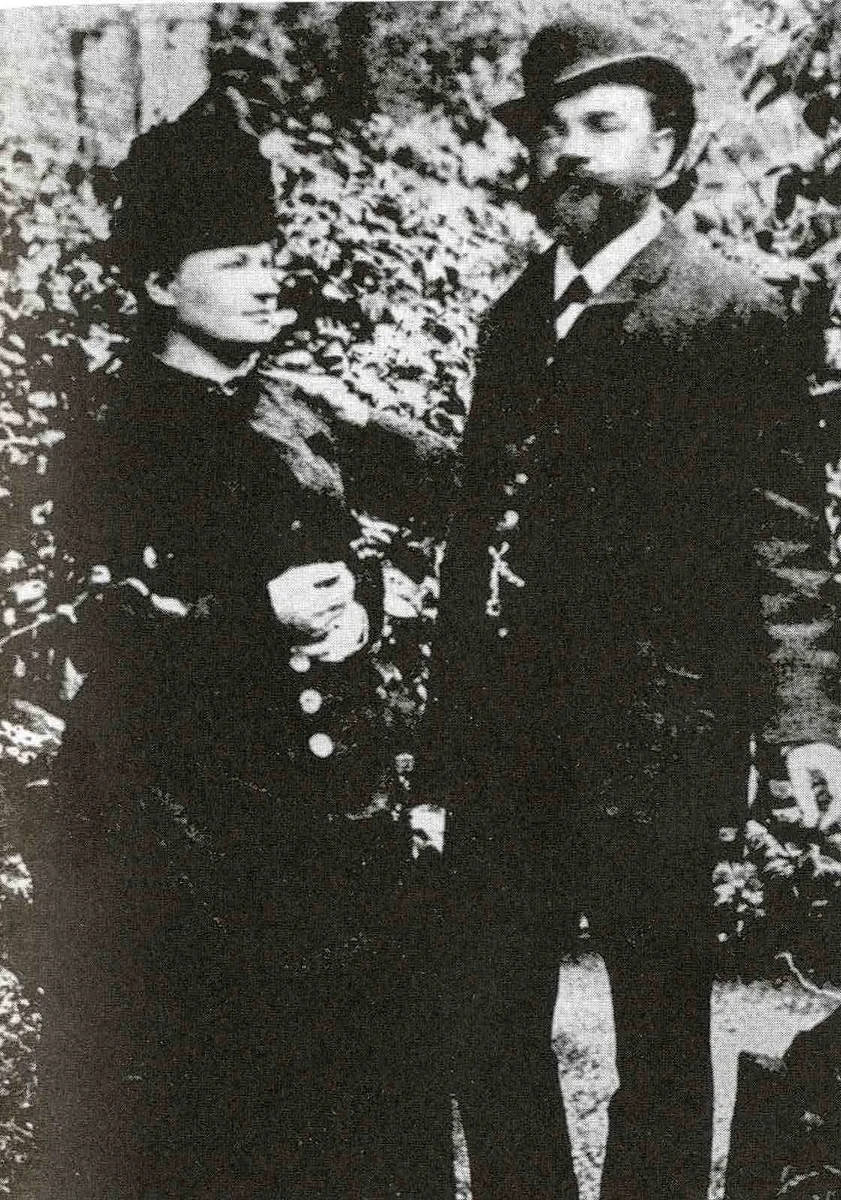
In London the two of them were photographed together.