Vyšehrad
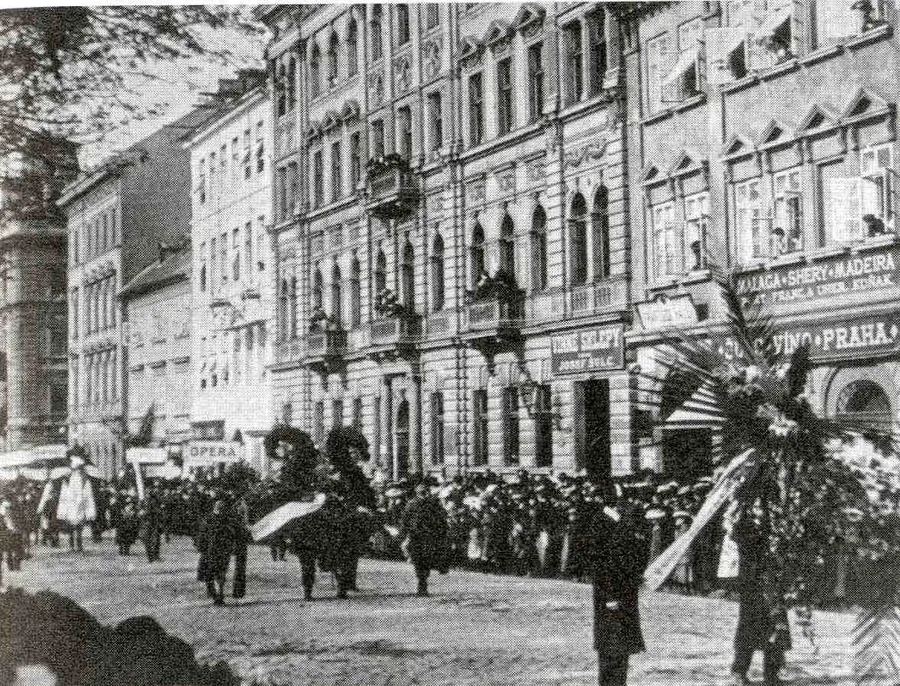
The coffin left the flat in Žitná street on the morning of the fifth of May and lay for several hours in the church of the Holy Saviour in the Clementinum, at the Old Town end of the Charles Bridge, while the church, the square outside it and the courtyard of the Clementinum filled with thousands of people. Suk had come back to Prague the day before. The telegram had reached him on tour in Spain with his quartet, and on the way home he had stopped at Nelahozeves and brought lilac from the village to lay on the coffin.
By then the news had been on the front pages of the Prague papers, and in newspapers in Germany and Austria, England and America. Janáček heard it in Warsaw. “The Warsaw Philharmonic changed the programme of its Symphony Concert,” he wrote: the orchestra had put in the Hussite Overture in his honour, the news having only just come in, and Janáček stood “uncertainly with the others in the crowded foyer.”
A little after three in the afternoon the procession set off for Vyšehrad, with the singers of Hlahol singing the Miserere as they walked and university students holding up banners with the titles of his works, and at the National Theatre it stopped for a moment while, from the balcony, the theatre's orchestra and chorus performed part of his Requiem; at Vyšehrad, where torches were burning on the ramparts, Karel Knittl, who now ran the Conservatoire, gave the address, and the coffin was put into a temporary grave.
Two years later, on the anniversary of his death, he was moved from it into the family tomb, under the arcades of the Vyšehrad cemetery.
Otilie died on the fifth of July 1905. She was twenty-seven. Suk finished a symphony in 1906 and called it Asrael. It is dedicated to the memory of Dvořák and of Otilie, and Kovařovic conducted its first performance at the National Theatre on the third of February 1907.
In Kroměříž, Moravan's two concerts did not take place.
In 1922 the Oliver Ditson Company published a song, Goin' Home, whose title page reads “From the Largo of the New World Symphony by Anton Dvořák” and, beneath, “Words and adaptation by William Arms Fisher”, who had studied at the conservatory in New York in Dvořák's years there. It was sung so widely that a great many people came to take it for an old spiritual that Dvořák had borrowed, when the tune was his, written in New York in 1893, and the words were Fisher's, written twenty-nine years later.
His first symphony dated from 1865, and the Czech Dvořák Society says that he died believing it lost for good. In 1923 the score emerged from the estate of Rudolf Dvořák, a professor at the Charles University in Prague and no relation, who seems to have bought it in a second-hand bookshop in Leipzig in 1882. It is known now as The Bells of Zlonice, and an orchestra in Brno played it for the first time on the fourth of October 1936, seventy-one years after it was written.
Vítězslav Novák, one of his composition pupils at the Conservatoire, called him “a teacher-artist”, and in Novák's account Suk once sighed, “Sometimes I could howl, but we learn a lot from it.” Suk and Novák both went on to teach at the Conservatoire, and Suk was four times elected its rector.
In 1932 a society formed to raise a monument to him in Prague opened a museum in a Baroque summer house in the New Town called Amerika, and most of the manuscripts of his music are kept there.
Anna outlived him by twenty-seven years and died on the fourteenth of July 1931. She was seventy-seven. She lies with him in the tomb at Vyšehrad, and her name and her years, 1854 to 1931, are cut in the stone beneath his.
The end