Vysoká
Count Kounic kept his carriages and his sledges in “an ordinary walled granary behind the villa in the woods”, and when it became known that Dvořák meant to spend the summer at Vysoká, the granary was quickly fitted out as rooms to live in. That is how Bohumil Fidler, a young choirmaster in Příbram, the old silver-mining town nearby, described the composer's first retreat in the country in recollections he wrote afterwards, and according to him Dvořák would often point to the building and say that it was there he had worked at The Spectre's Bride.
The estate, with a mansion house, a farm and woods, belonged to his brother-in-law, Count Kounic. Most of the people of the village worked in the Příbram mines.
At first the Dvořáks were the Kounics' guests. Then, in 1884, with money England had begun to pay him, he bought a piece of land from the Count. Fidler says it was a big place known as the Sheepfold, with a view across to the village of Třebsko, and that Dvořák fenced it in, built a small house in the middle and laid out a large garden round it. Other accounts say that an old building already stood on the land and that he had it rebuilt into a house fit for the summers. Either way, there was a study in it with an upright piano and a writing desk.
He wrote to Simrock from there one May that he had bought a piano in Prague with his own money, and that he was just setting off with a big wagon to fetch it from Příbram. The same letter, before it reached the piano, had been about birds: he was spending the loveliest days in the loveliest woods, listening to them, and he never once thought of composing while he did it, whatever other composers might find, for “I give myself up entirely to the enjoyment and work only when I feel rested and have gained new strength.” He asked Simrock not to laugh at him for writing poetically. He had received the money and the music, “very little of both”, and hoped Simrock would do better next time. Vienna wanted an opera from him, “as Hanslick writes”, and could have one, though why the gentlemen there did not want Dimitrij he could not understand: “they will be sorry for it yet!”
The Court Opera in Vienna gave The Cunning Peasant on the nineteenth of November 1885, and the performance set off demonstrations against the Czechs. In June 1886 he had been at Vysoká six weeks and told Simrock that he was better off than Bismarck on his estate at Varzin, “yet at the same time I am far from being idle. I spend most of the day in my garden, which I keep in beautiful order and love as I do 'the art divine', and go rambling through the woods.” That August he wrote to Novello's in London, in English, to ask that nothing more be sent to his Prague address: “Please don't send the letters to Prague. I seldom stay there.”
The day at Vysoká, as it is usually told, began at four or five in the morning. He walked to Třebsko for early Mass and played the organ there, the hymns to the Virgin that he liked best, and then shut himself in his study and composed through the rest of the morning; there was the garden, and there were the pigeons, and in the evening he went to the inn called U Fenclů and played cards with the miners.
The head gamekeeper at Vysoká, Jan Hertan, whose memories run on long past these years, saw the early mornings from the other side. Dvořák, he said, often came to wake them at five o'clock and was surprised that anyone could stay asleep while the thrushes were singing overhead, and in the courtyard he would sit and watch a flock of pigeons for hours, “his pride and delight”.
In church, Fidler says, what Dvořák liked best was to accompany the congregation; he used to say that a hymn sung by the people was far better than a Mass badly performed by a choir. More than once he told the choirmaster at Bohutin: “You know, in Prague they don't sing as they do here. They sing, too, but it's not the same thing. Here the people are still a little religious.”
In June 1887, from Vysoká, he wrote to the architect Josef Hlávka, a patron of Czech learning and the arts, that the Mass Hlávka had asked of him for the chapel at his castle at Lužany was finished, that he was truly satisfied with it, and that it was for voices and organ only, with very modest means, where everything of the kind he had written before had been on a large scale. And he added: “Do not wonder that I am so religious. An artist who is not could not produce anything like this.” He conducted the first performance of the Mass in D in the castle chapel on the eleventh of September 1887.
At the inn, Fidler says, he played darda, a card game, with the neighbours and talked to them about pigeons and farming. The one he liked best was the farmer and mayor, Fencl. He scarcely ever talked about music, and then only reluctantly, but with Fencl he talked it very often; he paid for Fencl to come to Prague, took him to the National Theatre to see one of his own operas, and sent him home again. Once, on his name-day, the village musicians of Třebsko, Vysoká and Bohutin came to serenade him with opera pieces they had practised specially, and he thanked them, treated them at the inn and had them play village music instead, telling them to leave the opera pieces to others.
He kept cages of songbirds too, mostly thrushes, at home and in the garden arbour at Vysoká. One summer evening Fidler walked with him through the park behind the Count's villa and past the pond into the woods, and all the birds of the forest started their evening singing at once. Dvořák sat down on a bench. “Sit down, comrade, and listen: it is divinely beautiful!”
The Piano Quintet was written between August and October 1887 and first played in Prague in January 1888.
In February Pyotr Ilyich Tchaikovsky came to Prague to conduct two concerts, and the two composers met at an evening given in the Russian's honour on the fourteenth; the next day Tchaikovsky called at the flat in Žitná street, and at a dinner on the sixteenth, when Dvořák answered the Czech toast Tchaikovsky had made, Tchaikovsky embraced him and spoke of “his newest but warmest bond of friendship with the great Czech, Antonin Dvorak”. He wrote from Vienna a month later, in German, which he said was terribly difficult for him, to say that he would never forget how he had been received.
Their daughter Aloisie was born on the fourth of April 1888, and there were six children in the family.
Tchaikovsky came back in November for the Prague premiere of his opera Eugene Onegin, and in January Dvořák wrote to him that none of his compositions had given him such pleasure.
Tchaikovsky could not read the letter. It went to Moscow to be translated, and he answered on the day the translation reached him, asking Dvořák to come and conduct in Moscow. A second letter named the dates on which the concerts could be held, and the fee: the Moscow society was not rich, he wrote, and could offer “about 800 roubles (about 1000 gulden) to defray your travelling expenses.”
The Jacobin was first performed at the National Theatre on the twelfth of February 1889, and in June he was given the Order of the Iron Crown. That June he had been at Vysoká since the sixth of May, he told a friend, and had not yet been to see him: travel had once been a delight, “and now? I am glad when I can sit at home.” He had just finished thirteen pieces for piano solo.
In January the society that ran the Prague Conservatoire had resolved to appoint him to teach composition. In September he declined. He wrote to its secretary, Dr Josef Tragy, that he was afraid he could not carry out the duties as he would wish, being so burdened with his own work and his journeys abroad. The critic Ladislav Dolanský set down what Dvořák said when the question came up in a Prague music shop: “Me a teacher? Get away with you! My duty is to write, do you understand and not to teach. I am too much of an old bear, and nobody will get me into doing that.”
He was received in audience by the Emperor Franz Joseph in Vienna on the ninth of December 1889, and on the same visit he saw Brahms.
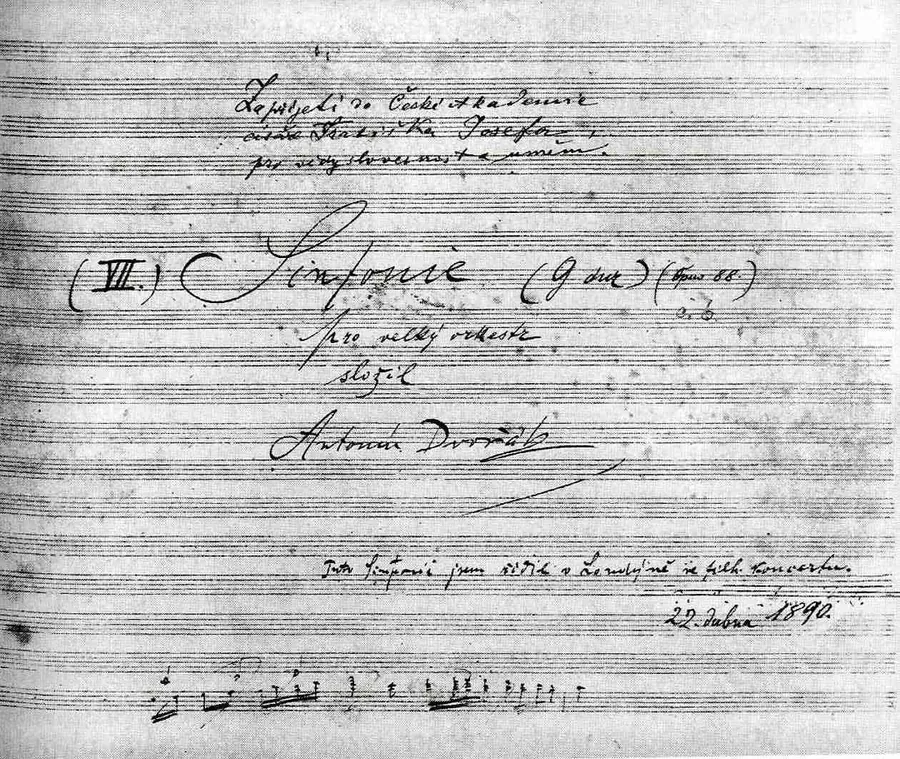
The Eighth Symphony was written that autumn, begun at Vysoká at the end of the summer and finished on the eighth of November 1889. He conducted its first performance himself in Prague, in the Rudolfinum, with the orchestra of the National Theatre, on the second of February 1890.
The opening tune is the cellos', low down, and before long a flute comes in with a different tune altogether and the movement goes the flute's way. The third movement is a waltz.
Simrock, who wanted shorter pieces from him that would sell, and Dvořák, who did not mean to write them, could not agree terms, and the symphony went to Novello in London.
In March 1890 he went to Russia, conducting in Moscow on the eleventh and in St Petersburg on the twenty-second, and on the morning after St Petersburg he wrote to his friend Gustav Eim, a Czech deputy in Vienna who sent reports to the Prague papers. Moscow had gone well, “in my view well but not so well as I expected”; St Petersburg had been splendid, with applause after every movement of the symphony, and Anton Rubinstein, the president of the Russian Musical Society, had given a banquet in his honour at which the critic Hermann Laroche toasted him and said that the Czechs, though a small nation, stood high in science and art. In Moscow the German choral society was giving the Stabat Mater in church that day, after he had left. “I was at the rehearsal and everybody was deeply affected and they gave me a laurel wreath.” At the banquet a violinist had drunk to the new Doctor of Music, and that was how he learned, from a telegram in the Russian papers, that the university in Prague had awarded him an honorary doctorate. He received it there on the seventeenth of March 1891.
He was in England again in April 1890. In October the Conservatoire asked again, and this time he accepted, on condition that he teach seven or eight months in the year.
Late that year a letter came from Cambridge, and he passed the news to Göbl. “What do you say to that? I must go there, however, and receive the degree in person.” It would be an elaborate ceremony, and he would have to conduct the Stabat Mater and one of his symphonies; he had been told it was a rare distinction, and that the only foreign artist who held it was Joachim. In the same letter he reported that his Requiem was finished, and that if he gave it to Novello, Simrock said he would take him to court. “He wishes to sue me but I am not afraid.” The Requiem went to Novello.
He took up the post at the Conservatoire in January 1891. The Dumky Trio, named for the dumka, a Ukrainian folk song half melancholy and half wildly gay, was finished on the twelfth of February.
On the sixth of June 1891 a telegram reached him from Paris, from the founder of a conservatory of music in New York, asking him to become its director.
At Cambridge, on the fifteenth of June, in place of a dissertation, he conducted a concert: the Eighth Symphony and the Stabat Mater. The degree was conferred the next day, a Tuesday. That morning he sent Göbl a note: “Today, Tuesday, at 12 o'clock, I shall be a Doctor.” About six others were to be made doctors with him, among them a Russian zoologist, and the concert had gone splendidly. “The lovely doctor's cap and gown were gifted to me by the University.”
What that felt like comes from Michl. When the talk in class turned to some celebration, the master said that he did not like such things, and was on pins and needles whenever he had to attend one. “I shall never forget how I felt when they made me a doctor in England: the formalities and the doctors.” All the faces had been grave, nobody seemed to speak anything but Latin, he had not known which way to turn his ear, and when he understood that they were speaking to him he had wished himself anywhere else and been ashamed not to know Latin; but looking back he could smile at it, and think “to compose Stabat Mater is, after all, better than to know Latin.”
He was just home from England, after forty hours' travelling, when he set the New York terms out to Göbl, and said he was waiting to hear from Dr Tragy before he decided: “The directorship of the Conservatoire and to conduct 10 concerts (of my own compositions) for 8 months and 4 months vacation”, for a yearly salary of fifteen thousand dollars. “Should I take it? Or should I not?”
From Vysoká, on the first of August, he wrote to Göbl again. “I walk the whole day in my garden and amuse myself with my pigeons. That is my occupation here.” He had news about America as well. “Yesterday I got a copy of the contract. It is very long but I don't know yet whether I shall accept it.” There would be three hours' teaching a day, four concerts with the students and six in American towns.
Half of the fifteen thousand dollars was to be deposited in Prague before he left, and the other half he would get by the month. There was, he told Göbl, one little hitch, and it was that second half: “I want the 7,500 dollars to be paid up by the end of May 1893”, so that he could have June, July, August and the first half of September at home in Bohemia. “If they meet this condition I shall probably accept. What people say of America is very mixed.”
Prague celebrated his fiftieth birthday on the eighth of September 1891. In October he crossed again, and on the ninth, at the Birmingham festival, he conducted the first performance of the Requiem. It was his eighth journey to England in seven years and seven months.
Back in Prague later that month he thanked a neighbour, who kept his garden supplied with cuttings, for sending what he had asked for his pigeons, and mentioned that he had just sent the contract, revised for the third time, and that if they agreed to all his changes he would sign. In November he told Göbl that Simrock had remembered his existence and wanted something new. “I am letting him wait in the meantime to punish him.” Unless Simrock paid very well he would have neither the overtures nor the Dumky: “I won't allow myself to be done down by him any more!” He signed with New York in December.
On the third of January 1892 he set out on a farewell tour of Bohemia and Moravia, forty concerts in the towns by the twenty-first of May, with two of his colleagues from the Conservatoire, the violinist Ferdinand Lachner and the cellist Hanuš Wihan, playing the Dumky with him. In Prague, on the twenty-eighth of April, he conducted three new concert overtures for the first time.
Then there was one more summer at Vysoká. He wrote a Te Deum there and sketched a cantata, The American Flag, both for the celebrations planned in New York that autumn for the four hundredth anniversary of Columbus's first voyage, while Suk and another pupil, Oskar Nedbal, stayed with the family and made piano arrangements of his new works.
They were to leave Prague on the fifteenth of September.