First Viola
Bedřich Smetana conducted the first performance of his comic opera The Bartered Bride himself, at the Provisional Theatre in Prague, on the last Wednesday in May 1866, eleven weeks after he had finished the score, and one of the violas in his orchestra that night was played by a man of twenty-four named Antonín Dvořák.
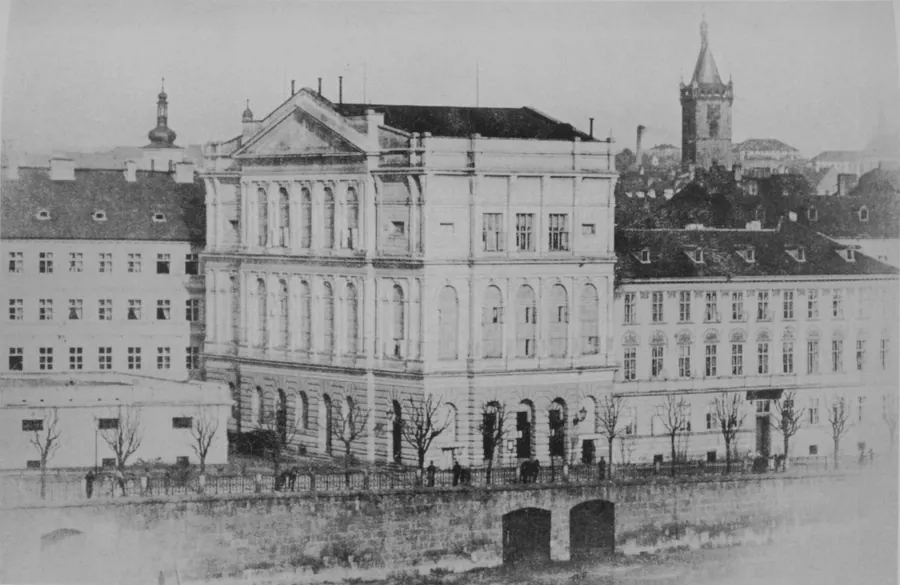
The theatre's name said what it was. It had been put up in 1862 as a stopgap, a house for plays and operas in Czech while Prague waited for a national theatre to be built, and Dvořák had been in its pit since the November it took on its orchestra. Adolf Čech, who was born in the same year as Dvořák, who was the theatre's choirmaster in those first seasons, and who set down his memories of the theatre some forty years after the two of them first met, placed him exactly: it was the orchestra “where he was first viola and I was choir-master.”
It was the second first night of a Smetana opera in that house in five months. In January Dvořák had played in The Brandenburgers in Bohemia, Smetana's first opera, with Smetana conducting that too.
The new one began, as it still begins, with the overture. A figure is thrown out by the whole orchestra at once, loud, and straight after it the second violins start a fast fugato, and the other strings take up the same running line one section after another, the violas among them, before the wind come in. That running fugato in the strings, in the first seconds of the overture, is what a viola player in that pit had under his fingers before a word of the opera was sung.
He had come to Prague nine years earlier to study at the organ school, where church organists were trained and where everything was taught in German.
His German was not good.
These are Dvořák's words about the school, as Michl set them down. “At the organ-school everything smelt of mould. Even the organ.” Whoever knew German well, he said, could be top of the class, and whoever did not could not. “My knowledge of German was poor, and even if I knew something I could not get it out.” The other pupils looked down their noses at him and laughed behind his back, and when they found out that he was composing they laughed at that too. He had not let it go. “And all those who laughed at me got on better than I did.”
The school's own verdict on him survives, in an extract from his report that Otakar Šourek printed in 1954 in his collection of letters and recollections, with a note that the director who wrote it was the man who kept up the school's German regime. It is cooler than the story, and it is not unfair: “An excellent but more practical talent. Practical knowledge and accomplishment seem to be his aim. In theory somewhat weaker.”
That was not all of his schooling. From the first of October 1857 he also attended the parish school attached to the church of Our Lady of the Snows, and took its leaving certificate at the end of August the following year. And six weeks after the parish school began, on the fifteenth of November 1857, he made his first appearance as a viola player, at a concert given by the Cecilian Association.
Čech wrote about that society's orchestra too. He had joined it as a viola player, and its conductor had put him at the same desk as a young man with a thick, tousled black mane who was a pupil at the organ school, both of them barely twenty, and sharing the desk had been no easy matter. “Now my playing did not please him, now he was annoyed with the next desk, another time he was dissatisfied with the conductor-or with himself.” And now and again the young man beside him would stop playing altogether and hum a scrap of tune to himself.
He played at the organ school's graduation concert on the thirtieth of July 1859, and his two years there were done.
That September he joined the band of Karel Komzák, a composer of dance pieces who ran one of the popular bands of the city, and he joined it as a viola player. In November he applied for the post of organist at St Henry's church, the kind of steady place an organ school existed to fill. In March 1860 the application was turned down.
In the first half of that year he moved in with his aunt, Josefa Dušková, whose family had a flat on Karlovo náměstí, Charles Square. Her daughter was Anna Dušková, and hers is the household seen from inside. His father, she wrote, was not doing at all well, especially after the family's move to Kladno, and could give him nothing, so he very soon had to earn his keep. At first he boarded with them on his own, because they had only one room and a kitchen, and he had breakfast with the family and took his dinner and supper at an eating-house, while his mother still saw to his laundry. And the fruit is what his cousin kept longest: “In the plum season he would ask Mother to give him dinner and I still see Mother, in my mind's eye, counting 30 plum dumplings on to a dish for Antonin — of which not one remained!”
Josefa Dušková was, in her daughter's words, the life and soul of the household. She took a bigger flat in the same house, two rooms and a kitchen, so that she could earn something by letting beds, and from then on the young man shared his room with a student. When they moved again, to a flat at the back of a house with a garden, he had a room with three windows, which he shared with two other lodgers, and in it a piano hired from his tailor for two gulden a month, a table facing it, and his bed behind the table.
His cousin watched him work in that room. “He often composed immediately on waking in bed, and whenever he got an idea, he played it over on the eiderdown.” At the table, she wrote, “he held the quill in his teeth and played with his fingers on his jacket or on his legs,” then went across to the piano and played the thing over, singing softly.
The family were devout, and knelt for their prayers morning and evening. Her mother asked the young man to join them, and his cousin gave his answer in his words: “Auntie, I like praying best there at the window when I look out on to the green and at the sky.”
“He never came home late,” she wrote, but there was one night when he did not come home at all. The young people of two or three neighbouring families got up a fancy-dress party at the Dušeks' flat, because the Dušeks had a piano, and asked him to join in and play for them, and “he did not come home at all that night and slept somewhere else for the first time.”
In 1864 he went before the recruiting board for the third time, and his cousin's family were so sure that a strong young man who had never been seriously ill would be taken that they mourned him in advance. He was not taken. The official record is shorter: exempted in March 1862, excused again in 1863, and in 1864 exempted for good.
Komzák's band did not stay a dance band. When the Provisional Theatre opened in 1862 it took the band over for its orchestra, and on the eighteenth of November that year Dvořák joined the theatre's orchestra as a viola player.
The band kept a life of its own outside the theatre for a while. On the eleventh of July 1863 it set out on a tour to Hamburg and to Helgoland, the island in the North Sea, and Dvořák went with it. It is the first journey out of Bohemia that is recorded for him.
Some of what is known of him in the pit comes at two removes. Petr Mareš, who played in that orchestra, met by chance on Charles Square the last musician still living from the old band, and wrote down in a letter what he was told, and it was not all about a pleasant colleague: Dvořák was “easily roused, quick-tempered and impatient,” the old bandsman said, and kept out of the way of the players who liked to get a rise out of him, and he also played, the old bandsman said, the solo viola part in Der Freischütz and the viola d'amour solo in Les Huguenots, and played them very well.
That letter has him poorer than his cousin does. He was “too poor to have his own piano,” it says, and so he went to a colleague's flat to play his things over, which the colleague's wife did not much welcome, “as he always left his footmarks on the newly-scrubbed floor.” So he took a room with a piano at his disposal, and there, when an idea came to him in the night, “he got up and played it over so as not to forget it,” whoever else in the flat was asleep. That, according to the letter, was the main reason he changed his rooms so often. When he shared lodgings with a violinist from the same orchestra, he kept the man's piano to himself for whole days.
His cousin tells it another way: apart from short breaks, she wrote, he lived as one of their family until he married. By the autumn of 1864, though, he had lodgings on Senovážné náměstí.
She also went to the theatre with him. When he played in that orchestra he often took her along and sat her on a chair among the players, and she never had to be told twice to keep still. “I sat there, scarcely breathing, just taking in all the beauty in great gasps.” At home she would creep into his room while he was at the piano and beg him, for a quarter of an hour at a time, to take her with him that day, and he would fix his eyes on hers, smile, and whistle under his breath without taking her in at all, until he came to and asked her, with a start that made her jump, what she wanted.
In April 1864 he began going regularly to the family of a Prague goldsmith, Jan Jiří Čermák, to teach them the piano, and he kept it up until December, while he was still playing viola in the orchestra of the Provisional Theatre.
The goldsmith and his wife, Klotilda, had seven children. One of them, Josefína, born in 1849, was by about the following year a young actress at that same theatre, so that the piano teacher and his pupil came to work under one roof. Another, Anna, was not yet ten that spring.
According to Josef Suk, a pupil of his many years later who married one of his daughters, and who told the story long after Dvořák's death, Dvořák was in love with Josefína. She married someone else, and Dvořák married her younger sister, Anna.
In July 1865, between the tenth and the twenty-seventh, working from a collection of poems by Gustav Pfleger-Moravský, he wrote eighteen love songs for voice and piano, some forty minutes of music in all, and the cycle is known as Cypresses. According to the Czech Dvořák Society, he expressed his love for Josefína in them.
He never published the cycle as he had written it, and he did not leave it alone either. He went on taking tunes back out of it for the rest of his working life: some went into Silhouettes, a set of piano pieces he wrote in 1879, and in the spring of 1887 he arranged twelve of the songs for string quartet.
The work of the pit was other men's operas: Weber's and Meyerbeer's, and Smetana's as they came. He was composing through all of it, and had been since before the theatre opened: the earliest work to which he afterwards gave a number was a string quintet written in 1861. By the November the theatre took the band over, Čech wrote, Dvořák had already begun to write small pieces, songs and entr'actes, and Šourek added in a note beside those lines that in the same years he wrote chamber music and two symphonies as well.
The foundation stone of the National Theatre was laid on the sixteenth of May 1868, the permanent house for Czech opera and drama that the Provisional Theatre had been built to stand in for, and on the same day, at the Provisional Theatre, Smetana conducted the gala first performance of his new opera, Dalibor, with Dvořák in the orchestra among the violas, as he had been for The Brandenburgers in Bohemia and for The Bartered Bride.
He stayed three more years. In the summer of 1871 he left the orchestra of the Provisional Theatre, after nearly nine years in it and after almost twelve, counting Komzák's band, of earning his living with a viola.
On Sunday the tenth of December 1871 a song of his, Remembrance, was sung in public. It is the first public performance of any work of his that is known.
In October 1872, a year after leaving the theatre, he was one of those who put their names to an open letter in defence of Smetana, the Provisional Theatre's conductor, and on the twenty-second of November an early piano quintet of his was performed for the first time. In 1873 a new household took him on as its music teacher, that of Jan Neff, a Prague businessman.
In the New Town Theatre in Prague, on the second Sunday of March 1873, the choral society Hlahol put women on its stage. The society kept a chronicle, and the chronicle set the concert down as an extraordinary one, with the male choir and the orchestra that its audiences expected and, besides them, the thing that was new: “a choir of 90 ladies appeared for the first time.”
The programme was full of novelties, and the chronicle said which of them had gone best: “the greatest success was achieved by the magnificent 'Hymnus'”. It copied out, too, what one of the newspaper reporters had written, that the piece “carried the whole audience off its feet on a wave of enthusiasm and can, with full justice, be described as the most brilliant item on the programme”. The critic Ludevít Procházka praised the way the whole of it moved forward without a break, the words set truthfully and expressively from the first line to the last.
The composer was thirty-one.
He lived by then on piano lessons, and two days before the concert, on the Friday, the first work of his ever to be printed had come out, which was one song, called The Lark.
He had finished the Hymnus on the third of June 1872. It sets a patriotic ode by the poet Vítězslav Hálek, The Heirs of the White Mountain, named for the hill outside Prague where the army of the Bohemian estates was beaten in 1620, and it is written for mixed chorus and orchestra, which is why Hlahol needed its ninety ladies. Karel Bendl conducted, a choirmaster and composer who was, in the words of a note of Šourek's, “from his youth Dvořák's good friend”. The players were drawn from the orchestras of both the city's theatres, the Czech one and the German one.
The piece is a single movement in two parts, opening slowly and solemnly and then turning festive and gathering pace towards a jubilant end. What Hlahol's audience heard that Sunday was not quite what is sung now, because he went back to the Hymnus twice, in 1880 and again in 1884, and it is the last of the three versions that choirs perform.
The National Museum calls it his first larger success as a composer, and says that it encouraged him to new work. Between April and the fourth of July 1873 he wrote a whole symphony, the one now called his Third, for a large orchestra with piccolo, cor anglais, three trombones, tuba and a harp.
Then, between September and December of the same year, he went through everything he had written so far and destroyed a number of the manuscripts. The chronology of his life kept by the Czech Dvořák Society calls it a self-critical assessment of the works written thus far. The Hymnus was not among the scores destroyed, and neither was the new symphony.
In those same months, on the seventeenth of November 1873, at St Peter's church in Prague, he married Anna Čermáková. She was nineteen and he was thirty-two. The two of them went to live with her family, in the Čermáks' house in Na Florenci street. She sang alto in the choir of the Týn Church, and in later years she sang the alto solos in his own Stabat Mater, his Mass in D and his Requiem.
In the new year the Town Council of Prague found him a salary. Its letter of appointment, dated the tenth of February 1874 and addressed to Antonín Dvořák, teacher of music and composer, at Na Florenci, made him organist of the parish church of St Adalbert, told him to report to the parish office and take up his duties on the fifteenth, and set one condition, “that he should personally and satisfactorily fill this post”, before it went on to instruct the parish office to take him into its service and report back at once, so that the pay due to him could be released. The post paid 126 gulden a year.
St Adalbert's had a choir with a small orchestra of its own, and its director was a composer and teacher called Josef Foerster. His son, Josef Bohuslav Foerster, was a boy of fourteen or so in that choir, and he wrote down his memories of the new organist long afterwards, when he was a well-known composer himself and the organist was famous.
Every Sunday and every feast day, while the choirboys were setting out the music on the desks, putting on new strings where old ones had snapped, rubbing resin on the bows and hanging the horns and trumpets on their nails beside the desks, Dvořák would come in. “He paid no heed to anybody, greeted nobody and sat down straight away at the organ.”
The bench of the old instrument was set to one side, and the organist had to follow the conductor's beat in a mirror above the keyboard, so that he played with his back to the choir, to the conductor and to everyone else taking part, and the boy seldom saw his face. What he did see of it, Foerster said, was severe and unvaryingly serious, the face of a man always deep in his own thoughts, and as a child he was afraid of it.
Nor was the playing thought remarkable in the loft. Foerster's father, the director, used to say that Dvořák's improvising was correct in its harmony and by no means commonplace, but that nothing in it marked him out as an exceptional talent; the son, by his own account, had been in no position to judge.
“At that time nobody knew that the poor organist of St. Adalbert's, with a monthly salary of 10 gulden, might be found sitting at his table, in the rare intervals of his leisure, working hard at a big opera.”
In February or March 1874 the organist and his wife left her family's house for a flat of their own, in Na Rybníčku street, and at the end of that March Smetana conducted the new symphony in Prague, the first time any symphony of Dvořák's had been played complete. It has three movements where most symphonies have four, and at its centre is a slow march, with the harp among the instruments of the orchestra. A Prague reviewer wrote that the impression it made came close to taking the breath away, and also that it was such as to leave an audience's attention beginning to tire.
On the fourth of April 1874 Anna gave birth to their first child, a son.
They named him Otakar.