A Summer in Iowa
At five o'clock on the first morning in Spillville, the schoolmaster's wife caught sight of Dvořák walking up and down in front of the school. She was always the first up in her house. Nobody had told her that he was an early riser too. Her son, Kovařík, said that she took fright, supposed that something had gone wrong in the house the family had been given, and ran out to ask him what had happened.
Nothing had happened, he told her, and yet a great deal. “Imagine, I was walking there in the wood along by the stream and after eight months I heard again the singing of birds! And here the birds are different from ours, they have much brighter colours and they sing differently, too.” Then he said he was going in to breakfast and would come back afterwards. Kovařík had the story from his mother.
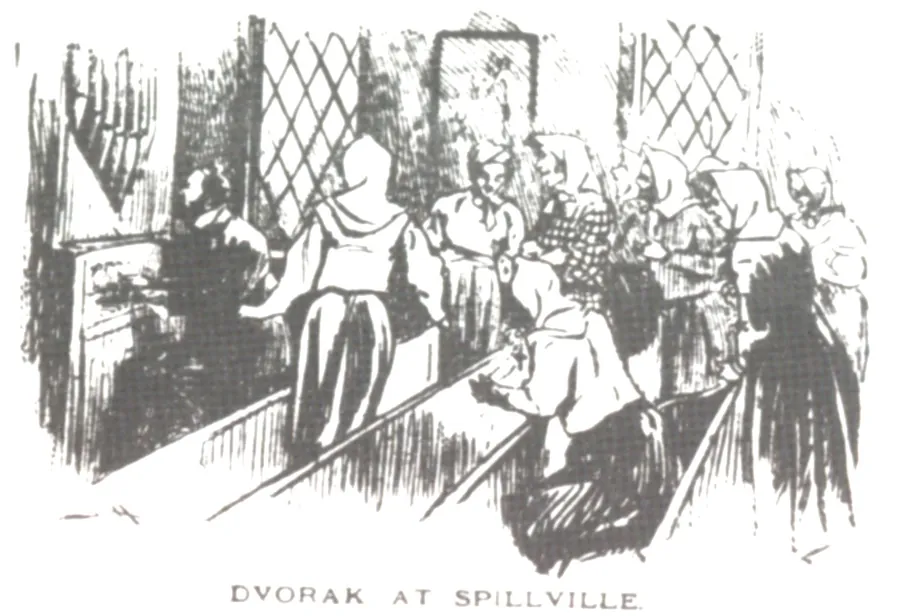
He came back soon, while the Kovařík household was still getting up. He asked what time Mass was, because he would like to play the organ. Mass was at seven.
The church of St Wenceslaus was one the settlers had built for themselves, and seven o'clock Mass there was a silent Mass. When the visitor at the organ began “God before Thy majesty” and his family started to sing, the old women in the pews looked up at the choir to see what was going on; they were not used, Kovařík said, to organ and singing at a silent Mass. He was at the organ every morning after that, except the days he was away in Chicago, Omaha and St Paul, and the old women got used to it and began to sing too, until in the end, after Mass, some grandmother or grandfather ventured to speak to him: “Mr. Dvořák, the singing was fine today,” and “What will you be playing us tomorrow?”
They had left New York on Saturday the third of June, three days after the children came off the ship. Kovařík called the party a caravan: Dvořák and Anna; Mrs Koutecká, who had brought the other four children across; all six children; a maid Mrs Koutecká had brought from Bohemia; and Kovařík himself. The line ran through Philadelphia and Harrisburg and over the Alleghenies to Pittsburgh and on to Chicago, and the whole way, he said, he had to explain what country they were passing through. The train kept to time. At eleven on the Sunday morning they were in Chicago, where Kovařík's brother met them, and they had ten hours there, drove round the town in the afternoon, and left again at nine at night. At eight on Monday morning the train stood for an hour at McGregor, Iowa, long enough for breakfast and for a look at the currents of the Mississippi, and two hours after that they reached Calmar, which was as far as it went: “the railway does not go on to Spillville,” as Kovařík put it.
At Calmar the schoolmaster was waiting, with the parish priest, Father Tomáš Bílý, and the family got into a carriage for the last eight kilometres. Kovařík had written ahead to ask his father whether there was a little house to let. There was not. His father had taken eight rooms from a German named Schmidt and had them furnished, and when the Dvořáks arrived, Kovařík said, “everything was in readiness except a piano.”
Spillville was a village of Czech farmers. Dvořák described it in September, in a letter to a friend in Moravia. It had been named after its founder, a man he called “Spielmann”, whose grave he passed every morning on his way to church. The settlers had come about forty years before, mostly from the country round Písek, Tábor and Budějovice, as poor as people could be, and after hard years they were well off. The schoolmaster had been there twenty-six years.
There were few people and “a great deal of empty space,” and a farmer's nearest neighbour might be four miles off. Out on the open prairie, which Dvořák called the Sahara, there was nothing to see but fields and grass and nobody on the roads, because everybody rode, while herds of cattle stayed out on the pasture summer and winter and the men walked out to the cows to milk them.
His day there, as Kovařík set it out, went like this. “He got up about four o'clock and went for a walk—to the stream or the river—and returned at five.” Then he worked. At seven he was at the organ; after Mass he talked a little, went home and worked again, and then went walking, usually alone, and often nobody knew where he had gone; and most afternoons he spent with the older settlers and got them to tell him about their first years in America: how the men had walked to jobs building the railway forty miles away, while their wives and children worked the farms.
“In Spillville the Master scarcely ever talked about music,” Kovařík wrote, “and I think that was one of the reasons he liked being there and why he felt so happy there.”
He began a string quartet on the eighth of June, three days after the carriage came in from Calmar, and he finished it on the twenty-third; on the twenty-sixth he began a string quintet with two violas, and it was done on the first of August.
The first of these is the String Quartet in F, known as the American. It opens with the two violins shimmering on a single chord over a low note held by the cello, and into that the viola comes alone with the tune, rising. The viola was the instrument he had played for nine years in the theatre orchestra in Prague. In the slow movement the first violin has a long tune, and later the cello sings it again. In the quick third movement, not far in, a quiet tune appears high on the first violin.
He wrote to Simrock on the twenty-eighth of July. “I am spending my 4 months' holiday here in Spillville, a completely Czech place in the State of Iowa, 1300 miles from New York,” he told him, and he explained why he was in no hurry to publish anything: he was “fairly independent”, with his salary, and so could give his leisure to composing, and was content. He reminded Simrock of the letters they had exchanged two years before, listed the new works he could have, the Quartet among them, named prices for most of them, and said he was asking no more than Simrock had always paid. Letters took sixteen days to cross, he added, so a long correspondence would drag the business out for ever. Simrock agreed to take everything.
Three weeks later Dvořák wrote to a friend in Písek: “At last Simrock has eaten humble pie and says that he will take all my works. I knew that he must come first to me and not I to him. So I have punished him after all with my waiting.”
The same letter described Chicago. The twelfth of August had been Czech Day at the World's Fair, with a procession he put at about thirty thousand Czechs, a Sokol gymnastic display, and a concert in the Festival Hall with an orchestra of a hundred and fourteen, in which he conducted his own pieces. The Exhibition was too big to describe, he said. He also reported that it was going to lose a great deal of money, and that business in Chicago was suffering badly. It was the year of the financial panic of 1893, and in consequence of it, the Dvořák scholar David Beveridge writes, Mrs Thurber fell behind with his salary. At the start of September the family went further west: three days at Omaha, where Czechs came in the evening to serenade him and an American band played as they left, and then four hundred miles on to St Paul and the Minnehaha Falls.
The letter to Moravia was written on the fifteenth of September, the day before they left. “The three months spent here in Spillville will remain a happy memory for the rest of our lives,” he wrote, and went straight on to say that they had been very happy, “though we found the three months of heat rather trying,” and that being among their own countrymen had made up for it. The old people had been pleased when he played them “God before Thy Majesty” and “A Thousand Times we greet Thee” in church. He had become very good friends with Father Bílý. They had often gone out to visit Czech farmers forty-five miles away. And he did not pretend the place was all one thing: “And so it is very wild here and sometimes very sad—sad to despair. But habit is everything.” The papers at home were saying he meant to stay in America for good. Never, he said. He would see Bohemia whether his contract was renewed or not. “I must see Bohemia, no matter what.” He added that without America he would not have written the new symphony, the Quartet and the Quintet the way he had.
They left on Saturday the sixteenth, by way of Chicago, and on the nineteenth they stopped at Niagara. Kovařík wrote that when the Master saw the Falls “he stood silent for a full five minutes,” and then exclaimed, “My goodness, what a symphony in B minor that will be.” Šourek noted that a few pages of sketches for a symphony in that key do survive from the American years; whether they have anything to do with Niagara, nobody knows.
He was teaching again in New York on the twenty-first of September. Most afternoons, according to Kovařík, he went to a café on Broadway to meet Anton Seidl, the conductor of the New York Philharmonic Society, who had worked beside Wagner for some years and now conducted Wagner at the Metropolitan Opera. Dvořák questioned him about how Wagner had worked. They argued, often heatedly, and the next day one or the other would admit to having been “partly” mistaken. That was the end of it.
In November there was the question of prolonging his contract by a year or two, and he wrote to Tragy to ask his advice. “My family circumstances require me to put aside enough to ensure a provision for my old age,” he wrote, and he promised that if his country needed him he would come home.
About the middle of that month, Seidl asked at the café whether he might have the new symphony for one of the Philharmonic's concerts. Dvořák thought about it and, as he was leaving, said yes. The next day Seidl told him the date, about the fifteenth of December, and asked for the score at once. That evening, before Kovařík set off with it, Dvořák wrote a title on the first page at the last minute, in Czech: From the New World.
The symphony was to be given twice, first as a “public rehearsal” on a Friday afternoon and then on the Saturday night, and on Friday the fifteenth of December it was played for the first time, at Carnegie Hall, by the Philharmonic Society under Seidl.
The New York Herald that day carried an interview with him in which, as the paper reported him, he said that he had used no actual Native American melodies, only themes of his own written in their spirit.
On Saturday the sixteenth he sat in a box with his family and heard it. The Herald's notice the next morning reported that when the slow movement ended the audience broke into applause, turned to look where Seidl was looking, found him in his box and called out his name; that he bowed and stepped back while the symphony went on; and that at the end he was called for again and again, the applause going on after he had left the box for the foyer, until he came back to the gallery, with Seidl and the whole orchestra applauding too.
Four days later he gave Simrock his own account. “I was in a box; the hall was filled with the best New York audience.” And he added: “You know how glad I am if I can avoid such ovations, but there was no getting out of it, and I had to show myself willy-nilly.”
On New Year's Day 1894 the Kneisel Quartet, made up of leading players of the Boston Symphony Orchestra, gave the Quartet its first performance in Boston, and on the twelfth of January they brought it to Carnegie Hall with the Quintet and his older String Sextet, in an evening given over to his music. He sat among the audience with Anna, he told Göbl. “I can, without hesitation, count these three works as my best and most original,” he wrote, and he passed on what one newspaper had said: “Why did not Dvořák come to us earlier if he can write such music here in America?” On the twenty-third of January he conducted a concert the conservatory had organised with Black American musicians.
Göbl had not written for a year and a half. When his letter came, Dvořák said, Otilie and her mother came running downstairs to find out what it was and where it was from. Two days before Dvořák answered it, Mrs Koutecká had written to Göbl as well, at Dvořák's urgent request, to ask him to write. “In spite of his splendid position and material prosperity,” she told him, “he is terribly homesick for his country.”
On the twenty-eighth of March 1894 his father, František Dvořák, died at Velvary in Bohemia.
Dvořák wrote to Simrock on the twentieth of April about the new songs, the piano suite and the violin sonatina he had finished that winter, and the date he was sailing, and ended: “How I am looking forward to seeing my native land again! Unfortunately I shall go there with a sad heart for I shall not see my aged Father again. He died just four weeks ago!”
They had had their berths booked since the beginning of April. On the nineteenth of May the whole family sailed from New York for Bremen, and on the thirtieth they came into Prague, where he was given a ceremonial welcome at the railway station and in the streets, and on the fourth of June they went on to Vysoká, where there was a procession in his honour, lit with Chinese lanterns.