Seventeenth Street
At number 327 East Seventeenth Street, in a private house across the road from Stuyvesant Park, the day began with a newspaper. “In the morning, the first Master's work was to take the ‘Herald’ and read the ‘shipping news’,” Josef Jan Kovařík wrote. The night before, over a game of darda, the two of them had worked out between them “how many knots the ship had probably made, where she might be”, and in the morning the New York Herald had the sailings and the arrivals in its columns, the ships in from Bremen and Southampton and the ships gone out.
Kovařík was the son of the schoolteacher in Spillville, a Czech village in Iowa, and he had gone to Prague to study the violin at the Conservatoire, finished there in 1892, and crossed the Atlantic that September with the Dvořáks; for the whole of the American years he lived with them as secretary, companion and member of the household, and he wrote his reminiscences of it down later. Šourek's note that introduces them says without any fuss that he adored Dvořák. Most of what is known of these rooms is seen through his eyes.
The same note records that Dvořák played darda at home, and that though “he did not play for money, he often got very worked up about it.”
The house belonged to a Mrs Drew. The family had moved into it in October. Dvořák described the arrangement to friends in Prague. Steinway had sent him a piano at once, free of charge, “so that we have one nice piece of furniture in our sitting-room”, and besides the sitting-room there were three other rooms and a small one, furnished, at 80 dollars a month, “A lot for us but the normal price here.” They had breakfast and supper at home and went out to a boarding-house for dinner. “We live in 17th street East, 327 (only 4 mins. from the school) and are very satisfied with the flat.” The school was the National Conservatory of Music of America, on the same street.
They had left Prague at three in the afternoon, seen off at the station by a crowd of friends to whom, Kovařík said, his last word was “au revoir in summer!”, and the party was five: Dvořák; his wife Anna; their eldest daughter Otilie, who was fourteen; their elder son Antonín, who was nine; and Kovařík himself. The other four children, their daughter Anna, who was twelve, Magdalena, who was eleven, their younger son Otakar, who was seven, and Aloisie, who was four, stayed behind in Bohemia. Two days later the party boarded the Saale at Bremen, and the next evening, at Southampton, Dvořák sent a telegram to the children in Prague that “everything is all right, all well”.
Kovařík wrote of three days of storm in which the other passengers kept to their cabins, and that “The Master proved an excellent sailor”: “the whole day, it might be as stormy as you like, he walked up and down the deck.” More than once he was the only passenger in the dining-room, and the captain asked him to his own table, and afterwards the two of them lit cigars.
Kovařík put the landing on “Monday, the 26th September, if I am not mistaken”. Dvořák, writing to Emil Kozánek, a lawyer friend in Kroměříž in Moravia, a fortnight afterwards, had one bad day at sea rather than three, “Our journey was lovely except for one day when everybody on board was sick except me”, and came in on Tuesday the twenty-seventh.
What he wanted Kozánek to see was the harbour. “The view from ‘Sandy Hook’ (harbour town) of New York with the magnificent Statue of Liberty (in whose head alone there is room for 60 persons and where banquets etc. are often held) is most impressive! And then the amount of shipping from all parts of the world?! As I say amazing.” They landed at Hoboken, where the ships docked, and were met by the conservatory's secretary and a deputation of New York's Czechs, and a carriage took them across to the Clarendon Hotel, by Union Square, where a room was waiting, in Kovařík's words, “complete with concert grand”. The city was magnificent, Dvořák told Kozánek, with “lovely buildings and beautiful streets and then, everywhere, the greatest cleanliness.” It was also expensive. “At the hotel we pay 55 dollars a week for three rooms, of course in the most central part of the city.” He had done the sum for the year, and they would “not spend more than 5000, and so, I am thankful to say, we shall be able to leave the rest untouched.”
The hotel, in Kovařík's account, was not quiet enough, and Dvořák longed for a private lodging, which was how they came to Mrs Drew's.
The conservatory welcomed him officially on the first of October. On Sunday the ninth New York's Czechs gave a concert in his honour, and he reported it to Kozánek: “There were 3000 people present in the hall.” There were speeches in Czech and in English, and he had to stand on the platform holding a silver wreath and make a speech of thanks. As for the American newspapers, “they see in me, they say, the saviour of music and I don't know what else besides!”
His first concert in America was on Friday the twenty-first of October 1892, in the Music Hall at Seventh Avenue and Fifty-seventh Street, the building his letters by the following spring were calling Carnegie Hall. He conducted his three new overtures. His Te Deum was sung for the first time. On the seventeenth of November he conducted his Sixth Symphony in the city.
It had been the idea of Jeannette M. Thurber, the founder and president of the National Conservatory, to bring him to New York. What the record keeps of her in these months is what she arranged. She had set up prize competitions for American composers, and Dvořák listed them for his friends in Prague: “1000 dollars for an opera, 1000 for an oratory, 1000 for a libretto, 500 for a symphony,” and 300 dollars each for a cantata, a piano concerto and a violin concerto. The entries came in from all over the country and he sat on the juries, and it did not take much work, he said, because “I look at the first page and can tell straight away whether it is the work of a dilettante or an artist.”
The operas were very poor.
His own duties were set out in the same letter: composition on Mondays, Wednesdays and Fridays, from nine until eleven; the orchestra twice a week, from four until six; and “the rest of my time is my own.” It was not a great deal, he wrote, and “Mrs. Thurber is very ‘considerate’ as she wrote to me in Europe that she would be.” He had only eight pupils, “but some of them very promising”. They came from as far off as San Francisco, and most of them were poor, which at the conservatory was no obstacle: “teaching is free of charge, anybody who is really talented pays no fees!” The school took Black students as well as white.
He wrote that letter on the twenty-seventh of November from the Parker House hotel in Boston, where his Requiem was to be sung by several hundred performers, and where Mrs Thurber had arranged everything. One performance was for the wealthy, and the other, the day before it, was “for poor workers who earn 18 dollars a week, the purpose being to give the poor and uneducated people the opportunity to hear the musical works of all times and all nations!” He added, “That's something, isn't it?” In the spring, writing to Kozánek about some newspaper gossip, he called her “an excellent woman and my staunch supporter”.
The Boston letter also set down what was expected of him. “The Americans expect great things of me and the main thing is, so they say, to show them to the promised land and kingdom of a new and independent art, in short, to create a national music. If the small Czech nation can have such musicians, they say, why could not they, too, when their country and people is so immense.” He asked his friends to forgive him “for lacking a little in modesty, but I am only telling you what the American papers are constantly writing”, and then he took the task on in his own words: “It is certainly both a great and splendid task for me and I hope that with God's help I shall accomplish it. There is more than enough material here and plenty of talent.”
“The Master lived in New York very quietly,” Kovařík wrote. He went regularly to the concerts of the New York Philharmonic, twice to the Metropolitan Opera in all his time there, and hardly anywhere else, and when he was invited out he usually declined.
In Prague, according to Šourek's note, Dvořák had gone to the stations on his early walks, knew which engine ran on which route, and knew the drivers personally. In New York the one station on Manhattan let nobody on to the platform but passengers, and Kovařík wrote that “it was in vain that we begged the porter to let us look at the ‘American locomotive’.” So they went north instead: “We travelled by overhead tram to 155th. Street, a good hour from the Master's house,” and there they stood on a bank and “waited for the Chicago or Boston express to go by”, and because one train was not worth the journey they always waited for several, so that it took most of an afternoon.
“What the Master missed in America were his pigeons and locomotives. He felt the want of these two ‘hobbies’ very much.” One day Kovařík took him to Central Park, to the small zoo with its houses for different birds, “And then we came to a huge aviary with about two hundred pigeons.” None of them, Kovařík admitted, “could compare with his ‘pouters’ and ‘fantails’” at home, but after that “we made the trip to Central Park at least once and often twice a week.”
Steamships became the next hobby, Kovařík said, because the harbour was nearer, and on the day a ship sailed the public was allowed on board. Dvořák went over them from stem to stern and talked to the captain and his officers, until “we knew all the captains and mates by name.” When a ship sailed they watched it from the shore until it was out of sight, and if he had stayed late at the conservatory, or had been working at home and forgotten the time, they took the overhead railway down to Battery Park, at the southern tip of the island, and followed her from there for as long as she could be seen.
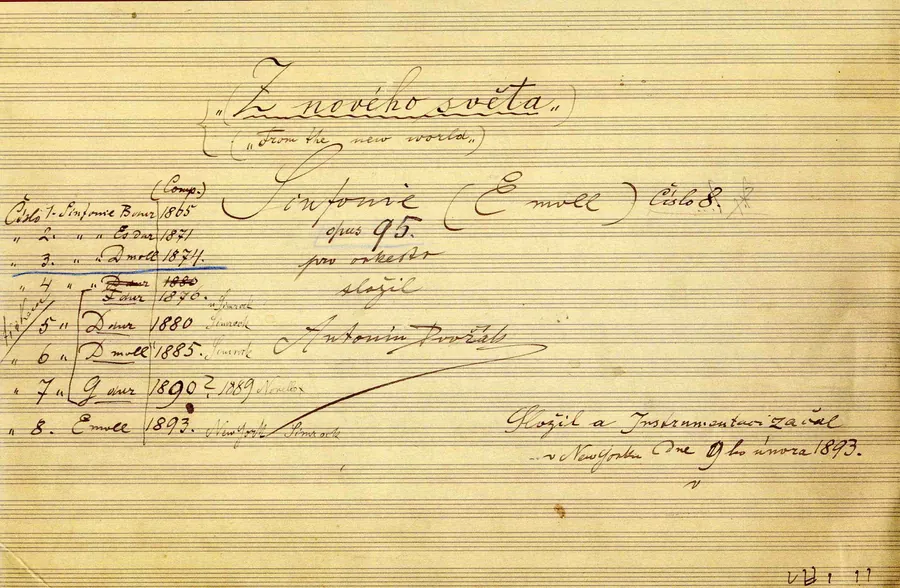
In the flat on Seventeenth Street, on the tenth of January 1893, he began a symphony.
One of the students at the conservatory that winter was Harry T. Burleigh, a Black baritone of twenty-six from Erie, Pennsylvania, who had come to the school on a scholarship. By Burleigh's own account, given later, he often sang spirituals for Dvořák, the songs he had grown up with.
Dvořák worked at the symphony through the winter and into the spring, between the composition classes and the orchestra practices, and on the twelfth of April, a Wednesday, at seven in the morning, he wrote to Kozánek. He was well, he said, and apart from some trifles very well off, and he was “not afraid of anything, not even of the bad, spiteful critics in Vienna and here, too.” Most of the New York critics were friendly. “I sit firmly in the saddle and I like it here except, as I say, for some trifles.” He had not much work at the school, and was “now just finishing my E minor Symphony. I take great pleasure in it and it will differ very considerably from my others. Well, the influence of America must be felt by everyone who has any ‘nose’ at all.”
It is the Symphony From the New World. It was published as his Fifth, and is numbered now as his Ninth. The first movement opens slowly and quietly, and when it turns fast the first tune belongs to the horns, a call that climbs and falls back. The slow movement, the Largo, begins with a handful of low chords in the brass and woodwind, and then the cor anglais takes up a long, slow tune over quiet held notes in the strings. The last movement starts with the strings pressing on two notes, faster and faster, until the march breaks out over them.
The letter also reported a concert. On the sixth of April, at Carnegie Hall, he had conducted his Hussite Overture, and the Church Choral Society had given The Spectre's Bride, and he had found “A small but good choir, the soloists good, with one exception,” and “the orchestra weak for such a big hall”, so that the full effect was not always achieved; in the autumn, he promised, there would be a big concert, and he would conduct it himself, and it would be different. On the eighth of May the conservatory gave a concert of works by his composition pupils.
The same letter changed the summer. “My wish to return to Bohemia will not be realized this year, we have decided otherwise.” The contract gave him four months' holiday, and he had meant to spend them at home. Instead the children were to come to him: they would leave Prague on the twenty-third of May with Anna's eldest sister, Terezie Koutecká, and sail from Bremen on the Havel, “so that, God grant, on the 31st May I shall look upon the faces of my dear and long-missed children.” After that the whole family would go west. Kovařík had suggested his own village, Dvořák had taken to the idea, and he described it to Kozánek as their summer Vysoká, “the Czech village of Spillville where the teacher and the parish priest and everything is Czech”. The teacher was Kovařík's father. “I shall have pigeons there and maybe we shall even play ‘darda’? How grand it will be.”
On Sunday the twenty-first of May 1893 the New York Herald printed a long article under the headline “Real Value of Negro Melodies”. It reported Dvořák as saying that the future music of the United States must be founded on the melodies of Black Americans, and that in them he had found everything a great and serious school of composition would need. The article was unsigned, and a reporter wrote it up: the opinions were given as his, but the sentences are the paper's.
He finished the symphony on Wednesday the twenty-fourth, and at the end of the score he wrote the hour, nine o'clock in the morning. The children were at sea. That afternoon a telegram came, and he went back to the last page and added a second note beside the first: that the children had arrived at Southampton, and that the telegram had come at 1.33 in the afternoon.
A week later, on the thirty-first of May, the Havel brought the four children into New York with their aunt, and for the first time since the afternoon at the station in Prague, all six of the Dvořák children were in one city with their father and mother.