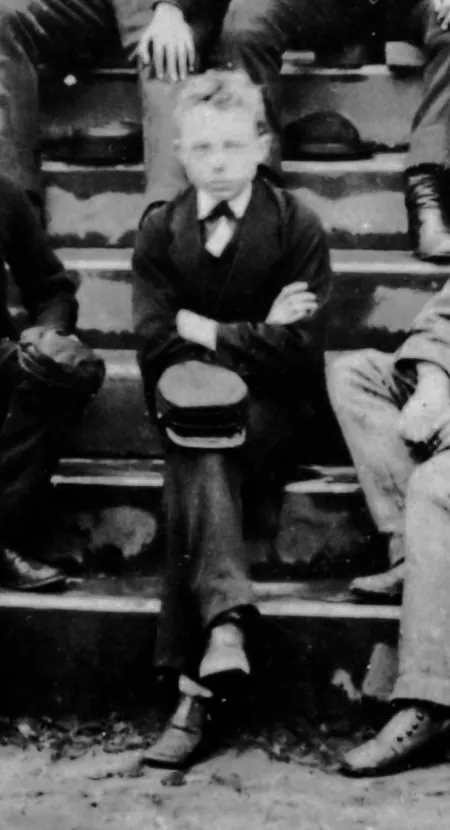
The Second Vincent
The little Protestant church at Groot-Zundert stands off the village street in a yard of grass and sand, and in that yard there is a headstone with a child's name cut into it. The name is Vincent Willem van Gogh. The date beneath it is the thirtieth of March 1852, and it is the date of the birth and the date of the death, the same day twice, so that the stone gives a whole life in one line of figures. The child was the first son of the Protestant minister of the parish. He was buried a few hundred paces from the room he had been born in.
The country round about is flat and light and sandy. Brabant: heath running to the horizon in low brown waves, pine plantations set out in rows, birch scrub, ditches, and the roads going white in dry weather and yellow in wet. The Belgian border is an hour's walk to the south, and the road through the village is the road that goes down to it. There are wheatfields where the land has been broken, and cottages with low doors, and men out on the heath in the wet months cutting turf and stacking it to dry in open piles, each stack laid up like a house of cards. In winter the fog comes down and stays down for days, and the pine plantations show and vanish in it like a shape under a dust sheet. In high summer the sand gets into everything.
It is poor country and it was poorer then. What it grew was rye and buckwheat and potatoes; what it kept was a few cows on land that would not carry many; and what it did in the winter, in a great many of those cottages, was weave, on hand looms, for merchants who brought the yarn and took the cloth and set the price of both. A man at a loom in Brabant in the eighteen-fifties worked in his own front room, at his own window, for somebody else, and was nobody's employee and nobody's master and could not stop.
The parish was very small. Zundert was a Catholic village in a Catholic district, and the Protestants in it were a minority the Reverend Theodorus van Gogh had been sent to look after in 1849, three years before the first child was born and buried. He stayed until 1871, and then moved on to other village parishes.
A year after that burial, to the day — the thirtieth of March 1853 — his wife gave birth in the parsonage to another son, and the child was given the same two names. Vincent for his father's father. Willem for his mother's. They were the names the dead boy had been given, and they went on to the living one without alteration.
So there was a Vincent Willem van Gogh growing up in a brick house on the Markt at Groot-Zundert, and a stone with Vincent Willem van Gogh on it in the churchyard a short walk off, and the family were churchgoing people who would have passed that yard most weeks of the year.
Whether he ever stopped at it, or what he made of it if he did, nobody wrote down.
Nobody wrote it down, and that is an odd thing to have to say about this particular man. About eight hundred and twenty of his letters survive, many of them long, most of them to one reader, and a great many of them taken up with explaining himself — his work, his money, his quarrels, his failures — at a length very few people have ever attempted. There is more of him on paper than there is of almost any painter who ever lived.
And almost none of it was written before he was nineteen.
The first letter of his that survives is from the autumn of 1872, and it is to Theo, as most of them would be. Everything earlier comes in one of two ways: from other people, writing afterwards, or from Vincent himself, remembering. Both are worth having and neither is the thing itself. The boy at Zundert reaches us always at second hand, and it is worth knowing each time whose hand it is.
The parsonage was a plain brick house facing the market place, with a small garden in front of it and a larger one behind, and it held, by the end, eight people and a servant or two. It was not a poor house and it was not a comfortable one. A country minister on a small stipend in the eighteen-fifties kept up appearances on very little, and the appearances included books, a piano, decent clothes for six children, and a front room fit to receive the doctor and the notary in.
Theodorus van Gogh was in his early thirties when his eldest surviving son was born. He came of a family that produced ministers and dealers in about equal numbers, he preached in a village where his church was the minority one, and by every account left of him he was conventional, devout, careful, and good at the visiting part of his trade. He was not a scholar and not an orator. In the whole of his working life he never held a parish larger than the one he started in.
Anna Cornelia Carbentus had come from The Hague, where her father bound books, and she had been brought up among paper and leather and the smell of glue. She drew, and painted in watercolour, competently, the way a good many well-brought-up Dutchwomen of her generation drew and painted. She wrote letters constantly. She was thirty-three at the birth of the second Vincent.
The week in that house was built round Sunday, and Sunday was built round talk. A Dutch Reformed church of that date had nothing in it to look at: whitewash, plain glass, wooden benches, a pulpit, a board with the numbers of the psalms on it, and no picture anywhere, on principle. What it had instead was a man explaining a text for the best part of an hour, twice, to people who had walked in from the heath to hear him do it, and who would have had views about how he had done it. The children of such a house grow up inside an argument about the meaning of words. It is not the usual training for a painter and it stayed with him all his life.
The rest of the minister's week was visiting: the sick, the old, the poor, the dying, the disgraced, in cottages with earth floors, in weather, on foot and by trap. He did it in that parish for twenty-two years, and in country parishes elsewhere until the day he died, and he was liked at it.
After Vincent the children came at intervals of two years or so: Anna in 1855, then a son on the first of May 1857 who was named Theodorus after his father and called Theo all his life, then Lies in 1859, Wil in 1862, and last his youngest brother, Cor, in 1867, by which time the eldest was fourteen.
What the family remembered of the boy was written down long afterwards by a woman who never met him. Johanna van Gogh-Bonger, who married Theo in April 1889, published the letters in 1914 with an introduction of her own. She is careful, she says when she does not know, and she is the best of the family sources. She reports that as a child he was "of a difficult temper, often troublesome and self-willed", and that he "had a great love for animals and flowers, and made all kinds of collections". She reports that the two brothers were strongly attached to each other from childhood, and that their childhood was spent among the wheatfields, the heath and the pine forests.
She was writing more than fifty years after the fact, from what she had been told.
Of Theo at that age there is even less. He was four years and one month younger, he was the third of the six, and he would be sent out into the same trade at much the same age as his brother, by the same relation, four years behind him. For these years he is a small boy in a garden in Brabant with a brother who walked a good deal and brought things home.
The country itself needs no source, because it is still there and because he spent a working lifetime putting it down. The heath and the sandy roads, the pine wood at the edge of a field, the weavers at their looms in cottages with the light coming in at one window, the men and women bent over in the potato ground, the turf cutters, the pollarded willows along a ditch, the church tower standing up out of flat ground and visible for miles — he knew all of it before he knew anything else, and the pictures he made before Paris are mostly of country like it, dark and brown and low-toned, the colour of the country under cloud.
He came back to Brabant twice as a grown man, both times to work, and the second time he stayed two years.
In the autumn of 1864, when he was eleven, he was sent away to school. The village had a school, and he had been at it, and he had been taught at home for a time as well; but what was settled on was a boarding school to the north at Zevenbergen, kept by a schoolmaster named Provily. He was there to get the languages and the manners that a Dutch boy of that class was sent away to get.
His parents took him there themselves and left him there, and that afternoon is the one piece of his childhood that has come down as a scene — because he wrote it out, twice, in his twenties, and because it is better written than anything anyone else ever wrote about his childhood.
The fuller of the two accounts he set down at Isleworth, outside London, in the first week of September 1876. He was twenty-three, he was working as an assistant teacher, he had become intensely religious, and he was answering a letter from Theo, who was nineteen, that had reached him that morning. Two paragraphs of scripture and consolation come first — God hiding His face, sorrowful times that are not without God, the voice that says Father. Then, without any joint in the sentence at all, this:
"It was an autumn day and I stood on the front steps of Mr Provily's school, watching the carriage drive away that Pa and Ma rode home in. One could see that yellow carriage in the distance on the long road – wet after the rain, with thin trees on either side – running through the meadows. The grey sky above it all was reflected in the puddles."
That is a man of twenty-three describing a road he had last seen at eleven, to a brother he was trying to comfort, and the comfort is the point of the letter and the road is only the illustration. It is not a diary entry and it is not evidence about 1864. It is evidence about what he still had by heart in 1876, which was the wet road, the thin trees, the grey sky in the water, and the exact colour of the carriage.
He had already used the same memory five months earlier, in April of that year, writing to his father and mother about a journey on which the train had just gone through Zevenbergen. That version is four lines long and has no weather in it: he had thought of the day they took him there, and of standing on Mr Provily's steps and watching their carriage drive away down the wet street, and then of the evening his father first came to visit him, and then of the first homecoming at Christmas. To his parents, the carriage is simply theirs and the street is wet. To Theo, five months on, the carriage is yellow and the sky is in the puddles.
He was at Zevenbergen for two years. In September 1866 he was moved on to the new state secondary school at Tilburg, the Willem II, and boarded with a family in the town, and there he was taught drawing by a man called Constantijn Huysmans.
Huysmans was fifty-six. He had painted in Paris and done well enough at it, he had run the art academy at Breda and taught at the military academy there, and he had opinions about drawing that were not the usual ones and that he had put into print. He did not want his pupils copying other men's engravings. He wanted them working from the thing in front of them, and he wanted the method fitted to the boy rather than the boy to the method. Whatever Vincent took from that year and a half, he had it from a teacher who believed that drawing began with the object.
In March 1868, in the middle of the school year, Vincent left Tilburg and went home to the parsonage.
No document says why.
He was fifteen. He stayed at home for the better part of a year and a half, and of that time almost nothing is recorded at all — not what he did with the days, not whether the leaving had been a disgrace or an economy or his own idea, not whether there was a row about it. He had been away at school since he was eleven. He came back into a house with five younger children in it, the youngest of them a baby, and a father whose working week was other people's troubles, and he stayed there through a winter and two summers.
A few drawings survive from his boyhood. The earliest of them that anyone can date is a barn and a farmhouse, in pencil, done in February 1864, a month before he turned eleven. It is careful. It is the drawing of a boy who has been taught a little drawing and is minding his corners. Nobody who saw these sheets at the time thought anything of them, and nobody looking at them now would either; the useful thing about this man is not that it was in him from the start. It is that he learned it, late, out of books and from teachers and by doing it every day for ten years.
What settled the matter was the family's other trade. Theodorus van Gogh's own brothers had gone into pictures — three of them dealt in art — and the most successful of those, Vincent, called Cent in the family, had done it on a scale that made him a rich man. Cent had built up a gallery in The Hague and sold his way into partnership with Goupil & Cie of Paris, which by the eighteen-sixties was the largest firm of its kind in the world. He had no children. His nephew carried his name.
Goupil's business was pictures in quantity and pictures as property. It sold the fashionable Salon painters, Gérôme above all — the polished, the accomplished and the enormously expensive — and, far more profitably, it sold reproductions of them: engravings, lithographs, photogravures, the same admired picture issued in several sizes and several qualities of paper, so that a lawyer in Lyons and a banker in Boston could each own a version of it at a price that suited him; and it had houses in The Hague, Brussels, London, Paris and New York to do it from, and a printing works of its own to turn the plates.
It was a good trade for a young man with no Latin, a fair hand, and relations in the firm. Uncle Cent had stepped back from the daily running of it by then, but he kept his partner's interest and his weight, and in the summer of 1869 he used it to find the boy a place at the Hague house, the first settled thing anybody had managed to do with him since he came home from Tilburg.
He was to begin on the thirtieth of July. He was sixteen years and four months old.