Learning to Draw
Fifty francs a month bought a room in a small lodging-house at 72 boulevard du Midi, in Brussels, and with the room came bread and a cup of coffee three times a day. He had come there from Cuesmes in October. He set out the arrangement for Theo on the first of November 1880, and then, so that his brother should not picture him living in luxury, he gave the rest of the menu: "my food consists mainly of dry bread and some potatoes or chestnuts which people sell on the street corners."
On the table was the Bargue. Charles Bargue's drawing course had been published in Paris by Goupil & Cie, the firm he had once sold pictures for. The price printed on the cover of the Exercices au fusain was seventy-five francs, which was more than his lodging cost him in a month. Every sheet was a finished drawing in firm, clean outline, with the shadow laid in as a few flat masses. The student copied it at the same size, then took the next one, then the next, and at the end of the series began again.
This is what a morning at that table required of a man of twenty-seven: the sheet propped up where the light from the window reached it, the paper pinned down, the charcoal held out at arm's length to take a measurement, the outline drawn and rubbed out and drawn again, and no teacher in the room to say whether the shoulder was too high or the foot too long, so that the only way to find out was to hold the copy up beside the model and look, and then look again.
He had started on them at Cuesmes, in the late summer. By the middle of October, writing from Brussels, he could tell Theo that he had "already done two series of Bargues" and had the third in hand. A Mr Schmidt, whom he had gone to see in the hope of an introduction to some artist's studio, had suggested the École des Beaux-Arts instead, and Vincent had told him frankly that "it was far more preferable in my particular case to work at some artist's", though he did not rule out going in the evenings if it was free or cheap. In January 1881 he wrote: "I'm now busy drawing all Bargue's Exercices au fusain for the 3rd time."
Sixty sheets, three times through, in about six months.
It was not all he did. That autumn he drew a skeleton with a pen, "rather large at that, on 5 sheets of Ingres paper", and he planned to get hold of the anatomical plates of a horse, a cow and a sheep from the veterinary school and draw those too. "There are laws of proportion, of light and shadow, of perspective," he told Theo, "that one must know in order to be able to draw anything at all." He was writing as a man who did not yet know them, and who had given up a salary, a vocation and a good deal of his family's patience to learn them late.
The money was a puzzle to him for most of that winter. His father had written that he could expect sixty francs a month, sent through the parsonage, and Brussels at once turned out to cost more than that, a good part of the money going on drawing materials and on two workmen's suits of coarse black velveteen, which he said would do for his models to wear. Then in April he heard from his father that the monthly allowance had been Theo's all along. Theo was twenty-three. He had just been made manager of Goupil's branch on the boulevard Montmartre in Paris, and a part of his salary was now going every month to a brother in a back room in Brussels who was copying Bargue's charcoal nudes for the third time and buying velveteen for models he could not yet afford to hire.
In November, on Theo's advice, he went to call on a young Dutchman at rue Traversière 64, on the eastern side of the city. Anthon van Rappard was twenty-two. He came of a well-to-do family of the Dutch nobility, he had been a pupil in Gérôme's studio in Paris, and he was doing, with money and with training, exactly what Vincent was attempting with neither. Vincent's first report of him is careful and not entirely warm: "He has a fine appearance, I've not seen anything of his work other than a couple of small pen drawings of landscapes. But he lives rather sumptuously and, for financial reasons, I don't know whether he's the person with whom, for instance, I could live and work." And then, a line later: "But the impression I got of him was that there appears to be seriousness in him."
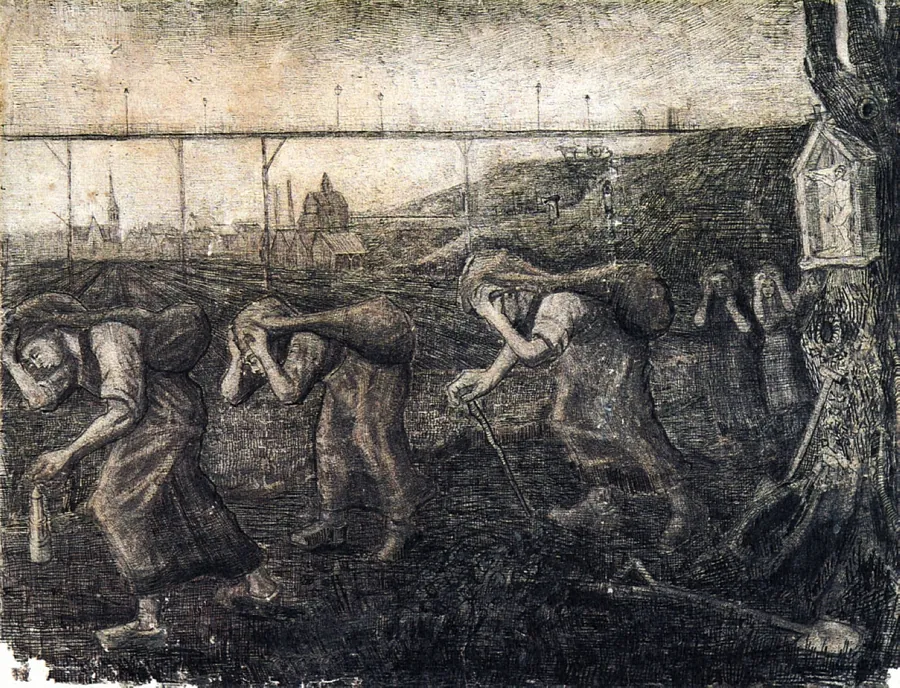
For some weeks after that he kept away, because he believed he had noticed, he wrote, that Rappard did not like to be disturbed. But by the spring the two of them were working in the same room, Rappard painting studies from the models at the academy and Vincent at his charcoal, in a studio that belonged to the younger man. In April he told Theo that he had sketched two drawings there, which he called "The lamp-bearers" and "The bearers of the burden". The first is lost. The second survives: a line of miners' wives from the Borinage walking bent under sacks of coal, drawn in pencil and ink in a Brussels studio by a man who had lived among them the year before.
Rappard was leaving Brussels in May. Vincent's own room was too small, the light was poor, and the people of the house would not let him hang his drawings on the wall. At the end of April he went home to his parents at Etten.
The parsonage at Etten gave him board and lodging for nothing, and a little room to call a studio, and his father said at the time that he could spare it. It also gave him a village full of people who worked with their hands and who, for a little money, would stand still.
He drew them all summer and into the autumn. In the middle of September he sent Theo the count: "I've drawn a peasant with a spade no fewer than 5 times, 'a digger' in fact, in all kinds of poses, twice a sower, twice a girl with a broom. Also a woman with a white cap who's peeling potatoes, and a shepherd leaning on his crook, and finally an old, sick peasant sitting on a chair by the fireplace with his head in his hands and his elbows on his knees." He had drawn the village smithy, the carpenter's shop and the clog-maker's, for the practice those interiors gave in perspective. And he had the bill in mind: "Of course I have to pay the people who pose. Not very much, but because it's an everyday occurrence it will be one more expense as long as I fail to sell any drawings."
That is the economy of the next ten years in two sentences. A digger standing for an afternoon with a spade was paid out of an allowance, and the allowance was a young dealer's salary sent from Paris, and nothing came back the other way.
The drawings were not good, and he said so. In the summer, with a heap of those studies behind him, he went back to the Bargue for a fourth time. "It costs me a great deal of effort to stick to that work," he wrote. "It's much more stimulating to draw something outdoors than such a sheet from the Bargues, but still, I set myself the task of drawing them again, thus for the last time." He had found, he said, "much too much" detail in his recent drawings, and he wanted Bargue's broad lines and large masses back in his hand before he went out to the fields again.
At the end of August he carried the result to The Hague, "the whole series of Exercices au fusain 1-60 again", and showed it to Tersteeg, who said he thought Vincent had progressed; and he showed his own studies to Anton Mauve, a painter there who was married to a relation on his mother's side, Jet Carbentus, and who gave him a great many suggestions. In September he told Theo that the constant drawing of those sheets had taught him "to measure and to see", and that "what used to seem to me to be desperately impossible is now gradually becoming possible, thank God." Two months later, in November, with two more drawings finished, a boy lighting a fire under a kettle and an old man laying dry twigs on it, he wrote that there was "something stiff and severe in my drawings".
That summer his cousin Kee Vos had come from Amsterdam to stay at the parsonage for a long visit. She was the daughter of his mother's sister and of the Reverend J. P. Stricker, the Amsterdam minister and scholar who had overseen his studies there; her husband, Christoffel Vos, had died in October 1878, and she had a small son. She and Vincent spent a good deal of time together, and at some point in the summer he told her he loved her and asked her to marry him.
He did not tell Theo until the third of November, and what he told him then is the whole of the record. She had replied, he wrote, "that her past and her future were all one to her and so she could never return my feelings." For the refusal itself he used three Dutch words, nooit neen nimmer, which the scholarly edition of the letters puts into English as "no, nay, never", and he used them over and over, in letter after letter, sometimes in inverted commas, as if it were a text he had been set to preach on. Those are his words for her answer, written down months afterwards for his brother; no account from Kee survives.
He did not accept it. Both families were against the match, and he told Theo that the elders would change their minds not when Kee changed hers but when he became "someone who earns at least 1,000 guilders a year". Towards the end of November he went to Amsterdam and stayed three days, trying to see her. The long account of the visit that he sent Theo in December describes an evening at the Strickers' house on the Keizersgracht, the family still at dinner, all of them there except Kee, and not a plate too many on the table.
There is no lamp in that account. The lamp comes in a letter he wrote to Theo from The Hague the following May, six months after the evening, in the middle of a quite different argument: "I put my fingers in the flame of the lamp and said, let me see her for as long as I hold my hand in the flame." The lamp, he believed, was blown out, and he did not see her. It is his account alone, and nobody else who was in that house is known to have written a word about it.
From Amsterdam he went to Haarlem, where his sister Wil was, and walked out with her, and in the evening took the train to The Hague and arrived at Mauve's at about seven o'clock.
Mauve was forty-three and one of the best-known painters in The Hague: cows and sheep, fishing boats hauled up on the beach at Scheveningen, low grey-green country under a low grey sky, painted with a fineness that sold. Now he took Vincent in.
"Well, Mauve immediately installed me in front of a still life consisting of a couple of old clogs and other objects, and so I could set to work." That was in the first days of December. Vincent took a room near Mauve's house, and for about three weeks he went to the studio every day to paint and every evening to draw, and at the end of it he sent Theo a tally of what the time had produced, which was five painted studies, all still lifes, and two watercolours from a model, a Scheveningen woman, together with an account of what it had cost, since Mauve had given him paint but the model had to be paid for several days and he had needed a pair of shoes. "In any event, Theo, I've been so enlightened by Mauve as regards the mysteries of the palette and painting in watercolour. And that will repay the 90 guilders this trip has cost."
At Etten his mother read the letters too. On the nineteenth of December she wrote to Theo: "Received cheerful letters from Vincent about his work. He sees riches in store; for us it's enough that he's hard at work and receiving capable instruction."
He had come to painting at twenty-eight, after a year and a half of charcoal, and the first real lessons he ever had in it lasted less than a month. Shortly before Christmas he went back to Etten.
At Christmas there was a row. He had not gone to church, and he told his father that if church-going was compulsory he would never go again; the whole matter of Kee, he wrote, was in it too. "At Christmas I had a rather violent argument with Pa, and feelings ran so high that Pa said it would be better if I left home. Well, it was said so decidedly that I actually left the same day."
He went back to The Hague and to Mauve, and he rented a studio: a room and an alcove at Schenkweg 138, just outside the town, about ten minutes' walk from Mauve's, near the Rijnspoor station, with meadows beyond the window. Mauve lent him a hundred guilders to rent it, furnish it, and get the window and the light put right. He wrote that for a bed he would have been content with a woollen blanket and the floor, but Mauve wanted him to buy a bed.
The watercolours went badly, and he described that as exactly as he had described the diggers. When Mauve first set him to work with charcoal and chalk and brush and stump, he told Theo, "it was damned difficult for me to work with that new material. I was patient and it didn't seem to help at all, and sometimes I grew so impatient that I trampled on my charcoal and was wholly and utterly discouraged." Watercolour was the same again, only worse. Models in The Hague were harder to come by than in a village, and dearer: one January morning a smith's boy failed to come, because his father said the painter would have to pay a guilder an hour, and Vincent was not inclined to pay it. He painted what he had instead, a girl grinding coffee in a corner of the studio by the stove, a woman knitting at the window, the meadows beside the Schenkweg. In addition to a couple of small watercolours, he told Theo, he had just started a large one.
"Mauve himself says that I'll ruin at least 10 drawings or so before I know how to handle the brush a little."