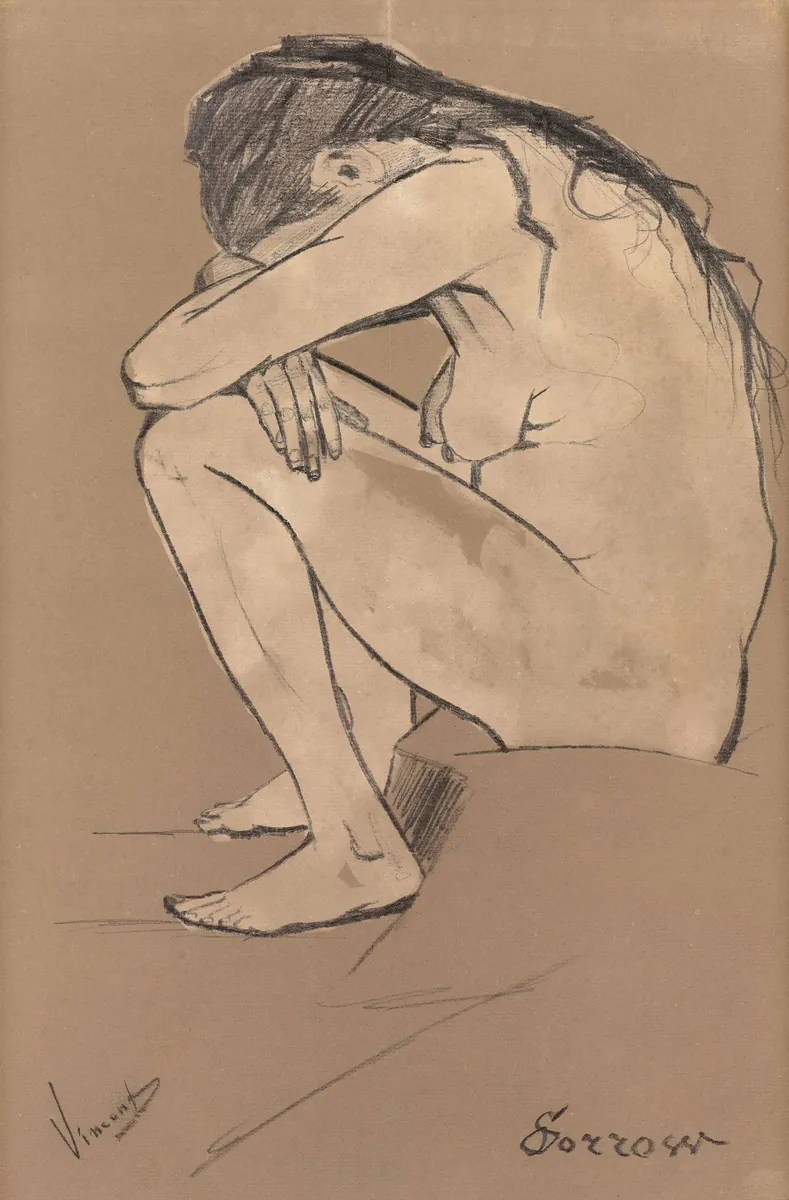
Sorrow
He had two sheets of paper lying under the one he was drawing on, and he was pressing hard.
The room was the studio on the Schenkweg, rented from the first of January 1882, and it had a window that he told Theo was twice as large as an ordinary window and more or less facing south; there was a stove in it, and a fireplace of iron and brick, and a wooden floor.
The drawing he was making that April needed a woman sitting with nothing on, her knees drawn up, her forearms folded across them and her head laid down on her arms so that no face shows. A pose like that has to be held for as long as an outline takes, and then held again the next day, by a stove, in a Dutch spring. He wrote a few weeks later that she found posing difficult, but she learned it anyway.
When he took the sheet off the board the pressure had gone through. The outline was, as he put it, very cleanly impressed on the two underlying sheets, and he worked those up as well, so that from one sitting he had three drawings of the same figure. "This isn't the study from the model and yet it's directly from the model," he explained to Theo about the one he posted to Paris. The summer before, Theo had owned a large woodcut by Millet of a shepherdess, and Vincent had looked at it and thought, he said, "how much one can do with one single line!"
Two of the three survive. The one with the words under it is in black chalk, on a sheet about forty-five centimetres high and twenty-seven across, and the figure fills nearly the whole height of it. She sits at the right on a low block, turned to the left, drawn almost entirely in outline: one long line down the back, one along the shin to the bare feet, the arms crossed over the knees, the hair hanging loose down her back in long dark strands. Her breasts and the curve of her belly are drawn in the same plain line as the block she sits on. There is very little shading anywhere. Round her feet he has put tufts of grass and a few spring flowers, and at the left a bare shrub with small buds along its twigs, and behind her a flat horizon runs across the sheet with one small tree standing on it.
In the bottom left corner is his signature, Vincent. In the bottom right, in a small ruled box, is one word, in English: Sorrow.
Along the lower margin, in his own hand, is a line from Jules Michelet's book La Femme: "Comment se fait-il qu'il y ait sur la terre une femme seule – délaissé." How is it that there is on earth a woman alone? The last word, abandoned, is not Michelet's. He added it.
"The enclosed is, I think, the best figure I've drawn, that's why I thought I'd send it to you," he wrote to Theo on or about the tenth of April, and he called it a token of gratitude for all that Theo had done for him in a hard winter. Which of the versions went to Paris is not known; the editors of the letters think it unlikely to have been the one in black chalk.
The woman was Clasina Maria Hoornik, and she was called Sien. She was thirty-two. She had a daughter of five, Maria, and she was pregnant again by a man who had not stayed, and she had been earning her living as a prostitute. Her mother lived in The Hague too, and comes into the letters often, helping.
He had met her in the winter, and he did not tell Theo about her for months. When he did, in the first week of May, he began by saying that he found what he had done "so simple and natural that I thought I could keep it to myself", and he described her, for a brother who would have to picture her from Paris, as "a pregnant woman who roamed the streets in winter – who had to earn her bread, you can imagine how." He had taken her as a model and worked with her all winter, and paid her rent, and made her take baths and as many strengthening remedies as he could afford, and he had gone with her to Leiden, to the maternity hospital where she was to have the child.
And he said that he meant to marry her, and gave his reasons in one breath:
"This woman is now attached to me like a tame dove – for my part, I can marry only once, and when would be a better time to do it than with her, because only by doing so can I continue to help her, and otherwise hardship will make her take the same road that ends in the abyss. She has no money, but she helps me to earn money in my work."
What she wanted is not recorded. She left no letters, and everything anybody knows about the months she spent with him is in his.
The same letter began with Mauve. That day, Vincent wrote, he had met him and asked him to come and see his work and talk things over. "Mauve refused outright, 'I certainly won't come to see you, it's over and done with'." In the end Mauve said, "you have a vicious character". "At that point I turned around – it was in the dunes – and walked home alone."
By Vincent's account the quarrel had begun over plaster casts: Mauve wanted him to draw from them, and Vincent went home, threw the casts into the coal-scuttle, broken, and received a note from Mauve saying he would have nothing to do with him for two months. In the dunes, Vincent wrote, Mauve also blamed him for saying "I'm an artist", which he would not take back.
Mauve was a successful painter with a name and a family and a position in the town to keep; and he had been, that winter, the one working painter in The Hague who would have Vincent in his studio and teach him. "As it is, I can't even look at a brush, it makes me nervous."
The letter went on to name the three men on whom everything depended: "Mauve, Theo, Tersteeg, you all have my livelihood in your hands, will you leave me penniless or turn your backs on me". Tersteeg had lent him small sums that spring. By the start of June Theo seems to have been warning him that the family might try to have him made a ward of court, and Vincent wrote back pages about the law of wardship and how hard it was, these days, to put away a man who protested calmly. Theo's warnings survive only as his brother quoted them back. Vincent wrote to his father about staying with her and marrying her, and his father, by his account, talked around it and gave no answer.
All of it, the studio and the model and the woman and the child and the one coming, was paid for out of what Theo sent from Paris, which that spring was a hundred and fifty francs a month. At the end of May nothing had come since the twelfth. Vincent owed the landlord twelve guilders fifty for two months' rent and wrote that the man could have his furniture sold publicly; he wrote it on a postcard, because he had no money for a stamp. In March Uncle Cor had ordered twelve small pen drawings of The Hague and paid thirty guilders for them; his second set of townscapes, seven drawings this time, was paid for in June with a postal order for twenty guilders, "but without a single word to go with it."
On the seventh of June he went into the municipal hospital with gonorrhoea: fourth class, Ward 6, number 9. They gave him quinine and instillations, "which isn't particularly enjoyable". He could not draw, because he had to lie still. He had a book by Dickens and his perspective books. Sien came regularly, until she had to go to Leiden, with a little smoked meat or sugar or bread.
She gave birth in Leiden on the night of the first of July. It was a difficult delivery, with forceps; there were five professors present, he told Theo, and he went there the next day with her mother and the little girl and found her alive and "a jolly nice little boy". The child was named Willem. Vincent was out of the hospital by then, and in the same week he moved the household into the upstairs rooms next door on the Schenkweg, while Sien's mother scrubbed the plaster dust out of them.
He made an inventory of it for Theo: the studio with the studies on the wall and an easel on each side and a big pine-wood work-table; a little living room with kitchen chairs and a paraffin stove; "a big wicker armchair for the woman in the little corner by the window", and next to it "a small iron cradle with a green coverlet". Upstairs in the attic, beds stuffed with straw and eel-grass that he and her mother had filled themselves. He had bought plates, forks, spoons and knives, because neither he nor Sien had owned any. "I thought 3 people so 3 sets, but then I thought — and another for Theo or for Pa when they come to have a look."
The work went on in the new rooms, and it went on at a pace. He was drawing from the model every day, because now there was a model in the house, and he was drawing old men from the almshouse, and a carpenter on the street had been making him instruments for perspective: a frame to look through, set up in front of a field, so that a man can find where its lines go. A few weeks after the move he asked Theo to imagine him "sitting at my attic window as early as 4 o'clock, studying the meadows and the carpenter's yard with my perspective frame — as the fires are lit in the court to make coffee, and the first worker ambles into the yard." In August he was having a better frame made, one that would stand on two legs in uneven ground like the dunes.
In the third week of July, three weeks out of hospital and with a baby in the house, he wrote to Theo:
"People like me aren't really allowed to be ill. You must really understand how I regard art. One must work long and hard to arrive at the truthful. What I want and set as my goal is damned difficult, and yet I don't believe I'm aiming too high. I want to make drawings that move some people. Sorrow is a small beginning — perhaps small landscapes like the Laan van Meerdervoort, the Rijswijk meadows and the Fish-drying barn are also small beginnings. At least they contain something straight from my own feelings."
And a little further on: "In short, I want to reach the point where people say of my work, that man feels deeply and that man feels subtly. Despite my so-called coarseness — you understand — perhaps precisely because of it."
In November he took up lithography, and among the first things he printed was the figure from April. Three impressions of it are known.
The household lasted a little over a year.
By the end of the summer of 1883 there was not enough money to keep it. Theo had come to The Hague that August, and afterwards Vincent quoted back to him what he had said: "that you thought it would do her good if she was away from me". On Sunday the second of September he talked with her, and wrote to Theo the same day that it was so clear it was impossible for him to carry on there that she understood it too, and that, "both of us being in a fix at the moment, and making it worse by staying together", they would separate "for a while or forever, depending on how things turn out." Three days later he wrote again: "we felt that staying together in the future was ruled out, indeed that we'd make each other unhappy, but we felt on both sides how strongly we were attached to each other. And then I went out of doors, a long way away, to talk to nature for a while."
Over that week he gave Theo reasons, and some of them were about her conduct, and some of them were about money, and he wrote both that he would not take her into his house again and that he did not want to lose touch with her, because he loved her and the children too much. There is nobody to answer them.
He left on the eleventh of September, on an afternoon train north. That evening he began a letter from a taproom in Drenthe: "The woman and her children were with me until the last minute, of course, and the parting wasn't very easy when I left. I've provided for her as best I could, but she'll have a difficult time."
Sien lived for another twenty-one years. In 1901 she married a baker named Arnoldus van Wijk, who took Maria and Willem as his own children; on the twenty-second of November 1904 she drowned herself in a canal in Rotterdam.
Drenthe is the province in the north-east of the Netherlands where the peat is. Nine days before he left, he had written to Theo that it would be good if he could "go to the country and do a lot of painting", and this was the country he chose.
The train got into Hoogeveen after dark, and he wrote that first letter at an inn near the station, where a woman was sitting peeling potatoes. Within days he was out on the heath. The people there lived in huts, and he sent Theo a scratch of the first one he painted: "A hut made of nothing but sods of turf and sticks." He went inside half a dozen of them and found them as dark as a cave. There were canals cut through the bog, and on them barges loaded with peat, and he told Theo how they were pulled along "by men, women, children, white or black horses" in the middle of the heath.
He had no studio. He painted in the corner of an attic with the light coming from one single glass roof tile, falling, he said, "on an empty painting box, on a bundle of brushes with few decent bristles remaining". A few days later he went out to paint in good weather and came back without having done it, because he was missing four or five colours.
At the beginning of October he took a barge further east, to Nieuw-Amsterdam, and lodged at an inn there, and drew and painted the drawbridge over the canal. In November he described a journey across the heath at three in the morning in an open cart, and the soil under the heather: "only the black earth is even blacker — like soot". "When one travels for hours and hours through the region, one feels as if there's actually nothing but that infinite earth, that mould of wheat or heather, that infinite sky. Horses, people seem as small as fleas then."
He was writing to Theo nearly every week that autumn, and in a good many of those letters he was urging his brother, who was having trouble with his employers in Paris, to give up the picture trade and come north and be a painter too. "Come on, old chap, come and paint with me on the heath, in the potato field, come and walk with me behind the plough and the shepherd — come and stare into the fire with me". Theo did not come.
The money came late, because every letter had to go round by Hoogeveen, and out of it he had to pay for his lodging and his paint and his debts, and, he wrote, "that I sent the woman something".
The people at the inn grew mistrustful of him when the money did not come. On the first of December he put it plainly: "that loneliness which a painter in an isolated region encounters when every Tom, Dick and Harry takes him to be a madman — a murderer — a vagabond &c. &c." He could not get the people he wanted as models to sit for him.
"Drenthe is superb," he wrote a few days later, "but staying there depends on many things — depends on whether one has the money for it, depends on whether one can endure the loneliness." He had been there not quite three months.
On Tuesday the fourth of December he left Nieuw-Amsterdam on foot and walked to Hoogeveen, to the railway: more than six hours, most of it across the heath, "on a stormy afternoon with rain, with snow". He told Theo that the walk cheered him up no end, and that nothing had calmed him down more.