The Walled Field
The window had iron bars across it, and beyond the bars, on a morning at the end of May, there was a square of wheat inside a wall.
He described the room to Theo that week, the way a man describes lodgings: grey-green paper, two water-green curtains patterned with very pale roses and thin lines of blood-red, and a worn armchair covered in a flecked tapestry. He thought the curtains and the chair had probably come from the same dead rich man. Through the window, he wrote, he could make out a square of wheat in an enclosure, a perspective in the manner of Van Goyen, above which in the morning he saw the sun rise in its glory.
Beyond the wall the ground went up into the Alpilles, a low limestone ridge with olives on the lower slopes and nothing much on the upper ones.
The house was a former Augustinian monastery with a Romanesque cloister, standing among cypresses a mile outside the town of Saint-Rémy, and it had been built for far more people than were in it. There were more than thirty empty rooms. Because there were, he was given a second one to work in, and the corridors he walked between them were mostly quiet.
On the eighth of May 1889 he committed himself to the asylum of Saint-Paul-de-Mausole. Theo paid. He went of his own accord, and he stayed a year.
The director was Dr Théophile Peyron, a former naval doctor and ophthalmologist who had come to the place late. He kept the admission register, and his entries in it are the only clinical record of the year. Vincent, writing to Theo a few weeks after he arrived, gave his own account of him: a little gouty man, widowed a few years ago, who had very dark spectacles.
The report that came with him from Arles, from Dr Urpar, said that he had suffered "an attack of acute mania with generalised delirium", and that at that time he had cut off his ear. Peyron wrote in the register on the ninth of May that he considered him "subject to attacks of epilepsy, separated by long intervals", and that it was advisable to keep him under long-term observation.
There were some thirty patients in a house built for hundreds. They had a game of boules and a game of draughts and, so far as he could see, nothing else to do at all, not a book among them, and he told Theo that the food smelled a little musty, as in a cockroach-ridden restaurant in Paris or a boarding school, and that the men there ate their way through chickpeas and haricots and lentils in regulated quantities because there was nothing else in the day to get through. He was given two baths a week, two hours at a time. At the end of his first month he wrote that he had not once had the slightest desire to be anywhere else, and that the will to work again was becoming a tiny bit firmer.
One morning at the beginning of June he saw the country from his window a long time before sunrise, with nothing in the sky but the morning star, which looked very big. He wrote that down too.
Four months earlier he had been in Arles, and out of hospital.
He was discharged on the seventh of January and went back to the Yellow House on the Place Lamartine, and within a fortnight he was painting. Two of the canvases from that January are of himself. In one he stands head and shoulders, close to life size, in a heavy green overcoat buttoned to the throat and a fur cap, with a dressing over his left ear; behind him on one side is an easel with a canvas on it that has been begun and not got far, and behind him on the other, pinned to the wall, a Japanese print of women and a mountain. In the other he wears the same coat and cap and has a pipe in his teeth with the smoke coming off it, and the wall behind him is two flat bands of red and orange.
They are two pictures, painted in a cold month, by a man who had got back to his easel inside two weeks.
In February he was ill again, twice, and spent a period back in the hospital. For three days, the Reverend Frédéric Salles wrote to Theo, he thought he was being poisoned, and saw poisoners and victims of poison everywhere. At the end of that month, or at the beginning of March, about thirty of his neighbours in the Place Lamartine signed a petition to the mayor asking that he be shut up, and the police closed the Yellow House and broke the lock. The petition said that he did not enjoy his full mental faculties, that he drank to excess and was then so over-excited that he no longer knew what he did or said, and that he was a worry to everyone in the quarter, above all to the women and children.
On the twenty-fourth of March Paul Signac came over from Marseille to see him, and the two of them went round to the house and argued their way past the gendarmes and got in. Signac looked at everything that was stacked there. Vincent gave him a still life of two smoked herrings as a keepsake, and wrote to Theo the same day that the picture had exasperated the good gendarmes of Arles, because a smoked herring, as Theo knew, is called a gendarme.
He also wrote, in that letter, that Signac thought he was looking well, and that it was perfectly true. And he called the men who had signed against him venomous layabouts of municipal electors. He was in a rage that week, and the rage is his own, on the page, in his own hand.
On the eighteenth of April, in Amsterdam, Theo married Jo Bonger. Six weeks after Signac's visit Vincent asked to be taken to Saint-Rémy, and Theo arranged it, and a clergyman from Arles went with him on the train.
What was wrong with him has been argued about for more than a hundred and thirty years, by doctors and by biographers, and it is not settled. Peyron's records show a small number of severe attacks across the twelve months, with long stretches between them in which he was entirely clear and painted without stopping. Those stretches are most of the year. He made something like a hundred and fifty paintings in that year.
The first of them were irises, done in the garden in his first week, before he had been outside the gate at all. A bed of them, seen close and from above, the leaves crossing like blades; the flowers a blue that goes to violet and one of them white; the earth under them red-brown and turned; and behind, at the top of the canvas, a band of orange marigolds.
Then the field. He painted the enclosure below his window at least a dozen times over the year — green wheat in the spring with the wall low and yellow behind it and the hills grey; the same field cut and stubbled; the same field in rain, the rain put in with long slanting lines scratched across the whole canvas; the same field ploughed after the harvest with a man and a horse turning it; the same field at daybreak with the sun coming up over the wall. In September he was working on a reaper in it. He told Theo the study was all yellow, terribly thickly impasted, and that the subject was beautiful and simple.
All of it went north. Rolls of unstretched canvas went up to Paris by goods train, five and six and ten canvases in a consignment, and paint and brushes and stretching frames came south, and the ordering of brushes runs through the letters of that year like the weather does — half a dozen each of these sizes, please, as soon as possible, with the sizes drawn on the page. The paint was Theo's, bought on an art dealer's salary out of which he was also sending his brother money every month. By the autumn there were so many canvases arriving that Theo rented a room at père Tanguy's in Paris to stack them in, and Vincent, who was glad of it, wrote back that the expenses went on and the pictures took their time to bring anything back, and that this often frightened him.
In June he painted a night sky. He mentioned it to Theo in a single line, between a complaint about models and a remark about Bernard: at last he had a landscape with olive trees, and also a new study of a starry sky. It is a village at the bottom of the canvas, small, with lit windows and a church spire, and behind it low hills; above it a sky of deep blue in which eleven stars and a crescent moon burn in rings of chrome yellow, and a long roll of cloud runs right across the middle of the picture from one side to the other; and at the left, close to the viewer and taller than the church, a cypress. He painted it from the window and from memory and out of his head as much as from anything in front of him, and the village in it is not Saint-Rémy.
In the middle of July an attack came on him in the fields, while he was painting on a windy day, and it was the twenty-second of August before he wrote to Theo about it. For many days, he said, he had been "absolutely distraught, as in Arles, just as much if not worse", and his memories of the bad moments were vague. The monthly notes Peyron kept in the register record that during it he ate filthy things he picked up from the ground, and tried to eat his paints and drink turpentine. In May he had told Theo that the other patients, like him, heard sounds and strange voices during their crises, and saw things change before their eyes.
By that summer Peyron was letting him out through the gate with an easel, and an attendant with him, and he worked in the country under the ridge. He made about fifteen canvases of olive groves — the trees silver-grey and orange-grey, the ground pink or violet or yellow depending on the hour, the trunks bent over like old men at work. He painted the cypresses again and again and complained that he could not get them as he felt them. One of them he kept for nearly a year and then gave away, and he wrote to the man he gave it to that it showed a group of them in the corner of a wheatfield on a summer's day when the mistral was blowing, that it was painted in full Prussian blue — that colour about which people say so many bad things, and which nevertheless Delacroix used so much — and that the vermilion of the poppies was set against the black note. He said the combination of green, blue, red, yellow and black was more or less that of the pretty Scottish checked cloths they had both once found so charming.
There were no models to be had in such a place, and he wanted heads. In September he got one: the wife of one of the attendants sat for him, and he painted her in pink and black, and then painted the picture a second time from the first, which is what he did when a canvas was going to have to be given to somebody. The second one was not as good as the one done from life, and he said so. He wrote to Theo that he was afraid they would take the good one and that he would rather Theo had it.
In the autumn and through the winter, in the weeks when the weather or his health kept him indoors, he copied. Theo sent black-and-white prints and photographs — Millet, Delacroix, Daumier, Doré, Rembrandt — and he set them up in front of him and painted them in colour of his own, and by the twentieth of September he had seven of the ten of Millet's Labours of the Fields done. He was uneasy enough about it to explain himself at length. Painters, he told Theo, are always required to compose for themselves and to be nothing but composers; but in music it is not so, and if a man plays some Beethoven he will add his personal interpretation to it, and it is not a hard and fast rule that only the composer plays his own compositions. He put the black-and-white in front of him as a subject, he said, and improvised colour on it, seeking the memory of their paintings, the vague consonance of colours in the same sentiment — and that was his own interpretation.
Then his brush went between his fingers, he wrote, as if it were a bow on the violin, and absolutely for his pleasure.
Heaps of people do not copy, he added. Heaps of others do. He had come to it by chance, and he found that it taught, and above all that it sometimes consoled. In February he was still at it, and still defending it: what he wanted, he wrote, was to go on translating certain pages of Millet, and he called the pictures translations, in that word, in his own quotation marks.
The world was beginning, slowly, to look.
In September 1889 two of his pictures hung at the Salon des Indépendants in Paris. In January 1890 a young critic named G.-Albert Aurier published an article about him in the Mercure de France — the first serious piece of criticism anyone had written about his work in his life — and it was long, and it was admiring, and it was the sort of article a painter waits twenty years for.
It embarrassed him thoroughly.
He wrote to Aurier in February to thank him and to argue with him. He liked the article very much as a work of art in itself, he said; he felt that Aurier created colours with his words; he rediscovered his own canvases in it, but better than they really were, richer, more significant. However, he felt ill at ease when he reflected that what Aurier said should be applied to others rather than to him. Things seemed to have strayed onto his name that would be better said of Monticelli, to whom he owed a great deal; and next he owed a great deal to Paul Gauguin, with whom he had worked for a few months in Arles. The article would have been more accurate and thus more powerful, he told its author, if it had done justice to Gauguin and Monticelli before talking about him. For the share that fell or would fall to him would remain, he assured him, very secondary.
He wrote to his mother about it in the same month and was blunter. He had been rather surprised at it, he told her, and saddened when he read it, because it was so exaggerated; it was not like that.
In the same letter to her he mentioned that Theo had informed him a painting of his had been sold in Brussels for four hundred francs.
That was The Red Vineyard, bought by the Belgian painter Anna Boch, the sister of Eugène Boch, out of the exhibition of Les XX. It is the sale everyone knows about, because of the story that he sold one picture in his life and no more, and the story is not true in the shape it is usually told. His uncle had paid for drawings in 1882. Tanguy took canvases against paint. A letter of Theo's from October 1888 records a self-portrait by Vincent sold to the London dealers Sulley and Lawrie. The Brussels picture is the best documented of his sales, not the only one. He was not quite thirty-seven, he had been painting for ten years on his brother's money, and he had one critic and a small standing among other painters.
On the thirty-first of January Jo gave birth in Paris to Theo's son, named Vincent Willem.
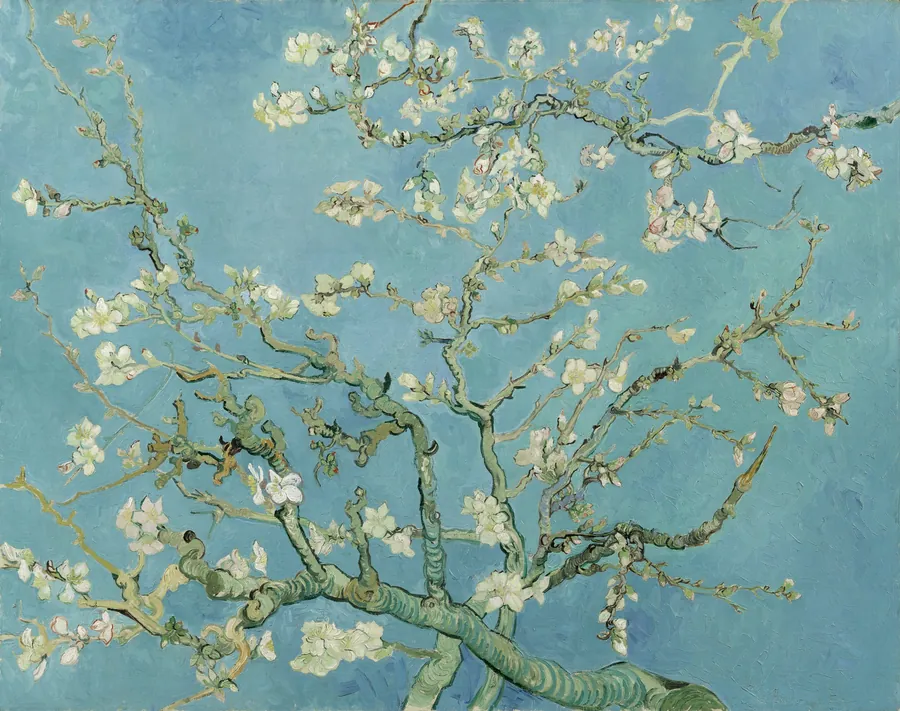
Vincent would much rather, he told his mother, that the boy had been called after his grandfather, whom he had been thinking about so often lately, than after himself; but as it had been done, he had started straight away on a painting for him. Large branches of white almond blossom against a blue sky. He meant it to hang in their bedroom.
That is the picture. Almond branches cut off by the edges of the canvas on every side, in flower, white and pink-white, the wood grey and dark against a sky that is one flat blue-green from top to bottom. There is no ground in it and no horizon and nothing else in it at all.
Late in February he went to Arles, apparently to give Madame Ginoux one of the portraits he had painted of her from Gauguin's drawing, and after that journey came the worst attack of the year. For two months, he told Theo at the end of April, he had not been able to work, and until then he had not been able to write to him either. The doctor had written, Theo told Jo's sister Mien, that for weeks Vincent had sat with his head in his hands, and made signs that he wanted to be left alone if anyone spoke to him. When it was over he went back to work, and by the beginning of May he had a trunk packed and sent ahead by goods train and thirty kilos of luggage allowance filled with frames, an easel and stretchers.
Peyron wrote him a certificate when he let him go. The patient, he set down, had been calm most of the time, and had had during his stay several attacks lasting from a fortnight to a month; that the last of them had come on after a journey he made to Arles and had lasted about two months; and that in the intervals between the attacks the patient was perfectly calm and lucid, and gave himself up to painting with ardour. Today, the certificate ends, he asks for his discharge, to go and live in the north of France, hoping that the climate will suit him better.
He had told Theo a few days before that as regards work his mind felt absolutely serene, and that the brushstrokes came to him and followed one another very logically.
On the sixteenth of May 1890 he walked out through the gate with his luggage, went down to the station, and took the night train to Paris by himself.