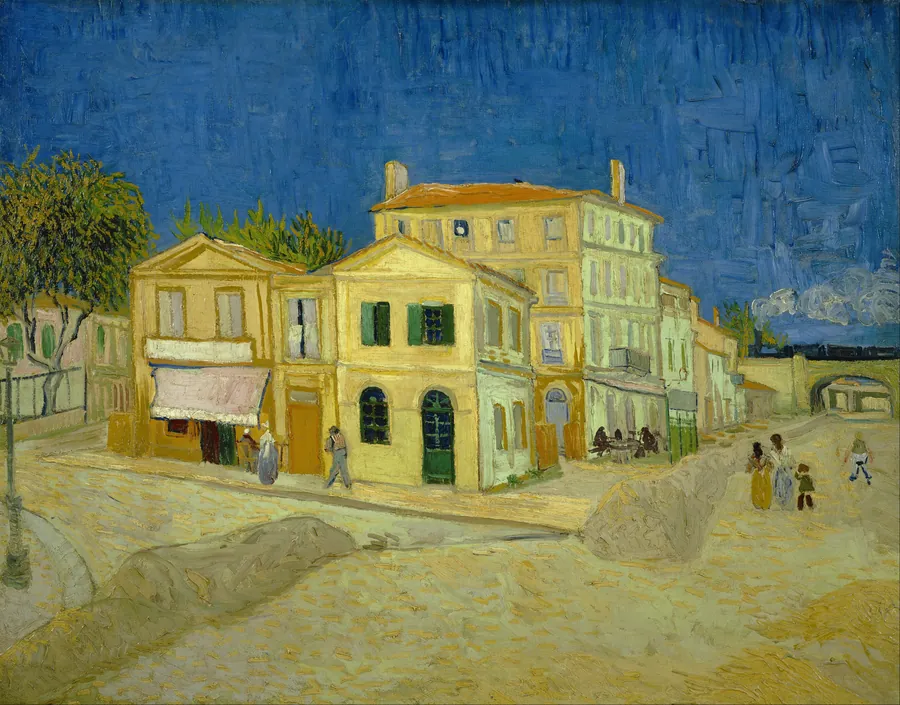
The Yellow House
On the way down from Paris, somewhere in the day and the night the journey took, he kept looking out of the carriage window to see whether it was like Japan yet. He owned up to it in October, in a letter to Gauguin. "Childish, isn't it?"
He got down at Arles on Monday the twentieth of February 1888, and it was snowing. "Now I'll tell you that for a start," he wrote to Theo the next day, "there's been a snowfall of at least 60 centimetres all over, and it's still snowing."
He had come south for the sun, and what he found first was a small town on a river under white roofs, with white hills behind it. Arles is old in the way very few French towns are old: the Romans built an arena there, and it still stands in the middle of the town with the streets curving round it, while the Rhône goes past below the walls, wide and fast and brown, and there are plane trees along the boulevards, and outside the old north gate, between the ramparts and the railway station, a square called the Place Lamartine, with a public garden on one side of it. He told Theo that Arles did not seem any bigger than Breda or Mons, and that the landscape under the snow, with the white peaks against a sky as bright as the snow, was just like the winter landscapes the Japanese did.
He took a room at the Restaurant Carrel in the rue Cavalerie, just inside the gate, paying five francs a day to begin with and then four, and he painted what the weather let him: an old woman of Arles, a butcher's shop seen across the pavement, the snow. At the beginning of March there was a hard frost in the town and still snow out in the country, and he had two little studies of a branch of an almond tree, standing in a glass of water, that was already in flower despite everything.
Then the orchards came out, and for a month he did very little else.
The fruit trees round Arles grew in small plots behind fences of yellow reeds, which were there to keep off the wind, and that spring they flowered one kind after another — apricot, peach, plum, pear. The season was so short, he told Theo, and these were subjects that cheered everyone up. He was out in them every day the wind allowed, and by the ninth of April he reckoned he needed ten more, same subject; by the nineteenth he had nine on the go, and described some of them for Bernard: "one white, one pink, one almost red pink, one white and blue, one pink and grey, one green and pink."
He knew what it was doing to the money. "The month will be hard for you and me," he wrote, and asked Theo to manage a steep one if he could, because orchards in blossom were subjects they had a chance of selling. Up to now, he said, he had spent more on his colours and canvases than on himself, and would Theo for Christ's sake get the paint to him without delay. He also had the grace to warn his brother what came next. "You know I'm changeable in my work, and this rage to paint orchards won't last for ever. After that it may be bullrings."
The difficulty was the wind: the mistral comes down the Rhône valley out of the north, cold and dry, under a perfectly clear sky, and blows for days together, hard enough to take a canvas off its easel. There were three windy days for one still one that spring. "I have a lot of trouble painting because of the wind," he told Theo, "but I fix my easel to pegs stuck in the ground and work anyway, it's too beautiful."
On one of those days, at the end of March, he brought home a canvas of two pink peach trees in a ploughed lilac field, with a reed fence and a glorious blue and white sky, which he thought probably the best landscape he had done. Just as he got in with it, a printed memorial to Anton Mauve arrived from their sister, with Mauve's portrait on the front. Mauve, the cousin by marriage who had given him his first lessons in paint at The Hague, had died in Holland at the beginning of February. "But something or other grabbed hold of me and made my throat tight with emotion, and I wrote on my painting Souvenir de Mauve Vincent & Theo." He meant it for Mauve's widow, and he told Theo why he had chosen that canvas and not a graver one: in memory of Mauve they needed something that was both tender and very cheerful.
On the first of May he found a house.
"Ah, well — today I rented the right-hand wing of this building, which contains 4 rooms, or more precisely, two, with two little rooms. It's painted yellow outside, whitewashed inside — in the full sunshine. I've rented it for 15 francs a month."
The building stood at number 2 Place Lamartine, on a corner where a street ran off under two railway bridges, with a grocer's shop in the left-hand wing and the public garden across the square. The floors were red brick and there was nothing in it at all, and since he had no money to furnish it, it served through the summer as a studio and a store for canvases while he slept somewhere else.
The somewhere else changed that week. He had fallen out with the Carrels over his bill, which he thought too high, and he told them they would explain it all in front of the justice of the peace — who, he added to Theo, would perhaps say he was in the wrong. That is his side of it. Madame Carrel, recalling it long afterwards, said there had been no disagreement about the price at all: he had wanted to pay while the family were at their dinner, had been asked to wait, and had gone off to the magistrate to hand the money over there.
By the seventh of May he had moved to the Café de la Gare, 30 Place Lamartine, kept by Joseph Ginoux and his wife Marie, on the same square as his yellow house. It was a café that stayed open all night.
At the end of May he went to the sea. "You go by diligence," he wrote to Theo the day before, "it's 50 kilometres from here. You cross the Camargue, grassy plains where there are herds of bulls and herds of small white horses, half-wild and quite beautiful." Saintes-Maries-de-la-Mer was a fishing village of low white cottages round a fortified church at the edge of the Mediterranean, and he stayed about five days.
"I'm writing to you from Saintes-Maries on the Mediterranean at last — the Mediterranean — has a colour like mackerel, in other words, changing — you don't always know if it's green or purple — you don't always know if it's blue — because a second later, its changing reflection has taken on a pink or grey hue."
The fishing boats lay on the sand overnight and put out very early, and every morning he watched them go without having had time to draw them; on the last morning, before he left, he did it — four of them drawn up close together on the beach, their masts leaning, their hulls picked out in red and green and blue — and he carried the drawing back to Arles and made a painting of it. He had done it, he said, without measuring, letting the pen go. "Tell me, in Paris would I have drawn in an hour the drawing of the boats?"
June was the harvest, and the harvest was in the Crau.
The Crau is the plain that runs east from Arles towards the Alpilles, a low line of limestone hills on the horizon; much of it was wheat, flat as a table, crossed by ditches, with farms set far apart and no shade anywhere. A day's work there meant a walk out in the early morning with the canvas and the easel on his back, a place found in the stubble or at the edge of the standing wheat, and then the middle of the day in a light that came up off the ground as hard as it came down from the sky, with dust getting into the wet paint. He mentioned the mosquitoes and the flies, and said the heat was doing him good in spite of them. In the middle of June he was on a harvest canvas about ninety centimetres wide, and he told Theo it killed the rest of what he had.
To John Russell, the Australian painter he had known in Paris, he wrote about it in English: "We have harvest time here at present and I am always in the fields."
The mistral came back. He painted a wheatfield with the sun going down behind the town, the town violet, the sun yellow and the wheat old gold and bronze, and he told Bernard how it was done. "I painted it out in the mistral. My easel was fixed in the ground with iron pegs, a method that I recommend to you." By the end of July he had a further method, for the days when even iron would not hold: he laid the canvas flat on the ground and painted it on his knees.
And he had found people.
The first was a soldier. The 3rd Zouaves had their barracks on the boulevard des Lices, and in June one of them sat for him — "a lad with a small face, the neck of a bull, the eye of a tiger," he told Theo — in a blue uniform with red and yellow facings, a sky-blue sash and a blood-red cap, against a green door and a wall of orange bricks. A second lieutenant of the regiment, Paul Eugène Milliet, took drawing lessons from him with his perspective frame and was, Vincent told Bernard, beginning to make drawings he had seen a lot worse than. At Fontvieille, a village a few miles off, there was a young Belgian painter named Eugène Boch, and Vincent went to see him and liked the look of him: "Face like the blade of a razor, green eyes, and distinction with all that."
The one who mattered most was Joseph Roulin. Vincent called him a postman, and so has everybody since; in fact he did not carry letters round the town but worked for the post at the railway station, seeing the mail sacks on and off the trains, and the station's mail room was in the lane beside the Yellow House. He was forty-seven, with a big beard going pepper-and-salt.
"Now I'm working with another model," Vincent wrote at the end of July, "a postman in a blue uniform with gold trimmings, a big, bearded face, very Socratic. A raging republican, like père Tanguy. A more interesting man than many people."
He wrote to their sister Wil the same day. Roulin's wife Augustine had had a baby girl that day, their third child, and Roulin was, Vincent reported, "in really fine feather and glowing with satisfaction." He meant, he said, to paint the baby too. The following week he told Theo he had painted him twice, a half-length with the hands and a life-size head, and that the sitter had proved dearer than a paid model. "The chap, not accepting money, was more expensive, eating, drinking with me, and in addition I gave him Rochefort's La Lanterne."
In the third week of August he started on the sunflowers.
"I'm painting with the gusto of a Marseillais eating bouillabaisse," he told Theo, "which won't surprise you when it's a question of painting large Sunflowers." He had three canvases going at once and worked on them all those mornings, from sunrise, "because the flowers wilt quickly and it's a matter of doing the whole thing in one go." He had a plan for the house: a dozen or so panels of nothing but sunflowers, for its whitewashed walls. "The whole thing will therefore be a symphony in blue and yellow."
Within a day or two he wrote: "I'm now on the fourth painting of sunflowers."
It is a big canvas, taller than it is wide. A pot of yellow earthenware stands on a table, and in the pot is a bunch of sunflowers — fourteen, he said — some full and fresh with their petals out round them like flames, some past it, the petals gone and the dark seed-heads swollen, and some with their heads turned away or hanging on their stalks. The background is yellow and the table a paler yellow. The flowers are yellow and orange and ochre and brown, the stalks and the few leaves green, and the paint on them is thick enough to stand up from the canvas. On the pot he has written his name, Vincent.
It is a picture of yellow things on a yellow ground, and it carries to the far end of a room.
At the beginning of September, after some weeks of worry, Theo sent three hundred francs.
Vincent had been quarrelling with Ginoux over what he was charged for his room, and had told him he would get his own back by painting his whole filthy old place. He did it the same week. "Well, to the great delight of the lodging-house keeper, the postman whom I've already painted, the prowling night-visitors and myself, for 3 nights I stayed up to paint, going to bed during the day." He added that it was one of the ugliest pictures he had done.
It is the café by lamplight, seen from one end. The walls are blood-red, the ceiling green, and the floor yellow, running back up the canvas to a doorway with a curtain over it, and in the middle of the floor stands a green billiard table with its long shadow beside it. Four lemon-yellow lamps hang from the ceiling with rings of orange and green light round them. A few men sit at the little tables along the walls, slumped, one with his head down on his arms; a clock on the back wall says a quarter past twelve; and beside the billiard table the proprietor stands in a white coat, looking out of the picture.
Most of the money went on furniture. The postman and his wife had told him what things ought to cost, and they were right: a sturdy bed was a hundred and fifty francs. He bought two anyway, one in walnut and one in plain deal, "which will be mine, and which I'll paint later," and linen for one of them, and two straw mattresses, and twelve chairs and a mirror. "If Gauguin or somebody else were to come, there you are, his bed will be made in a minute." The spare room upstairs was to be the prettiest in the house, like a woman's boudoir, really artistic, with the big sunflowers crowded on its walls in the Japanese way.
In the letter that thanked Theo for the money he had said what a home would lift from his mind: "this melancholy of being on the street. Which is nothing when you're a 20-year-old adventurer, but which is bad when you've turned 35."
On the eighteenth of September he wrote: "Last night I slept in the house, and although there are still things to be done, I feel very happy there."
He painted it from the outside at the end of September.
The house is on the left of the canvas, a plain two-storey block of yellow on its corner, with green shutters and a green door; beside it is a pink house with green shutters, shaded by a tree, which was the restaurant where he ate his supper every day. On the right a street runs away under a railway bridge, and a train is crossing the bridge with a puff of white smoke. The ground in front is yellow, with a few small people walking in it, and over all of it is a sky of cobalt blue so deep it is almost dark, in broad daylight.
He told Theo it was the house and its surroundings "under a sulphur sun, under a pure cobalt sky. That's a really difficult subject! But I want to conquer it for that very reason."
All summer the plan had been growing in the letters. He wanted painters working together in the south, sharing a house and the costs, cooking at home instead of paying hotels, and he wanted Paul Gauguin at the head of it. At the end of May, inside a letter to Theo, he drafted the offer: if his brother were to send them 250 francs a month for the two of them, would Gauguin come and share, and give Theo one painting a month and do whatever he liked with the rest? In June Theo sent Gauguin fifty francs and a few words about the plan, and Gauguin wrote that he was very touched. What Theo said to Vincent about any of it is lost; almost none of his letters from that year survive.
Gauguin was ill, and short of money in Brittany, and he did not come in July, or August, or September, and the letters from Arles grew longer about it. The fare came first, Vincent wrote on the third of October: "Gauguin's fare first and foremost, to the detriment of your pocket and of mine. FIRST AND FOREMOST." A week later Gauguin wrote that he dreaded the journey. "But come on, let's see — is this journey so exhausting, then, when after all the worst consumptives do it???"
In the middle of October his eyes were tired and he rested for two days, and then he painted his bedroom. The walls are pale violet and the floor red tiles; the bed and the two chairs are fresh butter yellow, the sheet and the pillows a very bright lemon green, the blanket scarlet; the window is green, the dressing table orange with a blue basin, the doors lilac; on the wall there are portraits and a mirror, and there is a hand-towel and some clothes. He sent Theo a sketch of it on the sixteenth and told him what it was for. "In short, looking at the painting should rest the mind, or rather, the imagination."
The next day there was a letter from Brittany. "Gauguin writes that he's already sent his trunk and promises to come around the 20th of this month, in a few days, therefore. Which I'll be very pleased about, because I dare believe that it will do us both good."
He had gas put in, in the studio and the kitchen, at twenty-five francs, so that the two of them could work in the evenings. The beds were bought and the chairs were in.