Colour
By the Saturday evening he had a stove and a lamp. They had cost him a few francs more on top of the rent, and with them, he told Theo, he was safe and sound as far as accommodation was concerned. The room was on the second floor of number 194 in the Lange Beeldekensstraat in Antwerp — he gave the address in French, 194 rue des Images — over a shop that sold artists' colours, and he had been in it four days. He had come from Nuenen with three paintings and a few small studies, and had left behind him in Brabant more than a hundred canvases and a mass of drawings.
"My studio's quite tolerable," he wrote, "mainly because I've pinned a set of Japanese prints on the walls that I find very diverting. You know, those little female figures in gardens or on the shore, horsemen, flowers, gnarled thorn branches."
That morning he had walked down to the customs sheds on the quay in pouring rain to get his luggage out, and he had come back with the docks in his head: the warehouses and hangars along the wharves, hides and buffalo horns coming up out of a ship's hold, a sailor thrown out of a brothel in broad daylight and scrambling over a pile of sacks with a string of girls after him. The pictures in his luggage were browns and greys.
The arithmetic of Antwerp is in his own hand. Early in December his stock of paint came on from Eindhoven, and he paid more than fifty francs for it. "It's hard, terribly hard," he wrote, "to keep working when people don't buy, and literally to have to pay for one's paint out of what wouldn't be excessive just for food and drink and lodgings alone, living frugally. And on top of that, the models." Ten days later he set down the figure: since he had come he had had hot food three times, "and that otherwise it's always just bread."
At the end of December he tried to explain it. "When I receive money, my greatest hunger, even if I've fasted, isn't for food, but is even stronger for painting — and I set out hunting models right away, and I carry on until it's gone. Meanwhile, the lifeline I cling to is my breakfast with the people where I live, and a cup of coffee and bread in the crémerie in the evening."
What the money went on, when it did not go on bread, was faces. He paid twenty or thirty centimes to get into the dance halls and looked at the women and the sailors and the soldiers. He hired whom he could. In the museum he walked past the famous Rubens altarpieces to look at a bold portrait of a man hanging not far from them, and on Sunday the tenth of January he went into the cathedral and saw, for the first time, the two great paintings there, The Raising of the Cross and The Descent from the Cross. The grief in them did not move him at all; a weeping Magdalen by Rubens, he said, put him in mind of a pretty girl of the streets in tears over a disease. "But all the same, I adore it because it is precisely he, Rubens, who seeks to express a mood of gaiety, of serenity, of sorrow, and actually achieves it, through the combination of colours."
On the eighteenth of January 1886 he enrolled at the Academy. The director, Karel Verlat, looked at the two landscapes and the still life he had brought from the country and said, by Vincent's report, "yes, but that doesn't concern me"; the portraits he had painted in Antwerp were another matter, and he was let into the painting class, which was nearly at its end. After that he drew from plaster casts in the evenings and joined two drawing clubs to get at a live model for nothing. The stories of exactly how badly the Academy went for him were told long afterwards, by men who had known him for a few weeks, and they are not evidence. What he wrote at the time was that the carping of the other students was often insupportable, and that he was glad he had gone.
At the beginning of February he went to a dentist. "I have no fewer than 10 teeth that I've either lost or am losing," he wrote. "And that's too many and too disagreeable, and besides it makes me look as though I'm over 40, which puts me at too much of a disadvantage." The work was to cost a hundred francs. He had the bad teeth cut down, paid about half in advance, and was told at the same time that his stomach was not right either. Beside the other men at the Academy, he said, he looked as though he had spent ten years in prison.
A sheet torn out of a sketchbook, written in black chalk, in French, reached Theo in Paris on or about the last Sunday of February 1886.
"My dear Theo, Don't be cross with me that I've come all of a sudden. I've thought about it so much and I think we'll save time this way. Will be at the Louvre from midday, or earlier if you like. A reply, please, to let me know when you could come to the Salle Carrée. As for expenses, I repeat, it comes to the same thing. I have some money left, that goes without saying, and I want to talk to you before spending anything. We'll sort things out, you'll see. So get there as soon as possible. I shake your hand. Yours truly, Vincent."
He had given no warning. He had gone straight from Antwerp to Paris, leaving his bills behind him, as he admitted two years afterwards; he had fixed the meeting in the great gallery of the Louvre; and he seems to have taken it for granted that his brother would leave his work at Boussod, Valadon & Cie, as Goupil's had been called since 1884, and come that same day. Theo kept the note. At some point that week he used it to write a laundry list on, in pencil, and dated it the sixth of March.
Somewhere among the pictures in the Salle Carrée the two brothers met, and from that afternoon until February 1888, the letters between them very nearly stop, because they were living in the same flat.
For thirteen years, by the time of that afternoon, nearly everything anyone can say about Vincent van Gogh has come through his letters, and chiefly through his letters to Theo; the modern edition numbers more than five hundred and sixty of them before the Louvre note. Between the note and Arles there are three letters to Theo in two years, and they exist only because Theo went home to Holland for a few weeks in the summer of 1886 and again in July 1887, and his brother had to write to him there. They were in the same rooms.
What there is instead is a handful of letters to other people, a few of Theo's to the family, the recollections of painters written down after his death, and the paintings, which cannot tell you why, but can tell you when, because the colour on them changes from one season to the next.
The one account from inside the flat, written at the time by somebody other than Vincent, is Theo's, and it is not kind. On the fourteenth of March 1887, a year into the arrangement, he wrote to Wil: "There was a time when I loved Vincent very much and he was my best friend, but that's over now. It seems to be even worse as far as he is concerned, for he loses no opportunity to let me see that he despises me and that I inspire aversion in him. This makes it almost intolerable for me at home." Six weeks later he wrote to her again, and the news was better. What had changed, the record does not say.
The two years in which Vincent learned to use colour are the two years he wrote least about, and the plainest thing on record about what he was like to live with is a complaint to a sister.
The first flat, in the rue de Laval, was too small to paint in, so for the spring of 1886 he went to the studio Fernand Cormon kept on the boulevard de Clichy, where the pupils drew from plaster casts and from the model. He was there three or four months, he told Horace Mann Livens, a painter he had known at the Antwerp Academy, "but did not find that as useful as I had expected it to be." At the beginning of June the brothers moved up the hill to 54 rue Lepic in Montmartre, a larger flat on the third floor, with a room for him to work in.
Theo, writing in July 1887 to an old family friend, described the view. "From the windows we have a magnificent view across the city with the hills of Meudon, St-Cloud etc. on the horizon, and a piece of sky above it that is almost as big as when one stands on the dunes."
Above the flat the hill still had its windmills, and in the first months in the rue Lepic he painted them from every side, and the view from the studio window, and the little gardens and fences and lamp-posts of a Montmartre that was still half a village — all of it, as Jo describes those first pictures, in the soft, low tones of the painters he had learned from in Holland.
The people are few, and each can be known by a thing done. Julien Tanguy, called Père Tanguy by everyone, sold colours from a shop in the rue Clauzel, let young painters have canvas and paint when they had no money, and put their pictures in his window; in July 1887 he put one there that Vincent had only just finished. Henri de Toulouse-Lautrec, whom he met at Cormon's, drew him in pastel in 1887, in profile, leaning forward at a table with a glass in front of him. Émile Bernard, fifteen years younger, met him at Cormon's and again in Tanguy's shop, and in the autumn of 1887 they worked together in the little wooden studio in Bernard's parents' garden at Asnières. Paul Signac was painting at Asnières that spring. The painter Armand Guillaumin had a studio on the quai d'Anjou, and at the end of 1887 Vincent went to see him there one evening.
In the first months of 1887 he hung his own collection of Japanese prints on the walls of Le Tambourin, a café on the boulevard de Clichy, and later that year he copied three of them in oil — a courtesan, a plum orchard in flower, a bridge in a downpour — in colours a good deal louder than the prints. From Arles, he said the show had had quite an influence on Bernard and on Louis Anquetin, whom he had met at Cormon's, "but it was such a disaster." At the end of the year he hung pictures by himself and his friends in the dining room of a big cheap restaurant on the avenue de Clichy, and it was there that he met Paul Gauguin, who had come back from Martinique in November. They exchanged pictures: two canvases of cut sunflowers gone to seed for a landscape of Gauguin's from Martinique.
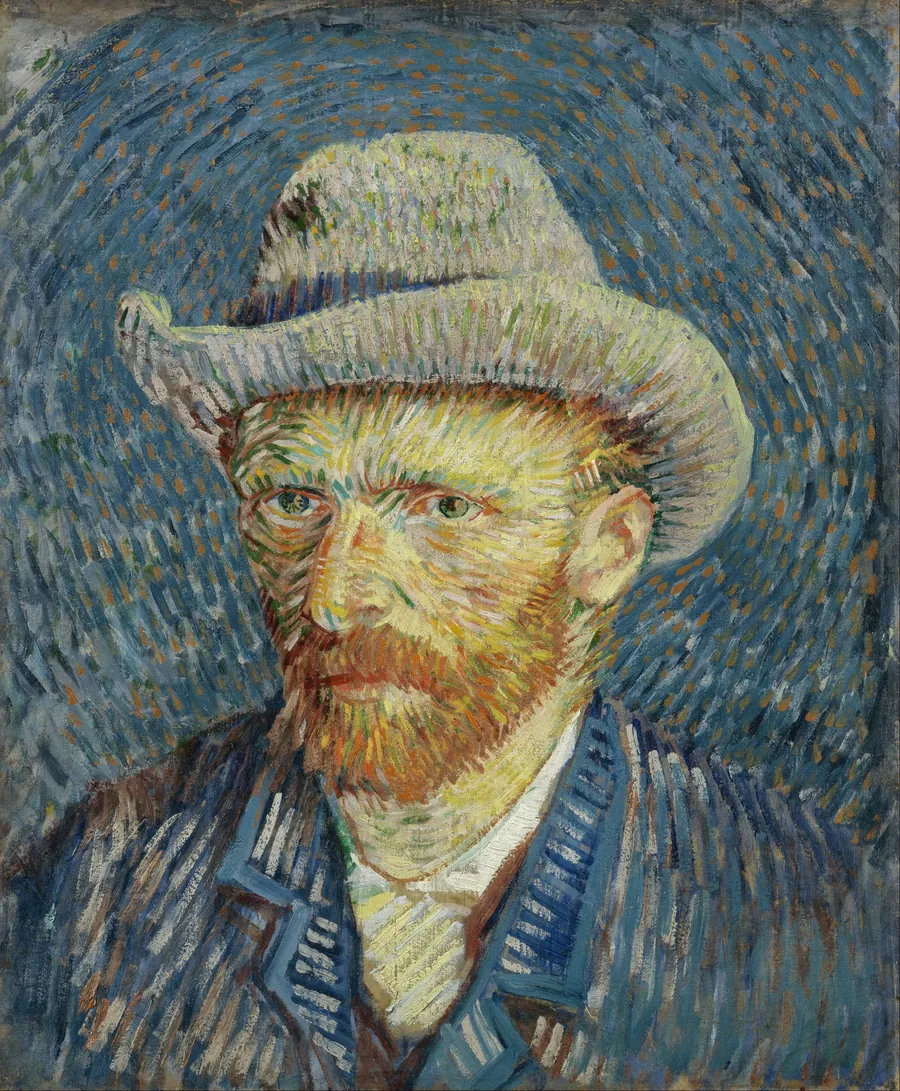
What there is most of from these two years is the work. He painted more than two hundred canvases in Paris, and more than twenty of them are pictures of himself.
The reason for that is in the few letters, and it is money. In the autumn of 1886 he wrote to Livens, in his own English, spelling and all: "I have lacked money for paying models, else I had entirely given myself to figure painting but I have made a series of colour studies in painting simply flowers, red poppies, blue corn flowers and myosotys. White and rose roses, yellow chrysanthemums." A painter who cannot pay a sitter has one sitter left, who is there every morning and asks nothing, in the glass.
A year later he wrote to Wil. "Last year I painted almost nothing but flowers to accustom myself to a colour other than grey, that's to say pink, soft or bright green, light blue, violet, yellow, orange, fine red. And when I painted landscape in Asnières this summer I saw more colour in it than before. I'm studying this now in portraits." In the same letter he said that the picture of the peasants at supper was after all the best thing he had done; and, of himself, that he was making rapid progress in growing up into a little old man, "with wrinkles, with a bristly beard, with a number of false teeth &c."
So put two pictures side by side.
The first is the one from Nuenen, painted in the spring before Antwerp: five people round a dish of potatoes under the one lamp, all of it a dusty green-brown.
The second was painted in the rue Lepic in September or October 1887, and it is not much bigger than a page of newspaper folded once: a man's head and shoulders, a grey felt hat with a dark band. The background behind the head is not a wall but short strokes of blue and orange, going round the head in rings, and there are strokes of red and green in the beard and the eyes; the eyes look straight out, and he painted them from the glass.
The same man made both, with the same hands, about two and a half years apart.
Everybody who has written about these two years has a reason for the change. He had seen the Impressionists; Camille Pissarro talked to him about colour; Signac was painting in dots of pure colour at Asnières; he had the Japanese prints; he had Rubens.
Which of them changed his mind, on what afternoon, or whether he could himself have said, is not recorded. The man who would have been told was in the next room.
He had spoken of the south to Livens as early as the autumn of 1886, "the land of the blue tones and gay colours", and a year later he told Wil it was his plan to go there as soon as he could, "where there's even more colour and even more sun." Theo agreed to go on paying.
On Sunday the nineteenth of February 1888 the brothers went together to Georges Seurat's studio to look at his newest work, and a few hours later Vincent took the nine-forty night express south from the Gare de Lyon. He left Paris, as he told Gauguin that October, "quite ill and almost an alcoholic". Bernard told afterwards how he had spent that last day in the rue Lepic setting out pictures in the studio, so that his brother would think him still there; that is Bernard's story, told years later. Before the week was out Theo wrote to Wil that it still seemed strange that his brother was gone, and that Vincent had meant a great deal to him lately.
Within a few days of getting there he was writing that his blood seemed ready to start circulating again, "which wasn't the case lately in Paris, I really couldn't stand it any more." But the first letter, on the Tuesday, begins with his brother.
"During the journey I thought at least as much about you as about the new country I was seeing."
From that day, because the length of France lay between them, the record opens again, and it is possible to follow him very nearly week by week.