Seventy Days
Dr Gachet, the doctor Pissarro had told Theo about, recommended an inn at six francs a day, and Vincent told him it was two francs too dear, and went and found another for himself on the square in front of the town hall, kept by a wine merchant named Arthur Ravoux, where he could have his bed and his board for three francs fifty. It seemed unjust to him, he wrote that evening, that when a man wanted to pay and work like any other workman he should be charged almost double because the work he did was painting. "Anyway I'm starting with the 3.50 inn."
The room was at the top of the house, about seven square metres under the roof and lit by a skylight, and one franc a day of the three-fifty was for the bed. He meant to stay there, he said, until there was a change of circumstances. He had arrived on Tuesday the twentieth of May 1890.
He had come from Paris, where he had spent three days.
The night train from the south brought him in on the seventeenth, and he went to Theo's flat in the cité Pigalle, four floors up, and there he met Theo's wife, Jo, who was twenty-seven. The baby named after him was three and a half months old, and the almond branches he had painted for the boy were hanging above the piano. His own canvases were in the flat too, more of them than the rooms had space for, and more again were stacked at père Tanguy's.
Jo's brother Andries saw him on the Sunday evening and wrote to their parents that he looked better than ever, had grown fat, and spoke very normally and cheerfully. Vincent, for his part, told his sister Wil that Jo was full of good sense and good will; the little one, he said, was not sickly, but not strong either.
He wrote to Theo and Jo together on his first night in Auvers, in French, and began by saying that after making Jo's acquaintance it would be difficult to write to Theo alone. He was glad to have seen her and the little one and the new flat, and he had felt in Paris, he said, that all the noise there was not what he needed.
Auvers-sur-Oise is a long village on the river north-west of Paris, with a thirteenth-century church and the wheat country on the plateau behind it. There were still thatched roofs on the hillside in 1890, "which are becoming rare," he wrote, and there were new villas among them covered in flowers, which he did not mind at all; he found them almost as pretty as the old cottages falling into ruin.
The doctor was the reason for the village: Paul Gachet, sixty-one, who lived in a tall house up the hill that had once been a girls' boarding school, painted and etched and kept a press, and had been a friend to Pissarro and Cézanne, whose pictures were on his walls. Otherwise the house was full, Vincent reported, of old things, "dark, dark, dark," full like an antique dealer's, and not all of it interesting.
He looked at Gachet the way he looked at everything, and wrote the results to Theo without softening them. The doctor was eccentric. His wife had died fifteen years before. He was as discouraged in his profession of country doctor as Vincent was with his painting, and Vincent had offered to swap profession for profession. He gave dinners of four or five courses, which were as abominable for him as for his guest, because he had a weak stomach, and he advised that Theo and Jo should drink two litres of beer a day.
On the first evening, the twentieth of May, he wrote that the doctor was certainly suffering from a nervous ailment "at least as seriously as I am." To Wil, a fortnight later, he said that Gachet was something like a new brother, so much did they resemble each other, physically and morally too.
"We're already firm friends," he told Theo.
In seventy days he painted about seventy pictures.
That is a canvas a day, every day, for ten weeks, and drawings besides, by a man of thirty-seven in a rented attic with no studio. He told Theo he went to bed at nine and was up at five most mornings. The letters of those weeks are full of what it took: twelve tubes of zinc white and two medium tubes of geranium lake, from Tasset, as soon as possible; a copy of Bargue's drawing course sent down on loan, so that he could go through all sixty sheets of it again in a month, because a man who stopped studying proportion and the nude would find himself in a bad position later on. "Don't think this absurd or futile," he added.
The first study was of the thatch: old roofs with a field of peas in flower in front of them, some wheat in the foreground, and hills behind.
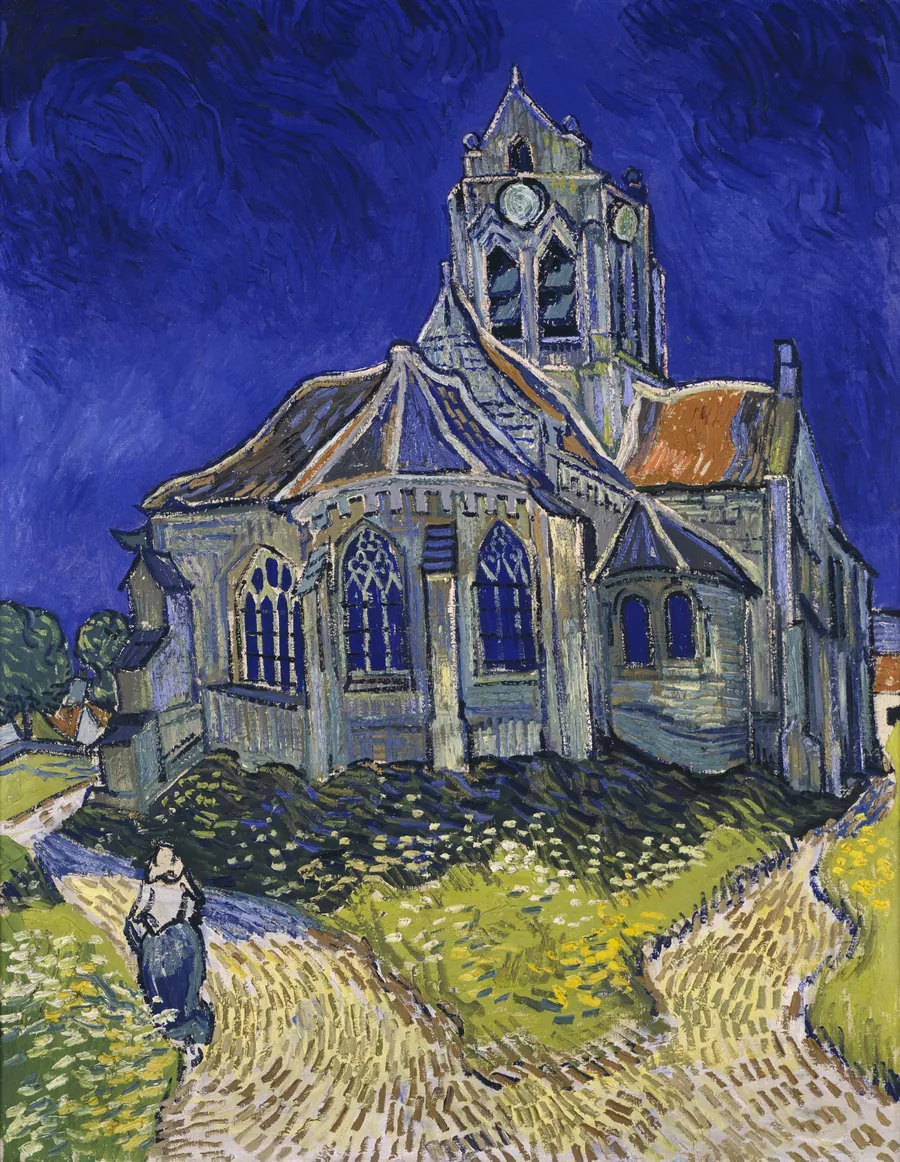
Early in June he painted the church, and described it for Wil, and the description is exact. The building fills the middle of the canvas, seen from its east end, and it is purplish against a sky of a deep and simple blue, pure cobalt; the stained-glass windows are patches of ultramarine, and the roof is violet and in part orange. A path comes up towards it through the grass and divides and goes round it on both sides, and on the left-hand path a woman is walking away. The foreground, he said, is a little flowery greenery and some sunny pink sand. The sun is on the path, but the church stands in its own shadow, and there is no sun in the sky. It was, he told his sister, almost the same thing as the studies he had made at Nuenen of the old tower and the churchyard, "only now the colour is probably more expressive, more sumptuous."
Then he painted Gachet. The doctor leans on a red table with his head on his hand, in a white cap and a blue frock coat against a cobalt background of hills. Vincent gave Wil the face as "the colour of an overheated and sun-scorched brick," the hair reddish, and the hands, "hands of an obstetrician," paler than the face. On the table are two yellow novels and a foxglove with purple flowers. Gachet was absolutely fanatical about the picture, Vincent wrote, and wanted one of his own absolutely like it. In the same letter to Wil he said that what he wanted, much more than anything else in his profession, was to paint portraits which would look like apparitions to people a century later.
On Sunday the eighth of June Theo and Jo came out with the baby for the day, and afterwards Vincent wrote that the Sunday had left him a very pleasant memory, that in this way they really felt they were not so far from one another, and that he hoped they would see each other often; since then he had done two studies of houses in the greenery, and a whole colony of Americans had installed itself next door to the inn, and they painted, but he had not yet seen what they did.
He painted in the doctor's garden on the days he went up the hill to eat those dinners: aloes, cypresses and marigolds; white roses, vines and a figure. At the end of June the daughter, Marguerite, who was twenty-one, sat for him, and he painted her at the piano, playing, in two days, on a canvas a metre high and half a metre wide, and sent Theo a sketch and the colours. The dress is pink; the wall behind her is green with orange spots, the carpet red with green spots, and the piano dark violet. "It's a figure I enjoyed painting," he wrote, "but it's difficult."
Theo wrote back that it must be admirable. "Oh those little patches of orange in the background."
On the fourteenth of July, the national holiday, he painted the town hall across the square from the inn, dressed for the day, with flags and strings of lanterns hung between the trees in front of it and not one person in the square.
And through July he was on the plateau above the village, in the wheat. For the wheat he took a new shape of canvas, twice as long as it was high, about a metre by half a metre, and laid the fields out flat across it under a great depth of sky. In one of them the field is green going to yellow and the whole upper half of the canvas is dark blue with heavy white clouds going over. To his mother and Wil, in the middle of the month, he described what he was in: "the vast expanse of wheatfields against the hills, large as a sea, delicate yellow, delicate pale green, delicate purple of a ploughed and weeded piece of land, regularly speckled with the green of flowering potato plants, all under a sky with delicate blue, white, pink, violet tones." He was, he told them, in a mood of almost too much calm.
To Theo and Jo, in the same week, he wrote of three large canvases of immense stretches of wheat under turbulent skies, in which he had tried to express sadness and extreme loneliness; and in the next sentence, of what he found healthy and fortifying about the countryside, which he hoped the canvases would tell them better than he could in words.
Theo's letters to him from Auvers survive, which is unusual, and they show what the popular story of that summer leaves out: that in July the household in Paris was in trouble of its own.
On the thirtieth of June Theo sat up while his wife and son slept and wrote him a long letter, and for Theo an unusually open one. "Our dear one has been very ill." The baby had cried almost without stopping for several days and several nights, and everything they did had seemed to make it worse; the doctor, anxious himself, had told Jo only the day before that they would not lose the child from it. Paris milk, Theo wrote, was a veritable poison, so they had put the boy on ass's milk, from an animal brought to the door every morning, and he was better. Jo was worn out, and at that moment, he wrote, she was sleeping but moaning in her sleep, and he could do nothing about it.
Then the rest of it came out. For most of his working life Theo had been with the firm that had grown out of Goupil's, now Boussod & Valadon. "Those rats Boussod & Valadon," he wrote, "treat me as if I'd just started working for them and keep me on a leash." He worked all day and still could not spare Jo worries about money, and he was thinking of going to his employers and asking for more, and if they dared refuse, of telling them, "Sirs, I'm taking the plunge and I'm going to set myself up as a dealer on my own account." Out of that salary came the rent, the doctor, the ass's milk, and the money and the paint that had kept his brother at work for ten years.
In a postscript the next morning he wrote that one thing was decided "in an unshakeable way": they would move to a new flat.
Vincent offered to come and help. Theo answered that with a patient in the house the fewer people the better, but that the baby was smiling again, and Vincent should come on the Sunday by the first train.
He went up to Paris for the day on the sixth of July. What happened is told twice. Jo, writing twenty-four years later, remembered days of worry and tension: the child only just recovered, Theo meaning to leave the firm, Vincent dissatisfied with the room his pictures were kept in, talk of moving to a larger flat, and visitors all day. Aurier, who had written the article, came to look at the work with the painter himself, and Toulouse-Lautrec stayed to lunch and made him laugh, and Jo's brother Andries was there, who was to have gone into business with Theo and was drawing back. The painter Armand Guillaumin was expected; it was too much for Vincent, she wrote, and he did not wait, but went back to Auvers in great haste.
Vincent's own account, written that week, is that he was very sorry not to have seen Guillaumin, and that if he had waited for him he would probably have stayed talking and missed his train.
The two versions do not quite agree, and there is no third.
The day after the visit he wrote a note asking whether he had done something wrong, and tore it up. A letter came from Jo, which is lost, and he wrote back to the two of them that it had been like a gospel to him, a deliverance from anguish, and that it was no small thing when all together they felt their daily bread in danger.
On the fifteenth Theo took Jo and the baby to Holland and came back to Paris alone. On the twenty-first he went in to see his employers and told them he would stay after all, rise or no rise, and he told his mother that he had nearly despaired at having let things come so far, and at the thought of perhaps very soon being without a penny of income. He did not tell Vincent. In a letter now lost, Vincent had written of violent domestic quarrels in Theo's household. Theo answered that he had seen no such thing: they had been very tired, that was all. Did Vincent mean the discussion with Jo's brother Andries, Theo asked, or Jo asking him not to hang a picture where he had wanted it? She had not meant to hurt him.
Vincent replied on the twenty-third. He began the letter once and did not finish it, and in that draft he wrote to his brother: "Ah well, I risk my life for my own work and my reason has half foundered in it." He did not send it, and wrote another. The letter he sent hoped that Theo had found his employers well disposed, enclosed an order for colours for a young Dutch painter in the village, and had four small sketches on extra sheets: thatched roofs, two canvases of wheat after rain, and the garden in the village that had belonged to the painter Daubigny, which he called one of his most deliberate canvases.
He wrote out the garden for Theo under the sketch as if Theo were standing in front of it: green and pink grass, a bed of roses in the middle, the house at the back, pink, with a roof of bluish tiles, a black cat in the foreground, and the sky pale green.
Theo read it in Paris and wrote to Jo on the twenty-fifth. "One cannot drop him when he's working so hard and so well. When will a happy time come for him? He's so thoroughly good and helped me so much to keep going."
On Sunday the twenty-seventh of July he went out with his painting things. In the evening he came back to the Auberge Ravoux with a gunshot wound in the chest and went up to his room. He had shot himself. When Ravoux asked him what he had done, he said that he had tried to kill himself. Ravoux sent for help; a doctor came, and Gachet came, and the bullet was not taken out. He had on him the draft he had not sent, as Theo later noted on it in pencil. Word reached Theo in Paris on the Monday morning, and he came out to Auvers and did not leave the bedside. Vincent was conscious, and the brothers were able to talk.
He died at about half past one in the morning on Tuesday the twenty-ninth of July 1890. He was thirty-seven years old.
Émile Bernard came out from Paris on the Wednesday with the painter Charles Laval and got to Auvers at about ten, and three days later wrote down what he had seen for Albert Aurier, who had been away. That is Bernard's account, to a friend who was not there, and it is the fullest there is.
Theo was at the inn, and Gachet, and père Tanguy, who had been there since nine. The coffin was already closed, in the room where the body had been laid out, covered with a plain white cloth and heaped round with flowers, sunflowers and yellow dahlias and yellow flowers everywhere, and his canvases had been hung on the walls all round it. On the floor in front of the coffin were his easel, his folding stool and his brushes.
People came through the day, mostly painters, among them Lucien Pissarro, and some people from the village who had known him a little. At three o'clock his friends carried the coffin out to the hearse, and in terrible heat they walked up the hill out of Auvers talking about him, to a small new cemetery on the rise above fields that were ripe for harvest.
Gachet tried to speak at the grave and was crying too hard to manage it. What Bernard caught was that he had been "an honest man and a great artist," and that he had had only two aims, "humanity and art." Theo, Bernard wrote, was broken with grief.
Vincent's own account of the shooting was questioned in 2011 by the biographers Steven Naifeh and Gregory White Smith, who argued that a boy had fired the shot; the Van Gogh Museum's researchers were not persuaded.
Then the mourners came down again. Some went off into the open country, and the others went back to the station.