Two Chairs
Paul Gauguin came in on an early train from the north on the twenty-third of October 1888, with his luggage and his canvases, and Vincent sent a telegram to Paris to say that he had come. The letter that followed the telegram reports that Gauguin had arrived in good health, and adds: "He even gave me the impression of being in better shape than me." Gauguin had brought with him a canvas he had exchanged with Émile Bernard, of Breton women in a green meadow, and Vincent described it for Theo in a line: "White, black, green and a red note, and the matt tones of the flesh."
He was forty, five years older than Vincent. He had been a sailor, and then a stockbroker in Paris, and had given up the Bourse for painting; he had a Danish wife and five children in Denmark, whom he was not living with; and the year before he had been to Panama and to Martinique and come back. He was a better talker than Vincent and a far better arguer, and he knew both of these things.
He came on terms Theo had arranged and was paying for. The arrangement was plain, and Vincent set it out for Theo that first week: Theo would have Vincent's work, and a painting by Gauguin in addition, every month, and he would send a hundred and fifty francs a month for each of them — more than had first been proposed — which in practice came south as three hundred francs a month in three instalments of a hundred, around the first, the eleventh and the twenty-first, and on which the two men lived together. By combining their expenses, Vincent wrote, the two of them would not even spend what living there had been costing him on his own. Theo had also just sold one of Gauguin's Breton pictures for five hundred francs, and Gauguin arrived pleased about it.
Vincent had done a sum of his own in the letter that announced the arrival, and it is worth having, because it is the kind of letter he wrote more often than the famous ones: "a man who lives for 50 years and spends two thousand a year spends a hundred thousand francs, and that he must bring a hundred thousand in, too. To make a thousand paintings at a hundred francs during one's life as an artist is very, very, very hard." Then he said that he was in a hurry, and had to go out to get back to work on another size thirty canvas.
The house had four rooms. Downstairs were the studio and the kitchen. Upstairs, at the front, over the square, was the guest room Vincent had spent the summer getting ready, with two of his canvases of sunflowers hanging in it, and Gauguin had that; Vincent's own bedroom was the next room along. Gauguin told him, some weeks later, that he had once seen a painting of sunflowers by Claude Monet in a large Japanese vase, very fine — "But," Vincent reported to Theo, "he likes mine better."
Gauguin put the place on a footing within a fortnight. He bought a chest of drawers, a quantity of household utensils, and twenty metres of very strong canvas, a coarse jute, and the two of them wrote down everything he had paid, which came to nearly a hundred francs, so that it could be paid back to him at New Year, or in March. They meant to prepare their own canvas and use less expensive colours. And Gauguin cooked. "He makes a really interesting friend," Vincent told Theo in November. "I must tell you that he knows how to cook perfectly, I think that I'll learn that from him, it's really convenient."
Vincent summed up the days at the beginning of December: "Our days pass in working, working always, in the evening we're worn out and go to the café before retiring to bed early. That's our existence."
Gauguin had come from Pont-Aven, and he let it be known. What he told Vincent about Brittany, Vincent passed on to Theo within the week, faithfully and with a straight face: "Of course, everything there is better, bigger, more beautiful than here. Of a more solemn character, and above all more of a whole and more defined than the small, stunted, scorched countryside of Provence." Be that as it may, Vincent added, Gauguin liked what he saw, and was particularly intrigued by the Arlésiennes.
The working was out of doors at first. On the south-east side of the town was the Alyscamps, the old Roman burying ground, an avenue of poplars with the stone tombs set along it like a row of empty troughs, and at the end of October the poplars were letting go of their leaves. Vincent painted two studies of the falling leaves in the avenue and a third of the whole avenue, entirely yellow. Gauguin painted there too, and hung two of Vincent's leaf studies in his own room, and wrote to Bernard that they were on very coarse, but very good, sacking.
On a Sunday at the end of October they had walked out together in the evening and seen a vineyard after rain. Vincent put it in a letter to Theo: "We saw a red vineyard, completely red like red wine. In the distance it became yellow, and then a green sky with a sun, fields violet and sparkling yellow here and there after the rain in which the setting sun was reflected." Within the week he was painting it, all purple and yellow, with figures at work among the vines.
Then, in the first days of November, one of the Arlésiennes sat for them. Madame Ginoux was the wife of the man who kept the café on the square where Vincent had lodged before the house was ready, and she sat in the dress of the women of the town, leaning on a green table, in a wooden armchair that he painted orange, while Gauguin drew her in charcoal and Vincent painted her, on a canvas a little under a metre high, in what he told Theo was one hour. The background is pale lemon. The face is grey. The clothing is, in his words, "dark dark dark, just unmixed Prussian blue."
Gauguin was painting women in a vineyard too, the same week. But Gauguin was doing his, Vincent reported, entirely from memory.
That was the argument, and it was a real one.
Many of the younger painters in France who had looked hard at the Impressionists were having it in some form that year. The Impressionists had gone out of doors and painted what was in front of them, the light on it and the weather round it, as it was on the day, and Gauguin had come to think that this was a limitation: a picture, in his view, was made in the head and not copied off a field, so that you looked, and went home, and painted what memory and imagination had made of what you had seen, in flat, strong colour, simplified, with the accidents of the day left out. There was a great deal to be said for it, and Gauguin said it well, and Bernard had been saying it with him in Brittany that summer, and younger men in Paris were beginning to listen.
Vincent had always needed the thing in front of him. His whole training, such as it was, had been drawing what sat or stood or grew before him, and he had spent eight years at it. And he took Gauguin's side of the argument seriously enough to try it, and he told Theo so, week by week, in letters that are the plainest record there is of one painter being argued with by another.
On the tenth of November, in weather he described as windy and rainy, he wrote that he was going to set himself to work often from memory, "and the canvases done from memory are always less awkward and have a more artistic look than the studies from nature, especially when I'm working in mistral conditions." He added that he was very happy not to be alone, and that he worked from memory on the bad days, and that that would not work if he were alone.
A day or two later he had painted, out of his head, a reminiscence of the garden of the parsonage at Etten, a garden he had not seen in seven years, with cabbages and cypresses and dahlias and figures in it. "Gauguin gives me courage to imagine," he wrote, "and the things of the imagination do indeed take on a more mysterious character." About a week after that: "Gauguin, in spite of himself and in spite of me, has proved to me a little that it was time for me to vary things a bit — I'm beginning to compose from memory." And in the same letter, "It does me enormous good to have company as intelligent as Gauguin and to see him work."
Gauguin was writing letters of his own, and his went to Bernard. In the second half of November he told him that in general he and Vincent saw eye to eye on very little, especially on painting, because Vincent admired Daubigny, whom Gauguin could not stand, and detested Ingres and Degas, whom Gauguin admired; and Gauguin's answer to him, he said, was "you're right, soldier, for the sake of a quiet life." "He likes my paintings very much," he went on, "but when I'm doing them he always finds that I'm wrong in this and that. He's a romantic, and I'm more drawn towards a primitive condition." Vincent, he said, saw in colour the chances that thick paint gave, as Monticelli had; he himself detested manipulated brushwork.
Both men wrote those letters in the same month, about the same rooms, each to his own correspondent.
By the third week of November it was cold, and Vincent had begun another sower, and sketched it in a letter for Theo with the colours written in: "Immense lemon yellow disc for the sun. Green-yellow sky with pink clouds. The field is violet, the sower and the tree Prussian Blue. No. 30 canvas." In the same letter he described the previous evening's sky over the town, a sickly lemon-yellow sunset, and against it cypresses of Prussian blue and trees with dead leaves in every broken tone, "not half bad."
A week or so later he told Theo that he did not find it disagreeable to try to work from the imagination, since that permitted him not to go out, and that working in the heat of a stove did not bother him, but the cold was not for him. Then, in the same paragraph, of the Etten garden, which this time he called Nuenen: "Only I've spoiled that thing I did of the garden at Nuenen and I feel that habit is also necessary for works of the imagination." And in the same paragraph again he reported that he had done the portraits of an entire family, the family of the postman whose head he had painted before, Joseph Roulin — "the man, his wife, the baby, the young boy and the 16-year-old son." Five sitters, from life. "You can sense," he told Theo, "how in my element that makes me feel."
Gauguin, meanwhile, was painting a portrait of Vincent at his easel, painting sunflowers. Vincent reported that too, and thought it one undertaking of Gauguin's that would come to something.
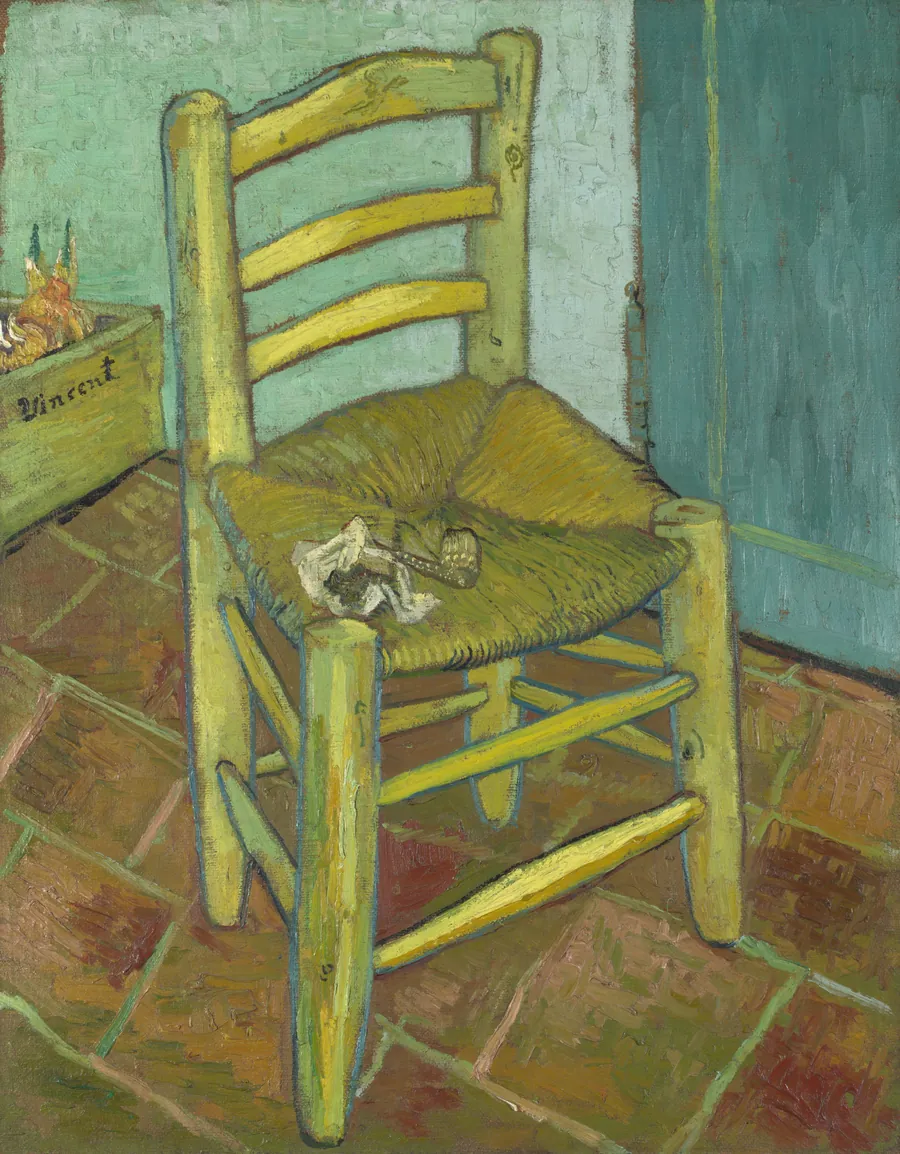
In the middle of all this, in November, he painted two chairs.
He mentioned them to Theo in a couple of lines, in a long letter written about the nineteenth of November: "the last two studies are rather funny." The canvases are the same size, a little under a metre high, and both are on the coarse jute Gauguin had bought.
The first is his own chair. A plain wooden kitchen chair, straight-backed, without arms, the wood painted yellow and the seat of woven straw, standing on red tiles against a blue wall, in daylight. It is seen from a little above. On the seat lie his pipe and some tobacco. Behind it, in the corner, is a shallow box with bulbs sprouting in it, onions by the look of them, and on the box he has written his name: Vincent.
The second is Gauguin's. An armchair, of dark, red-brown wood — he described it that way himself, more than a year later — with curved arms, and a seat of greenish straw. It is night. On the seat a lighted candle stands in its holder, and beside it lie two novels. On the wall behind, a gas lamp is burning. "Red and green, night effect," was what he told Theo, and the floor and the wall are red and green as well.
There is nobody in either picture.
In December Gauguin had an invitation to show his work in Brussels, with the painters who called themselves Les XX, and Vincent told Theo that Gauguin's imagination was already leading him to think of settling there, which would be a means of seeing his Danish wife again. At about the eleventh of the month Gauguin wrote to Theo himself. He asked for part of the money for the paintings of his that Theo had sold, and he said that, taking everything into account, he was obliged to return to Paris; that he and Vincent absolutely could not live side by side without trouble, as a result of incompatibility of temperament, and that both of them needed tranquillity for their work. "He is a man of remarkable intelligence," Gauguin wrote, "whom I greatly respect and whom I leave with regret, but I repeat, it is necessary."
Vincent wrote to Theo at the same time, briefly. "I myself think that Gauguin had become a little disheartened by the good town of Arles, by the little yellow house where we work, and above all by me." He thought that Gauguin would either definitely go or definitely stay, and he had told him to think and do his sums again before acting, and he said that he was waiting with absolute serenity for him to make a decision.
A few days later the two of them went seventy kilometres west to Montpellier, to the museum, to see the collection of Alfred Bruyas, who had been a friend to painters: portraits of Bruyas by Delacroix and by Courbet and by half a dozen others, and pictures by Delacroix and Courbet, Giotto and Botticelli. Vincent wrote about it at length the next day. "Gauguin and I talk a lot about Delacroix, Rembrandt &c. The discussion is excessively electric. We sometimes emerge from it with tired minds, like an electric battery after it's run down."
A note from Gauguin seems to have gone to Paris in the same envelope. Would Theo please consider his trip to Paris as something imaginary, he wrote, and the letter he had written as a bad dream.
On the evening of the twenty-third of December Vincent cut off his left ear. He took it to a brothel in the rue du Bout d'Arles and gave it to a young woman there, and went home. Who she was has been argued about ever since and is still not agreed. The police were told of it, and found him in his bed the next morning and took him to the hospital, the Hôtel-Dieu, where he was put in the care of the young house physician, Félix Rey.
He had been seeing and hearing things that were not there. At the end of January he wrote to Theo that "the unbearable hallucinations have stopped for now, reducing themselves to a simple nightmare on account of taking potassium bromide, I think." It had been the sight and the hearing at the same time, he wrote later, which Rey had said was usual at the beginning of epilepsy; epilepsy was what the young doctor believed he had.
Gauguin had not slept in the house that night. A few days afterwards, in Paris, he told Bernard that Vincent had come after him in the street that evening and that he had turned round, and that he had spent the night at a hotel; Bernard wrote it down. In 1903, fifteen years later, in a memoir, Gauguin — the only other witness, and a man with a reputation to consider — said more: that he had got almost all the way across the square when he heard a quick step behind him, and turned, and saw Vincent with an open razor in his hand, and that Vincent stopped and went back towards the house. The two accounts are both Gauguin's, and they are not the same account.
On the twenty-fourth Gauguin telegraphed Theo, and Theo took the night train south. He saw Vincent in the hospital on Christmas Day, and went back to Paris that same day, and Gauguin went with him.
Roulin went to see him. He wrote to Theo on the twenty-sixth that he had been, and that he had promised to say what he thought, and said it; and he went on going, and went on writing. He and the charwoman, Thérèse Balmoissière, cleaned the house and put everything in order, and Roulin paid the December rent out of thirty francs Theo sent him.
On the fourth of January the house physician was uneasy about letting his patient out for the day, and Roulin told him, as he reported to Theo, "that I would be in charge of accompanying him and seeing that he returns to the hospital," and took him home. They spent four hours in the yellow house. Vincent wrote to Gauguin from there that Roulin had been really kind to him, and to Theo that he expected to start work again soon.
"When I come out I'll be able to continue on my way here again, and soon the fine days will come and I'll start on the orchards in blossom again."