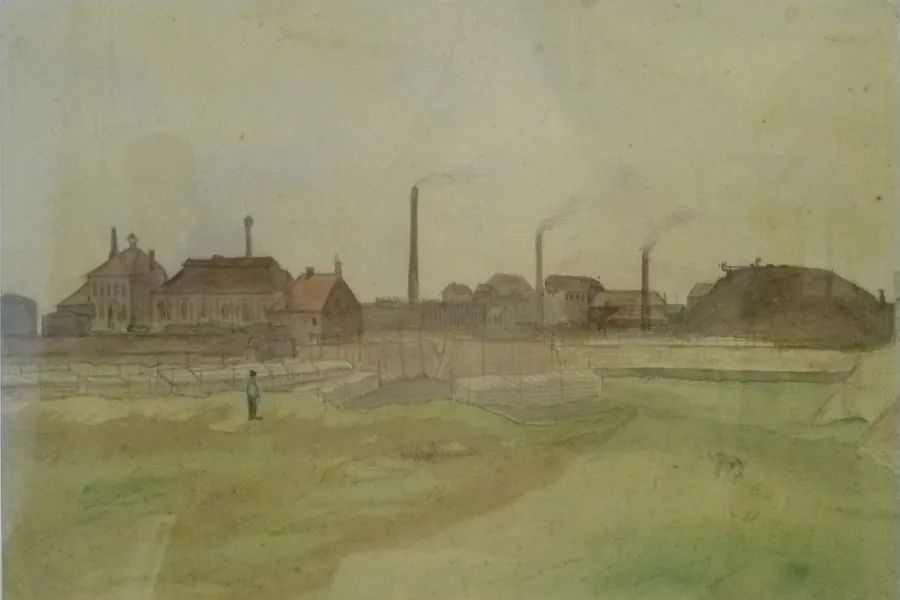
The Black Country
They went to the pit before it was light, men and women both, and a good many of the children went with them. On a winter morning in the Borinage the road out of Wasmes would have been frozen into ruts, the slag along its edge glazed with rime, and the only lights on it the small lamps the miners carried, bobbing in a line towards the headgear of the shaft, which stood up black against a sky only a little less black than itself. A man walking among them on that road would have heard boots and coughing and not much talk.
He tried to draw it, later. In August 1880 he sent Theo a rough sketch of "miners, male and female thrutchers, going to the pit in the morning, in the snow, on a path beside a thorn-hedge: passing shadows, dimly visible in the dusk", with the mine buildings and the slag heap going indistinct behind them. By then he had been living among those people for the better part of two years, and the sketch was a thing he had looked at a great many times before he tried to put it on paper.
The Borinage is the coal country of Hainaut, west of Mons, close under the French border: a string of mining villages run together along low hills, Pâturages and Wasmes and Frameries and Cuesmes, with the pit-heads among them and the spoil heaps rising between the houses. He arrived there at the beginning of December 1878, without a post and without anyone having sent him, from the evangelical training school in Brussels, which had not kept him. An evangelist-colporteur named Vanderhaegen received him and found him lodgings, first at Pâturages and then with a family named Denis on the rue du Petit-Wasmes.
His first letter from there, written on Boxing Day, is not about poverty. It is about what the place looked like. There had been snow in the dark days before Christmas, and in the evenings, at twilight, he had watched the workers coming home from the mines, "completely black when they come out of the dark mines into the daylight again", to houses that "could better be called huts, scattered along the sunken roads and in the wood and against the slopes of the hills". Round the gardens and the fields ran hedges of black thorn, and the snow, he wrote, "gave it the effect of letters written on white paper, like the pages of the gospel."
He had already spoken, he told Theo, both in a room set aside for meetings and in the workers' houses in the evenings: on the mustard seed, on the barren fig tree, on the man born blind, and at Christmas on the stable at Bethlehem.
The Union of Protestant Churches of Belgium kept a committee for evangelisation, and on the fourteenth of January 1879 the committee took up the case of "Mr van Gogh, son of a minister from Holland, who has come to the Borinage with the aim of working there." Two ministers spoke for him. The minutes record that "this devout young man, completely devoted to work, would make a good Bible reader", and that one of them proposed employing him in that way "at the modest salary of 600 francs. There will be a trial period of 6 months." The appointment ran from the first of February.
His mother gave Theo the news in her own terms: "His work is holding Bible classes, instructing children, visiting the sick, all fortunately work after his own heart and 50 francs a month." His father, the next day, did the sum for Theo. Thirty francs a month would go on board and lodging. That left twenty.
His father added one more fact. Vincent had been down a mine shaft six hundred and thirty-five metres deep.
In April he went down again, further, and this time he wrote it out for Theo himself, at length. The mine was the Marcasse, at Petit-Wasmes, which had a bad name — men died in it, he wrote, "whether going down or coming up, or by suffocation or gas exploding, or because of water in the ground, or because of old passageways caving in". He was below ground for six hours, with a guide who had worked there thirty-three years. The cage went down "like a bucket in a well, but then a well 500-700 metres deep, so that down there, looking upward, the daylight appears to be about as big as a star in the sky."
At the bottom were five levels, the upper three worked out and abandoned, and along the working passages ran a series of cells, "supported by rough timber-work", each with a man in it in a coarse linen suit, "dingy and soiled as a chimney-sweep, chipping away at the coal by the dim light of a small lamp", some standing to it and some lying flat on their backs. Water came in everywhere. The loosened coal went off in little wagons on rails, and "it's mostly children who do this, both boys and girls." Seven hundred metres down there was a stable, with "around 7 old horses". The day comes to us entire from a man of twenty-six, writing to his brother, who had gone down to see and meant to be believed.
"The villages here have something forsaken and still and extinct about them," he wrote, "because life goes on underground instead of above."
On the seventeenth of April, probably a few days after that letter was written, there was an accident at the Agrappe pit at Frameries, just east of Wasmes, and a great many of the men below were killed. He sent the newspaper reports home to Etten.
The trouble had started before any of that, and it was not about the mines at all. It was about where he slept.
The Denis house was a good one, and he did not stay in it. By the middle of February he had moved out into a hut. His father set out for Mons on the nineteenth of February, in foul weather, with a parcel, and that same evening a letter from Vanderhaegen reached the parsonage at Etten: that despite all the advice he had been given Vincent had left the family where he had been so well looked after, and now had no bed and no clean clothes, and that if he would not listen he would lose his post. A visiting minister from Brussels had inspected the work, and the church council at Wasmes had met to discuss him.
Vincent wrote afterwards that the two of them had walked through the snow to call on the three ministers of the district, visited a miner's family, watched coal being hauled up at a pit called Les Trois Diefs, and gone to two Bible readings, "so we did a great deal in those couple of days." By March he was boarding with the Denis family again, because, he told Theo, "Pa thinks it better that I board with Denis, and I do too." That month he also sent back the money meant for the Denis family's trouble in looking after him, and his mother asked Theo, reasonably, how those people were supposed to launder his clothes.
The rest of the story of the giving-away comes in the same outline from the family's letters and from the church's own report, and the details differ with the teller. The outline is enough. He gave away his clothes and his linen, he sat up at night with the sick and the burnt, and he stopped looking like a minister's son, or like anyone's.
In April the committee, hearing details it called "both regrettable and encouraging", allowed its Hainaut sub-committee to extend his trial by three months if it saw fit. By the summer it had not seen fit. Its report for the year set the reason down in print, and it is fair to let the committee have its whole sentence:
"If to the admirable qualities he displayed among the sick and injured, to the devotion and spirit of sacrifice of which he furnished many demonstrations, watching with them at night and divesting himself for them of most of his clothes and linen, had been added a gift for speaking, indispensable to anyone placed at the head of a congregation, Mr van Gogh would certainly have been an accomplished evangelist."
The trial period expired, and they did not keep him. They gave him three months to find something else. His successor started on the first of October, and within two months, the report noted, had revived a meeting at Warquignies that had lapsed under Mr van Gogh.
On the nineteenth of July his father wrote to Theo that they were "literally at our wits' end".
At the beginning of August he walked — most of the way, according to his father — to Sint-Maria-Horebeke in Flanders, and on to Brussels, to consult the Reverend Pieterszen, who had spoken for him in January. Pieterszen wrote to Etten that he had arrived weary and flushed, that he gave everyone the impression of a man who gets in his own way, and that he had lost a great deal of weight. His father sent fifty francs to Pieterszen to hand on, and asked that Vincent not be told where it came from.
He did not go home. He went back to the coal country, but not to Wasmes. His letter of the fifth of August gives his address as "Mr Francq. Evangelist in CUESMES (at Marais, near Mons)". It says he had been sitting up late drawing "types from here", that Mr Tersteeg in The Hague had sent him a box of paints and a sketchbook, and that the sketchbook was already half full.
Theo came that month. They walked together near a disused pit that the people there called La Sorcière, the witch, and Theo said — as Vincent reported it ten months afterwards — that they had once agreed about a great many things, and that his brother had changed and was not the same any more.
A few days later, in the middle of August 1879, Vincent wrote to thank him for the visit.
Then there are no letters.
There are none from Vincent to Theo from the middle of August 1879 until the end of June 1880, and the family's own letters for those months are largely missing too; the editors of the correspondence think some of them were kept back, or destroyed, because of what they said. What he did with the time is almost unrecorded, except in what he said about it afterwards.
A few things show through. In March 1880 he was at Etten, at the parsonage, and his father wrote to Theo: "Vincent is still here. But oh, it is a struggle and nothing else." He talked of going to London. He went back to the Borinage instead. That year his father also thought of having him committed to the asylum at Geel, in Belgium; in November 1881 Vincent was still resentful of it, writing to Theo that his father had wanted "to send him to a madhouse (which I naturally opposed with all my might)".
And that same March he walked into France.
He told the story in September 1880. He had set out for Courrières in the Pas-de-Calais, where the painter Jules Breton lived, "hoping perhaps to find work there (any sort, if possible; I would have accepted anything), but actually without any real plan". He had ten francs. He spent them on the train at the start and did the rest on foot, a week on the road. At Courrières he found Breton's studio, and it was "brand-new", "newly built in brick, of a Methodist regularity", chilly and inhospitable to look at. He did not get a look at the inside.
"Because I didn't dare to introduce myself, so as to go in."
He looked about the village for any other trace of an artist and found a photograph of Breton in a shop window, a copy of Titian's Entombment in a dark corner of the old church, and a café called the Café des Beaux-Arts, in new brick, with bad paintings of Don Quixote on the walls. He looked at the fields, which were brown and almost coffee-coloured with whitish marl showing through, and at the thatched roofs, and at the crows. He traded a few drawings from his case for bread. With nothing left, he slept out the last three nights: once in an abandoned carriage, "all white with frost in the morning", once in a wood-pile, and once in a haystack that had been opened, where he made himself a nest, and it rained.
He came home, he wrote, "worn out, with bruised feet".
The letter that ends the silence was written at Cuesmes about the twenty-second of June 1880, and it does not begin as a reconciliation. It begins as a receipt.
"It's with some reluctance that I write to you, not having done so for so long, and that for many a reason. Up to a certain point you've become a stranger to me, and I too am one to you, perhaps more than you think." He would not have written at all, he says, if Theo had not put him under the necessity of it: "I learned at Etten that you had sent fifty francs for me; well, I accepted them." It is the first time Theo's money appears anywhere in the correspondence.
Then, because he was Vincent, the letter kept going for eight pages. He was a man of passions, he wrote, and liable to do foolish things. He had neglected his appearance, and he admitted it was shocking. He had read the Bible and Michelet, and last winter Shakespeare and Hugo and Dickens, and lately Aeschylus. He knew perfectly well that his affairs were in a sorry state, and he set out the whole indictment against himself, clause by clause, each beginning "it's true that", and then asked whether that was called going downhill. And then he came to the question of what an idle man is.
"Someone has a great fire in his soul and nobody ever comes to warm themselves at it, and passers-by see nothing but a little smoke at the top of the chimney and then go on their way."
A page later there is the bird.
"In the springtime a bird in a cage knows very well that there's something he'd be good for; he feels very clearly that there's something to be done but he can't do it; what it is he can't clearly remember, and he has vague ideas and says to himself, 'the others are building their nests and making their little ones and raising the brood', and he bangs his head against the bars of his cage. And then the cage stays there and the bird is mad with suffering. 'Look, there's an idler', says another passing bird — that fellow's a sort of man of leisure. And yet the prisoner lives and doesn't die; nothing of what's going on within shows outside, he's in good health, he's rather cheerful in the sunshine. But then comes the season of migration. A bout of melancholy — but, say the children who look after him, he's got everything that he needs in his cage, after all — but he looks at the sky outside, heavy with storm clouds, and within himself feels a rebellion against fate. I'm in a cage, I'm in a cage, and so I lack for nothing, you fools! Me, I have everything I need! Ah, for pity's sake, freedom, to be a bird like other birds!"
He signed it "Yours truly", and gave his address: care of C. Decrucq, rue du Pavillon, Cuesmes.
Charles Decrucq was a miner, and he lived next door to Francq. Vincent had a room in his house, and he shared it with the Decrucq children.
In August he wrote to Theo again, and this time the letter is about drawing and very little else. He had been copying Millet from prints, the size of a sheet from a drawing course. He had done the rough sketch of the miners in the snow. He wanted to study the figure from masters, and he had written to Tersteeg in The Hague to ask whether he might borrow Charles Bargue's Exercices au fusain, a portfolio of charcoal exercises printed for students to copy.
Tersteeg lent them, with Bargue's Cours de dessin as well, and a book on anatomy and another on perspective.
On the seventh of September Vincent reported that he had finished the sixty sheets. It had taken him about a fortnight, "from very early in the morning until evening", and he had gone straight on to Millet's Labours of the Fields, ten sheets, and had one of them done, a woodcutter. By the twenty-fourth he was working through the Cours de dessin and meant to finish it before he undertook anything else, "since day by day it exercises and strengthens both my hand and my mind". The anatomy and the perspective were thorny, he said, and sometimes "as irritating as could be".
It was in that same letter of September, with Courrières in it, that he put the matter into words. It was on the road, he wrote, "in this extreme poverty", that he had said to himself: "I'll pick up my pencil that I put down in my great discouragement and I'll get back to drawing". That is how he told it three months after the silence broke, to a brother who had begun to write to him again, and who had heard a year before that Tersteeg's sketchbook was already half full.
The same letter says what it cost. To work as one should, he reckoned, would take about a hundred francs a month; you could live on less, "but then you're hard up, far too much so in fact." He did not earn a sou. And he could not go on much longer in the room at the Decrucqs'. It was tiny, there were two beds in it, the children's and his, and the Bargue sheets were big. He did not want to upset the household. The other room was not to be had at any price, because the wife needed it for the washing, "which in a miner's house has to be done almost every day."
A little workman's house of his own, he wrote, would cost nine francs a month.
So in September 1880 there was a man in a miner's back room at Cuesmes, with the children's bed on one side of him and the washing going on through the wall, copying a printed figure, and then another, off a lent sheet nearly two feet wide, and when he got to the end of one portfolio, starting on the next.