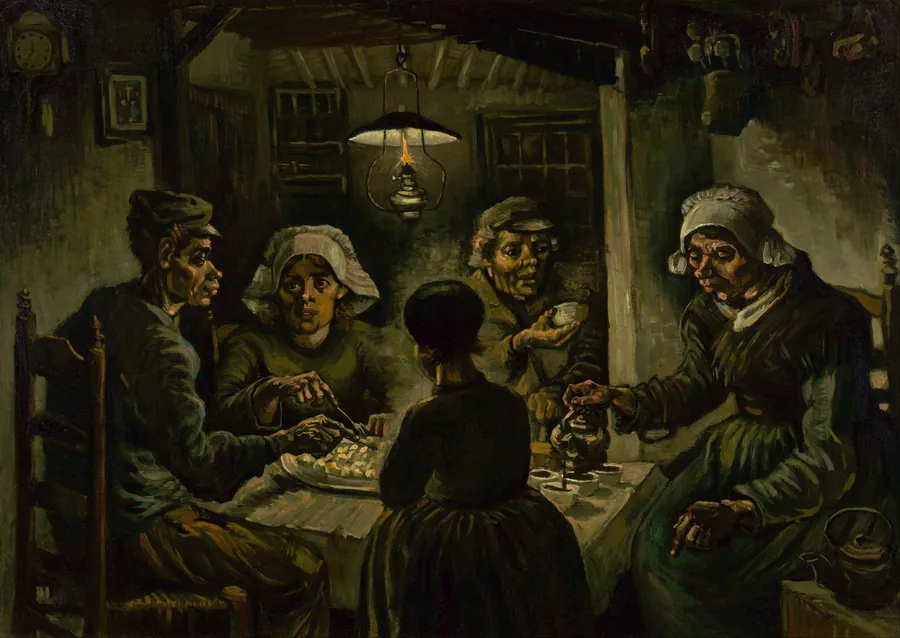
The Potato Eaters
The whole trouble with weavers, he told Theo in his first weeks back in Brabant, was that a man had to sit so close to the loom that he could hardly take its measurements: "in the small rooms one can't get far enough away to draw the loom", and he thought that was why most attempts at it failed. He had found a cottage with two looms in it where it could just be done.
A hand loom in a Nuenen cottage took up most of the room it stood in. It was a frame of heavy timber taller than a man, with the warp stretched through it and the cloth winding on to a beam at the front, and the weaver sat inside it on a plank, working the treadles with his feet and throwing the shuttle across with his hands, and the whole frame knocked and shook with every pass, like a cart on a paved road. There was usually one small window, set where the light would fall on the cloth, and there was a bed built into the wall, a table, a stove, and what floor was left over. One of the looms he painted that winter was, he wrote, "of old oak gone greenish brown – with the date 1730 carved into it", and beside it, by a little window looking out on a small green field, a child sat in a high chair and watched.
To Anthon van Rappard, the friend from Brussels, the gentleman with money, who was a painter and would understand, he put it less politely. He had drawn the machine carefully from start to finish, and then added the man, because he could not bear a drawing of a loom without the noise in it. What he wanted it to say was this: "when that black monster of begrimed oak with all its slats somehow shows up like this against the greyness in which it stands, then there, in the centre of it, sits a black ape or goblin or apparition, and clatters with those slats from early till late".
He also did the arithmetic. A weaver who worked hard, he set down for Theo, made a piece of sixty ells in a week, and a woman had to sit beside him the whole time winding yarn on to the bobbins, so that two people were working and had to live on it; and on that piece the weaver cleared "say, 4.50 guilders in that week", and when he took it to the manufacturer he was often told not to bring another for a week or a fortnight. He drew and watercoloured and painted these men through the winter of 1883 and into the next spring, a small series of pen drawings first and then canvases, the loom from the side, the loom from the front with the figure a dark shape against a white wall, a loom with a piece of red cloth on it.
He was thirty years old, and he was living in his parents' house again, on his brother's money.
His father had been called to Nuenen, a village of weavers and smallholders a few miles out of Eindhoven, the year before, and the parsonage had a garden behind it with a pond at the bottom. Vincent came to it in December 1883, and his parents gave him the room at the back where the mangle was kept — the laundry room, in a small shed behind the house — to use as a studio and a store for his things. His father wrote to Theo about it that month, which is one of the rare places in these years where the father speaks for himself rather than through his son: "We don't think it's a particularly suitable place, but we've had a decent stove put in there." The room had a stone floor, and they were having a wooden foot-rest made for him.
It did not answer for long, and in May 1884 he rented a proper studio from the sexton of the Catholic church, Johannes Schafrat, in the sexton's house next door to the church, for seventy-five guilders a year, and walked to work there from the parsonage.
Margot Begemann was a neighbour at Nuenen. That year she and Vincent wanted to marry, and her family was against it. In September 1884 she took poison. Vincent got help for her, and she survived and was taken to a doctor in Utrecht to recover. When the news began to get out, his father wrote to Theo that the relationship was said to be broken off, but that the two of them still wrote to each other constantly.
That autumn he made a decision about how to spend the winter, and it was a decision about quantity. In October he told Theo he wanted to paint thirty heads before he went anywhere else. A week or two later the figure had gone up. "Now look here – to make progress, because I'm just getting into my stride, I have to paint 50 heads. As soon as possible and one after the other." The next sentence explains that this could not be done "without extra", and the letter goes on to ask for it. That is the figure he gave in a letter asking for more money, and it is both a plan and a plea; but the heads were painted.
This is what a head required of him, in a Brabant December. A cottage with a single window, and a man or a woman in it willing to sit still for an afternoon in exchange for a few coins, because they would otherwise have been working and needed the money; a canvas on a small easel as near the window as the bed and the table allowed. A face in the grey light: a woman in a white cap starched stiff at the edges, a man in a cloth cap with the peak pulled down, cheekbones, the hollow under them, a mouth with teeth missing. Then the light going at four o'clock, and the canvas carried back through the mud to the sexton's house, and the next day another. He paid his sitters something every week that winter, he wrote the next November, and they would miss it.
"With hard work, these 50 heads will be finished this coming winter," he wrote in December. "But they involve so much work and toil that I need every day."
He was painting hands as well, studies of hands by themselves. By the beginning of March he could write that "Recently, as you know, I've painted heads almost exclusively." Dozens of those heads survive. They are brown and dark green and slate-coloured, the faces lit from one side and the rest of the canvas lost in shadow.
On the evening of Thursday the twenty-sixth of March 1885, at half past seven, the Reverend Theodorus van Gogh came home, having gone out that morning in good health, and as he came in at his own door he collapsed and gave no further sign of life. He was sixty-three.
That is his daughter Willemien's account, the only one from inside the house, and she wrote it seventeen months afterwards, to a friend.
The next morning Vincent went into Eindhoven and sent three telegrams to Paris, to the two branches of the firm where Theo might be found. The first said only "sudden death, come", and did not say whose. The other two named their father; one of them said "Our father fatal stroke, come, but it is over." Theo took the train that day and was at Nuenen on the twenty-eighth.
The father and his eldest son had been quarrelling, on and off and sometimes very badly, since 1881. The quarrel had not been settled, and now it could not be.
A few days after the funeral, with Theo gone back to Paris, Vincent wrote to him. "They have therefore been days that none of us will forget, and yet the overall impression isn't terrible but only grave." Then, in the same paragraph: "The painting went better again today; the first two heads went wrong – today's is a head of a young girl, almost a child's head." It was, he wrote, a contrast of bright red and pale green against the colour of the little face.
On the sixth of April he told Theo he would go and live in the studio: "Of course you'll understand that it's not for my convenience that I'll go and live in the studio." Their sister Anna, as Wil wrote afterwards, thought it would be more peaceful for their mother if he no longer lived at home. A month later it was done. "My move is now complete; at home they're rather different from what you suppose, and they say I've had 'my way'. Well – it's all the same to me, and I'd rather not talk about it. I must get to work".
He did not leave the village; he moved into the sexton's house, where he could get started, he said, first thing in the morning.
Several members of a family called de Groot had sat for him that winter, in their own cottage. In the first days of April he was working there on a composition of peasants round a dish of potatoes — "I've just come home from there – and have worked on it further by lamplight" — and sending Theo scratchy sketches of it, and he knew in advance what the dealers would say. Uncle Cor, for instance, "would speak of – badly drawn &c."
He made two painted studies of it first. Of one of them he wrote that he had worked three days continuously, "from early till late", until on the Saturday evening the paint would take no more. The big canvas itself he painted at the end of April and into the first days of May, and not from the cottage but, as he told Theo, "largely from memory". It had taken, he said, "a whole winter of painting studies of heads and hands", and the few days on the canvas had been "a formidable fight".
On the thirtieth of April, the day before Theo's birthday, he wrote to say that the picture was not quite finished, and to say what it was for. "You see, I really have wanted to make it so that people get the idea that these folk, who are eating their potatoes by the light of their little lamp, have tilled the earth themselves with these hands they are putting in the dish, and so it speaks of manual labour and – that they have thus honestly earned their food."
A few days later he took the faces out and put them back. "I quickly repainted them without mercy, and the colour they're painted now is something like the colour of a really dusty potato, unpeeled of course."
On the sixth of May he packed it in a crate marked V1 and sent it to Paris, carriage paid, for a little under two guilders, not quite dry. He asked Theo to see it against a tone like gold or copper, because then, he said, "the marbling effect disappears".
The canvas is a little over a metre across and not much more than two-thirds of that high. It is a room at night: low ceiling, dark beams, and hanging from the middle beam on a hook, an oil lamp with a glass chimney and a small yellow flame, the only light there is, and at the back a window with small panes and nothing outside it but dark. Round a square table sit five people.
On the left a young man in a cap, gaunt, his fork out over the dish, and beside him a young woman in a white cap, turned towards him, with a fork of her own. In the middle of the picture, nearest to us, a girl sitting with her back turned, so that she is only a black shape against the lamplight; nobody is shown her face. Behind her a man in a cap lifts a cup. On the right an older woman in a white cap, with her eyes down, is pouring from a kettle into a row of small cups. The potatoes are in a flat dish in front of the young couple, and they are steaming.
The colour is all one colour, or seems so at first: a brownish, greyish green, the green of old moss on a north wall, laid over everything — the walls, the clothes, the faces. The faces are the lightest things in the room after the lamp and the caps, and they are not pretty faces. They are lumpy, big-nosed, hollow-cheeked, with knuckles to match. It takes the eye a while, in that dark, to find the clock on the wall at the upper left, and the small framed print hanging beside it, and the hands of the clock are at seven.
It does not ask to be liked.
He knew that it would not be. "If it's now a fabric that has a rough and coarse look, nevertheless the threads were chosen with care and in accordance with certain rules," he wrote. "And it might well prove to be a real peasant painting. I know that it is." And: "For my part, I'm convinced that in the long run it produces better results to paint them in their coarseness than to introduce conventional sweetness." It is dark, the hands are too big, the arms are not where arms go, and it is the most serious thing he had yet made. He was thirty-two.
He had also drawn the composition on a lithographic stone in April, ordered in Eindhoven, where the graining of the stone, the paper and the printing of fifty copies came, he reckoned, to three guilders; and he sent one of the prints to Anthon van Rappard.
Rappard, the only man of Vincent's own trade who had kept up with him for five years, had come to Nuenen twice and painted the weavers there alongside him. His reply is dated the twenty-fourth of May, and he was hurt, to begin with, that the news of the father's death had reached him as a formal announcement: "Did you think that I had so little interest in your father or in the events in your family that a common polite formula to announce something so affecting was enough for that interest?" Then he turned to the lithograph. "You'll agree with me that such work isn't intended seriously." And then, one thing after another: "That coquettish little hand of that woman at the back, how untrue! ... And why may that man on the right not have a knee or a belly or lungs? Or are they in his back? And why must his arm be a metre too short? And why must he lack half of his nose?" He ended: "Art is too important, it seems to me, to be treated so cavalierly."
Vincent wrote his answer on Rappard's own letter, most likely the next day, and posted it back. "My dear friend Rappard I just received your letter – to my surprise. You hereby get it back. Sincerely, Vincent".
It was not quite the end. They argued on paper through the summer, long hard letters from Nuenen, one of which told Rappard that the friendship must be "Either cordial or over"; and by August the argument had worn itself out and they were writing about drawing again. The last letter between them that survives is from about the eighteenth of August 1885.
Across the fields from the parsonage there had stood the tower of the old church, with the peasants' graves round its foot in the grass, and he had drawn and painted it again and again since the week he arrived — some fifteen pictures of it are known. In May they began pulling it down. "The old tower in the fields is being demolished," he wrote. "There was a sale of woodwork and slates and old iron, including the cross." He made a watercolour of the sale, and by the end of June the tower was probably gone altogether, and his painting of it had gone to Paris in a crate.
At the beginning of September there was trouble with the priest. A girl he had often painted was expecting a child, and people in the village, he wrote, "thought it was mine, although it wasn't me". The priest told his parishioners not to sit for the painter, and, according to Vincent, "went so far as to promise the people money if they didn't allow themselves to be painted – however, the people replied very pertly that they'd rather earn it from me than go cap in hand to him." He went to the burgomaster about it; it was a bad business, he told Theo, and if it went on he would probably move.
It went on, more quietly, through the autumn. He painted autumn landscapes and an avenue of poplars, and in October, answering a description Theo had sent him of a study by Manet, he painted a still life in a single day and described it himself: "a still life of an open, hence an off-white Bible, bound in leather, against a black background with a yellow-brown foreground, with an additional note of lemon yellow. I painted this in one go, in a single day." The Bible was a big family book on a table, open near the middle, its pages laid almost flat, the columns of print put down in grey and blue strokes. Behind it, to the right, a brass candlestick with a white candle in it, not lit. In front, lying on the tablecloth, a small paper-covered book, worn at the corners, his own copy of Zola's novel La joie de vivre, and that is the lemon yellow.
The Bible itself, he told Theo in the next letter, was one the family had given him to send on to Theo from home, and he was putting it in the crate with the studies.
By November the cold had stopped the outdoor work and the models were not to be had. He wrote to Theo that he was "in danger of becoming stuck with my work here for want of models", and that it came to a choice: "between a studio without work here, and work without a studio there. I took the latter." The feeling, he said, was like "a return from exile".
On Monday the twenty-third of November 1885 he signed himself out of the municipal register at Nuenen, and on the Tuesday he went to Antwerp.