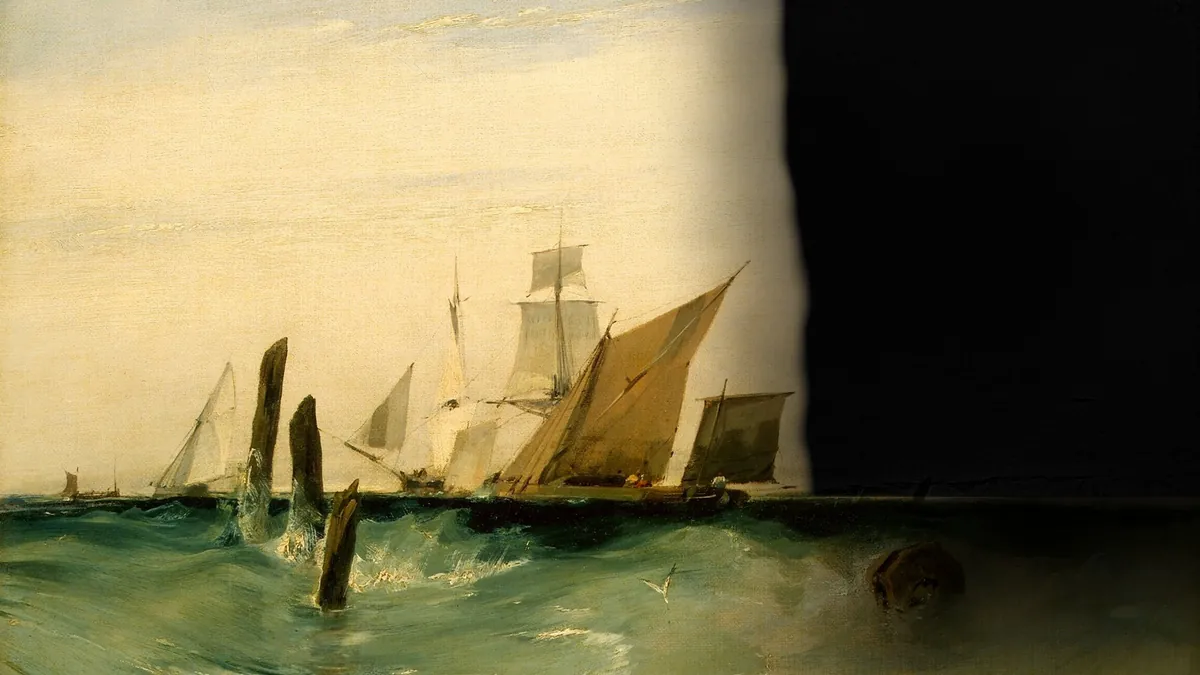
The Fishing Boat
They brought Tavin Rusk home in irons on the brightest morning of the autumn.
The Sparrowhawk came up the buoyed channel into Greyhaven with a fresh northerly breeze on her beam and every sail drawing. Rusk stood at the rail with his wrists chained in front of him and watched the harbor open. He had not seen it in three years. It had not waited for him. The long stone mole curved round on the left hand with the sea breaking white along its foot, and the chain house squatted on the south point with the Compact's blue flag snapping above it. Between them the harbor was crowded with the last big cargoes of the year. Grain ships lay deep at the wharves. Timber rafts were coming down the Grey under sweeps. Ferries went across and back, and the fishing fleet was out beyond the sands, a scatter of brown sails on a blue sea.
He could smell tar from the ropewalk, and smoke, and bread.
"You're smiling, Captain," said the woman beside him.
"Am I, Commander?" Rusk asked.
"Don't." Elske Marr kept her eyes on the harbor. She stood with her hands behind her back, exactly as she had stood every morning for five weeks of passage from Casmir. She was a straight, spare woman in a blue coat with the salt dried white on its shoulders. A light sword hung at her hip, and an old burn ran across the back of her left hand. "It will not help you this afternoon."
"It's a fine morning. I'm allowed to notice."
"You are allowed to keep quiet," Marr said, "until the court asks you something."
He kept quiet. The Sparrowhawk came in past the chain house, and the harbor noise rose round them: gulls and hammers, a bell on a lighter, a boy on a wharf shouting the price of mackerel. The merchant ship's master was making a poor job of the turn into the inner harbor, and Rusk felt every wrong touch of the helm in his hands.
"He's late with the foresail," he said.
"Captain Rusk," Marr said.
"I'm only saying," Rusk said.
Marr turned her head and looked at him then. She had gray eyes, very level. At Ember Roads she had been first lieutenant of the Halcyon. He had seen the Halcyon burn from the Osprey's deck while he hauled children up her side in a cargo net. He had never asked what Marr had seen from hers, and in five weeks she had never told him.
"This afternoon," she said, "Judge-Advocate Hask will open the preliminary hearing at noon. You will be charged with abandoning your station in the face of the enemy. You will be held in the Admiralty cells until the full court sits. I'll hand you over at the door, and you will never see me again except as a witness. That is what today is, Captain. Nothing else."
"I know what today is," Rusk said.
"Then stop enjoying the view," Marr said.
They came down the Sparrowhawk's gangway onto the long wharf with two of Marr's marines in front and two behind, and Sergeant Dunning at Rusk's elbow. Dunning was a lean, quiet man of forty-odd, with a broken nose and a fiddle case he had carried off the ship under one arm. In five weeks he had played it every evening, and badly.
The wharf was crowded. Porters ran with sacks on their shoulders. Carts came through with their iron tires grinding on the stone, and a tally-man with a slate stood shouting at a lighter's crew who would not listen. A party of marines drew no second looks. Rusk walked between them with the chain hanging from his wrists and his head up, and for the first hundred yards he thought he might get through the town without being known.
Halfway along, by a stack of salt barrels, a big man in a leather apron stopped dead.
Rusk saw him stop. He saw the man's face, red and broad, with a gray stubble on it, and saw it change. The man put down the coil of rope he was carrying. He did it slowly and carefully, as if it were made of glass.
"Rusk," the man said.
The marines walked on, but Rusk had stopped. Dunning's hand came onto his arm.
"Keep moving, Captain."
"You're Tavin Rusk." The big man's voice rose. Heads turned along the wharf. "Of the Osprey. That's who that is."
"Wat," someone said behind him. "Wat, leave it."
"My boy was on the Halcyon." Wat Gorley came out from behind the barrels. He had a bale hook in his right hand, a curved iron spike on a wooden grip, the kind every docker on the coast carried. He seemed unaware that he was holding it. "Sixteen. His first ship. He went into the water burning, and you were half a mile off picking up islanders."
"Stand away," Marr said, turning to face him with her sword still in its scabbard. "This man is going before the Admiralty court. Stand away from him."
"The court." Gorley laughed. It was not a good sound. "Three years, and they never caught him. Three years he's been sailing about the south like a lord."
The crowd had begun to come in. Dockers, porters, two women with fish baskets, a boy. Rusk took them in with one look, as he would have taken the set of the tide: thirty of them and more coming, and none of them friends.
"Mister Gorley," he said. "I'm sorry for your son."
He meant it, and Gorley heard that he meant it. It made no difference. For three years the man had carried the Halcyon, and here was the captain who had turned away from her, walking up the long wharf in the sun.
"You chose," Gorley said. "My boy was burning, and you chose a boatload of islanders."
His face went dark, and he came on with the hook.
He was fast for a big man. Rusk had perhaps a heartbeat. He threw his hands up and took the first swing on the chain between his wrists, and the iron hook rang off the links and nearly tore his arms down. Gorley wrenched it back for another blow. Rusk stepped in instead of away, inside the swing, and drove his shoulder into the man's chest. They went back together into the salt barrels. A barrel split and spilled gray salt over the stones.
Somebody was shouting, and Dunning was shouting over him. Gorley got a hand in Rusk's beard and the hook came round again, short, low, at his side. Rusk caught the wooden grip with both chained hands and held it. The point stopped a finger's breadth from his ribs. They strained there, face to face, and Rusk could smell the man's breath, onions and beer and fury.
"Let go," Rusk said through his teeth. "Let go, you damned fool, they'll hang you for this."
Gorley ripped the hook free. The point dragged along Rusk's forearm, and he felt the skin open and the hot run of blood under his sleeve. He swung the chain at the man's face, missed, and fell against the barrels. Gorley stood over him with the hook up.
Then Marr was between them.
He never saw her draw. She was simply there with the light sword in her hand. Gorley's hook came down, and she took it on the flat of her blade and turned it. The iron screeched along the steel, and her point flicked across the back of Gorley's hand, and he roared and let go. The hook clattered on the stones, and she put her foot on it.
"He will be tried," Marr said. Her voice was not loud, but it carried the length of the wharf. "Not by you."
Gorley stared at her. Blood ran from his knuckles and dripped off his fingers.
"You were there," he said. "You were on the Halcyon. I know you. You're the lieutenant that brought the boat in."
"Yes," Marr said.
"And you'll let him walk," Gorley said.
"I brought him back across half the world to stand in front of a court," Marr said. "I didn't do it so that he could die on a wharf with a hook in him and never answer. Go home, Mister Gorley. Wrap your hand. If you want to see him tried, come to the Admiralty House at noon and stand at the back. That's your right. This is not."
For a breath nothing happened, and the crowd hung there undecided. Dunning and the marines had their pikes level across the front of it, and a porter at the back was shouting for the watch.
Then Gorley turned and pushed out through the people, holding his hand against his apron, and the crowd broke up after him in knots. Somebody was laughing. The tally-man had started shouting at the lighter again.
Marr sheathed her sword. She looked down at Rusk, sitting in the spilled salt with his sleeve soaking dark.
"Get up, Captain."
He got up, and his arm stung like fire. Dunning took his wrist and turned it over and looked at the cut with his head on one side.
"It wants stitching," the sergeant said. "It's not deep. He meant your ribs."
"I noticed," Rusk said.
Marr was looking up the wharf, where Gorley's broad back had gone in among the carts. "The loss was too much for him," she said. "His boy was sixteen." She held out a handkerchief without looking round.
"Salt and blazes," said a voice from the barrels. "I leave you alone for three years."
Rusk knew that voice before he turned. A short, wide old man stood at the end of the salt stack, bald as an egg, with white whiskers that went down his jaw to his collar. He had a covered basket on one arm, and a short-handled axe hung from his belt. He was looking at the spilled salt with sorrow.
"Orris," Rusk said.
"Captain." Orris Fen came over the stones and looked him up and down. His eyes were blue and sharp. "You look terrible. Have you been eating? You haven't. Here." He pulled the cloth off the basket. Steam came up, and the smell of hot mutton and pepper. "I was passing."
"You were passing the long wharf at nine in the morning with a basket of pies," Rusk said.
"Is that a crime now? I keep an eating house. I deliver." Orris turned to Marr and made a short, courtly bob from the waist that had nothing of the smuggler about it. "Commander. Orris Fen, of the Lantern and Oar, on the waterfront. Sailing master of the Osprey, once, for my sins. You'll be the officer that brought him in. Have a pie."
"No, thank you," Marr said.
"They're good pies," Orris said.
"I'm sure they are, Mister Fen," Marr said. "I am escorting a prisoner."
"And you've done it handsomely, too. I saw that, with Wat Gorley." Orris put a pie into Dunning's hand, and another into the hand of the nearest marine, and the marine looked at Marr and then bit into it before she could say anything. "Handsomely. I'll walk with you. I'm going that way."
"You don't know which way we're going," Marr said.
"Up to the ridge, to the Admiralty House. Everyone in Greyhaven knows. It's been the talk of every tavern for a week, Commander, ever since the cutter brought word you'd landed in the south with him." He took Rusk's good arm. "Come on, then. Let's get you there alive."
Marr considered the old man, then turned and walked on up the wharf, and the marines fell in round them again.
"She's a hard one," Orris said quietly, at Rusk's shoulder.
"She saved my life just now."
"I saw. I'm still saying she's a hard one." Orris looked back down the wharf. "Wat's not a bad man. He's had three years of hearing you called a coward in every tavern on the waterfront, and then there you were, walking up his own wharf."
"In his place I'd have done the same," Rusk said.
"Don't say that in court," Orris told him. "Eat a pie."
The way up to the ridge ran along the south side of the inner harbor, past the old naval basin. It was a narrow arm of water walled in stone, where the Compact had once kept its small craft. Now it was half empty. A dredger lay rusting at its head, and there were two hulks stripped to the lower masts. At the outer end, moored stern-on to the low stone wharf, lay a ship Rusk had not expected to see again in his life.
He stopped walking so suddenly that Dunning nearly ran into him.
She was a brigantine of about ninety feet, square-rigged on the foremast and fore-and-aft on the main. Her paint had gone to a chalky gray, and her standing rigging hung slack, gone dull and gray with weather. Someone had taken her heavy crossbows out of their carriages and left the empty ports open like missing teeth. But her lines were the same: the sweet sheer of her, low amidships, rising to her quarterdeck, and the rake of her masts. He had stood on that quarterdeck at twenty-eight, with his first command under his feet and his hands shaking.
"The Kestrel," Orris said. "I wondered if you'd know her."
"What's she doing here?"
"Dying, mostly. They surveyed her in the summer. Condemned. The Navy sold her for what she'd fetch." Orris nodded down the wharf. "And there's the one that condemned her. Having words, by the look of it."
On the wharf beside the Kestrel's stern, two people were arguing. One was a plump man in a green coat with a silver chain across his belly. The other was a tall young woman in a canvas apron, with her sleeves pushed to the elbow and a sawdust-colored braid down her back. She held a sheaf of papers in one big hand and was hitting them with the other.
"No," she was saying. "Not for fifty marks, not for a hundred. I won't sign it."
"Mistress Pell," the merchant said, "I'm asking for a patch, not a new ship."
"You're asking for a paper that says she's fit to carry grain," the young woman said, "and she isn't. That seam under her counter is gone, below the waterline, from the sternpost forward eight feet. You can stuff it and nail a plank over it and she'll float in the basin. The first time she meets a real sea with eighty tons of wheat in her, she'll work, and it'll open, and she'll go down like a stone with your crew in her. I won't put my name to that."
"Your name," said the merchant, "is not worth fifty marks."
"Then you won't mind going without it," she said.
A man leaned over the Kestrel's rail above them. He was gray-headed and brown-faced, with a ragged beard and a fat orange cat held against his chest like a baby.
"She's right, Mister Spane," he called down. "You listen to her. I've pumped that seam every day since midsummer. Ask Pudding." He lifted one of the cat's paws and waved it. "Pudding says she's right."
"Garvey," Spane said, "you are a shipkeeper. You keep the ship. You don't advise on it."
"I'm advising for free, sir," Garvey said. "That's the best kind."
Rusk had walked down the wharf without meaning to. Marr said his name behind him, sharply, and he stopped a few yards off. But he was near enough now to see the Kestrel's stern. The water lapped at her counter. Down along her quarter, just above the green weed of the waterline, a long dark stain ran in the paint.
"It's not the seam," Rusk said.
The young woman turned and looked at him. She looked at his chained wrists, and at the bloody handkerchief, and at the marines. Then she looked at his face, with an expression that said she had no time for any of it.
"I beg your pardon?"
"It's not the seam itself," Rusk said. "It's the knee under it. There's a hanging knee inside her, low aft on the starboard side, that was put in green when she was rebuilt at Darn. It shrank. It's been working loose for twenty years and pulling that seam open every time she rolls. You can caulk the seam all you like. It'll open again in a month unless you draw the knee and fit a new one." He looked at the stain. "She weeps worst on the port tack in a seaway. Doesn't she?"
The young woman stared at him. Up on the rail, Enoch Garvey's mouth had fallen open.
"How do you know that?" she said.
"She was my ship," Rusk said.
"When?" she asked.
"Twenty years ago. I was her captain for four years. I asked them to draw that knee every winter, and every winter they said next year."
"They never did," said the woman. "And you're right. It's the knee. I found it in July with my arm up to the shoulder in her bilge. It's not in the survey, because I couldn't prove it without opening her up." Her eyes narrowed. "Who are you?"
"A prisoner, this morning," Rusk said. "Tavin Rusk."
He watched her place the name, as most people in Greyhaven would. Something closed in her face, but she held his eyes and stood her ground.
"Nera Pell," she said. "Shipwright. I signed her survey."
"You were right to," Rusk said.
"I know I was." She looked at the merchant, who had turned purple. "Mister Spane. You heard her old captain. The knee and the seam both, or no paper."
"I'll find another shipwright," Spane said, and stalked off up the wharf with his chain swinging.
"Good luck," said Nera Pell, after him. "There isn't one in this harbor who'll sign it after today." She turned back to Rusk. "Why are you in chains, Captain Rusk?"
"Ember Roads."
"Ah." She looked at the Kestrel and then back at him. "I was twenty-four. I was at Darn. We heard about it there." She left it there, with no word of which part she had heard. "I'm sorry about the arm."
"So am I," Rusk said.
"Captain," Marr said, behind him. Her voice was very quiet now. "We're going to be late."
He went. When he looked back from the corner of the basin, Nera Pell was standing on the wharf with her papers under her arm, looking after him. Enoch Garvey was waving the cat's paw.
The Admiralty House stood at the top of Ropewalk Street on the crown of the ridge. It was a long building of pale stone with a portico, and the blue flag of the Compact flew over it. From its steps you could see the whole harbor laid out below like a chart: the curve of the mole, the chain house, the sands beyond the mouth with the sea breaking over them, and the open Reach stretching away west to the sky.
They were early. The hearing would not open until noon. Marr handed Rusk over to the Admiralty marshal in the hall, and the marshal put him on a bench under the windows with a guard at each end, and went away to find the surgeon. Orris was not allowed past the door. He stood outside on the steps, eating the last pie and talking to the doorkeeper.
Marr stayed. She stood at the window, facing the harbor.
"You can go, Commander," Rusk said. "I've been delivered."
"I'm a witness."
"Not today," Rusk said.
"Today the court will want to know how you were taken and how you came home. I'll give it that." She did not turn from the window. "After that I'll go."
The surgeon came, a brisk old man who smelled of camphor. He put six stitches in Rusk's forearm and bound it up and went away again. Rusk sat with his arm across his knees and listened to the clock in the hall. A clerk went past with an armful of papers. Somewhere upstairs a door shut.
The bells started at ten minutes to twelve. They began down at the harbor: the bell on the chain house first, the bell on the mole after it, and the ship's bells at the wharves taking it up one after another. They rang the old harbor signal for a vessel in distress coming in, over and over.
Marr was at the window. Rusk got up and went to stand beside her, and the guards let him.
A fishing boat was coming in through the harbor mouth.
She was a small decked boat with one mast and a brown lugsail, the kind that fished the western banks for a week at a time. Rusk could see nothing wrong with her, except that it was noon on a bright day and every lamp she had was burning. A lantern hung at her masthead, and another at the stern. Lights glowed at her rail, pale yellow smudges in the sunshine. And her rigging was white, sparkling in the sun. As she came in under the chain house into the sun of the inner harbor, the white began to smoke. It steamed off her shrouds and her furled sail in long gray wisps. The breeze took it and blew it away across the water.
"Frost," Rusk said.
"In September?" Marr said.
The pilot boat was already going out to her. Rusk watched it come alongside and a man go up her side. The fishing boat came on into the harbor, slow, under her one sail, steaming. People were running along the wharves to see. The bells stopped one by one.
Behind them, the hall had filled with people. The Judge-Advocate came down the stair in her black robe, a small sharp-faced woman of sixty with spectacles pushed up on her forehead, and stopped on the last step with her clerk beside her. Behind her came a stout officer in an admiral's coat with a napkin still in his collar.
"What's that racket?" the stout officer demanded. "Somebody tell me what that racket is."
"A boat in distress, Admiral Sefton," said the marshal. "Coming into the inner harbor now."
"In distress?" Sefton said. "It's a fine bright noon. What distress?"
It was a quarter of an hour before anybody could tell him, and by then the hearing had been forgotten.
They brought the fishing boat's master up to the Admiralty House at a quarter past twelve, because Admiral Sefton wanted to hear it from the man himself, and the hearing room was the only room large enough for everyone who had come to listen. So Rusk was there, at the back by the wall, still in his chains, with his guard on either side. Marr stood beside him. In the end everyone forgot to take him out.
The master's name was Jack Treen. His boat was the Dunlin, out of Greyhaven, and he had left on the twelfth for the Darn banks in the middle of the Reach. He was a stocky man of fifty with a fisherman's red hands, and he could not keep them still. They had given him brandy. He held the glass in both hands and did not drink it.
The pilot who had brought him in stood behind his chair. Rusk knew him slightly: Saul Wray, a lean old man with a limp, who had piloted ships into Greyhaven for thirty years. Wray's face was very grave.
"Tell it from the start, Master Treen," said Admiral Sefton. "Where were you?"
"On the Darn banks, sir, west of Darn island. Four days ago." Treen's voice was hoarse. "We were hauling in the afternoon. Clear sky. Then it got dark."
"A squall," Sefton said.
"No, sir," Treen said. "No cloud. Not a cloud in the sky. It got dark. Like somebody pulled a sack over the world. From the west. It came across the water, and the sun went out, and we were in the dark. Black, sir. No sun. No stars after, none. No moon. Black as the inside of a boot."
Somebody laughed nervously at the back. Sefton looked round, and the laugh stopped.
"How long?" Sefton asked.
"Three days." Treen looked at the glass in his hands. "Three days and nights in the dark. We had the compass, sir, and the lamps. I set a course east for home. But there's rocks and islands all over that water, and no stars, and nothing to see by but the lamp. So we felt our way. Sounding all the time, a mile and stop, a mile and stop, anchored when the bottom came up. We should have been out of it. Whatever it was, we should have come out of it in an hour."
"And?" Sefton asked.
"And it went with us." His voice dropped. "It kept pace. We'd creep a mile, and it'd be dark. We'd anchor, and it'd still be dark. It was moving, sir. East. The same way as us. Like it was following us home. And the first night there were lights in it, off to the west of us, near enough to count. A great crowd of lights, as if there was a town on the water. We steered away from them."
There was a murmur in the room. Rusk felt Marr shift beside him.
"It got cold," Treen said. "The second night it froze. Ice on the rigging, ice on the deck. We burned the lamps and we huddled round the galley stove and we kept on east. And the first night, the first night in the dark, we lost Davy." He stopped.
"Davy?" Hask asked.
"Davy Coombe. My nephew's boy. He went over the side reaching for a line. We heard him go in. We put about, we searched with the lamps, we called. Nothing. He was gone." Treen lifted the glass and drank half of it at a swallow, and coughed. "The third night, we saw him."
The room had gone quiet.
"He was in the water," Treen said. "Off the starboard quarter, in the lamplight. Standing up. Standing up in deep water, sir, with his head and shoulders out. Walking toward the boat. His face was all white. He called me Uncle Jack. He called me Uncle Jack the way he always did."
Someone laughed again, a short, breathless sound, and someone else told him to shut his mouth.
"The man was exhausted," said Sefton's secretary, quietly, to the Admiral. "Three days without sleep. Frightened half out of his wits. The cold."
"I know what I saw," Treen said.
"Nobody doubts you saw something, Master Treen," Sefton said.
"I know what I saw. My mate saw it too. Ask him. We put on all sail and ran, and we didn't look back." He set the glass down on the table with a hand that shook. "And this morning, about nine o'clock, the light came. Just like that. Daylight. We were ten miles out beyond the North Sands, and there was the sun, and we came in."
Sefton looked round the room. The Judge-Advocate had taken her spectacles off and was polishing them with great care.
"Which way was it moving?" Rusk said.
Every head in the room turned. He felt the guards stiffen on either side of him. Sefton stared at him, trying to work out who this chained man at the back could be.
Treen had turned in his chair. "What?"
"The dark, Master Treen," Rusk said. "When you came out of it this morning. You came out of it into daylight. Which side did the light come from? Ahead of you, or astern?"
Treen frowned over it. "Ahead. We came out into the light ahead. Then I looked back and it was standing there behind us on the sea, like a wall."
"Was it moving?" Rusk asked.
"Yes." Treen's voice dropped. "East. With us. Like I said, it was following."
"Then it's coming here," Rusk said.
The room stayed silent.
"Who is that man?" said Admiral Sefton.
"The prisoner, sir," said the marshal unhappily. "Captain Rusk. For the hearing."
"Then take him somewhere and lock him up. I can't have prisoners giving opinions in my hearing room." Sefton pulled the napkin out of his collar at last and threw it on the table. "Shut the outer berths. Nobody else goes out past the sands until we know what this is. Send the Swift west to look. Now, if you please, not tomorrow." He turned to the Judge-Advocate. "Madam, I beg your pardon. I need this room. Your hearing will have to wait."
"Until tomorrow, Admiral," said Edith Hask. She put her spectacles back on and looked down the room at Rusk. Her face gave nothing away. "Ten o'clock. Marshal, the prisoner is to be kept somewhere secure."
"The Admiralty cells are full of last night's drunks, madam," the marshal said. "The chain house has a guardroom."
"Then the chain house," Hask said.
So they marched him back down the hill, through the bright afternoon, all the way he had come. Marr walked beside him. Orris walked on the other side without a word, and Rusk had never known him so quiet.
The chain house was a squat round tower of dark stone on the south point of the harbor mouth, with the great harbor chain coming out of a slot in its seaward side. The chain ran across the bottom of the harbor mouth to the end of the mole. In wartime a windlass in the tower could raise it, a barrier of iron across the whole four hundred yards of water. In peace it lay on the harbor floor under the keels of the ships going in and out. The tower held a winch room, a powder store with no powder in it, a guardroom, and a small company of harbor guard who were mostly old.
They put him in the guardroom. It was a stone room with a bench, a bucket and a single deep embrasure, barred, that looked west over the harbor mouth to the sea.
"I'll go up to the town," Marr said at the door. "I'll see the Judge-Advocate about the terms you're held on."
"You needn't trouble."
"It's no trouble. It's my duty." She looked at him. "Captain. What do you think it is?"
He had thought of nothing else since the hearing room. "I don't know. Something that moves at about the speed of a fishing boat, whatever the breeze is doing. Something that doesn't care what the breeze does."
"A ship," Marr said.
"Something on a ship. Or ships." He shook his head. "I don't know, Commander. I'd like to."
She stood in the doorway as if she meant to say something else, and went. The door shut and the bar dropped across it outside. He heard her steps go down the stair, and Orris's voice asking her something, and then nothing but the sea.
He sat down on the bench under the embrasure. Through the bars he could see the harbor mouth, and the sands beyond with the surf on them, and the open blue Reach. The Swift was going out under all plain sail, a little gray cutter heeling to the breeze with a bone in her teeth, standing out to the west. He watched her until she was a fleck of white against the blue, and leaned back against the stone with his bandaged arm across his knees, and tried not to think about the fishing boat, and thought about it.
At some point he slept, and when he woke, the light in the embrasure had gone long and golden. He got up stiffly and looked out.
The Swift was coming back.
She was a mile beyond the sands and coming in fast, with everything she had set: topsail, gaff sail, both headsails, a jib-topsail he would not have flown in that breeze. She was heeling until her lee rail was in the water. She came on like a thrown stone, and the men on her deck were looking astern.
Behind her, the western sky was missing.
At first he could make no sense of it. A cloud has a top. This rose from the sea far out in the west in a wall of perfect black, straight up, and went on rising until he could not see where it ended. It filled the western sky from north to south. It had no texture of smoke or weather. It was an absence, with no edge the eye could hold.
And it was coming, against the breeze, which had gone round into the east while he slept. He watched the sea under it. The afternoon sun lay gold on the water of the Reach for miles. Where it touched the bottom of the wall, the gold went out, and the next mile with it, and the next. It was eating the sunlight off the sea and coming on.
Out on the North Sands, the fishing fleet was running for home. Every brown sail was full, and every boat was crowding for the harbor mouth.
Rusk went to the door and hammered on it with both fists.
"Guard!" he shouted. "Guard! Ring the bell! Ring the bell, damn you, and get the chain watch up here!"
No one came. Out in the west, the light went on going out.