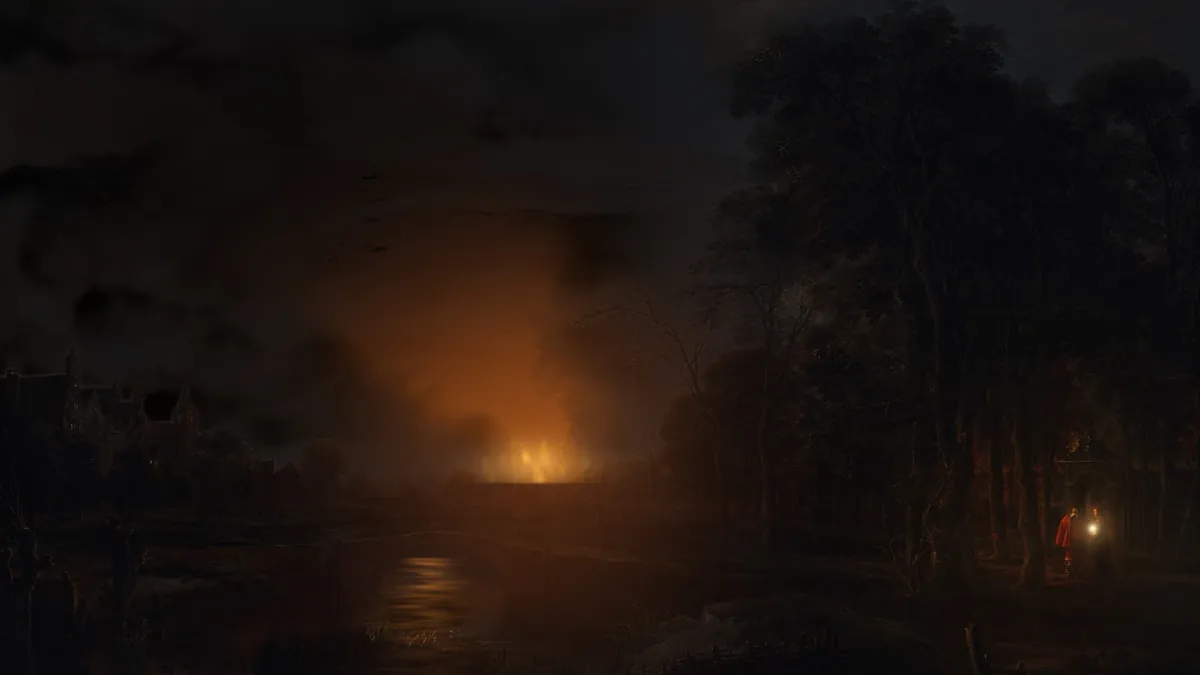
The Prisoners in the Pumping House
Nera Pell had been five days in Darn under a false name, and the yard had not changed in any way that mattered.
It was the same yard. She knew every slip and shed of it by feel in the dark that had lain over the island, with two days' grace, for most of a month. She could have walked from the ropewalk to the dry dock with her eyes shut. She had walked it with her eyes shut, at sixteen, on a bet. The sawpits smelled the same, of resin and wet sawdust. The tar boilers ticked on their fires. The men and women at the benches worked by lamplight, with Pale Fleet guards at the shed doors. When a guard looked at Nera he saw a tall yard hand in a sacking apron with a caulking mallet in her belt. There were three hundred of those in Darn. Agathe Moll had put her on the roll as a cousin from Holm Ennis, and not one guard had looked twice.
She had done everything herself in those five days, because that was how she did things. She had walked the culvert's mouth at low water, carried the bucket past the pumping house, picked the lock on the mast-shed loft and sounded out the pumpman. On the fourth night she had sat on a coil of cable in the dark of the mast shed and caught herself wishing for Enoch. Not for luck. For a man who would see the half of a job done before she thought to ask for it, so that she could stand back and see all of it at once. Then she had thought of him under the oak at Fallow Creek. She sat there with her face in her big hands where no guard could see her, until the bell went for the night shift.
On the evening of the twenty-second, she lay on her stomach in the loft of the mast shed with Dunning beside her, and showed him the yard through a gap in the boards.
"Pumping works," she said. "There, on the south wharf, the stone house with the great wheel beside it. The main dry dock is the black gap next to it. The pumps drain the dock into a pit under the pumping house floor, and the pit empties through the outfall culvert. The culvert runs south from the pit, under the sea wall, and comes out on the shore outside. The guardhouse is at the yard gate, over there by the lamp. Half the pumping-house guard sits in the house and half at the gate, and they change at midnight."
Dunning studied it with his chin on his fists. He had come in that morning on a timber boat, under a load of oak knees, with Joss Ambry and a sack of short swords. He smelled of bilge.
"And the wardwrights are in the house."
"In the loft over the pump floor. Four of them, and their families." She had counted them herself, twice, from the dock edge, carrying a bucket. "They bring the wardwrights out each morning to the drawing office under guard, and back at night. The families never come out at all."
"How do we get up into the house?" Dunning asked.
"From underneath." Nera pointed to the great wheel, black against the faint lamplight from the wharf. "The pumps run on the falling tide. The water goes out through a race under that wheel and turns it, and the wheel drives the chain pumps in the pit. Every tide they drain the dock a little. When the pumps run, the culvert runs half full and loud. You could fire a crossbow in it and not be heard on the wharf. Gil Hatcher says it runs like that for forty minutes, then the dock's down and he lets the pumps go slack."
"Gil Hatcher?" Dunning asked.
"The pumpman. He's tended that wheel for twenty years. They let him in and out because no one else can keep it running." She rolled on her side and looked at Dunning. "He'll be on the pump floor tonight. When we come up the pit ladder, he'll have the grating off."
"Forty minutes," Dunning said. "In through a drain, up a ladder, into a house with six guards in it, a loftful of people down the ladder, and out through the drain. Some of them old, and some of them children."
"Yes."
"And the guards at the front," Dunning said.
"Ansel's boats will draw them off. Rusk's notion." Nera nodded east, toward the harbor mouth, where Darn's walled harbor opened onto the black water of the Reach. "There's an empty lighter moored off the north mole. When the tide turns to run out, Ansel sets a fire raft against her. It'll look like an attack on the shipping. Every guard in the yard will run to the north wall to look."
"Not all of them," said Dunning.
"No," Nera said.
"Who's this woman, then?" Dunning asked, "The one that knows the gates."
"Annet Sorn. Ebb says she warded half the coast." Nera looked out through the gap again at the pumping house, where one lamp showed in the loft window. "Ebb says she wouldn't speak to him for two months. I like her already."
They went into the culvert at a quarter past eleven, with the tide an hour into its fall.
There were five of them: Nera with her adze, Dunning, Joss, and two Darn men. Gil Hatcher was inside already. Ivo Kerrow was a sawyer, broad and silent, with forearms like ship's knees. Bram Coulter was a cooper's journeyman who knew the sea wall. They came along the shore outside the wall in the dark with one shuttered lantern among them. Behind them, tied to a stake in the shingle, lay the boat that would take the families off. A Carrick man named Piers Heron sat in it with his oars shipped.
The outfall opened in the foot of the sea wall, a black arch eight feet high. Water poured out of it in a steady, roaring sheet and spread over the shingle and ran away into the sea. The noise was enormous. Nera put her hand on the stone of the arch and felt it shake.
Below the arch the water had scoured a pool, black and deep, among the rocks.
"Wait," Dunning said.
He took the lantern from Joss and opened the shutter a crack and let the light lie on the pool. Something pale was in it. It stood waist-deep in the black water at the edge of the pool, with its back to them, facing the arch. It was a man, or had been. A chain ran from an iron collar round its neck to a ring bolt in the wall.
"They've chained one of them here," Joss whispered. "Like a dog."
"It's a watchman," said Dunning.
Nera stared at it. They were three miles from Covenant here, inside the engine's five miles, and whatever held the dead held this one. Nothing that drowned at Darn tonight would rise; Covenant's fitting was too far off. But the ones already risen were Covenant's, and this one was waiting.
The dead man turned its head toward the light.
Dunning went into the pool before it had finished turning. He had a pike with the head taken off, a plain ash staff shod with iron, and he swung it low through the water at the dead man's knees. It struck with a sound like a mallet on wet timber. The dead man lurched and came at him along the chain, its arms up. Dunning stepped back, let the chain fetch it short, and broke the other knee. It went down into the pool. It came up again on its hands and reached for him. He brought the butt down on the back of its neck, hard, once, and again, and the reaching stopped.
He stood in the pool with the water to his thighs, breathing.
"Right," he said. "In you go."
The culvert was a stone tube five feet wide, and the water in it came to Nera's waist and pushed. It was cold beyond anything she had felt, colder than the sea, because it came from the bottom of the dock where the sun never reached. It roared in the stone. She went in first with the lantern shuttered to a thread and her free hand on the wall, and the others came behind her with a hand on each other's belts.
She counted her steps without meaning to, as you did in a dark place you had once measured. The culvert ran a hundred and forty yards from the pit to the shore. She had drawn it at seventeen, for Master Dray, on a sheet of foolscap she had probably still got somewhere. She could see the drawing now in her head, the line of the culvert and the thickness of the wall over it, the place where it dipped under the dock footings. The stone over her head was sweating.
At the dip the water came up to her chest. Joss gasped behind her, and she felt Ivo's big hand take hold of the boy's collar and haul him on.
Then the light changed ahead. A gray glow came down from above through bars, and with it a sound of chains clanking: the chain pumps, lifting water out of the dock sump and dropping it into the pit. The pit was a stone chamber twenty feet across, and the water fell into it from the pump buckets in a dozen spouts, so that the whole chamber was full of noise and spray. An iron ladder went up one wall to the grating in the pump floor.
The grating was off. A face looked down through the square hole, round and bald and worried.
"Took your time," said Gil Hatcher.
The pump floor was a long room of stone and timber, lit by one lamp, shaking with the thud of the wheel outside. The great axle came through the wall at one end and turned the gearing for the pumps. Everything was wet. At the far end a stair went up to the loft, and beside the stair was a door to the front room, where the guards were. It was shut.
"Four in there," Hatcher said. He spoke into Nera's ear; you had to, over the wheel. "Two went out to the wall when the fire went up. Can you see it?"
She could. Through the high window over the axle there was a red glow in the sky to the north-east, over the harbor, and a bell was ringing over there. Ansel's fire raft had found the lighter.
"The loft door?" Nera asked.
"Locked. Sergeant has the key. I have this." Hatcher held up a cold chisel and a mallet wrapped in sacking. "The hinges are on the outside. Old ones. I've been greasing them a week."
Nera went up the stair with him. Dunning stood at the guardroom door with Ivo, and Joss and Bram Coulter stayed by the pit. The hinges came off in four blows that were lost in the thudding of the wheel. Hatcher lifted the door aside.
The loft was low and dark, with straw on the floor and a lamp burning very small on a nail. Eleven people were in it. They were all awake, and they were all looking at the door. In front of them, standing, was a woman of fifty-five or so with her gray hair cropped short and a long, hard, bony face. She had a broken length of iron in one hand, from the bed frame by the look of it. She held it like a woman who meant to use it.
"Who are you?" she said.
"Nera Pell. I was Gideon Dray's apprentice. We're getting you out through the pump pit and the outfall. Now."
The woman looked at her. Her eyes were very pale, and red-rimmed, and nothing at all escaped them.
"Pell," she said. "The tall girl who drew the culvert. Dray showed me that drawing. You got the wall thickness wrong at the dock footings."
"I was seventeen," Nera said.
"You were careless." Annet Sorn put the iron bar down on the straw. "Gerrit. Lise. Get the others up. Quickly, and quiet."
They went down the stair in a line, with Nera in front and Hatcher at the back. Sorn's husband was a small, mild, gray man who carried their daughter's shoes. The daughter was twelve, thin and dark and silent. A young wardwright, tall and nervous, brought his mother, who was eighty and could hardly walk. Two more wardwrights came behind with their people, one of them carrying a sleeping boy.
At the foot of the stair Nera put her finger to her lips and pointed across the floor to the pit.
Dunning stood by the guardroom door with his staff. Behind the door, men were talking and laughing. One of them was singing a western song. The thud of the wheel went on and on.
Joss took the children down the iron ladder one at a time, in his arms, into the noise and the spray, and Bram Coulter took them at the bottom. The other wardwrights went down after them. The young man and Ivo between them got the old woman onto the ladder and down it, rung by rung, with her face set and white. Gerrit Sorn and Lise went last. Gil Hatcher went down with them; he would take them through the culvert to the boat on the shore.
Sorn stood at the top of the ladder and did not go.
"Go," Nera said.
"There are four more on the roll," Sorn said. "In the cooper's shed by the gate. Carpenters' wives. They were taken last week for a theft none of them did."
"We can't get them tonight," Nera said.
"No," said Sorn. "I know. I wanted it said." She went down the ladder.
Nera went to the head of the ladder after her. Six minutes left of Hatcher's forty, perhaps eight. Down in the pit she could see the lantern moving into the culvert mouth, and the white shapes of the children's faces in the spray.
The guardroom door opened behind her, and a man came through it.
It was the sergeant. He was a heavy, red-bearded man with a ring of keys in one hand and a lantern in the other, and he had come to count the loft. He stood in the door with the light of the guardroom behind him and looked across the pump floor at the open loft door at the top of the stair. Then he looked at Dunning, standing beside him against the wall.
Dunning drove the butt of the staff into his face.
The sergeant went back through the door into the guardroom, and the lantern went with him and broke. Men shouted inside. A stool went over. Dunning went through the door after him, and Ivo Kerrow went after Dunning with a short sword in his fist. Nera heard steel. She heard a man scream, and Dunning's voice, very calm, saying, "Down. Down. Stay down."
Joss came up out of the pit to the top of the ladder.
"Go back," Nera said. "Go with them."
"Not without you," Joss said.
"Go," Nera said.
Then the wheel stopped. She heard it go: the great thud slowed and dragged and stopped, and the pump chains in the pit rattled down and hung slack. In the sudden quiet she could hear everything: the shouting in the guardroom, the bell over the harbor, a man running outside along the wharf and yelling. And under it all, a new sound. Water was pouring into the pit from the race side, white and roaring, and it was rising.
Somebody out on the wharf had thrown the brake on the wheel. Hatcher had told her what came of that. With the wheel braked, the race spilled into the pit to spare the gearing, and in a minute or two the culvert would run full to its roof.
"Hatcher's got them," Joss said. His face was white in the lamplight. "They were well down the culvert. They're past the dip, they must be past the dip."
"Then they're out." She grabbed him by the shoulder. "And we're not going that way. Dunning!"
Dunning came out of the guardroom backward, with Ivo beside him, and blood on the staff. "Three down. One out the front door, shouting. That's the yard roused."
Somebody outside was pounding on the pumping house's great double door to the wharf. Voices were calling the sergeant's name.
"The back," Nera said. "There's a wicket on the yard side, by the axle. Come on."
They went out of the wicket into the yard and ran.
The yard was waking up round them. Lamps were coming on in the sheds. A drum was beating at the gate. Away to the left, across the dark slipways, men were running toward the pumping house with torches, and somebody was shouting in a western voice for the gate to be shut. The gate was the way out for anyone on foot. It was the one way they could not go.
"Ropewalk," Nera said.
The ropewalk was a shed four hundred yards long, low-roofed, running west along the back of the yard. At night it was empty. The long strands of half-laid rope hung in it on their stakes, the whole length of it, at waist height, like the strings of some enormous instrument. Nera had played in it as a child. Joss had worked in one for five years. He was through the end door before her, with a lantern he had snatched off a hook somewhere.
"Keep low," he said. "Under the strands. Don't touch the hooks."
They ran down the ropewalk bent double, under the hanging hemp. Behind them the end door banged open, and torches came in, and voices.
Halfway down, Joss stopped at a stake where a coil of heavy cable lay ready on a reel, and he cut the lashing on the reel with his knife. "Help me," he said. The cable ran out of the reel and across the floor. Ivo and Joss heaved it, and Nera saw what they meant, and threw her weight on it with them. They dragged it in a long loop round two stakes and back across the walk, waist high and knee high, among the hanging strands.
The first two men with torches ran into it in the dark. The torches went down into the loose old hemp, and one of the men fell full length and the other on top of him. The hemp caught. A sheet of yellow flame ran up along the strands.
"Rot it," Nera said. "The ropewalk."
"It's their ropewalk tonight," Dunning said. "Run."
They came out of the far end of the ropewalk onto the head of the slipways. There were five slips there, running down into the harbor in long timber ramps, black with grease. Covenant had been built on the middle one, the biggest. It was empty now, a great bare ramp with the shores and blocks still lying along it where the hull had stood. Below, at the foot of the slips, the black water of the harbor lapped at the ways.
Two of the garrison came round the end of the mould loft as they reached the slip head. One had a crossbow. Nera heard the bolt go past her ear like a hornet. The other ran at Ivo with a cutlass. Ivo caught his wrist in one huge hand and simply held it, and the man screamed and dropped the cutlass. Dunning dealt with the crossbowman before he could span again.
"Down the slip," Nera said. "Keep to the blocks. The ways are greased, you'll go straight in the harbor."
They went down the big slip among the blocks, slipping and catching at the shores. At the bottom they turned north along the foot of the slips, under the yard wall, to where the log slide came up over it from the sawpits. They went up the slide on hands and knees and over the top, and below them lay the timber pond.
The pond lay outside the wall on the north-west, a square of water penned by a chained boom of logs, where Darn kept its seasoning oak afloat. The logs lay in it packed side by side, rafted together with chains and dogs, an acre of timber shifting gently on black water. Beyond the pond's far side was the log gate in the boom, and the open sea. Agathe Moll had said she would have people at the gate.
"Over the logs," Nera said. "Step where I step. If one rolls, go with it, don't fight it."
"I can't swim," Ivo said.
"Then don't fall in."
She went out onto the timber. The first log rolled under her boot and she rode it and stepped to the next. They were big logs, oak and elm, and wet, and every one moved differently under her. She went across them fast, as she had at fourteen with the other apprentices, racing for a penny. She heard the others coming behind her, Joss light and quick, Dunning steady, Ivo cursing under his breath at every step.
In the middle of the pond, the water between two logs moved.
A hand came up out of it and took hold of the log in front of her. A white arm. A head. The dead man pulled himself up out of the gap between the timbers, slowly, the water pouring off him. He was in a yard hand's apron. She knew him. She had seen him at the sawpits five years ago, a big cheerful Darn man whose name she could not remember.
She swung the adze at his knee, and he caught her ankle as he fell. She went down on one knee on the rolling timber. Her other foot went into the water to the shin. The cold of it went through her like a nail.
"Nera!" Joss was behind her.
She did not try for his neck. She knew logs. She got her free boot against the next trunk and shoved. The two great logs rolled together with the dead man's arm between them, and ground it between them. The hand opened. She dragged her foot clear and kicked the log away, and it rolled back over him, and he went under, and the timber ground shut over the place.
She knelt on the log with the adze in her hands and could not get her breath.
"Come on," Dunning said, above her. "Come on, girl. Gate."
The log gate was a length of the boom that swung on an iron pivot, chained shut. Torches were coming along the wall behind them. Nera heard the crossbows begin again from the top of the slide. A bolt struck the log beside her and stood quivering.
And the gate opened.
She heard the chain fall. The boom swung outward, slowly, pushed by figures she could just see on the logs: four women and a man, with Agathe Moll among them, square and solid, leaning on the gate beam with her whole weight. The outgoing tide took the gate and swung it wide, and the pond began to pour out to the sea, and the logs nearest the gate began to move with it.
"Ride them out," Agathe Moll shouted. "Lie on them and ride them, you fools! The boat's outside!"
They lay down on the logs. The logs went through the gate in a slow, grinding, shouldering crowd, out into the open water on the falling tide, and the torches on the wall went small behind them. A boat came out of the dark alongside, with Ansel Hart standing in the stern and four men at the oars, and hands came down and hauled them in, one by one, Ivo last and heaviest.
Behind them, Darn's ropewalk was one long bar of fire.
They found Heron's boat at the meeting place a mile off the south shore an hour later, lying without lights in the dark. Gil Hatcher was in it, and Annet Sorn, and her people round her wrapped in sacking and boat-cloaks. All of them were soaked to the neck. All of them were alive. The old woman had come through the culvert on her son's back with the water up to his chin at the dip. She sat in the bottom boards now with a blanket over her head. She told anyone who came near that she had been a fishwife for fifty years and was not about to drown in a drain.
The two boats went north-east together, toward the edge of the dark and the long pull to Fallow Creek, showing no lights. Ansel's oarsmen kept the stroke slow and quiet. Nera sat in Heron's sternsheets next to Annet Sorn and shook with cold.
Sorn did not shake. She sat upright with her daughter asleep against her side. After a while she put her hand inside her coat and began to pick at the lining with her fingernails.
"Give me your knife," she said.
Nera gave her Enoch's knife. She had carried it since the first raid on Darn. Bring it back, he had said, and bring yourself, and then on his own deck at Sandle Bay he had told her to keep it. She held it out handle first, and her fingers were slow to let it go. Sorn cut the stitches along the hem of the coat, and drew out a long fold of oiled silk, and from inside the silk a sheet of heavy paper folded small. She opened it on her knee. Nera unshuttered the lantern a crack and held it low under the thwart, so the light fell on the paper and nowhere else.
It was a survey. Nera knew the hand at once: Darn's drawing office, the old style, the coastline drawn in fine ink and the soundings in red. She knew the coast too. Greyhaven at the top, with its harbor and its mole. South of it, the sea wall and the Basin. South of that, the long line of the mainland shore running down toward Southwick, and behind it the Wendle Levels in their sea walls, basin after basin, each with its sluice marked.
Each basin had a figure written in it, small and red, and Nera knew what they were before Sorn said it, because she had drawn sea walls.
"Feet below the top of the springs," Sorn said. She put her finger on the Basin behind Greyhaven. "Six, there. That's the tanneries and the market gardens and the workers' streets. It was sea when my great-grandfather was a boy. He walled it." Her finger went down the coast, basin after basin, through the Levels. "All of it held dry by the sea walls and the gates."
"I know the gates," Nera said. "Darn built them. They're warded."
"I warded them. Half of them. Thirty years ago." Sorn's voice was very low and quite steady. "Every sluice on that coast has a master plate in its gatehouse, keyed to the others in its reach. When the surge comes up in a southerly gale, the wards hold the gates shut whatever the sea does. Nothing living can open them against the ward. That was the point."
"Then what's he want with them?" Nera asked.
"A ward that holds can be told to let go. If you have the key cut for it." Sorn turned to Nera in the thread of lamplight. "They made me cut new plates. Copies of my own plates, Pell, keyed to every master on the Levels and the Basin. Ward plates to bolt over the old ones, inside each gatehouse. A man named Lockwood took them to the mainland a fortnight ago. Gate engineer. I'd have known him for a fool in any yard on the coast."
"And the key?"
"On the flagship," Sorn said. "Crown. In the forward hold, there's a machine like nothing you've seen, a warded drum the size of this boat. Separate from the engine, separate from the frame. Its own work entirely." She spread her fingers flat on the survey. "When Crown comes within three miles of a prepared gate, at high water, the drum can break the locks on every plate in that reach."
Nera stared at the paper in the thread of light.
"At high water," she said slowly. "The sea six feet above the streets. And the gates swing."
"Inward," Sorn said. "The sea opens them for you once the ward lets go."
Nera saw it: a pair of oak gate leaves across a race, six feet of sea behind them at the top of the springs, the slope of the Basin floor, the drains, the streets. The water would come through the gates in a wall. It would fill the Basin in an hour. Less. It would come at night if Vaust chose the night tide, through streets where people were sleeping, in the dark of the canopy where nobody could see it coming.
"They'd drown," she said. "Thousands of them."
"Yes," Sorn said.
"For what?" Nera asked. "He wants the coast. He wants the ports. What's the good of a drowned basin to him?"
Sorn let the question lie. Ahead in the dark, Ansel's boat had stopped pulling, and Heron's men lifted their oars. Off to the north, a lantern was moving slowly across the water: a guard boat, a mile off, on its beat. Every face in the boat turned toward it and held its breath. It went on west, and dwindled, and Heron's men let their oars down into the water again without a splash.
"There's a third thing," Sorn said, when they were moving. "They're cutting small fittings at Lisk, the size of my fist, and Lockwood sinks them in the gate races, where the stream runs through the sluice and powers them. They make no dark. Each one is a door into the water, a mile round, and inside that mile it has everything that drowns."
Nera's hands went cold on the lantern.
"In the gate races," she said. "Where the water comes in. Where the people are."
"Where twenty-six thousand people are, at the top of the November springs." Sorn folded the survey along its old creases, carefully, and put it back in the oiled silk. "I asked Lockwood once, in the drawing office, when the troops would come off the Basin. I said it as if I knew. He told me. There's a sealed order gone to the Greyhaven garrison by the Petrel. Every soldier off the Basin and the Levels before the ninth. A protection ceremony at the springs, he called it. He thought it was a fine phrase."
"And the people?" Nera asked. "Are they to be moved?"
"I asked him that too." Sorn's mouth was a thin line. "He said, 'Why would anyone move them?'"
Lise stirred against her mother's side and murmured something in her sleep. Sorn put her arm round the girl and drew the blanket up.
"Vaust," she said, "is not conquering the coast, Pell. He's feeding it."