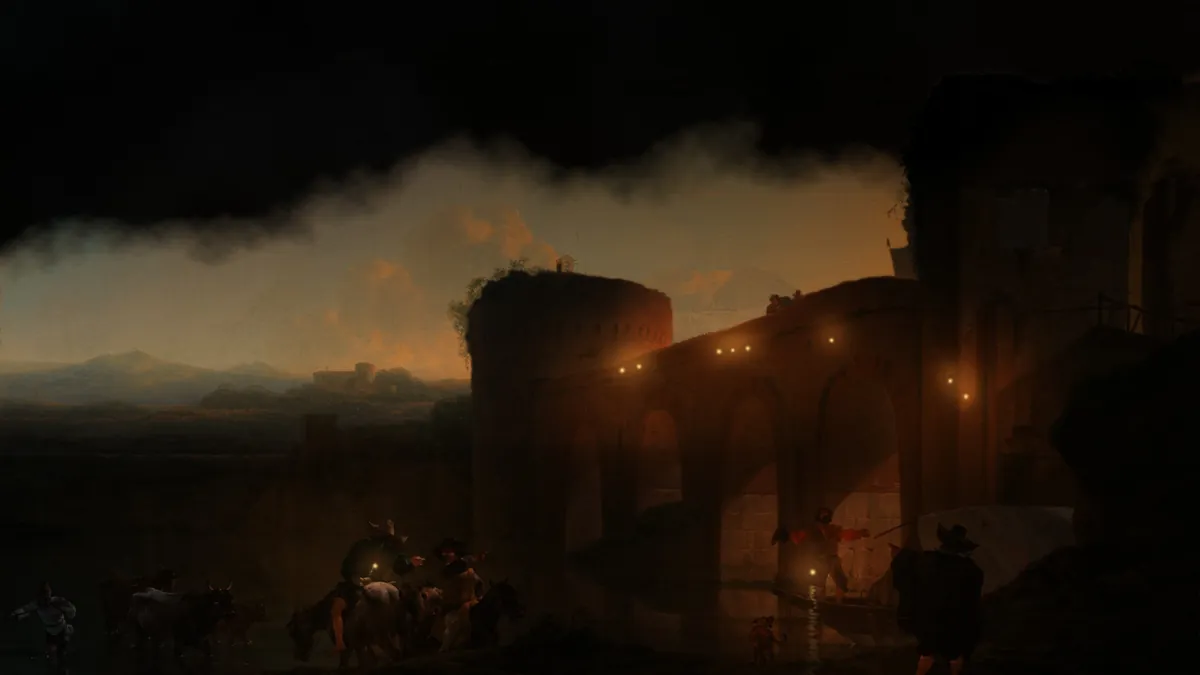
The Keeper's Departure
The wick wanted trimming at a quarter past one, every night of the year, and Marietta Voss went up to trim it.
The hulks were moving in the Throat below. She could hear them from the stair, that long grinding groan coming up through the stone, and the clank of the sheer-hulks' chains, and men's voices across the water. She kept climbing. Her trimming scissors were in her apron pocket and the oil can was in her hand. Her great-grandfather had climbed this stair every night of his keeping, and her grandfather after him, and her mother after that.
The lamp burned in the middle of the room inside its ring of lenses. It was a broad brass reservoir lamp with a round wick as thick as her wrist. Round it, in a bronze cage taller than a man, stood the lenses. They made one great lens, ring upon ring of thick glass prisms ground by hand in Darn a hundred years ago, each set to catch a little of the flame and bend it out to sea. From the inside the light was almost too much to look at. From the outside, on a clear night, ships had seen it from twenty miles off.
Outside the windows tonight was only Northward's dark, the sheer-hulks' lamps in the Throat, and the far small lights of the engine in the west.
She opened the little door in the lens cage and trimmed the wick, straight across, the way her grandfather had taught her at nine years old, standing on a stool. The flame steadied and went up white. She filled the reservoir from the can. She wiped the soot from the inside of the nearest lens with the chamois she kept in her other pocket. She shut the little door and stood back, and looked at the light, and let herself feel how tired she was.
Four keepers. A hundred and ten years, by the book on the shelf. Every night of every one of them, someone of her name had climbed that stair to trim the wick.
"Aunt."
Cal was in the doorway. He had his crossbow over his shoulder and a lantern in his hand, and his face was strange.
"Ruth says come down," he said. "It's the cistern. There's something in the cistern."
The lower cistern lay under the middle terrace, cut out of the living rock by whoever had built the first tower, long before there were keepers named Voss. It was a long dark vault with a pool of fresh water at the bottom of a stone stair, fed by every gutter and roof on the island. Under a broken slab at its north end, in the floor of the pool, was a hole Marietta had not known about until a month ago. It was the top of the Cistern Cut, which ran down through the rock to a sea-cave on the north shore. At half tide and below, a man could come up through it. Abner Daw had brought Marr and her marines in that way, a month ago. Only a few old Holm Ennis fishermen had ever known of it.
Somebody else knew it now. Marietta came down the cistern stair at a run with Cal behind her. Ruth Annick was at the bottom on the landing with a lamp held high and four of the island men round her with pikes. She kept her eyes on the water.
"Listen," Ruth said.
Marietta listened. Under the drip of water and the hiss of the lamp, she heard it. A splashing, steady and patient, from the far end of the cistern, where the broken slab was. The sound of something wading.
"How long?" Marietta asked.
"Ten minutes. One of the men came down to draw water for the wounded and heard it. He thought it was a seal come in through the Cut." Ruth's mouth was a hard line. "It's not a seal."
Marietta took the lamp from her and held it out over the water.
Before the light reached the far end, a voice came across it.
"Keeper?" It was a man's voice, wet and level, and it came from the water. "Keeper, is that you with the lamp? I can't find the stair."
She knew it. It belonged to a Holm Ennis fisherman who had taken a boat out through the Gut on the fourth night with nine people in it and had not come back, and whose wife had asked Marietta about him every morning since. She had the breath in her to answer him before she knew it.
"Don't," Ruth said, very low. "Marietta. Don't answer it."
"Keeper," the voice said again, patient, from nearer. "The water's cold."
"That's my uncle," said Wil Pascoe behind her. "That's my uncle's voice."
"It's his mouth," Marietta said. "It isn't him." She held the lamp higher.
The light ran across the black pool to the north end, fifty yards off. Out of the water there, where the slab lay broken, heads were rising. Pale shapes in sodden clothes came up one after another out of the hole in the floor and stood waist-deep, and turned, and waded toward the stair. Ten of them. Twenty. More were coming up behind.
The tide was falling, and it was half tide. The Cut was open.
"They'll foul the water," Wil Pascoe said. He said it in a strange, empty way, as if that were the worst of it.
"They've fouled it already." Marietta handed the lamp back to Ruth. Her voice came out level and brisk, and she was grateful to it. "Ruth, wake the terrace. Get Corporal Cobley and every pike he has. Cal, the stair. Nothing comes up this stair. Wil, you and the others with Cal. Break their legs. They can't climb a stair with broken legs."
"Aunt, what about the water?"
"The water's gone, Cal," she said. "Hold the stair."
They held it for twenty minutes.
The cistern stair was eight feet wide, and it climbed the side of the vault from the landing at the water's edge to an iron door at the top, which opened onto the middle terrace. Cal put his men on the landing with pikes, five across, with himself in the middle and his crossbow. Marietta stood behind them on the stair with a maul from the workshop.
The dead came wading up out of the pool onto the landing in a mass, without hurry and without a sound. They walked into the pikes, and the pikes broke their knees and their shins. They fell and crawled, and the ones behind climbed over them and came on. Wil Pascoe's pike was torn out of his hands. A drowned man got him by the arm and dragged him screaming into the water. Marietta went down onto the landing and hit the dead man across the back of the neck with the maul, so hard the shaft stung her palms. It let go, and Cal pulled Wil out by the hair.
"Back," she said. "Back up the stair."
They gave ground, and the dead came on. Cobley's marines came down from above with their pikes and their lamps, and the stair became a narrow place of noise and light and stinking water. The dead kept coming up out of the pool, with no end to them. They had been walking the bottom of the strait for a month, Vaust's drowned, brought east from wherever they had died. Northward's fitting, three miles off, was holding them all.
Then a crossbow bolt came up out of the dark at the far end of the cistern and hit the wall beside Marietta's head.
She turned. At the north end, behind the dead, there were lanterns now. Living men were coming up out of the Cut, in Pale Fleet blue-gray, with crossbows held high and shields on their backs. Marines. They had sent the dead in first to clear the way, and now they were coming in behind them.
"Corporal," Marietta said. "We can't hold this."
Cobley looked down at the landing, and at the living men wading across the pool behind the dead with their crossbows held up out of the water.
"No, ma'am."
"Then up," Marietta said. "Everybody up. We hold the door."
The iron door at the top of the cistern stair held them for another hour. Then the marines brought a baulk of timber up through the Cut for a ram, and the dead put their shoulders to it beside the living, and the door's hinges came out of the rock.
By then Marietta had pulled the middle terrace back.
She did it as she had planned it, years ago, sitting in the lamp room with her grandfather's drawings of the island spread across her knees. Everything on the middle terrace that could walk went up the east ramp into the upper walls. Everything that could not be carried was left. The stone throwers on the south side were spiked. The workshops were left open and empty. When the cistern door came down and the enemy came up out of the ground into the middle terrace, they found it deserted, and the defenders shooting down at them from the upper walls.
By four in the morning, by the clock, Vaust's marines held the middle terrace and the cistern under it, and the south half of the lower terrace above the cove. The east side of the island was hers yet: the upper walls, the refuge court, the tower, and the keepers' stair. That was the old stair cut into the island's east face, which ran down from the upper walls to the boat slip. Cobley's marines and the Kestrel's people held the slip. The Kestrel lay off it, with her heavy crossbows covering the water.
Marietta stood on the upper wall in the cold, looking down at the enemy's lamps moving among her workshops, and made herself take stock.
The upper cistern was a tank in the refuge court, half full. Three days for the people left on the island, if nobody washed. Eighty-four souls were in the refuge, forty-one of them wounded, a dozen old, and the rest fighters. They had food for a week, and crossbow bolts for a day's hard fighting. And in the Throat below, the sheer-hulks had lifted the Edith clear of the channel floor and were swinging her north, out of the deep water. The Old Pruett would follow by the next high water.
When the Throat was clear, Vaust could bring whatever he liked through it. He would bring it to her slip.
Rusk came up the keepers' stair at six in the morning with Joss Ambry behind him, and found her in the lamp room.
She had not meant to go there. She had gone up to check the oil, because it was a thing to do. Then she had sat down on the bench under the lens cage, and her legs had declined to lift her again. The lamp burned on. It had never once gone out in a hundred and ten years, except to be cleaned.
Rusk stood in the doorway. He looked as tired as she felt. His coat had blood on it that was not his, and he held his left side stiffly where the shield had caught him four nights ago.
"Captain," she said. "Sit down. There's tea in the can, if it's still warm."
He sat on the stool by the oil store. Joss stayed in the doorway. Nobody poured the tea.
"I'm staying," Marietta said.
He waited.
"Not everyone. The wounded go. The children went days ago. Ruth goes, and the old ones. But somebody has to hold the upper walls while the boats load, and somebody has to keep the stair, and someone has to keep this light lit until the last boat is off. That's me. That's my work. I'll keep twenty volunteers. Cobley, if he'll stay." She looked at the lamp. "It's my family's light, Captain. Four of us. I'm not giving it to him."
Rusk sat on the stool with his hands on his knees and looked at her for a time.
"I won't tell you what to do," he said. "It's your island, and your light, and your life. I've told enough people what to do with their days. But I'll tell you what I know, and then you decide. Will you hear it?"
"Go on," Marietta said.
"In two days, on the tenth," Rusk said, "Vaust brings three engines into this strait, and we mean to break all three on that one tide. Marr is bringing the Southwick ships. The boats that do the work are island boats, in the dark, under two fields, and they need someone to tell them where to go."
"Ansel knows it," Marietta said.
"He knows the Gut," Rusk said. "You know the island. On the tenth, somebody has to land on Orra and take back the signal terrace on the south crown, so the boats have a station to talk to. They'll have to come up from the cove, in the dark, by the old cliff stair. I've been down that stair once, in daylight, with you. I couldn't find the foot of it from the cove in the dark. I'd have to guess. If I guess wrong on the tenth, the boats work blind."
"And there's this," Rusk said, more quietly. "If you stay, you'll hold that wall for an hour after the last boat goes. Maybe two. Then he'll take the tower, and you with it. And on the tenth he'll have your light, and every signal you've ever made from it."
"He won't have my signals," Marietta said. "I'll break the lenses first."
Rusk sat back. "That's what I know. I won't order you, Marietta. I'm not your captain. You decide."
She looked at him, and past him, at Joss Ambry in the doorway, nineteen years old, a ropewalk boy with tar on his hands and a cut on his cheek. He was looking at her with an expression she could not quite meet.
She looked at the lamp. It burned white and steady inside its rings of glass, as it had burned every night of her life.
"My mother," she said, "used to say there were people here. Every time anybody asked her why she stayed. There are people here." She stood up. Her knees cracked. "I suppose that holds. Wherever the people go."
"Yes," Rusk said.
"Then I'll go." She heard her own voice, steady and dry. "But the wounded go first. Every one of them. Then the fighters. Then me and Cal, and the light goes out last. That's my condition, Captain."
"Agreed," Rusk said.
"And the Kittle tonight, at the top of the tide," Marietta said. "Not the channel. He'll have the channel by dark."
"That too," Rusk said.
She nodded, and turned her back on him, and opened the little door in the lens cage and looked at the wick, because she could not look at anything else.
They held the upper walls all that day.
Vaust's marines came at them three times from the middle terrace, up the east ramp and the south stair, and three times they were thrown back. In the afternoon a boat came in under the slip with living marines and tried to land, and the Kestrel's crossbows swept it and it pulled away with half its men down. From the walls Marietta could see the sheer-hulks working in the Throat. By the clock it was afternoon, and black as midnight.
At noon Resolute went east down the channel under Venn, with every one of the wounded aboard. Hanne Webb and Ruth Annick went with them, bound for Holm Sound before the channel shut. Marietta saw her off from the wall. She watched Resolute's stern lantern go away east down the channel until it went out of the dark into the daylight two miles off, and vanished.
The rest went in the boats that night.
The Kittle's high water was at eleven. At half past nine, Orris began to send them off from the slip. Six island boats pulled away one after another, round the island's east end into the Kittle's mouth, where the Kestrel waited under Isobel. Thirty-odd fighters were left on the walls. Cal held the head of the keepers' stair with eight crossbows. Cobley held the slip.
At ten, the enemy saw what was happening and came at the walls.
They came all together this time, up every ramp and stair on the south side, sixty men or more, with lamps and shields and scaling poles, and the dead coming with them. Marietta's crossbows on the wall emptied into them and could not stop them. They came over the south wall of the refuge court. She heard the shouting change and knew it.
"Out," she said. "Everyone out. The stair. Now. Cal, come with us."
"Go, Aunt," Cal said. "I'll hold the head of the stair."
"You'll come with me," Marietta said. "There's one more thing."
She took him up the tower. They ran up the spiral stair together, her in front, him behind with his crossbow, and came out into the lamp room. The light was burning. Below, she could hear the fight coming across the refuge court toward the tower door, the clash and shout of it, and Cobley's voice bellowing at his marines to hold.
She had brought the hammers up that morning. Two of them, heavy shipwright's mauls from the workshop, laid on the bench under the window. She had sat beside them all afternoon between the attacks and not looked at them.
"Aunt," Cal said.
"The flame first." She opened the little door in the lens cage. She reached in and turned the wick down, slowly, the way she had been taught. The white flame shrank and yellowed and guttered. It went blue at the edges and sank to a bead and went out. The lamp room went dark, except for Cal's lantern on the floor.
The smell of hot brass and lamp oil hung in the room, the oldest smell she knew. She picked up the maul.
The lenses stood round her in their bronze cage, ring on ring of thick clear glass. In Cal's lantern light they caught the flame and threw it back a hundred times, small and gold. Her grandfather had polished them every morning with chamois and rouge. So had her mother. So had she, for thirty-one years. She knew every prism in every ring. She knew which had a fleck of bubble in the glass, and which had a chip in the edge from the great gale of the year she was born. She knew the one that had been replaced after her mother dropped a wrench on it. She knew the sound they made in the cold, a faint high singing when the glass contracted at dawn.
Over the door, cut into the lintel stone, were four names. Edmund Voss. Aurel Voss. Hester Voss. The last had been cut by her mother with a mason's chisel the winter before she died, when her hands were already shaking, and the letters wandered: Marietta Voss. She had never once come into this room without seeing them.
"I'll do it, Aunt," Cal said. "Let me. You go down."
"No." She did not look at him. "It's mine to do. Help me, if you like. But I start it."
Below them, the fighting had reached the foot of the tower. Somebody was beating on the door with something heavy, and Cobley's voice was hoarse.
She set her feet among her mother's lenses, and swung the maul at the nearest ring.
It broke with a sound like a bell cracking. Glass flew everywhere, in great curved shards and a glittering spray, and rang on the stone floor and the bronze. She swung again. The second ring broke. She heard Cal begin beside her, on the other side of the cage, and the sound of his blows came with hers, and the glass went on breaking and breaking. It cut her hands, and she kept on. She broke every ring she could reach, and climbed on the bench and broke the upper rings, and the bronze frame that held them. Then she turned on the signal shutters in their brass slides, the shutters that had sent the message to Southwick in September: THERE ARE PEOPLE HERE. She broke them until the slides were twisted and would never run again.
When she stopped, there was nothing left in the lamp room but the cold lamp in its ruined cage, and glass to the ankles. Her breath was loud. Cal's lantern lay on its side among the shards, and every broken piece round her feet held a small gold flame, hundreds of them, going nowhere. For a hundred and ten years the light had gone out to sea every night. Now it lay on the floor and lit nothing but her boots.
"Aunt," Cal said. "Aunt. Come on."
She was holding the maul. She put it down on the bench.
On the shelf by the door was the book: a hundred and ten years of the light, in four hands. Every night's oil, every ship seen, every gale. She took it and put it inside her coat. She took the trimming scissors too, from her apron pocket, where they always were, and held them in her fist.
They went down the stair.
The refuge court was full of fighting. Cobley's marines were holding the tower door and the head of the keepers' stair, a dozen men in a tight knot with their pikes out, and Vaust's marines were coming at them across the court. The dead were with them. In the lamplight Marietta saw a drowned woman walking into a pike with her arms out, and the marine on the pike's end yelling as he broke her.
"Down!" Cobley roared. "Down the stair! Keeper, go!"
She went down the keepers' stair with Cal in front of her and the marines coming behind, step by step, in a fighting retreat. The stair was steep and narrow, cut into the rock face, with a rope rail on the seaward side and a hundred-foot drop below. Lanterns burned on the slip at the bottom, and the last boat waiting. Below that, out in the dark, she could see the Kestrel's lights at the Kittle's mouth.
Halfway down, the enemy reached the stair head and began to shoot.
The bolts came down past them and broke on the rock. A marine behind Marietta grunted and fell against the rope rail and hung there. Another dragged him up and on. And from the slip below, crossbows were shooting back, upward, past them, at the stair head: the Kestrel's men, and Orris roaring orders.
Cal stumbled and went down on one knee in front of her, and she saw the bolt in his thigh, through the leather of his breeches, high up. He tried to stand and could not.
"Go on," he said. "Aunt. Go on."
"Get up," Marietta said.
"I can't," Cal said.
Rusk was there, coming up the stair from below at a run, with Joss behind him. He got his shoulder under Cal's arm and heaved him up, and Joss took the other side, and they went on down together with Cal hopping and swearing between them. Marietta came behind with her hand on the rope rail and the bolts breaking on the rock round her.
At the bottom, Orris was on the slip on his feet, his splinted leg stuck out stiff, a crossbow in his hands. He was shooting up at the stair head as if he were twenty.
"Into the boat," he said. "All of you. Keeper. Into the boat."
She got into the boat. They put Cal in after her, in the bottom boards, with his leg out and his face gray. Rusk lifted Orris in like a sack of meal and swore at him. Cobley's marines came down off the stair and tumbled in on top of them, the last three with their pikes pointed back up the stair. Abner Daw was at the tiller.
"Shove off," Rusk said.
They shoved off. The oars bit. The slip went away behind them, and the lantern on it, and men came running down onto it from the stair with lamps, and crossbows began to shoot after the boat across the water. A bolt struck the rail by Marietta's hand. Another went into the water alongside. Abner put the helm over and the boat swung north round the island's east end, and the slip went out of sight behind the rocks.
The Kittle at the top of the tide was black and quiet. The boat came up into it, round the island's north-east shoulder, toward the Kestrel's lights a quarter mile ahead. Abner was steering by memory and the feel of the stream. Nobody spoke. Rusk sat in the stern beside Abner with his hanger across his knees. Cal lay in the bottom with his head in Marietta's lap. She held the cloth to his leg with one hand. The other was in her coat, holding the book.
She turned to look back. Orra stood up behind them against the dark. She could see the shape of it only because of the enemy's lamps: lights moving on the slip, on the keepers' stair, in the refuge court. Lights on the middle terrace among her workshops. Lights coming into the cove below the south cliff, boats landing, more and more of them. Vaust's people were taking her island.
And at the top of it, on the western crown, where for a hundred and ten years there had always been a light, there was nothing. The tower stood black against the black. She could not even see its shape.
For the first time in her life, there was no light on Orra.
She looked at it for as long as she could see anything, before she turned away to the west, past the island's shoulder, where the open sea was.
The west was full of lights. Northward's great cluster lay where it had lain for five days, three miles west of the tower, at anchor. But south of it there was a second cluster now, low on the water, coming in from the south-west under tow with a fan of towboat lamps ahead of it, slow and huge. Mercy, closing on the strait. And farther out still, beyond them both, so far and faint she was not sure she saw it, a third glow on the edge of the dark. Something very big, coming east from Lisk.
"Crown," Rusk said beside her. He had seen her looking.
"He's bringing them all in," Marietta said.
"Yes. For the tenth." Rusk sat with his hanger across his knees and looked west. "We'll be waiting for him."
Marietta held the book against her chest under her coat. In her other hand she held the trimming scissors, so tight her fingers ached, and she kept hold of them as the boat went on down the Kittle toward the Kestrel's lights.