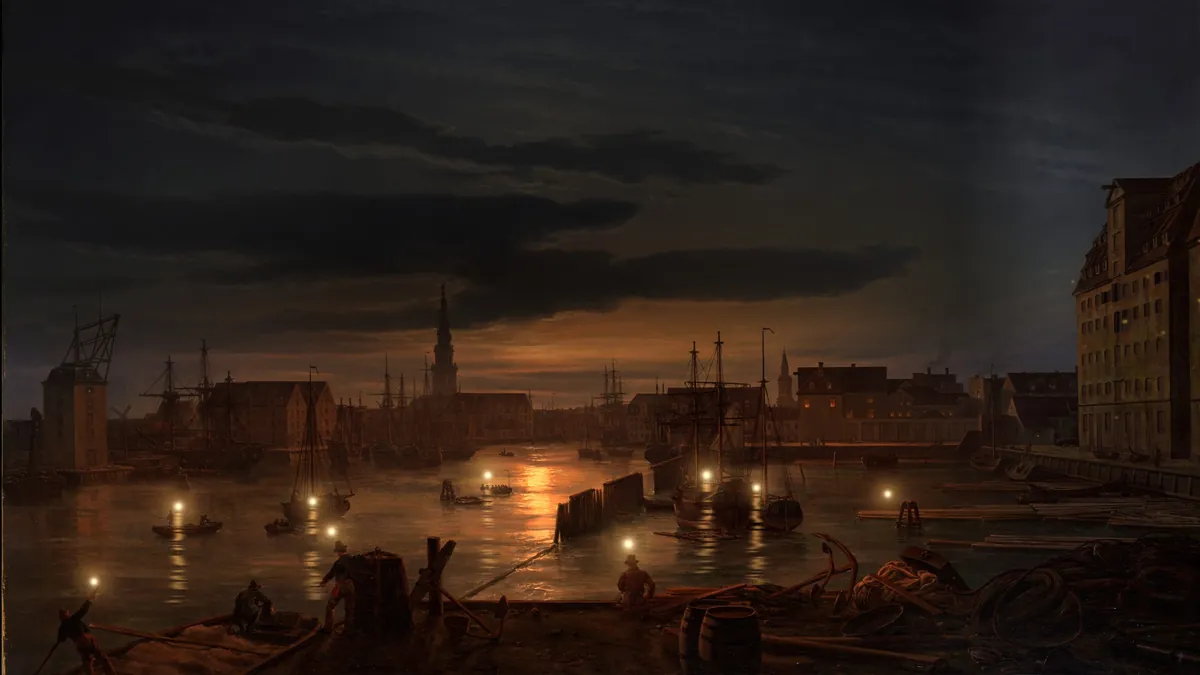
The Raid on Darn
Nera drew Darn on the Kestrel's cabin table with a stick of charcoal, from memory, and her hand knew it better than her head did.
"The harbor faces east," she said. "Walled all round, with the mouth here between the two wall-heads, a hundred yards wide. The south side is the main dry dock, with the pumping works beside it and the drawing office over the dock head. The slipways run along the west side, five of them, and the big slip is the middle one. Behind the slips are the sawpits and the ropewalk. The north side is warehouses, the sail loft and the timber store." She drew a ragged shape outside the wall on the north-west. "And here's the timber pond. Logs come in from the sea through the log gate and float there to season. A slide runs up from the pond to the sawpits, so the logs can be dragged straight up to the saws."
Rusk leaned over the table with his hands spread on it. Marr stood across from him. Dunning sat on the locker with his arms crossed, and Ansel Hart and Isobel Wray stood in the doorway because there was nowhere else to stand. Enoch held the lamp.
"And Tamsin says one sentry on the boom," Rusk said.
"One sentry, and three feet over the sill at the top of high water." Nera tapped the log gate. "That gives us an hour and a half either side of the top, no more. After that the sill comes up, and nothing goes over it but a duck."
"Where's Patience lying?" Rusk asked.
"In the Darn Race." Ansel Hart reached past her and put his finger on the chart beside her drawing, south-west of the island. "Anchored in the stream there since yesterday noon. Her tugs went back to their moorings. And Resolute's lying a mile south-east of the harbor mouth as guard ship. I saw her lights coming in."
Nera felt Marr stiffen beside her at the name.
"Three miles from the Race to the harbor," Nera said. "So her dark covers the whole island. But anyone who drowns in Darn harbor stays dead. It's too far from her door."
"Unless there are already dead in the harbor," said Marr.
"Unless that," Nera said. "Yes."
Rusk straightened. "Who goes?"
"Me," said Nera. "I know the yard. I know every door in that drawing office and which floorboard squeaks. I know Master Dray." She looked at Marr. "Commander, you'll want to come. Don't. If it goes wrong, someone has to bring the boats in after us, and they'll need you."
Marr held her eyes, then nodded. "Dunning goes with you. Four marines. Hart, because he knows the water and the western speech. And Ebb."
"Ebb," said Rusk.
"He knows their drawing marks. Nera says the office will hold ten thousand sheets. She can't search ten thousand sheets in an hour and a half. He can tell her which ones are theirs." Marr turned to Dunning. "He stays under your hand every moment, Sergeant. If he so much as coughs at the wrong time, you knock him down."
"Yes, ma'am," said Dunning.
"And Isobel takes the boat in," said Rusk. "Sellick's lent us his. She's flat enough to go under the boom."
Isobel had gone pink to the ears. "Yes, Captain."
Afterward, when the others had gone, Enoch caught Nera at the foot of the ladder and pushed something into her hand. It was his clasp knife, a heavy old thing with a horn handle worn smooth.
"For luck," he said. "It's been in every scrape I ever got into, and here I am."
"Enoch, I've got a knife," Nera said.
"Not a lucky one." He closed her fingers over it. "Bring it back. And bring yourself. Pudding's taken to you."
"Pudding bit me yesterday."
"That's how she shows it," Enoch said.
Isobel took them in at half past eleven on the night of the tenth, with the tide nearly at the top and the black water lying smooth as oil.
The boat was a Carrick fishing smack with her mast unstepped and four men at the oars, the blades muffled in rags. Nera sat in the stern beside Isobel with Ebb at her knee and Dunning behind him. Ahead, low against nothing, a single lantern burned on the timber pond's boom. It hung on a post on a raft of logs chained across the log gate, and a man sat beside it on a stool with a crossbow across his lap. Beyond him, faintly, the yard showed as a glow of lamps on the black.
"Easy," Isobel breathed. "Easy all. Let her carry."
The boat ghosted in. At twenty yards the sentry stood up.
"Who's there?"
Ansel Hart answered him from the prow in the flat, quick speech of the western islands, without hurry. "Hold your water, it's only us. Timber boat from Lisk Roads, with the oak for the new frames. Where's the night foreman? We've been an hour finding this damned gate."
"Lisk?" The sentry lifted the lantern. "Nobody said anything about a timber boat."
"Nobody ever says anything about anything," Ansel said. "Lift the boom end, will you, or do we sit here till morning?"
The sentry came along the raft to look down at them with the lantern held out. Dunning rose from the bottom of the boat in one long movement, caught him by the ankle and pulled. He came down off the raft into the boat on top of the marines, and before he could shout, Dunning had him by the throat.
"Not a sound," Dunning told him. "Not one, and you see morning."
The man nodded, wide-eyed. They tied him and gagged him with his scarf and laid him under the thwarts. They unshipped the boom's end-chain and swung the last log aside, and Isobel brought the boat through the gap, over the sill with a soft scrape of keel, and into the pond.
Logs floated all round them in the dark, great trunks of oak and elm lying in the black water, nudging one another. The smell came up off them, wet bark and tannin, and Nera's throat went tight. She had been seventeen the first time she smelled it.
"The slide," she said. "Straight ahead. Where the ramp comes down."
They grounded at the foot of the log slide. Nera went first, up the wet planks of the ramp on her hands and feet with Enoch's knife in her pocket and her caulking mallet on her belt. At the top she lay flat and looked over.
The sawpits were dark and empty. Beyond them the yard opened out, and it was lit.
Lamps burned everywhere on poles and in brackets on the walls: along the ropewalk, along the slipways, round the dry dock's rim. Under them the yard was working. She could hear adzes, and mauls, and the long rasp of a saw in a pit somewhere further off, and a foreman's voice calling the heave. Darn had never in her years worked through the night like this. And among the workers walked men in dark coats with crossbows and pikes, slow, watching.
On the big slip in the middle of the yard stood a ship unlike any she knew.
It was enormous. It was broad as a hay barn and longer than any hull that slip had carried in her time, and it stood high on its cradle with scaffolding round its sides. Its planking was black with fresh tar. Iron straps ran round it like hoops on a cask. Under it, along both sides of the keel, the iron cages of the vanes hung empty, waiting for their plates. Amidships, the hull bulged where the frame room would be, and the planking there was sheathed in iron plates as thick as her thumb.
High up in its side, well above where its waterline would come, there was a square hatch the size of a cart's tailboard, closed and bolted. She could not think what it was for.
"Covenant," said Ebb's voice beside her, very low. He had come up the ramp behind her with Dunning's hand on his collar. "They'd laid her keel when I left. I never thought they'd have her so far on."
"How far on?" Nera asked.
"Ten days. Two weeks, perhaps. The vanes are the last thing." He was staring at it. "She'll be the best of them. They learned on the others."
Nera looked at the iron sheathing round its middle, and thought of the Lamb's frame cracking under her bar, and knew no bar on earth would reach that one.
"Come on," she said.
They went along behind the sawpits in the shadow of the timber stacks, and under the ropewalk where it ran on stone piers, and came to the dry dock by the back way, past the pumping works. A steady thump of pumps came from the pumping house, and its windows were barred, and two men with pikes stood at its door. Nera noted them and went on.
The drawing office was the long room over the dock head, with its windows looking down into the empty dock. The outside stair went up the end wall. A guard sat at the top of it on a stool with a lantern at his feet, half asleep.
Dunning went up the stair without a sound, and the guard woke with Dunning's fist in his collar and a knife under his ear. They took him inside with them.
The room was as she remembered it, and it was not. The long tables were there under the windows, and the great flat presses where the sheets were kept, and the smell of ink and paper and lamp oil. But there were bars on the windows now, and a chain on the press drawers, and a cot in the corner. At the far table, under a single lamp, sat an old man in a frayed brown coat. He had a pen in his hand and a sheet in front of him and spectacles on the end of his nose. His hair was white and stood up from his head like thistledown.
He looked up at the noise. He looked at the guard with the knife at his ear, and at the marines, and at Ebb. Last of all he looked at Nera, and put down his pen.
"Pell," said Gideon Dray. "You're late. You were always late."
Nera crossed the room in four strides, and no words came. He stood up and took her by both arms and looked into her face.
"You're thinner," he said. "And you've hurt your hip. You're favoring it. Sit down before you fall."
"There's no time, Master," Nera said. "We've come to take you out."
"No," said Dray.
"Master Dray, please," Nera said.
"Four hundred people in this yard, Pell, and their children are shut in the chapel on the hill as surety. If I'm gone in the morning, they'll hang somebody. They've told us so, and they meant it. They hanged a caulker a fortnight ago for a loose bolt." He let go of her arms. "I'll not go. Don't waste your breath. What did you come for?"
She told him in twenty words. He listened without interrupting, and at the end he turned and looked at Ebb.
Ebb stood between two marines with his hands knotted in front of him. He had gone gray.
"Tomas," said Dray.
"Master Dray." Ebb's voice was barely there. "I'm sorry." He could get no further.
"You were always good," Dray said. "That was never the trouble with you." He turned to the presses and took a key from his waistcoat pocket. "They gave me the key so I could fetch their sheets. Come here, both of you. The frame sheets are in the bottom four drawers. Their mark is a ring with a bar through it. You'll know it, Tomas."
They worked by one shuttered lamp at the long table, with tracing paper from Dray's stock and a pot of his ink. Dunning put the bound guard in the corner with a marine sitting on him, and set Cobley at the stair head and a marine at the window. Ansel Hart stood at the door, listening to the yard.
Ebb went through the drawers with his fingers flying. He pulled out sheets, glanced at them, put them back, pulled out others. He laid them in front of Nera one after another, and she traced: a vane cage in section, a frame lattice in plan, the sea-chest and its trunk. Her pencil moved fast and her hand stayed steady. She could hear her heart.
"This one," Ebb said. "This is the one. It's the trial sheet for the full engines. Patience and the rest." He pulled the lamp nearer and put his finger on a column of small, neat figures down the right-hand margin. "Here. Charge held after the vanes are stopped, in all trials. Twelve minutes."
"You told us a quarter hour," said Nera.
"I guessed long. Twelve, every trial, the same within a few breaths. And here." His finger moved. "Recovery. To bring a stopped engine back once its charge is gone: two hours of stable work at the frame before it will hold the dark again. And here, the canopy at full tune."
"Somebody's on the stair," said Cobley at the door, cutting across him.
They froze. Nera put her hand over the lamp shutter. Feet went up the outer stair, slowly, and halted at the top. A voice said something outside in a low tone. Then the feet came on in through the door, and it was a boy of twelve with a coal bucket.
"Master Dray," the boy said, and stopped, staring at the marines' pikes.
"It's all right, lad," said Dray. "These are friends of mine. Put the coal down and go and fetch Mistress Moll. Quietly. Tell her I've spoiled a sheet and need her."
The boy looked at them all, put down the bucket and was gone.
"Spoiled a sheet," said Ebb.
"It's what we say." Dray adjusted his spectacles. "Go on, Tomas. The canopy at full tune."
Ebb bent over the margin again. "Five miles. The canopy at full tune reaches five miles from the frame, all round. That's measured off at Lisk Roads, with boats."
Below the figures, in the same clerk's hand, ran a list of names, each with the ring-and-bar mark beside it. Nera spoke them aloud as her finger went down them. "Shelter. Bounty. Vigil. Patience. Crown." Mercy and Northward came after, and a line was ruled under the seven.
"Seven great ones," said Ebb. "And the Lamb, which they never troubled to list."
Nera was writing the figures in the corner of her tracing in letters an inch high. Twelve minutes. Two hours. Five miles. She looked at them, and her mind turned them over on its own, as it would turn over a load on a beam.
"Patience's in the Race," she said. "Three miles south-west. Her dark goes two miles past us to the north-east. If we stopped her vanes, the dark over this yard would hold twelve minutes. Then it would go, and the sun would come down on every dead man in the open." She looked up. "And if they couldn't stop us breaking the frame after that, they'd need two hours to bring her back. Even if she were whole."
"Two hours of sunlight," said Ansel from the door.
"Long enough to finish her," said Nera.
Ebb had pulled out another sheet. It was a different thing from the others, smaller, its corner burned brown and its lower half stained with water so that the ink had run. He held it to the lamp.
"I don't know this one," he said.
Dray came and looked over his shoulder. "That came in from Lisk in the summer, with a bundle for copying. Half of it was spoiled on the voyage. I was never shown what it went with."
Nera made out what she could of it. There was a drawing of a great drum, set on heavy timbers, and a line of small square plates running away from it in a chain. There were notes in a cramped hand, half run to nothing. She could make out "gate wards", and "linked", and a few lines further down, "the coastal sluices at the springs". The rest was a gray smear.
"Sluices," she said. "What sluices?"
"I don't know," said Ebb. "I swear I don't. I made fittings. I never touched anything like this."
"Trace it anyway," said Dray. "All of it. Every smear."
She traced it.
Agathe Moll came up the stair ten minutes later with the boy at her heels. She was a square woman of forty-five, with a sailmaker's palm still strapped on her right hand and a face like a shut door.
"Nera Pell," she said. "I heard you'd gone to Greyhaven to get rich."
"I heard you'd been elected to something," Nera said.
"Spokeswoman for the yard. For my sins." Moll took in the marines, the bound guard, Ebb at the presses, and came straight to it. "What do you want, and what will it cost us?"
"A way to talk," Nera said. "Signals. When we come back for Darn, and we will come back, we want the yard ready to rise. And we want to know what's building on that slip, and when it moves."
Moll considered her. "You'll come back with what?"
"With enough," Nera said.
"That's a shipwright's answer. You never would give a straight estimate." Moll sat down on the corner of a table. "All right. The Carrick boats still come in with fish, they need feeding, and Tamsin's one of them. He can carry word both ways." She held up a square finger. "That's my side. Now here's my price."
"Go on."
"There are twelve men in the cooperage behind the ropewalk," Moll said. "Caulkers and riggers. They were caught slacking the bolts on the vane cages, and they're to be taken to Lisk on the next supply ship and worked on the frames until they drop. Two guards on them. Take them out tonight, and I'll give you your signals."
Dunning said, from the window, "Twelve more in that boat? She'll not carry it over the sill. Not with the tide going."
"Then you'll find another boat," said Moll. "That's my price."
Nera looked at Dunning. He looked at the clock on the wall over the presses. It said ten past one. The top of the tide had been at midnight.
"Isobel," Nera said. "Ansel, get down to the pond and tell Isobel to take her boat out now, light, while there's water over the sill. Tell her to find the Kestrel and tell the Captain we're coming out by the harbor mouth in a yard boat, with twelve more, and to come in and meet us."
Ansel went without a word.
"There's a launch at the dock steps," Moll said. "The pilot launch. Eight oars. It'll take you all."
"And the harbor mouth?" Nera asked.
"Has a lantern on each wall-head and a man with a crossbow at each lantern." Moll got up. "I didn't say it'd be easy, Pell. I said it was my price."
Dray had come back to his table. He sat down and picked up his pen.
"Go on, then," he said, without looking up. "Before you're any later. Leave me tied. Hit me if you must, it'll look better. And Pell."
"Master?" Nera asked.
"Draw clean," Dray said. "Don't guess. If you don't know a length, leave it blank."
The cooperage was a long shed behind the ropewalk, half full of barrel staves, with a lamp burning over the door. The two guards sat inside it on upturned casks, playing cards by the light.
Dunning and the marines went in through the door, and Nera went in behind them. The first guard died with his cards in his hand, with Bramley's pike in him. The second got up with his cutlass half drawn and Dunning hit him with a stave across the side of the head, and he went down in the shavings and lay still. In the back of the shed, chained by the ankles to a ring in the floor, twelve men stared at them.
Nera had the chain off the ring in four blows of her mallet.
Agathe Moll stood in the shed doorway with the lamp on her face, looking at the two men on the floor.
"Two," she said. "They'll hang two of mine for those in the morning, and the chapel children will be made to watch it. Draw clean, Pell. Make it worth two men." Then she was gone up the alley toward the hill.
They went out at a run, down the alley between the ropewalk and the sail loft, with the twelve stumbling in the middle of them, and Ebb clutching the canvas tube of tracings against his chest. They came out on the harbor's south side by the dry dock steps. The launch lay there at the foot of the steps, long and low, her oars in her.
From up the hill, behind them, a bell began to ring.
"They've found the sentry," said Dunning. "Or the guard. In, in, all of you. Oars."
Ansel Hart came pelting down the steps from the pond side as they reached her. "Isobel's away," he panted. "Over the sill with a hand's breadth to spare."
They tumbled down into the launch. Ebb fell in over the thwart with the tube held up over his head. Nera took the tiller. The twelve from the cooperage took the oars at once, because they were Darn men and had pulled yard launches since they were boys, and they pulled now like men who could see a rope.
The launch shot out across the black water of the harbor toward the mouth.
The harbor mouth opened ahead of them between the two wall-heads, each with its lantern burning. Beyond it was the black of the Reach. Out there to the south-east, a mile off, hung Resolute's riding lights. To the north-east there was nothing yet. Nera prayed Isobel had found the Kestrel.
A crossbow bolt came out of the dark from the south wall-head and hit the water beside the launch. Another went into the stroke oar's shoulder, and he screamed and dropped his loom, and the man behind him leaned forward and took the oar from him and pulled.
"Heads down!" Dunning roared. "Marines, give them something!"
The marines shot back at the wall-head lanterns with their own crossbows, and one lantern went out. The launch went through the mouth between the walls at a racing stroke and out into the open water, and the dark closed round her.
Then Nera heard oars ahead of them, many oars, and a voice calling a stroke.
Out of the black to the south came a long boat with a lantern at her stern, and another behind her. The first was a pinnace with twelve oars and men crowded in her stern-sheets with crossbows. She was coming fast, on a slant to cut them off.
"Resolute's boats," said Ansel. "That's her pinnace. And that's Venn in her stern. Tall one, captain's coat."
"Pull!" Nera shouted. "Pull, Darn!"
They pulled. It was no good. The pinnace was lighter, with fresh men, and she came up on the launch's quarter in a long curving rush, and a grapnel came over the launch's rail and bit. The two boats slammed together. Men came over from the pinnace with cutlasses.
The first of them landed on the launch's after thwart beside Nera. She swung the caulking mallet into his knee, and he went down across the tiller. A second came behind him. Dunning met him with a pike butt in the chest and knocked him back into the gap between the boats, where he went into the water and came up yelling. A crossbow bolt hummed past Nera's ear.
"The grapnel!" she shouted. "Cut the grapnel!"
Ansel was at it with a knife, sawing at the line. A pinnace man struck at him with a cutlass and he ducked, and the blade bit into the rail beside his hand. One of the cooperage men stood up with his oar and swung it like a flail, and the pinnace man went over backward. Nera dragged Enoch's clasp knife out of her pocket, got the blade open with her teeth and slashed at the grapnel line beside Ansel's hand. It parted.
The boats began to swing apart. The second of Resolute's boats was coming up on the other side.
And out of the dark to the north-east came the Kestrel.
Nera saw her lanterns first, three of them, high and swinging, coming down on them out of the black faster than seemed possible. After them came the gray loom of her sails, and she heard Rusk's voice across the water, and the rattle of her heavy crossbows being run out. The Kestrel's boat was in the water ahead of her, pulling hard, with a lantern at its prow and a woman standing in it with a drawn sword.
"Marr," said Ansel.
The Kestrel's boat came straight at the pinnace and struck it amidships with a crack of timber. Marr went across from one boat to the other before they had stopped moving. She landed in the pinnace's waist among the oarsmen with a marine and two Kestrel hands behind her, and went aft along the thwarts toward the stern.
Venn was coming forward to meet her.
She was tall and dark, in a captain's coat, with her hair tied back, and she had a sword in her right hand. She came over the thwarts as easily as walking down a stair. The two women met in the middle of the pinnace with oarsmen ducking under their blades on both sides.
Venn's first cut came at Marr's head, and Marr met it, and they were blade to blade on two thwarts with the boat rocking under them. Venn knew boats. She shifted her weight, and the pinnace rolled, and Marr's foot went off the thwart onto the bottom boards. Venn's point came down at her as she fell. Marr got her blade across it late, and Nera saw the steel go along Marr's cheekbone and the blood come black in the lantern light.
Marr came up off the boards. Venn rolled the boat again, but Marr was ready for it this time and rode it. Venn's next thrust came low at the body. Marr turned it wide, went in on the roll onto the next thwart, and cut back along the line of Venn's arm.
Nera saw the blade open Venn's sleeve from wrist to elbow. Venn's sword fell into the bilge. She went back a step with her right forearm clamped against her chest, and her left hand went to the dagger at her belt and rested there.
Marr's point was at her throat. Neither of them moved.
"Commander," said Venn. Her voice was perfectly level.
"Captain," Marr said.
"You've cut my arm," Venn said.
"You'd have taken my people," said Marr. "Sheer off, Captain. The Kestrel's crossbows are on you, and I'd sooner not."
Venn's eyes went past Marr to the Kestrel's black side looming over them both, with the six heavy crossbows run out along it and a man behind each. They came back to Marr.
"Back water," she said to her men, without raising her voice. "We're done." Then, to Marr: "Next time, Commander, come to my ship. She doesn't roll."
Marr stepped backward over the thwarts with her sword up, to the Kestrel's boat, and her people came with her. The pinnace backed off into the dark with its lantern swinging and Venn sitting in the stern-sheets with her arm wrapped in somebody's coat. The second boat went with it.
"Who was that?" said one of the cooperage men, panting.
"Ilyra Venn," said Ansel Hart. "Of the Resolute."
"She's dangerous," said Nera.
"Yes," said Marr from the other boat. She had a handkerchief pressed to her cheek, and it was black with blood. "So she is."
They spread the tracings on the Kestrel's cabin table the next afternoon, the eleventh, lying in the lee of a small islet north-east of Darn, in the sun just beyond the rim of Patience's dark.
Nera had pinned them down with whatever came to hand: a sounding line weight, Orris's tobacco jar, a dirk, a tin plate. Rusk and Marr leaned over them. Orris sat with his chin in his hand. Ebb sat on the locker between two marines, but they were not holding him. Somebody had given him a cup of tea.
Enoch stood behind them with the lamp.
"Twelve minutes," Rusk said. He had a finger on the figures in Nera's corner. "Stop the vanes, and the dark holds twelve minutes."
"Then it goes," said Nera. "And then, if the frame's still whole and they try to bring it back, two hours of work before the dark will hold again. If we break the frame, it goes at once. If we break the door, everything it held falls." She looked up at them. "And five miles. Every engine's dark reaches five miles from her, all round."
"So Patience at Darn covers ten miles of sea from side to side," Rusk said. "If you were outside that, and saw her lights, you'd know how far you had to go to be in the sun again."
"And if you were inside it," said Marr, "and you'd stopped her vanes, you'd have twelve minutes to stay alive."
They looked at the figures.
"What's the other sheet?" said Orris. "The ruined one."
Nera pushed it across. Orris put on his spectacles and peered at the drawing of the drum and the chain of plates and the smeared words.
"The coastal sluices at the springs," he said. "What sluices? Every sea wall from here to Southwick has sluices. Greyhaven's got a dozen."
"Nobody knows," said Nera. "Not Ebb, not Dray."
Marr was staring at it. She did not say anything.
Above them on deck, feet ran, and a voice hailed. Then Ansel Hart put his head down the companion.
"Fishing boat alongside, Captain. Out of Halsey, by way of the outer lane. Her master says there's a grain convoy coming south from Halsey, twenty-two sail, for Southwick." Ansel came down a step. "And he says Patience's tugs are making up their tows in the Darn Race. They're taking her east. To put out the light over the convoy."
Rusk straightened up from the table. He looked at the twelve minutes in Nera's corner, and at the chart, and then at Marr.
"East," he said. "Into open water, with only her tugs and her escorts round her."
"Twenty-two grain ships," said Marr.