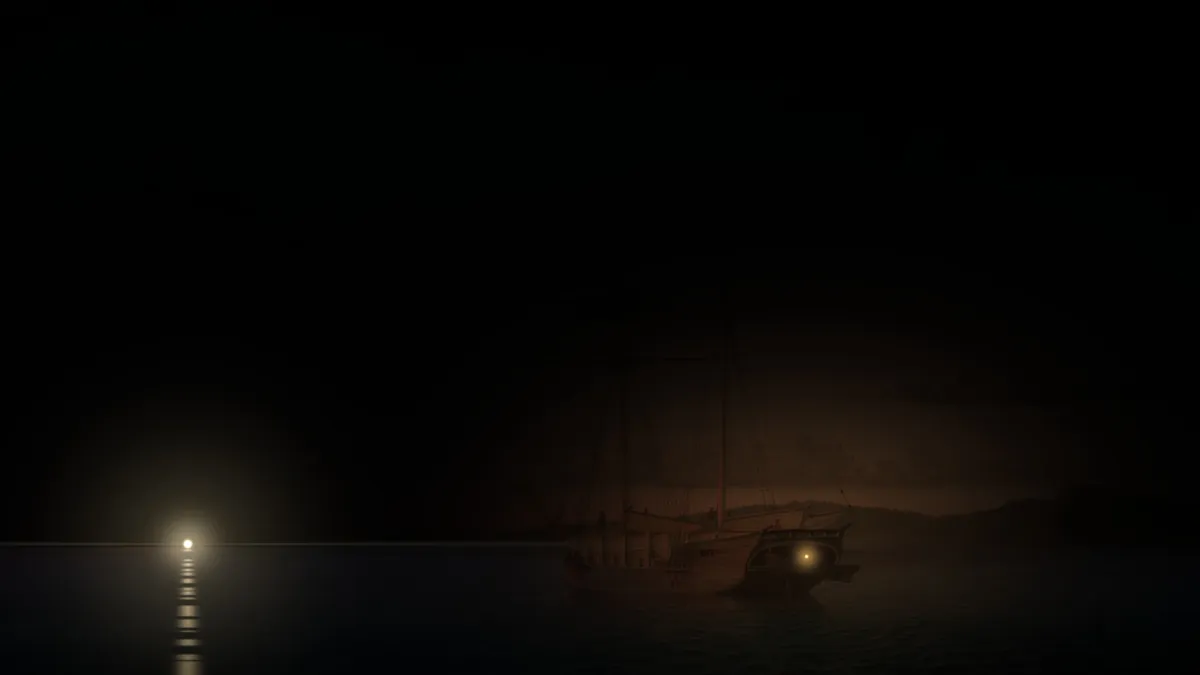
Through the Occupied Islands
The dark came over the Kestrel a little after ten in the morning on the twenty-ninth, and Nera Pell was below when it happened.
She was on her knees in the after hold with a lantern, checking the new knee, as she had at the change of every watch since Southwick. It had not shifted. The oak was seasoned and sweet, the trenails were tight, and the seam beside it was as dry as a church floor. She pressed her palm to the planking and felt the ship working round her as she beat into the breeze, a long slow flexing of timber against timber with none of it in the wrong place. Then the light coming down the hatch behind her went out.
It went out all at once. She turned on her knees, and the square of the hatch above her was black, and her lantern was the only light in the world.
She went up the ladder. On deck the crew stood where they had been, at the ropes and the rails, with their faces turned up, and lamps were being lit along the deck one after another. Above the mastheads there was nothing. Astern, the wall they had sailed into was simply the end of the light. Under it she could see a band of bright sea for a mile or so before the edge took it, like light through a sprung seam.
"Mistress Pell," said Rusk at the helm. "How's the stern?"
"Dry."
"Keep it so," Rusk said. "It's going to be a long day."
It was. The cold came first. She had expected the dark, but the cold came on slowly through the morning and got into her hands and feet and made the tar in the deck seams go stiff. By noon on the ship's clock the men on deck had their coats buttoned and their breath was smoking in the lamplight. She saw them glance again and again at the place where the sun ought to be, and look away.
Rusk sailed her by compass and sounding line and Orris. Orris stood in the waist with a lantern in one hand and a slate in the other, calling a course or a depth every few minutes. Between calls he turned to Isobel Wray beside him and made her do it instead.
"Where are we?" Orris asked her.
"Eight miles west-north-west of where we went in," Isobel said, "by the log."
"By the log," Orris said. "And what does the log say about the tide?"
Isobel bit her lip. "Nothing."
"Nothing," Orris said, "because the log's a liar. The tide's setting us north a mile an hour. So where are we?"
"Nine miles," Isobel said. "And a mile north of where I said."
"Better. Now go and sound, and tell me the bottom. Not the depth. The bottom."
Isobel swung the sounding line and hauled it in and turned the weight in the lamplight to see what the tallow in its foot had brought up from the seabed.
"Shell," she said. "Broken shell and black sand."
"There you are, then. That's the Corran bank. Nowhere else in the Reach has black sand. We're two miles north of Skell Rock." Orris raised his voice. "Captain! I'd come a point to port, unless you want to see Skell Rock. I've seen it. It's ugly."
Nera watched them from the after hatch. She had not liked Orris Fen at first. He talked too much and was too pleased with himself, and he fed people whether they wanted feeding or not. But she had watched him all day in the cold and the black with a slate and a lantern and the Reach in his head. He was teaching a frightened girl to see the bottom of the sea through a lump of tallow. If she ever had a yard, she thought, she would want a man like that in it.
They saw the engine in what the clock called evening. Her lights lay far to the north, a great slow cluster with smaller lights round it, crawling westward across the black.
"That's Patience, the one we saw from Southwick," said Rusk. "That's what carries this dark. She's under tow, west by north, two knots." He gave Nera the glass. "You're a shipwright. What do you make of her?"
Nera studied the shape the lamps made along the hull: broad, high, flat-sided, sitting low.
"Heavy," she said. "Heavier than she needs to be for her length. She's built to carry a great weight low down amidships, and she'll roll like a pig in a seaway." She lowered the glass. "Whatever they've put in her, Captain, it isn't cargo. It's built in."
They met the Wickmouth boat the next night in the dark south of Tull. She was a little open fishing boat with three men in her and no lamp, and she nearly ran into them before either saw the other. When the men saw the Compact ensign in the Kestrel's lantern light, one of them sat down in the bottom of the boat and wept.
Their story was short. The Pale Fleet had come to Wickmouth with the dark six days ago, a living garrison of twenty or so. They had taken the pilots, every man in the village who knew the water among the islands, and locked them in the net loft by the harbor. Each night the garrison brought out one pilot to guide their boats through the shoals, and he came back, or he did not. And the dead stood in the harbor. They stood in the shallows below the village day and night, waist-deep, and moved only when somebody tried to take a boat out. These three had swum their boat past them in the black of the morning.
"How many dead?" said Rusk.
"A dozen," one of the fishermen said. "More. We didn't stop to count."
The loft stood at the head of the harbor, a tall timber building with an iron-strapped door, and the garrison was quartered in the cooper's house beside it. South of the harbor lay the beach where the village dried its fish, a quarter mile of shingle with the racks standing on it.
They held a council in the cabin. Nera had never been asked to the cabin before. She went because Rusk sent for her, and stood by the door while he laid it out on the chart with his finger.
"In by the beach, south of the harbor and away from the shallows where the dead stand. Up through the drying racks to the loft. Break the door, take the pilots, back down the beach to the boats." He looked up at Marr. "We don't try for the village or the garrison. We take the pilots and go. In by the beach and out by the third bell of the middle watch, whatever we've got and whatever we haven't. If we're ashore at the third bell, we've failed, and we come off anyway."
"Why the limit?" said Marr.
"Because the garrison has the night and the dead have the water, and the longer we're on that beach the more of both we meet," Rusk said. "An hour and a quarter is enough to do it and not enough to get greedy."
Marr studied the chart. "Agreed. The third bell." She turned. "Mistress Pell. They say the door is strapped with iron. Can you open it?"
"If it's strapped, it's hung on pins," Nera said. "Iron eyes over iron pintles, outside, because it's a store and they wanted it to open out. Knock the eyes up off the pins and the door falls off. Ten blows if the iron's sound, five if it's rusted. It'll be rusted. It's a fishing village."
"Then you'll come with us," Marr said.
Nera had expected to be told to stay with the ship, and was glad not to be.
Wickmouth lay on the north-east shore of Tull, a huddle of gray houses round a little stone harbor. Three miles off to the north-west, across the black water of the Tull Narrows, hung the lights of the engine ship, which had come to anchor in the race there at dusk. The Kestrel lay hove-to a mile offshore without a light. They went in at a quarter past midnight in two boats with muffled oars, eight in each, Rusk at the tiller of the first and Marr in the second.
Nera sat in the stern with her caulking mallet across her knees and a cold chisel in her belt. She could see nothing but the engine's lights far off, a lamp in one window of the village, and the pale line of surf on the shingle ahead. The boats grounded with a long crunch. They went over the side into knee-deep water so cold it stopped her breath, and waded ashore, and crouched on the stones.
The drying racks stood in front of them in long lines up the beach, wooden frames taller than a man, with split fish hanging dark on them. They went up between the racks in single file with Dunning in front. The shingle shifted and rattled under their feet, and a dog was barking somewhere in the village. Off to the left, toward the harbor mouth, lay the shallows where the dead stood, and she could not see them.
They reached the loft without a challenge. Dunning set his marines along its wall, Marr raised her hand, and Nera went to the door.
She found the hinges by feel. They were as she had thought: two big iron straps bolted across the planks, their eyes dropped over pins driven into the doorpost, the upper pin rusted thick. She set the chisel under the upper eye and hit it with the mallet, and the iron rang out over the sleeping village.
"Quick, now," said Marr.
Nera struck again, and the strap jumped a quarter inch. Inside the loft a man's voice called out and another answered. She struck again and again, and the rust cracked, and on the fifth blow the eye came up clear of the pin and the top of the door sagged outward.
A shout came from the cooper's house, and a door banged, and lantern light spilled across the stones.
"Garrison," said Dunning calmly. "Here they come, Commander."
Nera went down on her knees to the lower hinge. Behind her she heard the marines move and the first clash of steel, and she kept her eyes on the iron. The lower pin was sound and would not move. She struck it so hard that the mallet's head rang and her arms went numb to the shoulder. Somewhere behind her a man screamed. She struck again, and the strap jumped, and on the next blow it came up off the pin. The door leaned out from its frame and fell flat on the stones with a crash.
In the dark inside were faces.
"Out!" said Nera. "Out, come on! Compact! Out!"
Six men came stumbling past her, blinking. One was young and broad and fair, with a pilot's brass tally on a cord round his neck. Another was very old and small and bent, with a white beard down his chest, and the young one had him by the arm.
"Down the beach!" Marr shouted. "To the boats!"
Nera turned, and saw the fight.
A dozen of the garrison had come out of the cooper's house with lanterns, swords and pikes, and more were coming. The marines had met them at the corner of the loft in a shoving, hacking knot, with Rusk and Marr in the middle of it and Dunning bellowing. A man in a western coat broke from the knot and came at Nera with a pike held low for her belly. She took the point on the mallet's head and turned it, felt the shaft slide along her ribs, and hit him in the face with the other end of the mallet. He went down.
"Back through the racks!" Rusk shouted. "Marines, rearguard! Mistress Pell, with the pilots! Go!"
She took the old man by one arm while the young pilot took the other, and they half carried him down between the racks with his feet barely touching the shingle. Behind her the marines came backward down the beach in a line, swinging their pike-butts, with the garrison pressing them. Through the racks on her left she could see the harbor shallows, and the dead standing in them.
They had not moved. A dozen or more stood waist-deep in the black water below the village with the lantern light from the cooper's house on their white faces, like posts, and they watched the beach. Not one of them took a step.
"Why don't they come?" the young pilot said.
"I don't care," Nera said. "Keep going."
They came down to the boats. The pilots went over the sides, and the old man was handed in, and Nera stood knee-deep in the surf with the mallet while the marines came down the shingle. The garrison stopped at the edge of the lantern light and shot. A bolt thudded into the boat's side by her hand. Then Dunning hauled her over the side, and the oars went out, and the boats backed off the beach.
Faint across the water from the Kestrel came the ship's bell. Two strokes, a pause, and a third.
"Third bell," said Rusk from the other boat. "Pull."
The boat had gone two lengths when the water beside it opened and a white hand came over the rail.
Nera saw it in the lantern light from the beach: one hand, then another beside it, and a head coming up under the rail with the water running out of its hair. The dead had not walked down the beach. They had walked out along the bottom of the harbor, under the black water, and come up beneath the boats where nobody had been looking.
The hand closed on the rail by Nera's knee. She hit it with the mallet, square across the knuckles, and it did not let go. The boat tilted. An oarsman screamed and dropped his oar, because something under the water had hold of its blade. On the far side a dead man came up over the rail to the waist, streaming, and reached in. Dunning stilled him with a blow of the pike-butt to the neck and shoved him back under, and the boat rolled the other way and shipped a sea.
"They're under us!" somebody was shouting. "They're under the boats!"
"Back water!" That was the young pilot, on his feet in the stern with the old man's arm still in his fist. "Back water, all of you! Into the surf! Put her in the breakers, they can't stand in it!"
Nera did not understand him, and Dunning did. "Back water!" he roared, and the oars bit the wrong way, and the boat went stern first toward the beach, into the line of breaking surf where the shingle shelved. The sea picked her up and dropped her. A wave came in over the transom and soaked Nera to the neck. And the hand on the rail beside her tore loose, because the thing it belonged to had been standing on the bottom, and the bottom was moving. She saw a white shape roll over in the surf and go under. Another came up on its knees in the broken water, and the next wave took its feet from under it and tumbled it up the shingle. It lay there with the foam going back round it and began, slowly, to get up.
"Now pull!" the pilot shouted. "Pull, and keep her in the white water till we're past the point!"
They pulled along the line of surf with the breakers bursting under the keel and the dead rolling in them, and came round the point into deeper water, and the sea went quiet. Nothing came over the rail. Rusk's boat came out behind them the same way, with Rusk himself at the stroke oar and Marr steering.
"Captain," Marr called across the water, sharply. "There were no more than six left in the cooper's house. We could have had them."
"We could," said Rusk. "And we'd be in that surf yet at the fourth bell, with every dead man in that harbor under our keel. Pull, lads."
He kept his eyes forward. Nera looked back. She saw the lanterns on the shingle, and the dead getting up out of the surf one by one, and standing, and not following.
The young pilot was Ansel Hart, an island man from the north of the Reach, broad and fair and quiet. He had been taken off his boat a week before and brought to Wickmouth to guide the Pale Fleet among the islands. He had guided three of their boats and run two of them aground on purpose, and been beaten for it, and he showed Nera the bruises without much interest.
"I know every gut and channel from here to the Bar," he said. "So does he, better than me." He nodded at the old man, who sat wrapped in a blanket by the galley stove eating Orris's soup with great concentration. "He's fished it sixty years."
The old man was Abner Daw of Holm Ennis, the island north of Orra. He had been taken at sea off the Kittle on the day the dark came down on the strait. He had nothing to say to anyone, and he ate his soup.
At about eight in the morning, by the ship's clock, they saw the lights of a ship coming up from the south-east.
They had crept north-west all night by soundings, out of the Tull Narrows and up through the middle islands toward the Pennant Flats. The engine had been towed off from the Narrows before dawn, and her lights lay far to the north of them now, crawling north-west. Nera was on deck with a mug of Orris's coffee when the lookout called. Astern, at the edge of sight, a cluster of lamps sat low on the black water and was growing.
"A ship," said Rusk. "A real one, under sail, and bigger than us. Ansel, what is she?"
Ansel took the glass and studied her a long while.
"Resolute," he said. "Their escort. A hundred and ten feet, and she sails like a witch. Her captain's Ilyra Venn, from Lisk, and they say she's the best they've got. She carries twice your crossbows and twice your crew."
"What does she draw?" Rusk asked.
"Thirteen feet," Ansel said.
Rusk bent over the chart in the binnacle light, and Nera saw his finger go to the Pennant Flats. It was a great bank of sand spread across the middle of the Reach, an hour's sail to the north-west, with six to nine feet of water over it at half tide.
"We draw nine, and it's an hour before high water," Rusk said. "If we can get onto the flats, she can't follow."
"There's a gut through the middle," said Ansel. "Twelve feet at the top of the tide. Everybody knows it."
"Then that's where we're going," Rusk said.
The Kestrel came round onto the starboard tack and ran for the flats under every sail she had, heeling hard. The ship astern came round after her, and in half an hour Nera could make out her shape, long and dark and heeling under a great spread of canvas. In three-quarters of an hour a bolt from her forward crossbows went screaming over the quarterdeck into the sea ahead, and Rusk remarked that she was very well handled.
Nera went below to the pumps. The Kestrel was driving hard, and every time she slammed into a sea the stern seam groaned under its new pitch, but it held. She kept four men on the pumps and stood in the black hold with her hand on the knee, listening. Through the planking she heard the sea change from the deep hollow roar of open water to a shorter, harder hiss. They were coming onto the flats.
On deck Isobel Wray's voice rang out, high and sharp. "Boats! Two boats ahead, in the gut!"
Nera went up the ladder.
They lay across the mouth of the gut, right where the Kestrel was steering: two long boats with their oars out and men in them with crossbows leveled. Isobel had caught the gleam of their wet blades in the Kestrel's lantern light when no one else had.
"She sent her boats ahead to hold the gut," said Rusk, and he sounded almost admiring. "She knew where we'd go. Ansel, is there any other way across?"
"The Ram's Gut, a cable north of this," Ansel said. "Nobody uses it. It silts. Nine feet at high water on a good tide, and some days less."
Old Abner Daw had come up from below. He stood at Ansel's elbow sniffing the air.
"Nine and a half," he said. It was the first thing Nera had heard him say. "Maybe. North of the stake. Keep the stake on your left hand."
"I can't see any stake," said Rusk.
"I can," Abner said.
"Starboard, hard," Rusk said. "Abner, you have the con. Tell me where. Hold everything she's got, Orris, I'll not have those boats on us at the stake."
He had not looked at Marr. Nera saw the Commander's head turn, and saw her decide that this was not the moment.
The Kestrel swung away. A ragged volley came at her from the boats in the gut, and two bolts smacked into the rail and one went through the foretopsail. The Kestrel answered along her port side, the heavy slam of the carriage crossbows going off one after another, and somebody in the boats screamed. The boats fell astern. The old man stood in the prow with one arm raised, pointing.
"There. Left of that. Hold it."
Nera went back down to the hold and put her hand on the knee. Above her she heard Rusk's voice, and no order to shorten sail. The ship was still driving, heeled and slamming, under every stitch she had, when the sand took her.
This time it was no soft stroking. She struck, and the whole hull rang, and Nera was thrown against the pump. The shore timber she had set against the new knee at Southwick jumped out of its chock and went across the hold like a thrown spar. It took the docker at the pump handle across the shin, and he went down on the planks screaming. The seam opened. Water came in along it in a sheet, black and fast, over her boots.
"Pump!" she said. "Enoch! Enoch, get me men down here, six, now!"
The ship dragged, and lifted, and struck again. Nera got her shoulder under the shore and drove it back against the knee and held it there with her whole weight. The water came up round her calves, and the hurt man sobbed behind her. She talked to the plank without knowing what she said. Hold. Split and rot you, hold. Hold for me. Men came down the ladder. The pumps clanked, and the sand hissed under the keel.
The dragging ceased. Under her feet she felt the hull float free, and the ship heel to the breeze and gather way, and the deep sound of open water came back through the planking.
"Keep pumping," she said. "Two of you, get him up to Hanne. Mind his leg." And she went up.
It was daylight on deck, gray and soft, with low cloud going over the mastheads, and a mile astern the black wall stood on the flats with the pale water breaking under its edge.
The Resolute had come to the edge of the sand and hove to there, a long dark shape under the edge of the black, with her sails shivering and her boats pulling back to her. As Nera watched, the lantern at her stern went down slowly the length of a man's arm and came up again.
"She's dipping to us," said Enoch beside her. "Saluting, like. Well, I'm damned."
On the quarterdeck Rusk took off his hat and held it up in the daylight toward the ship in the dark.
"Ilyra Venn," he said. "I'll remember that."
"Captain," said Nera.
She was wet to the thighs, and there was blood on her hands that was not hers. The deck was very quiet.
"I've six men on the pumps and a man with his leg broken, and the shore's out from under your new knee. You put her over that bank at six knots on an old man's maybe. Half that and she'd have kissed it."
"There were two boats of crossbows in the gut, Mistress Pell," Rusk said.
"Then you should have said so to somebody before you spent my knee on it." She looked round the deck, at a crew that had become very busy. "She'll lie at the Hen today heeled over, with her seam to the sun and me in it. And she'll not be driven like that again until I've a grid under her."
Rusk looked at her, and at the pumps, and at Marr, who said nothing at all.
"Who's hurt?" he said.
"One of Orris's dockers," Nera said.
"I'll go down to him." He turned the hat in his hands. "You're right. I should have said it."
They spent the rest of the day in the lee of an islet called the Hen, west of the flats, in the sun and out of sight of anything. The Kestrel lay heeled over on a hawser to her mainmast with her stern seam drying in the sun. Nera spent the day on her back in the bilge with hot pitch and a lantern, and came up at evening to the smell of fish stew.
Orris had made it with fish Ansel caught off the stern, and onions, and a great deal of pepper. They ate it on deck in the last of the light, crowded round the main hatch with bowls on their knees. It was too hot to taste, and Nera thought it the best thing she had eaten in her life.
"There's too much pepper," said Enoch.
"There's the right amount of pepper. You've no palate. You eat like a gull." Orris pointed his spoon at Rusk. "And you. Running her onto the Swatch bank. What were you thinking?"
"Saul called starboard," Rusk said.
"Saul called it late. You should have felt it a cable before. I'd have felt it." He turned to Isobel. "Your father's a good pilot, girl, but he's slow on the call. Don't learn that from him."
"I won't," said Isobel, and went red, and looked happier than Nera had yet seen her.
After the stew Enoch brought out a cup and a pair of dice and challenged anyone who dared. Marr dared, for reasons Nera never learned, and lost four coppers in one game with her face growing more severe as Enoch grew more cheerful.
"Again, Commander?" Enoch said.
"No," Marr said. "Captain Rusk will show you how it's done."
Rusk took the cup. He shook it, and held it, and looked at the dice in the lamplight as if they were a chart.
"Three to throw," he said. "He's thrown two fours already."
He started on the odds against a third, and Marr cut him short.
"Throw, Captain."
"It's dice. There's nothing to think about." He threw, and lost. He took the cup back and shook it, and held it again. Nera watched his lips move. Enoch watched him with great kindness.
"He'll say that every time, Commander," Enoch said. "And then he'll think."
Rusk lost three games running, working the odds aloud on the third, and was two coppers down to Enoch and one to the cat, whom Enoch had entered as his partner. The crew were trying not to laugh and failing, and Marr sat on the hatch and looked at the Captain as if she had been handed a sheet of paper she had not known existed.
"You think about it," she said.
"It's a game of chance, Commander," Rusk said. "One ought to know the chances."
"Nobody wins at dice by knowing the chances," said Enoch. "You win by not caring. Another?"
"No," said Rusk, and after a moment, to Nera's astonishment, Marr laughed.
Later, in the dark, with the lamps lit and the crew gone forward, Nera heard them talk. She had not meant to listen. She was sitting against the mainmast working a splinter out of her palm, and they were standing at the rail above her, and they spoke as if she were not there.
"You gave my ship to a man you'd known a day," Marr said, "and never turned your head."
"There wasn't time to turn it."
"There was time to say his name. There was time to say 'with your leave'. You chose not to spend it." Her voice was quiet. "You were right about the Swatch. You were right to go for the Gut. You had no business driving her at it, and you'd have heard that from me or from Orris if you'd given either of us a breath to say it. Instead a man has a broken leg and my shipwright has spent the day on her back in the bilge. One day you'll do it and be wrong from start to finish, and I'll have had no say in it, and it will be my ship that pays. That is the charge against you, Captain. Not the beach. The habit."
"The court will say the beach," Rusk said.
"Courts do," Marr said.
"There were six hundred people on that island," Rusk said. "Men, women and children, with the town burning behind them. I could see them on the beach. If I'd held my station, they'd have died."
"And because you didn't, a hundred and forty of ours did." Marr's voice was perfectly level. "I knew most of them, and I can tell you their names. Edwin Mallory was my captain. He was a good man, and he died on his quarterdeck because the corsairs came through the gap where the Osprey should have been."
"I know."
"Do you?" Marr said. "You've never said so."
"I've never been asked," said Rusk. "I'm not sorry I took those people off, Commander, and I never will be. I'm sorry for every one of yours. And I'd do the same again."
The silence above Nera's head went on and on.
"Then we have nothing more to say to each other on the subject," said Marr.
"I suppose not."
Neither of them moved away. Nera pulled the splinter out and sat without a sound.
An hour later old Abner Daw came aft and sat down on the hatch by the lantern, asked for Rusk, and began to talk without preamble.
"You're going to Orra," he said. "They'll be watching the channel, and the Kittle, and the Gut. Every way in."
"I'd think so," Rusk said.
"There's another way." The old man's eyes were bright in the lamplight. "On the north shore of Orra, under the cliff, there's a cave with the sea going in at the bottom of it. From the middle of the falling tide to the middle of the flood, the mouth stands clear of the water, and you can take a boat in. It goes back a long way under the rock. At the end of it there's a step and a hole in the roof, and the hole goes up into the bottom of the keeper's lower cistern." He smiled, showing three teeth. "The Cistern Cut, we call it. My father and his father went in there for lobsters. The western men don't know it. I doubt the keeper's people do."
Rusk crouched down beside him. "Can you find it in the dark?"
"I can find it with my eyes shut," said Abner Daw. "I have."