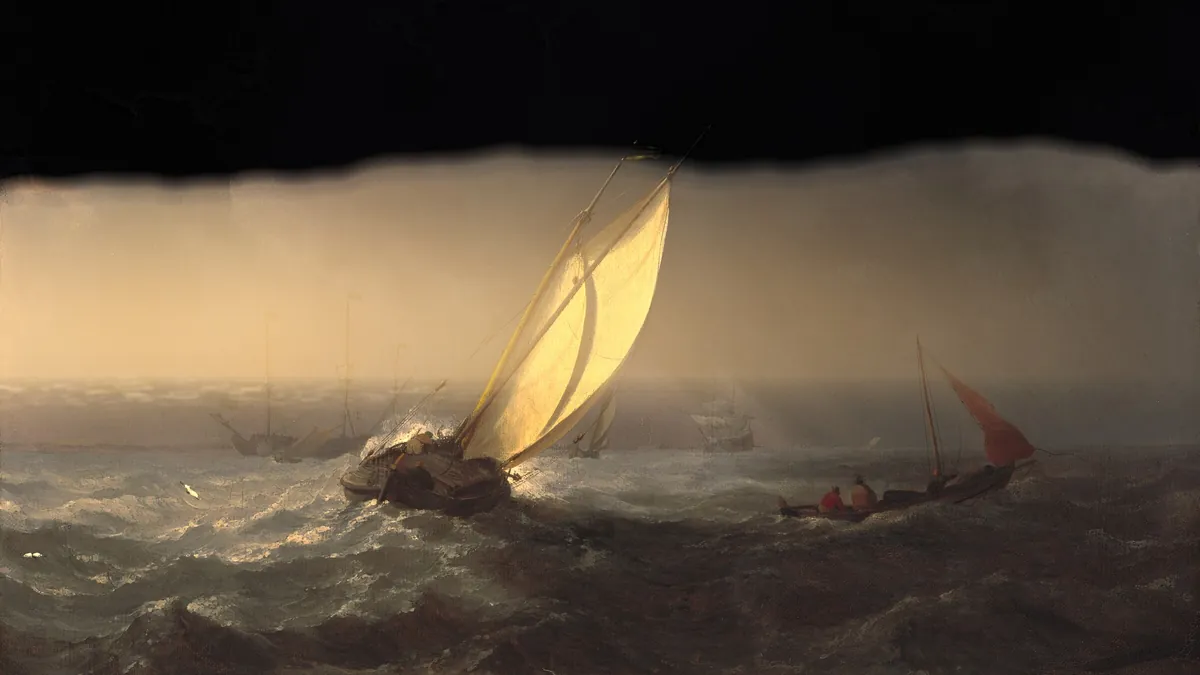
Into the Daylight
The harbor mouth was four hundred yards wide between the end of the mole and the chain house. Beyond it the buoyed channel ran two miles west between the North Sands and the South Sands, and south of the sands the mainland coast ran away toward Southwick, low and empty. Tonight Rusk could see none of it.
He stood at the Kestrel's helm with Orris beside him and watched the one thing he could see: a small yellow light bobbing on the black water a cable ahead. It was Isobel Wray's lantern in the prow of her father's pilot boat. Every half minute it dipped and swung, and Saul Wray's voice came back thin across the water, calling the depth.
"Four fathoms. Four fathoms, and the basin buoy on your right hand, Captain."
"I have it," Rusk called, though he had nothing. He put the helm a spoke down and felt her answer.
She was moving under her topsails alone, with a light northerly off the land and the young flood setting in against her. She was moving badly. She sat deep, and every soul on her deck shifted her trim when they moved, and she answered the helm like a cart with a stone under its wheel. People sat on the hatches and against the masts and along the rails, packed so thick that Enoch had to step over them to get forward. A baby was crying in the waist.
"She's sulking," Orris said. He raised his voice. "Mistress, if you'd take your basket off that line, the ship would be obliged. Bless you. And the hen. Salt and blazes, is that a hen?"
Rusk let him talk. Under the voices Rusk could hear the ship: the creak of the yards, the slap of water along her side, and from aloft a slow, stretching groan that came every time she rolled to starboard.
"Enoch," he said.
Enoch Garvey was at his elbow before the name was out. "I hear her, Captain. Fore shroud, the after one, weather side. I told the yard about that shroud in June."
"Will it hold to the mouth?"
"It won't hold to the end of this sentence," said Enoch, and from forward came a crack like a pistol shot.
The shroud had parted at the masthead. It came down out of the dark in a slithering rush, and people screamed, and the foremast lurched. Up in the blackness the topmast was swaying with nothing to steady it on that side but the shrouds that were left, and those were as old as the one that had gone.
"Ease her," Rusk said, and Orris put the helm up a touch, and she came upright and the weight came off the mast. "Enoch. Can you rig a new one?"
"In the dark?" Enoch said. "Moving? With a hundred people under my feet?"
"Yes," Rusk said.
"Course I can." Enoch was already going. "Joss! Joss Ambry! A coil of your best and a mallet and the tar bucket, and if you drop any of them on a grandmother I'll have your ears."
From the helm Rusk watched them up the foremast by the lantern Joss had tied to his belt, a small spark climbing into nothing. He heard Enoch's voice above, telling the boy where to put his hands and what would happen to him if he let go. The Kestrel slid on through the harbor with her topmast held up by an old man's temper and a boy's splice, and ahead of her Isobel's lantern dipped and Saul called the depth.
A little past nine they came to the burning ferry.
She was a big passenger ferry, and she was burning from end to end. Her fire stood up off her into the black air with no smoke cloud above it and nothing for the light to touch. It lit the harbor for two hundred yards round in a jumping red glare. For the first time since he cast off, Rusk saw the water: the mole on his right hand, the chain house ahead, and the people in the water.
There were a dozen of them, swimming and clinging and going under. Among them, moving through the red water with a slow, steady purpose, were others. Pale heads. White arms. They were not swimming to save anyone.
"Drown me," said Orris quietly.
Most of the swimmers were on the far side of the fire, where nothing could reach them, and Rusk looked past them. Fifty yards off the Kestrel's port side, a man hung on to a long oar with one arm. His other arm was round a child of eight or nine, her hair plastered black across her face. He was kicking toward the Kestrel's lights with all his strength and getting nowhere against the flood. Behind him, three white heads were coming across the water.
"Heave to," Rusk said. "Back the foretopsail. Enoch! How's that shroud?"
"Seized at the masthead," came the voice from the dark. "Not pretty. It'll hold if you're civil to her."
"I'm going to be very uncivil," Rusk said. "Come down. I need a line over the side to port."
The foretopsail came aback with a clap, and the Kestrel shivered and lay rocking in the red water. Enoch came down with a coil of line, and Joss after him.
"I'll go," Joss said.
"You'll go," Enoch agreed. He had a loop in the end of the line already, made by feel, and he dropped it over the boy's head and under his arms. "Swim to them, take hold, shout. We'll do the rest. Don't you let go of that rope. I've only the one apprentice."
Joss went over the rail feet first. He came up spluttering at the cold and struck out hard, with the line trailing behind him through Enoch's hands. The nearest of the white heads was ten yards behind the man with the oar. Rusk could see its face in the firelight. It was a young man's, and the eyes were open, and they did not blink.
Rusk took a boarding pike from the rack and went to the rail.
Joss reached the oar and got one arm round the man and a fist in the child's collar. "Haul!" he yelled. "Haul away!"
Enoch hauled, with three dockers behind him, and the four in the water came skating across the harbor toward the ship's side. The dead man came after them, swimming now with a slow, heavy stroke, and he was gaining. His hand came up out of the water and closed on the oar. The oar jerked back and dragged the man half under, and he let it go and grabbed for Joss, and Joss held him, and the line held them both.
"Haul, damn you!" Rusk said.
They came in under the ship's side, and the hands at the rail dragged them up. Joss came over first with the child in his arms, and then the man, coughing and streaming. The dead man came up behind them. His white hands took hold of the chains under the rail, and he began to climb.
Rusk leaned out and drove the pike-butt down onto his wrist, and the hand opened. The other hand reached up, and he beat that loose too, and the dead man slid down the ship's side and floated face up in the firelight. The second one swam past him to the side, and the third.
"Fill the foretopsail," Rusk said. "Get us out of here."
The yards came round and the Kestrel gathered way.
The child's father knelt on the deck, retching harbor water. When he could speak he looked up at Rusk.
"Lew Farrow," he said. "Coast boatman. That's Bett. Bett, thank the gentleman."
The child did not. She was staring at Joss, who sat against the mainmast soaked to the skin with an expression of pure terror.
"You're all right," Joss told her. "You're all right now. Have you ever seen a cat?"
Enoch went below and came back with Pudding and put her in the child's arms. The cat endured it. After a minute Bett put her face down in the orange fur and began to cry, and Enoch told her about the day the cat bit an admiral.
"Which admiral?" said Lew Farrow, sitting up.
"All of them, given the chance," said Enoch.
The chain was half up when they came to the mouth.
Rusk saw it by the cresset on the chain-house roof. In its red glow a black line lay across the harbor mouth a foot above the water, dripping, sagging between the tower and the end of the mole. Every few seconds the winch ground inside the tower, and the line jerked and rose another link, and the water poured off it.
The Kestrel was making three knots with the breeze on her beam. If he backed his sails now she would lose her steerage in the mouth. The flood would set her down onto the rocks at the mole's end with a hundred and ten people on her deck.
"There's fighting at the tower," said Orris.
A dozen figures were packed round the door, some hooded and some pale and streaming, and he could hear steel. At the foot of the steps lay the Kestrel's boat, with two marines holding her off the stone.
"She said she'd drop it," Rusk said.
"It's going up," Orris said.
"She'll drop it," Rusk said. He held his course. "Enoch, get every soul off the foredeck. If that chain's up when we reach it, I want them clear of the forestay."
Enoch opened his mouth to argue.
"Do it, Enoch," Rusk said.
A hundred yards. Eighty. The pilot boat had slipped over the chain at the mole end, where it lay lowest.
The grinding in the tower stopped.
Then came a sound he had heard once before, on a man-of-war whose cable had parted: a roaring thunder of iron running out. The chain fell back into the harbor along its length in one long rushing splash. In the narrow window of the winch room, a lantern swung three times.
"That's Marr," Rusk said, and let his breath go.
The Kestrel went over the place where the chain had been, and nothing touched her keel.
On the steps the fight broke out again. The marines came out of the door in a tight knot, backing, pike-butts swinging, with Marr among them and her sword going. They went down toward the boat with hooded men and dead men pressing after. A big marine was the last man out. He turned on the bottom step to cover the others and swung his pike, and a dead man went down. A hooded man came past the falling body and drove a short spear into the marine's side under the arm. The marine sat down on the step. Two of his fellows dragged him into the boat by his collar, and the boat pushed off.
"Line to port," Rusk said. "We'll not stop. Snatch them as we pass."
The boat came out under hard oars, and the Kestrel swept down on her. Enoch threw. Dunning caught the line in the boat's prow and took a turn, and the boat swung and came slamming in against the ship's side. Marines scrambled up. Marr came up last but one. The last thing up was the big marine, hauled on a line by four men, and they laid him by the mainmast. Rusk knew the face: Ingram, the Southwick man. Hanne Webb knelt beside him, and looked up at Marr, and shook her head.
Marr stood over him with her sword hanging from her hand, then sheathed it and came aft.
"The chain's down," she said. "The pawl is knocked out and the winch handle is in the harbor. They'll not raise it tonight."
"I saw," Rusk said. "Thank you, Commander."
"Corporal Lindley would not come," Marr said. "He has barred the inner door with his men inside. He says the chain house has never been given up in two hundred years, and he is too old to start." Her eyes went forward to the man on the deck. "Private Ingram is dead. He had a sister in Southwick."
"I'm sorry."
"Where are we going, Captain?" Marr asked.
"Out," Rusk said. "Then I'll tell you."
They came out through the mouth into the buoyed channel. Outside the mole the sea was lumpy and black, and they could feel the Reach breathing under them. Above, there was no sky at all.
Three miles to the west, there was a town on the sea.
That was how it looked at first: hundreds of lights on the black water where no town had ever stood. Then he made out masts, and small lights scattered round one enormous one. The enormous one was a ship, broad and high-sided and square, lit along her length from end to end. Smaller vessels lay round her, the size of tugs, with heavy cables trailing from their sterns into the dark.
"What in the Deep is that?" said Orris.
"Whatever brought the dark." Rusk was sure of it as he said it. The dark had crept east with Treen's boat for three days, and here it had halted. In the middle of it lay a ship bigger than any he knew, anchored where the Grey's stream ran out across the sands, with her tugs round her like dogs round a cow. "That's what it follows. That ship."
Boats were putting off from her. Most of their lights were heading for the harbor mouth behind him. One was not. She was long and low and coming fast, with sweeps flashing along her sides and a brown lugsail drawing above them, and she was coming straight down the channel for the Kestrel.
"She's seen us," Marr said.
"She's seen our lights. If we douse them, we lose Saul, and we're on the sands in a quarter hour." Rusk watched the long boat come. "She's a boarding boat. She'll make eight knots under sweeps, and we're making four. West takes us into the big ship. North, she catches us on the North Sands in an hour. So it's south. Through the Swatch."
Orris drew in his breath. The Swatch was the boat channel through the South Sands, narrow and crooked and shifting every winter, and nothing that drew more than eight feet used it.
"She draws nine," Orris said.
"It's high water in an hour," Rusk said. "Saul knows the Swatch, and so do you. That boat doesn't. She'll not follow us into the sands blind. She'll go round outside to cut us off at the far end, and that's six miles for her."
"And then?" Orris asked.
Rusk turned. Lew Farrow sat against the mainmast with his daughter asleep across his knees.
"Master Farrow," Rusk said. "Where were you when the dark came?"
"Off Kettle Head, sir," Lew said. "Coming up from Hythe with a load of hides. It came over me from the west all at once. I sat there a quarter hour before I could take the oars up."
"Kettle Head is four miles south of the harbor," Rusk said. "Could you see the sun anywhere?"
"South, sir. Behind me, there was sun on the water off the Head, a mile off or less. I pulled north into the dark to get home to Bett." He looked down at the child. "It was worse at home."
"So it stopped at Kettle Head," Rusk said. "It has an edge."
"It's a wall," said Marr. "We saw it come."
"A wall has two sides." He looked at the brass clock in the binnacle. It was a quarter to eleven. "The sun comes up at about six. Since late this afternoon those things have come up out of the water with the dark. Treen saw Davy Coombe walking in the dark, never in daylight. If I'm going to fight that boat and what she carries, I want to fight her in daylight, and there's daylight four miles south of here at six in the morning."
"That's a guess," said Marr.
"It's a guess," Rusk said. "Have you a better one?"
"No," she said. "Take her through the Swatch, Captain."
They went into the Swatch at half past eleven, on the top of the tide.
Saul went first in the pilot boat with a sounding line, and Isobel held the lantern. Orris stood in the Kestrel's fore chains with another line, swinging and calling. Rusk steered between Orris's calls and Saul's voice across the water. He could see the pilot boat's lantern and the pale water breaking on the banks to either hand, and nothing else.
"By the mark three," Orris called. "And a half, three."
"Three fathoms here, Captain!" Saul called. "Starboard a touch. The channel bends."
"By the mark two and a half," Orris called. "Two and a half."
Fifteen feet of water. She drew nine. Rusk eased the helm a spoke.
"By the mark two."
Twelve feet. The deck had gone silent. Marr stood at his shoulder, and he could hear her breathing.
"A quarter less two."
"Starboard!" came Saul's voice. "Starboard, Captain, hard, the bank's coming up under us!"
The Kestrel touched.
It was a long shuddering grind under her keel, and she lifted and checked, and every person on her deck staggered forward. "Everyone aft!" he roared. "Every soul on this deck, to the stern! Move!"
A hundred people ran aft in the dark, stumbling over the hatches and each other, and crowded onto the quarterdeck round him. He felt her head lift as the weight came off it. She ground again and checked, and the flood pressed her on, and she slid off the bank all at once and was afloat.
"By the mark three," Orris called from the chains, quite steady. "Deep three. I thought I'd mention it."
"Nera," Rusk said.
She came up out of the after hatch with tar on her face.
"It's weeping," she said. "The patch is sound. The seam forward of it took the bank and worked. Two men on the pump will hold it. Four will keep it dry. Do that again and I'll want six, and I won't promise anything."
"I'll not do it again," Rusk said.
"See you don't." She went back down, and he heard her below, ordering men to the pump.
They came out of the south end of the Swatch at a quarter past one in the morning, into open water under the coast. Far out to the west, beyond the South Sands, a single light was moving south. The long boat had gone round outside, as he had known she would. He reckoned she was two hours behind.
They took the pilot boat in tow, and Saul and Isobel came aboard. Saul could hardly stand on his bad hip. Isobel got him below to Hanne. When Rusk told her she had done well, she looked at him as if he had said it to be kind.
The breeze died at three. It did that on this coast before an autumn dawn, and came back only in cat's-paws from anywhere on the compass. The Kestrel drifted south on the falling tide at a walking pace, with her sails slatting. Rusk kept her a mile offshore by soundings and reckoned her three miles south of the harbor, with Kettle Head a mile ahead and the edge somewhere near it. He had no way to know, and the boarding boat was somewhere astern, and he had nothing to give her but oars.
At a quarter to six, Enoch hailed quietly from the foretopsail yard. "Light to seaward, Captain. Coming up fast under sweeps. A mile, less. And there's something to the south. Low down."
Rusk looked south. There was a seam along the bottom of the black. A thread of gray lay on the sea ahead, no wider than a hair, as if the dark had been laid down on the water and did not quite meet it. He could not tell how far off it was. A cable, he thought. Two.
"That's the edge," he said. "That's the sun coming up outside it. Orris, man the pilot boat and ours, every oar we have. Pass a line to her stem and tow her head south. I want her under that gray before that boat reaches us."
"She'll not reach it," Orris said. "Not in the time."
"Then we'll be nearer it when they come. Go."
"Commander," Rusk said, "clear the deck. Every passenger below. Pack them in the hold and put men on the hatches."
"Dunning!" said Marr.
Lew Farrow put Bett into Hanne's arms and came back up with a belaying pin and stood on the main hatch.
"You've no need," Rusk said.
"She's down there," Lew said. "I'll mind the door."
What was left on deck was the crew: a dozen dockers and fishermen who had stayed to haul, two old navy men, Enoch, Nera with a caulking mallet, Dunning's seven marines, and Marr with her sword out. The heavy crossbows had gone to the naval stores when they condemned her. They had broken open the old arms chest under the quarterdeck for a dozen rusty cutlasses, some pikes and a pair of hatchets, and Rusk took a hanger from it, the short curved sword he had carried as a midshipman.
Under the Kestrel's stem the two boats lay with a line to her head: the pilot boat with Orris and four dockers, the Kestrel's own with Joss and six more. The oars dug in. The line came taut, and the ship's head came round a point, and two, and she began to crawl toward the gray at the pace of a child walking. Rusk watched the thread of light. It did not seem to grow.
The long boat came up out of the dark on the seaward side. She was a hundred feet long and low, black-hulled, with a gilded wolf's head on her stem. Her sweeps came in with a single clatter, and she swung and slid alongside, and her grapnels came flying over the Kestrel's rail. Her deck was packed with men in dark clothes, and amidships a great hatch stood open over a flooded well, black water slopping in it. Out of that water, as the two hulls ground together, the dead were climbing.
Then her sweeps went out again on the far side and backed water together, and the Kestrel lurched and hung. The towline at her stem sang and went slack. The long boat had her by the rail, and she was the heavier, and she was hauling the Kestrel back into the dark.
"Here they come," said Marr.
The first man over the rail had a cutlass and a yell, and Dunning put him back over it with a pike-butt in the chest. The second was dead. He came up the side without a sound and stood dripping on the Kestrel's deck, and Enoch swept his feet from under him with a boathook. He went down, and when he tried to rise, Enoch took his knee and he stayed down.
"There," said Enoch, breathing hard. "Mind your manners."
Then they were over the rail everywhere.
A hooded man came at Rusk with a sword. Rusk took the first cut on the hanger, and the shock went up into his stitched forearm like a hot wire. He cut back, and the man parried and pressed him across the deck, and a dead man came up beside the hooded one and caught Rusk by the coat. He felt the cold of its hand through the cloth. He wrenched free. An old navy hand came out of the dark and swung a hatchet low, and the dead man's leg folded, and the hooded man went backward over it and was gone.
"Legs!" Dunning was bellowing. "Legs and necks!"
The marines held a line across the waist with the main hatch at their backs. They swung their pike-butts in short, hard strokes, and the dead came at them in a steady stream, and went down, and the ones behind came over the fallen. A dead woman got past the line and bent to drag at the hatch cover. Lew Farrow hit her on the back of the neck with his belaying pin, and she sprawled, and he hit her again.
Marr was on the quarterdeck ladder.
She was halfway up it, and above her stood a tall man in a blue-black coat with silver at the collar and a straight sword in his hand. He had every advantage of height, and she gave him nothing. She kept her point at his knees, where his height was no use to him, and every time he dropped his guard to cover them she took another step.
"Commander Marr," the officer said. His voice was light and educated, with the islands in it. "I'd heard you were a swordswoman."
"You have the advantage of me," Marr said.
"Aske. Lieutenant, Pale Fleet." He cut at her head. She let it go past and stepped up onto the quarterdeck beside him. "You should have stayed in the dark, Commander. It's the only safe place left."
Then a dead man had Rusk from behind.
It held him round the chest with both arms, and it was stronger than any living man its size, and it was dragging him to the rail. He could not reach it with the hanger. He drove his heel into its knee, and his head back into its face, and it did not care. The rail was at his back. It was lifting him. Below gaped the black gap between the two hulls, with the water heaving in it.
Over the dead man's shoulder, past the taffrail, he could see the seam of gray on the sea. It was wider than a hair now. It was a cable off, and the Kestrel was not moving toward it. The two hulls hung together in the dark and turned slowly on the tide.
"The grapnels!" He got the words out with the breath he had left. "Enoch! Cut her loose! Orris! Pull, damn you, pull south!"
Nera Pell's mallet came down on the dead man's knee from the side. The leg folded, and it went down still holding him, and he went with it onto the planks. He got an elbow free and his heel into its face and rolled out of its arms, and Nera hit it again across the neck, and it lay still.
"Get up," said Nera, and went to hit something else.
Forward, Enoch was hacking at a grapnel line with a hatchet, and a hooded man was trying to stop him, and Dunning was dealing with the hooded man. The line parted with a crack. The long boat's prow swung off a yard, and the dead who had been coming over the rail there went down between the hulls. Beyond the Kestrel's stem the towline rose dripping out of the water and came taut.
The boats were pulling. Rusk could see them from the quarterdeck, two black shapes on the black water under the ship's head, and the pale backs of the oars going. The dead were in the water round them. He saw a white hand come up over the pilot boat's transom, and Orris's axe come down. In the Kestrel's boat Joss stood driving an oar down into the sea like a pike.
The Kestrel's head came round, a point, two points, slow as a church turning. One grapnel still held her by the quarter, and the long boat came with her, backing water and losing. She crawled across the black water toward the gray with the dead boarding her as she went.
Less than a cable. Half. The gray widened as he watched, the color of old pewter, a dawn coming up behind cloud on a dull morning. The ragged edge of the black lay above the foretopsail yard, and then abaft it, and the light came in under it low and sideways across the water.
It struck the foretopsail first, and the old canvas went gold. It came down her rigging and across her deck like water poured from a jug. It lay on the wolf's head, and on the marines' faces, and on the dead.
The arms round his chest went stiff.
They hardened, as a man's arm hardens in a cramp. The dead man made a low, dry rattle behind him. The arms fell away, and the weight sagged against his back and slid down to the deck. Rusk turned. It lay at his feet, a man of fifty in a fisherman's smock, with his eyes open and the sun on them.
All over the deck, the dead were falling.
They went down where they stood, at the rail and in the waist and on the hatch, and two that had been climbing the fore shrouds let go and dropped into the sea. It took three or four breaths. They stiffened and swayed and dropped, and lay in the morning light, and were only dead men.
The living did not fall. A hooded man came at Dunning with a sword, and Dunning killed him. Under the ship's head the boats lay on their oars in the sun. Orris sat in the pilot boat's stern with his axe across his knees, and raised a hand to the quarterdeck, and let it drop. On the boarding boat's deck the oarsmen stood staring at the bodies of their own dead in the sun, and an officer was shouting at them to go over, and none of them went.
On the quarterdeck, Marr and Lieutenant Aske were fighting in the sunlight.
She had driven him back to the taffrail. He was fighting hard and well, with a long reach and no fear in him. She took his blade in a bind and carried it round. Her own slid down it to the hilt, and with a twist of her wrist she took the sword out of his hand. It went spinning over the taffrail into the sea, and her point was at his throat.
"Lieutenant Aske," she said. "Call your men off."
He stood with her steel under his chin. His eyes went past her to his dead lying in the sun, and to the sun itself, a red disc low over the coast under the ragged edge of the black.
"Strike!" he called. "Strike! Throw down. It's over."
They took nine prisoners off the boarding boat, all living, and sat them in the Kestrel's waist under the marines' pikes. Eleven of her people lay dead on the two decks, not counting the drowned. The rest had gone over the far side and were swimming for the coast, and Rusk let them go. Of the Kestrel's own, a docker whose name Rusk never learned was dead with a sword through him, and four more were hurt. In the pilot boat a docker had been pulled over the transom by the wrist and hauled back by the hair. He sat on the bottom boards with his arm broken and would not let go of the thwart. Orris took a prize crew across and came back to the rail to report.
"She's called the Wolfhound," he said. "Stores for a fortnight, and arms. She'll tow. They battened the well over when the light came. There's something moving down there, Captain. Knocking."
"Leave it shut," Rusk said.
They passed her a towline and took her in tow astern with the pilot boat behind. A breeze came off the land with the sun, smelling of grass and woodsmoke, and the Kestrel's sails filled and she began to move south. The passengers came up from the hold slowly, blinking, with their hands over their eyes. Some sat down where they stood with their faces turned up to the sun. Bett Farrow came up in Hanne's arms and saw her father with blood on his sleeve, and screamed until he showed her it was not his.
Rusk went aft to the taffrail and looked back.
The edge stood a mile astern. It rose from the sea in a cliff of black, sheer and endless, from the coast out into the Reach until it faded into the haze, and the sun lay on the sea up to its foot and went no farther. Behind it were Greyhaven and the harbor, Corporal Lindley barred in his tower, and the people left on the wharves.
Marr came and stood beside him. Her coat was torn at the shoulder and there was blood on her sleeve, and in the sunlight her face was tired to the bone.
"Daylight matters," Rusk said.
She looked at the black wall over Greyhaven without answering.
"You are still my prisoner, Captain," she said at last.
"Then you'd best keep me alive," Rusk said.
She turned her head, and he could have sworn the corner of her mouth moved.
Behind them in the waist, among the prisoners sitting with their hands on their heads, one of the young islanders leaned to the man beside him. He said one word.
"Orra."