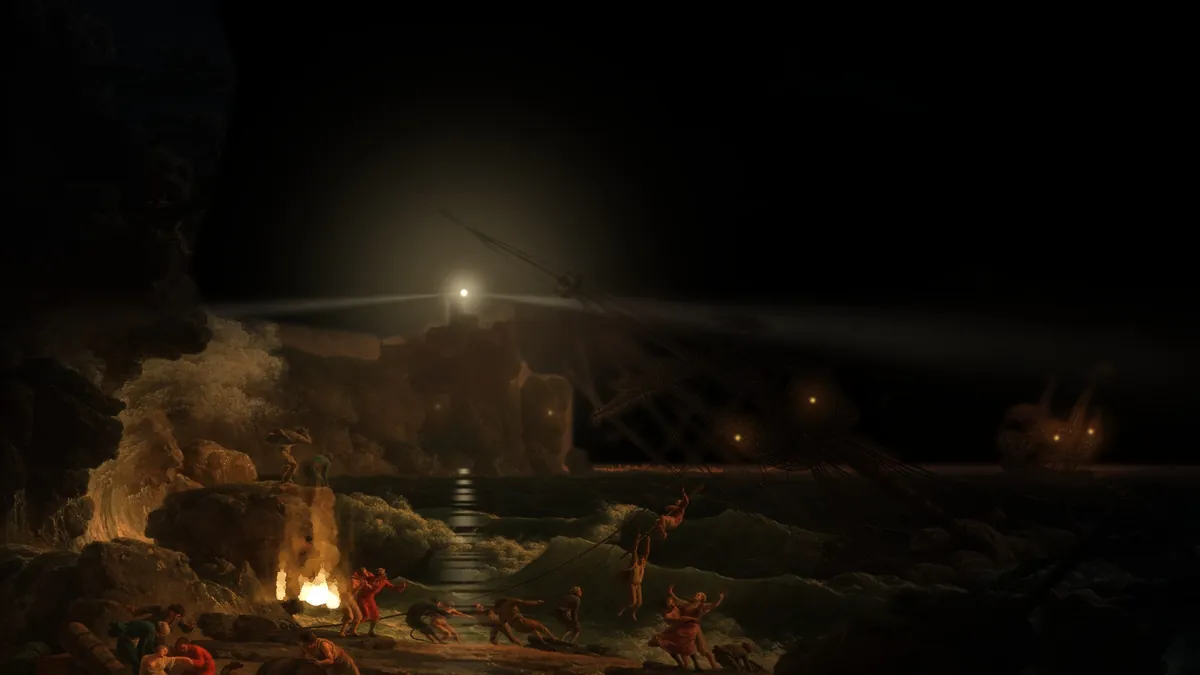
The Second Siege of Orra
Three days before Nera went into the drains at Greyhaven, on the morning of the third of November, Northward came up out of the west, and Rusk watched it come from the lamp gallery of the Lantern with Marietta Voss beside him. Marr was still at Southwick then, arguing with the council.
By the clock it was eight in the morning. Outside the canopy the sun would be well up. Here it was night, as it had been at Orra since Vigil anchored in the western approach a month ago, and the only lights in the world were the ones men had made. Northward brought a great many of its own. It came on slowly from the open sea, a broad cluster of lamps low on the water with a fan of smaller lights ahead of it, the towboats leaning into their hawsers. It took an hour to cover the last two miles. Then the fan of lights went slack and drifted back, and the cluster stopped three miles west of the tower, and Rusk heard the faint far rumble of a great cable running out.
"There," Marietta said. "That's him anchored."
To the north-west, Vigil's lights were moving away. Vaust had towed it off to make room.
Northward lay three miles west, a little north of the deep channel's western mouth. Its field covered Orra and the Kittle and the Throat with the sunken hulks in it, and ran out east along the channel to a point about two miles beyond the tower. East of that, in daytime, the last mile of the deep channel would lie in sunlight. Vigil had held Orra for a month. Now Northward did, and Northward's fitting was three miles off, near enough to hold every dead man in the strait.
"He's swapped one for the other," he said. "Why?"
"Because Vigil is a fat old tub and Northward is one of the three he means to bring through," Marietta said. Her hands were working at a bit of tarred twine, knotting and unknotting it. "He wants it on station before the springs. Which means he means to clear my hulks before the springs. Which means he's coming for my island."
"Yes," Rusk said.
"Then we'd better be ready for him, Captain." She put the twine in her pocket. "Come and see what Cal has done with the anchors."
Orra was built like a stair. The Lantern stood on the island's western crown, a hundred and forty feet above the sea, inside the old upper walls that also held the refuge court and its storehouses. Below the walls, on the east and south slopes, the island came down in three broad terraces to the water. The upper terrace held the dwellings. The middle terrace held more dwellings and the workshops, with the great cistern cut into the rock beneath it. The lower terrace was the boat slip and the landing on the east side, and the cove under the south cliff where the Lamb had lain a month ago. Stairs and ramps climbed between them. Each terrace had a wall along its outer edge, chest-high, built by Marietta's great-grandfather against the corsairs.
The deep channel ran along the island's south side, six hundred yards wide, between Orra and the bare rocks of the Brack. A mile east of the tower it narrowed into the Throat. Marietta's people had sunk the two hulks there in September, in the north half of the channel, hard under the island's south-east point. The stone throwers on the lower terrace could reach anything that came to work on them there, and she had chosen the place with care.
Cal Voss had been busy. At the edge of the lower terrace above the Throat, he had rigged three pairs of sheer-legs. They were tall spars lashed together at the top, leaning out over the forty-foot drop to the water. From each pair hung a ship's anchor on a single rope. They were old anchors, rusty, taken from wrecks over a hundred years and kept in the Lantern's store because Marietta's family threw nothing away. The smallest was the height of a man.
"Cut the rope and down she goes," Cal said cheerfully. "Anything that ties up under the point to work the hulks gets an anchor through its bottom. They have to come in under here. The hulks are right below us."
Rusk leaned out over the wall and looked down. In the lamplight from the terrace he could make out the dark water, and the white of the current round something just under the surface. The Edith's masthead. Beyond it, the low black hump of the Old Pruett's stern.
"They'll come at night," he said. "At slack water."
"It's always night," said Marietta.
The first attack came at two in the morning on the fourth, at low water.
Rusk was asleep on the Kestrel when it started. She lay in the channel east of the island off the boat slip, with Resolute anchored astern of her and the island boats moored between them and the slip. A boom of chained logs ran from the slip's outer end to a rock offshore, held at its middle by two anchors, to keep anything from coming at the boats from the water. Joss woke him. He came on deck with his hanger in his hand and heard the bell on the lower terrace ringing.
"The boom," Joss said. "Isobel says the boom's moving."
Rusk took the night glass. Off the slip, the line of logs was bending, slowly, in the middle, though there was no current to bend it. As he watched, one end came free of the rock and swung out.
"They're under it," he said. "Cutting the anchor cables from below."
Drowned men did not need air. Vaust had found work for them that living men could not do. They walked on the bottom of the channel in the dark and cut what they found there.
"Do we go after them, sir?" Cobley asked.
"No. We let them have the boom." Rusk turned the glass on the island. Up on the lower terrace, lanterns were running. Below, under the south cliff, he could see more lights coming round from the west: boats, a dozen of them, low and crowded, pulling hard for the cove. Living marines. The cut boom was to get them a way to the slip. The cove was the other door. "Isobel, get the boats off the slip and out to us before they're cut adrift. Joss, Cobley's marines into the cutter. We're going ashore."
By the time Rusk reached the middle terrace, the lower terrace had been given up.
That was the plan, and it was Marietta's. The lower terrace was too long to hold and too easy to land on. So when the boats came into the cove, Cal's crossbowmen on the lower wall had shot once, twice, three times into them, and then run for the stairs. The stone throwers on the middle terrace had taken over. Rusk came up the east stair as the first of the throwers loosed. It was a great timber arm on a frame, worked by a capstan. When Cal's men knocked the pin out it slammed forward against its stop with a crash that shook the terrace, and a basket of stones went up into the dark. He heard them come down in the cove. Wood splintered and men screamed.
"Two boats," said Marietta beside the thrower. She had a crossbow in her hands, an old heavy one with a brass-bound stock. "Maybe three. The rest are ashore."
The rest were coming up the south slope. Rusk could hear them on the lower terrace among the workshops, boots on stone and an officer's voice calling in the island accent. Forty men, perhaps fifty. Pale Fleet marines, in blue-gray, with short swords and boarding pikes and round shields. Living men, every one.
They came at the middle-terrace wall in a rush up the south stair and the ramp beside it.
The wall was chest-high, and Corporal Cobley had his twelve marines along it with pikes, and Cal's island crossbowmen behind them, thirty men and women who had been shooting at Vaust's people for seven weeks. The crossbows went off together. The front of the rush staggered and went down on the ramp. The rest came on over them.
Rusk was at the head of the south stair. A marine came up it at him with a shield up and a sword back. Rusk caught the sword on his hanger and kicked the shield, and the man went backward into the two behind him. Another came up the side. Rusk cut at him, missed, and took the man's shield-edge in his ribs. He felt something give. He hit back with the hanger's hilt, and the marine's helmet rang and he sat down on the stair.
The pikes along the wall were working, short hard thrusts down at the men trying to climb it. A Pale Fleet marine got a leg over the wall and Cobley drove him off it with a pike-butt. Somebody threw a lamp, and burning oil splashed across the ramp, and men leaped back from it shouting. The fire lit the whole slope. Rusk saw the officer in it, a tall young man with a feathered helmet, waving his men up the ramp again.
Marietta shot him from the wall beside Rusk, with the brass-bound crossbow at her cheek, at forty yards in bad firelight. The officer turned half round and fell on the ramp. The men behind him stopped.
"Again," Marietta said to her crossbowmen, as she spanned. "Again. They're thinking about it. Don't give them time."
They shot again, and the marines broke. They went back down the slope through the workshops toward the cove, carrying their wounded. The stone thrower crashed once more. Somewhere below, a boat was pushing off.
Rusk stood on the stair with his ribs on fire and his hanger dripping, and counted his breath until it came back.
"How many?" he said to Cobley.
"Two of ours hurt," Cobley said. "One bad. Island folk, I don't know."
"Three," said Marietta. "Old Maud Rae. Her grandson. A boy from Holm Ennis called Piran." She slung the crossbow on her shoulder. "Get the wounded up to the refuge, Corporal. Hanne's there. Captain, you're holding your side."
"A shield," Rusk said.
"Hanne can look at that too." She turned away to the wall, and looked down at the dark slope, and the dead marines on the ramp, and the burning oil. "They'll come again."
"Yes. But they won't take this terrace with fifty men. He'll know that by morning." Rusk wiped his blade. "He wasn't trying to take the island tonight. He was trying to take the boom off the slip, and to see how we fight. Now he knows."
They came again on the night of the fourth, and again on the fifth, smaller each time, and each time the middle-terrace wall held. Between the attacks, the evacuation went on.
It went every night, at the top of the tide, by the two shoal channels. North of the island, the Kittle twisted east between Orra and Holm Ennis into the Reach Water. South, beyond the Brack, the Mare's Gut ran for boats alone. Every night the island boats went out through one or both with the old and the children and the hurt, and every night they came back empty for more. The enemy knew the channels too. Some nights there were patrol boats in the Kittle, and some nights there were drowned in the Gut, waiting in the shallows.
Orris ran it. He sat at the head of the boat slip on a stool, with his splinted leg up on a cask and a lantern on a pole beside him. He ran the evacuation as he had once run contraband past the Compact's revenue cutters. He knew every pilot in the Reach and what each of them was worth. He knew which channel to use on which tide and which boat to send with which pilot. He sent Ansel Hart through the Gut on the bad nights, because Ansel was the best. He sent old Abner Daw through the Kittle, because Abner had fished it for fifty years. He shouted at everyone. He swore, steadily and inventively and without repeating himself. Nobody minded.
"Salt and blazes, Lew Farrow, what do you call that? Is that a boat or a haystack? Take four off and put them in Daw's, he's got room. You. The woman with the goat. No goats. I don't care whose goat it is. Drown me, the goat can swim."
"It's a good goat, Mister Fen," said the woman.
"I'm sure it's an excellent goat. Give it to the marines. They'll be grateful." Orris turned his head. "Captain. How are the ribs?"
"Sore," Rusk said.
"Good. Means they're there." He pointed with his chin at the boats going out into the dark one by one, each with a pilot in the stern and a hooded lantern at her prow. "Forty more tonight. Ninety left in the refuge, and most of them won't go without Marietta. She'll need to tell them herself."
"She knows," Rusk said.
"Knowing's one thing." Orris looked up at him. His face was tired, and his eyes were very sharp. "You're thinking she'll stay to the end. With the tower."
"I'm not thinking anything about it."
"Liar." Orris shifted his leg on the cask, and winced. "Don't you decide it for her, Tavin. I know your face. Don't you decide it."
"I won't."
"Hm," said Orris, and turned back to the boats. "Abner! Shove off, you old fool, the tide won't wait for you, it never has!"
On the morning of the fifth, Rusk took the Kestrel out to go after the clearance craft.
Three big flat barges with sheer-legs on them had come up in the night from the west, with a crowd of smaller boats. They had anchored in the channel just west of the hulks, out of reach of the stone throwers. Rusk could see their lamps from the Kestrel's deck. They were rigging slings to go down to the hulks. In the water round them, he knew, the drowned were working, walking on the bottom of the Throat in the dark, passing the slings under the Edith's keel.
If he could get the Kestrel within crossbow range of the barges, he could sweep their decks and cut their tackle. He had been waiting for the breeze. It came that morning out of the south-west, fresh and steady, and he got under way at eight by the clock with the outgoing tide under him.
The map was simple. The deep channel ran west to east along Orra's south side, six hundred yards wide, with the island on the right hand going west and the Brack on the left. The Kestrel lay off the boat slip, half a mile east of the hulks. To go west at them he had to beat up the channel against the breeze, tack and tack, between the island and the rocks. Behind him, two miles east of the tower, the dark ended; at this hour there would be daylight on the last mile of the channel and on the Reach Water beyond it.
Isobel had the deck. Orris had trained her for six weeks and she was good. She took the Kestrel up the channel in short boards, toward the Brack and then back toward the island, as near the breeze as she would lie, clean and quick at every turn, with Joss and his people from the tow deck handling the main sheet.
"Two escorts," said the lookout. "Coming out of the Kittle."
Rusk looked. North of the island, where the Kittle's mouth opened into the Reach Water, two sets of lights were coming out round Orra's north-east shoulder. They were small, fast ships with lugsails, light enough to come through the Kittle at high water. He had seen them two days ago and knew them by their lights. Vaust's people called them Diligence and Temperance.
"They'll be after the island boats," Isobel said.
"Maybe." Rusk watched them. The first, Diligence, was coming round the island's east end into the channel behind them, on the Kestrel's quarter. The second had stayed north, outside, along the island's shore. "Hold your course. Let's see what they want."
Diligence came down the channel behind the Kestrel, gaining on her. She was fast, faster than the Kestrel beating. When she was four hundred yards off, her carriage crossbows went off together, and the bolts came skipping across the water and one of them hit the Kestrel's transom with a crack.
"Starboard battery," Rusk said. "Isobel, bring her round. Give them a broadside on the turn."
The Kestrel came about, heading for the Brack, and as she turned her starboard battery came to bear on Diligence and the six heavy crossbows went off. Rusk saw splinters fly from Diligence's prow. She fell off. She was turning too, away to the south, keeping her distance, and Rusk followed her round with his eyes. She was going toward the Brack as well, ahead of the Kestrel now and between her and the open channel.
That made no sense for a ship that meant to run, and he looked north. Temperance had come round Orra's east end at last, and she was coming down fast on the Kestrel's quarter, between her and the boat slip.
Diligence ahead, barring the open channel. Temperance behind, closing fast. And the Brack under his prow in two minutes, whichever way he turned. They were driving him onto the rocks between them, and he had walked into it with his eyes open.
"Captain," Isobel said. Her voice was steady. "Orders?"
He had none ready. That had not happened to him in years.
Then Joss shouted from aft.
"Resolute! Captain, Resolute's under way!"
Rusk turned. Astern, from her anchorage off the slip, Resolute was coming down the channel under topsails and jib, and coming fast. She was a hundred and ten feet of Pale Fleet escort, the best ship Vaust had ever had, and Venn was on her quarterdeck. She had cut her cable. She came down out of the north with the breeze free, straight for the gap between Temperance and the Kestrel.
Temperance saw her and tried to haul off. She was too late. Resolute came across her prow at a hundred yards with her whole port battery bearing, and the heavy crossbows went off in one long rolling clatter. Temperance's foresail came down. Her helmsman fell. She swung up into the breeze with her sails flogging and lay there helpless, and Resolute went past her and put her helm over, turning toward Diligence.
"Now," Rusk said. "Isobel, tack. Bring her round. Port battery on Temperance as we pass."
The Kestrel came round. The Brack was two hundred yards off her prow, black rocks with the swell breaking white on them in the lamplight. She came through the eye of the breeze and filled on the other tack, heading north, away from the rocks, and as she passed Temperance her port crossbows emptied into the helpless ship's waist.
Diligence was alone now, and she knew it. She came about and ran east down the channel toward the daylight with Resolute after her. Rusk watched her go out of the dark into the morning light two miles east of the tower, a small ship suddenly bright, and turn north for the Kittle and safety. Resolute did not follow her into the light. She came back.
Venn came aboard the Kestrel an hour later in her gig. She held her side carefully, where Hyde's blade had cut across her ribs. Sabin came up behind her.
"Captain Rusk."
"Captain Venn." Rusk met her at the rail. "Thank you."
"Don't." Her voice was dry and quiet. "I wrote that drill. Six years ago, for the Lisk squadron. One ship draws the quarry onto a lee shore while the other closes the back door. We called it the Lisk pincer. They've been practicing it on fishing boats." She looked at him. "I saw Diligence turn south and knew what Temperance would do. I'd have done the same, in their place."
"You cut your cable," Rusk said.
"Sabin cut it. I'll want it back." She did not smile. "You'd have got out of it."
"No," Rusk said. "I wouldn't."
Venn's eyes went over his face, slowly. She was weighing something. She nodded.
"Then we're square for Fallow Creek, when your people had me in their sights and didn't shoot," she said. "And you owe me a cable."
She went down into her gig. Orris, on the boat slip, watched her go back to Resolute. That evening he sent a covered basket over to her in the gig: hot bread and smoked fish and a crock of his pepper relish. Nobody on the Kestrel said anything about it. Venn sent the basket back empty, with a note in it that said: TOO MUCH PEPPER.
The clearance craft came in under the point on the night of the sixth, at low water.
Vaust had worked out that he could not lift the hulks from the west. They were too heavy, and they lay too far into the north half of the channel, wedged hard under the island's south-east point. To get the slings under them, his barges had to come right in under the cliff. Marietta had sunk them there because she knew it, and Vaust had needed two weeks of failure to find it out.
Rusk was on the lower terrace with Cal and Marietta and the anchors. It was very dark. The lamps on the terrace were shuttered. Below, he could hear the barges coming in: the creak of sweeps, a voice giving orders very low, the wash of water round hulls. He could see nothing until the first of them put up a lamp to work by.
It was a big flat barge with sheer-legs standing up from its deck, two spars lashed together at the top with a heavy lifting block hanging from them. It came in under the point and moored itself to something below the water. Rusk realized it was the Edith's masthead. A second barge came in beside it. On their decks men were moving, rigging tackle. In the water round them, white shapes came and went: the drowned, coming up with the slings and going down again.
"Wait," said Marietta. "Wait for the second to make fast."
The second barge made fast. Its men began hauling on a fall, and Rusk heard the deep groan of the slings coming taut under the hulk.
"Now," Marietta said.
Cal cut the first rope.
The anchor went down forty feet in the dark, and the sound it made when it hit the barge came up through the stone of the terrace. It came through the deck and the bottom together. The barge broke in the middle and folded, and both halves went down with the men on them and the sheer-legs toppling over into the water. Lamps went out. The second barge's men were shouting. Cal ran to the second pair of sheer-legs and cut. The anchor went through the second barge's after deck and jammed there, and the barge's stern dropped and filled, and her sheer-legs came down across her own lifting tackle and tangled it.
"Throwers!" Marietta was on her feet now, unshuttering the lamps. "All of them, on the barges! Crossbows!"
The terrace came alive with light and noise. Stones went down into the boats. Crossbow bolts went down into them. The men in the water were shouting for help, and other boats were pulling in to pick them up, and Rusk saw two living men dragged under by white hands. Those two would stay down, at least. Northward's fitting lay four miles off, too far to raise them.
Then the enemy's crossbows answered from the boats, and a bolt hit the wall beside Rusk's head and broke. Cobley's marines shot back, and for ten minutes the cove below the point was a pit of noise and fire.
When it was over, the barges were gone. One was on the bottom on top of the hulk it had come to lift. The other was being towed off west, half sunk, with its lifting gear trailing in the water behind it like weed.
Marietta sat down on the terrace wall with her hands pressed between her knees.
"Days," she said. "That's days. They'll have to bring new barges from Lisk. They'll have to clear the wreck off the Edith before they can rig slings again. Days."
"Three," said Rusk. "Maybe four."
"Four days." She laughed, short and harsh. "The springs are on the tenth. Four days is the tenth, Captain. Four days is everything."
Shelter went west through the Kittle on the morning high water of the seventh. Rusk watched its lamps creep along Orra's north shore for four hours, warped from rock to rock, with escorts lying off to keep the island boats away. By noon it was out in the western approach, beyond Northward's lights.
That afternoon, by the clock, the lookout on the Lantern's gallery shouted, and Rusk went up the tower stair. Marietta was already on the gallery with the night glass. She handed it to him without a word.
In the west, beyond Northward's lights, more lights were coming in from the sea under tow. Big lights, high above the water. Rusk put the glass on them and made them out slowly, against the black. Two hulks, old ships of the line cut down to the lower deck and stripped. On each, enormous sheer-legs stood up from the deck, three times the height of the barges' and twice as thick. Northward's own towboats were bringing them in, a dozen of them, with drowned men walking the bottom ahead of them, Rusk had no doubt, clearing the way.
"Sheer-hulks," he said. "From the Lisk yards."
"I know what they are." Marietta's voice was very quiet. "My grandfather lifted the old harbor wall at Lisk with one of those, before the troubles. They'll lift anything that floats. They'll lift the Edith out of the Throat in one tide, wreck and all."
"They'll have to come in under the point," Rusk said. "Cal still has the third anchor."
"One anchor." She took the glass back from him and looked again. "One anchor won't sink that. You'd need a hill."
They came in that evening at the turn of the tide. Rusk watched from the gallery. They came in out of the west under tow, one behind the other, and anchored just west of the hulks. They lay well out from the point, where the throwers could not reach them. Their sheer-legs reached out over the water a hundred feet. In the light of their lamps he could see men swarming over their decks, and heavy chains going down into the black water of the Throat.
Cal cut the third anchor when the first chains went down. It fell short. They heard it go into the sea.
At ten o'clock that night, at the top of the evening high water, the great sheers took the strain.
Rusk heard it from the gallery: a long, deep groan of timber and iron under load. Then a sound came up out of the Throat that he felt in the stone under his feet. It was a grinding, sucking roar of mud and water, as something huge that had lain there for seven weeks came loose from the bottom.
Below him, in the lamplight of the sheer-hulks, the Edith's masthead rose up out of the water. It came slowly, streaming, a foot, two feet, five. It leaned. And beside it, black against the lamps, the stern of the Old Pruett lifted from the channel floor and swung, and began, very slowly, to move.
Marietta stood at the gallery rail with her hands on the iron and watched her hulks go.