Ships That Will Answer
Southwick was packing to run.
Marr saw it from the deck of Leland Spurr's lugger as they came up the outer roads on the morning of the second of November. The great anchorage that had been crowded with grain ships in September was half empty. On the long wharf, carts stood three deep, loading sacks from the granaries for the inland road. A coaster went past them outward bound with children on her hatch covers and a goat tied to her mainmast.
"They're scattering," Spurr said. "Look at that. Every hull that floats, going south or going inland. They've heard there was fighting at Darn, and they think the dark's coming next." Spurr spat over the lee rail. "You'll have a job, Commander."
Marr had a leather case under her arm, held against her side by a strap across her chest. She had not let go of it since Darn. Inside were three papers, and they were all the argument she had.
Sergeant Dunning stood beside her with his fiddle case and his sword. Behind him, eight of his marines sat on the lugger's hatch in their blue coats, cleaning their pikes. The rest had gone west with Rusk and the Kestrel to Orra, under Corporal Cobley.
The Council of Southwick met in the long room above the corn exchange. It smelled of chaff and wax. Twelve councilors sat at a horseshoe table, with Speaker Aldous Brennan in the middle under a painted chart of the coast. Commodore Harlan Petch sat at the end in a coat that wanted brushing. He looked ten years older than he had in September. He gave Marr a short nod as she came in, and his eyes went to the case.
"Commander Marr," said Brennan, a big, heavy-jowled merchant with a soft voice. "We have half an hour. At noon this council meets the masters to settle the order of sailing. We have voted to disperse the shipping and empty the granaries inland. I tell you that so you will know what you are asking us to undo."
"I know, Speaker," Marr said.
"Then ask," Brennan said.
She unbuckled the case and laid the three papers on the table in front of Brennan. A single sheet of heavy cream stock, broken at the seal, with Vaust's anchor-and-star in red wax at its foot. A survey folded in eight and soft with handling, with the stitch holes in it where Annet Sorn had sewn it into her coat. Four pages in a small upright hand, signed with a sharp flourish and witnessed by Rusk and Nera.
"The order, Mistress Sorn's survey, and Captain Venn's sworn statement," she said. "The flag captain's answer is pinned to the order. Say that part aloud, Speaker, if you would. I've said it too often to hear it any more."
Brennan put on his spectacles and bent over it, and the room waited.
"No civilian movement from the Basin or the Levels is to be permitted or encouraged before the ceremony," he said aloud, slowly. "Any such movement would warn the coast and the Compact." He looked up. "What ceremony?"
"Crown opens the sluice gates at the November springs," Marr said. "The blue on the survey is the land behind them."
A councilor at the end of the table, a thin woman in black, made a short impatient noise.
"Commander, the sea cannot rise above the tide. Everybody knows that. If he opens the gates, the water comes in to the level of the tide and goes out again."
"It doesn't have to rise, madam," said Petch, before Marr could answer. He had not looked up from the survey. "It only has to come in to the top of the tide, at night, into streets six feet under it." He reached out and touched the blue wash over the Levels with one finger. "My wife's people are at Wendle Cross," he said to the chart. Then he looked up at Brennan. "I can give her Brightwater, Fulmar and Halberd. They're all I have that will swim. And the stores in the naval granary, if the council doesn't send them inland first." He turned to Marr. "Merrick's still in the infirmary with that bolt in his hip. Take Brightwater yourself, Commander. Kell knows her, and he'll serve."
"Harlan," Brennan said, "those ships are the only defense this port has."
"Against what, Aldous? Nothing has come within forty miles of Southwick since September except refugees." Petch's voice was tired and very steady. "If Crown gets into the Reach Water with that machine, we'll be dispersing our shipping every spring tide until we die. I'd sooner spend the ships once."
"And your terms, Commander?" said Brennan.
"One tide, three engines, in the strait at Orra on the morning of the tenth, where Crown must come through and the other two must cover her," Marr said. "Any boat the council requisitions is paid for at survey value if lost. During the action I command, and my orders stand. And any master may withdraw his ship before the fleet sails, without penalty, and nobody will call him a coward for it in my hearing."
The vote took ten minutes and went eight to four. When it was done Brennan folded his spectacles and put them in his coat.
"You have your ships, Commander, and your stores. I can't give you the independent masters. They're not mine to give. You'll have to ask them yourself." He stood. "They will be waiting downstairs at noon to hear the order of sailing. I suggest you go down and give them a different one."
Sixty of them waited in the corn exchange, sitting on sacks and standing along the walls. They were fishing masters in oiled smocks, traders in long coats, lightermen, a ferry captain. Two women who owned their boats outright looked at everyone else as if they were cargo. Saul Wray sat on a grain bin by the door with his bad hip stretched out in front of him and his stick across his knees. When Marr came down the stair he lifted a hand to her, and she went and stood beside him.
"I've been talking to them for two days," the old pilot said. "They know who you are, and they know about Darn. They're not sure about you."
"Are you?" Marr asked.
"I sounded the channel for you on the first night, Commander," Saul said. "I don't do that for everybody."
Marr went up onto the weighing platform. She told them what she had told the council, shorter, and laid Sorn's survey out on the weighing table where they could come and look at it. They came, in ones and twos, and stood round it with their hats in their hands, finding their own villages in the blue.
A heavy fishing master with a brown beard put his finger on the Levels. "My sister's at Corley," he said. "That's under."
"Yes," Marr said.
"Right." He took his finger off. "So what do you want my boat for? I've got a forty-foot lugger with a crew of five and two harpoons. I'm not laying her alongside a warship. I'll be sunk before I'm in crossbow range, and so will every boat in this room. You want us for numbers. To soak up bolts so your warships don't have to."
"No," Marr said. "I want you for what your boats do. Mister Wray?"
Saul heaved himself up on his stick and set a slate on the weighing table beside the survey.
"Every engine ship moves under tow," he said. "Two knots, three at most, with four or five towboats ahead of her on long hawsers. Cut the hawsers and she stops. When she stops, her vanes stop. When her vanes stop, she has twelve minutes before her dark fails. The Kestrel's people did it to Patience off Sandle Bay." He chalked a fat oval and a fan of lines ahead of it. "Your boats can get in among the towboats where no warship can. A lugger with a sharp axe can cut a hawser in the time it takes to say it. That's one."
He drew a second set of lines. "The wardwrights at Darn have made fouling hawsers, weighted cables that foul in an engine's vane cages under her. Two boats lay one across her track between them, and they've got to be fast and handy. That's two."
"And three?" said the heavy man.
"Three is the worst," Marr said. "Rescue boats. Every one of ours we leave in the water near an engine, we fight again by noon. I want boats whose only work is pulling people out, alive or dead, before that happens. They'll be in the thick of it, and they'll carry no weapons worth the name."
The heavy man studied the slate for a time before he turned to the women by the wall.
"Angove," he said. "You've the fastest pair of boats on this coast."
"I know I have, Tregear." The older of the two women came off the wall. She had a bargeman's forearms and a voice to carry across a harbor. "Fouling hawsers. Two boats. Who's going to show me how they handle?"
"I'll show you on a hulk in the outer roads," Marr said. "Every day, until you can do it in the dark."
"I can now," Angove said.
"Then you can show the others," Marr said.
That was how it went for the next hour. Saul sat on his bin with the slate and took names, and the masters came to the table and argued with him about what their boats could do, and he argued back.
Then a man by the door said, quite loudly, "I've a question for the Commander."
He was short and broad, in a trader's blue coat, and one of his ears was missing its lobe. Marr knew him before he gave his name. She had last seen him at Ember Roads, bleeding from the head in the waist of the Plover as the corsairs came over her rail.
"Leary," she said.
"Captain Jonas Leary, master of the Thrift, out of this port." He came forward through the masters. "I was second mate of the Plover, Commander. You'd remember better if you'd been taken with her and spent eleven months in a corsair hulk at Casmir. Forty-one of us went into that hulk. Twenty-three came out."
"I remember," Marr said.
"Then you'll remember why the corsairs got to us. The Osprey's station was empty. Captain Tavin Rusk took his ship out of station to pick up islanders. The corsairs came through the gap and took us in the rear, and burned the Halcyon with your captain on her." Leary stopped in front of the weighing table. "And I hear Rusk is sailing again, in a ship you command, and that you've vouched for him." He glanced round the room. "So my question is this. Why should any man here follow a plan that puts Tavin Rusk in the middle of it?"
Marr thought of half a dozen answers, most of them angry, and let them go by.
"Captain Leary," she said, "everything you have said is true. Captain Rusk broke formation at Ember Roads. He did it on his judgment alone, against his orders, and the gap he left let the corsairs in. Men died who would have been alive, and you paid for it in that hulk. I'll say so before the Admiralty court when he's tried. The case is open. It will stay open until a court closes it."
"Then why?" Leary asked.
"Because I have been with him since the dark came," Marr said. "I've seen what he does in this. I saw him take a condemned ship out of Greyhaven in the dark with a hundred and ten people on her deck. I saw him break the plan at the Skerrow, and I broke it worse that morning on a false signal. When it fell apart, he let a laden transport go by to pick the Tern's crew out of the water. And after it we sat down and agreed that whatever ship changes her orders does it by countersign, and that decisions on objectives get made together, in front of witnesses, and that when the plan says stop, we stop. He has kept to that ever since. I trust him with this task because of what he's done in it. I'm not asking you to forgive Ember Roads. I don't."
Leary held her eyes, and his face was dark red.
"You were his jailer," he said. "Now you're his friend."
"I'm his commander," Marr said. "The question is whether he'll do his work on the tenth, Captain, and he will."
Leary turned his head and looked round the room at the masters, and Tregear frowned at the floor.
"I'll still want him tried," Leary said.
"So will I," Marr said.
"Hm." He took a pencil from his coat and leaned over Saul's slate. "Write the Thrift down. Seventy tons, eight hands, two swivel bolt throwers. She's handy and she's fast with the breeze free. Put me where the towboats are."
Saul wrote it down without a word. Leary straightened, put his pencil away, and walked out of the corn exchange into the bright noon. A dozen masters came up to the table after him.
They drilled that afternoon and all the next day on an old condemned coaster anchored in the outer roads. The boats cut dummy towlines off her stem at speed, and laid weighted cables across her track in pairs. Dunning's marines went over the side in their shirts, and the rescue crews had two minutes to have each one back over the rail, or they did it again.
And, because Saul asked for it, they practiced grappling. "Anything that comes down on you with the tide, you don't fight," he said. "You hook it and tow it clear. It's what we do in the harbor when a lighter catches fire."
So the boats went at the coaster with grapnels on long lines, hooking her at the stem and the quarter and pulling her round against her anchor, while Saul stood in Spurr's lugger with a bell and timed them. They were slow the first time and clumsy the second. By the evening of the third, the pairs were hooking on and swinging her head round in less time than it took Marr to walk the length of the deck.
"They're very good," Marr said that evening on the wharf.
Dunning had his fiddle out and was tuning it, which was always the worst part. "Eleven years, Commander, and that's the first time I've heard you say anybody was very good."
"Play your fiddle, Sergeant."
He played it, and it was dreadful. A fishing boy on the wharf laughed out loud and was cuffed by his father, and Marr was smiling.
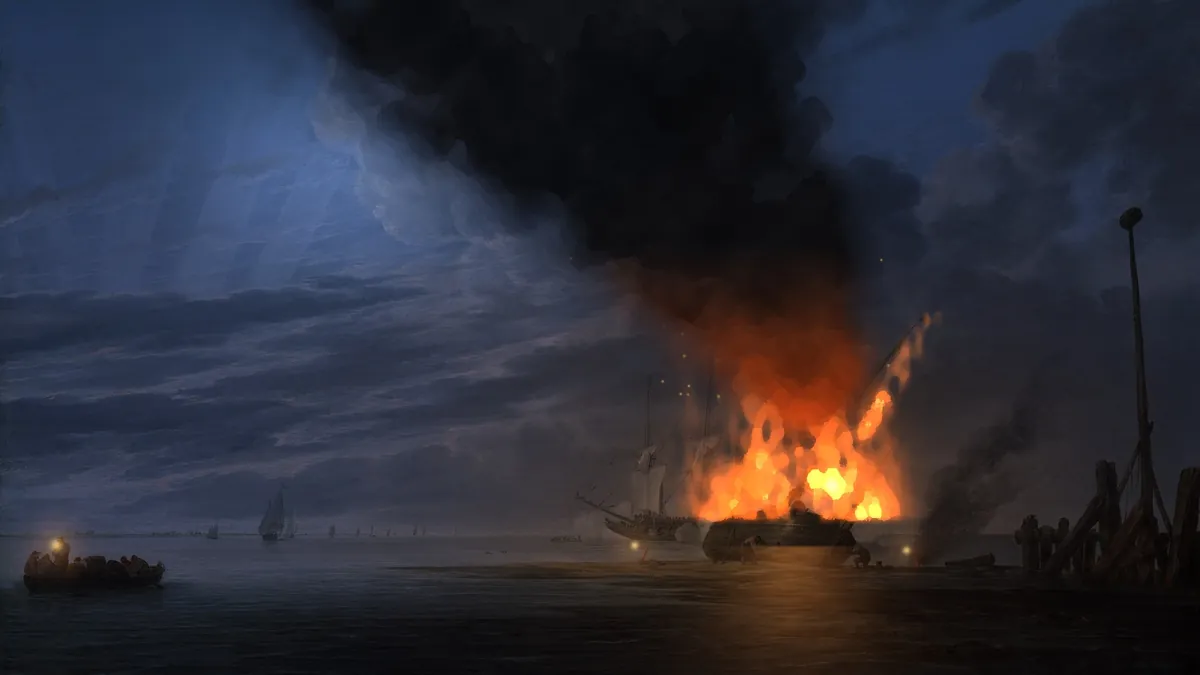
The fireships came at two in the morning on the fourth.
Marr was asleep in the harbormaster's office with her boots on when the fire bell on the outer mole woke her.
Southwick's anchorage opened south-west from the town, a broad sheet of water two miles across with the long mole on its west side and the low sandy point of the Spit on the east. No canopy reached this far south. Stars hung over the roads, and a thin moon low in the east. The breeze was fresh from the south-west, blowing straight up the anchorage toward the wharves and the grain ships that had not yet sailed, and the flood was running in under it.
Out at the mouth of the roads, beyond the end of the mole, three ships were burning.
They were coming in with the breeze and the flood together, sails set and drawing, fire running up their rigging in sheets. Behind them, in the light they threw, she could see two dark low hulls under lugsails: raiders, keeping upwind of the fire, ready to shoot down anyone who tried to stop it.
They were old coasters packed with tar and brushwood, set alight and sent in to burn whatever lay at anchor. Living crews had set them going, for nothing dead could stand up here, fifty miles from the nearest engine. Fire needed no dark to do its work.
In fifteen minutes, with that breeze, they would be among the grain ships.
"Dunning!"
"Here, Commander." He was in the doorway with his sword belt in his hand.
"Every boat we drilled," Marr said. "Grapnels and long lines. Rescue boats behind them. Get the marines into Spurr's lugger with the crossbows, and get her out to cover the boats from those raiders."
"And you?" Dunning asked.
"With the boats," Marr said. "Somebody has to tell them which fire to take."
She went down the harbor steps into Angove's first boat as it came past, and Angove hauled her aboard by the collar without looking round. The boat was a long open lugger with eight oars and a grapnel in the stern sheets. Behind them, boats were putting off from every wharf and slip in the harbor, under sail and under oars, all heading out into the roads toward the fire.
"How do you want them?" Angove shouted.
"Pairs, as drilled," Marr shouted. "Hook them at the stem and the quarter and pull their heads round to the east. Put them on the Spit. If they're on the sand they can burn all they like. Rescue boats astern of the pairs, and nowhere else."
"And the raiders?" Angove shouted.
"Dunning has them," Marr said.
Angove bawled it across the water, and the boats spread out into their pairs, twenty and more of them in the firelight, with the rescue boats behind them.
The first fireship came on at them, huge and roaring. The heat came across the water a hundred yards ahead of her, and Marr felt it on her face like the door of an oven. Sparks came down on the boat in a hot rain. The noise was the worst of it, a deep steady roar with sharp cracks in it as timbers split, and a hiss of steam wherever burning rigging dropped into the sea.
"Now!" Angove yelled. "Pull!"
The oarsmen pulled. The lugger shot in under the fireship's starboard quarter. Angove's son stood up in the stern with the grapnel and swung it twice round his head and let it go. It flew up and over the burning rail and caught. He threw two turns of the line round the boat's sternpost and sat down hard.
"Pull! Pull away! East!"
The line came taut with a jerk that threw Marr against the thwart. The lugger hung there, oars thrashing, held by the burning weight behind her. Then Angove's second boat came in under the fireship's stem. Its grapnel went up and caught in the burning headrigging, and both boats were pulling together. Marr felt the fireship's head begin, very slowly, to come round.
"She's coming!" Angove shouted. "Pull, you dogs, pull for your mothers!"
A bolt hit the water beside the boat with a sound like a slapped hand. Another took an oarsman in the shoulder and knocked him off his thwart. The raiders were coming down from upwind, both of them, a hundred yards off and closing, with men on their rails shooting at the boats by the light of the fire.
Marr grabbed the dropped oar and pulled.
She had not pulled an oar in fifteen years, and it came back to her in the first stroke: the drive of the legs, the weight in the back, the blade biting. The man beside her was groaning with the bolt in his shoulder, and she kept pulling.
Then a third light came down the roads. Spurr's lugger, with all sail set and Dunning's marines along her rail with the heavy crossbows, came in between the boats and the raiders. The marines shot as one. Marr saw a man on the nearest raider's deck go over backward. The raider sheered off. The second one held on, and the marines shot again, and its lugsail came down in a heap with a cut halyard. It fell off before the breeze, drifting toward the mole, and Spurr went after it.
The fireship had come round. Her head pointed east, toward the dark low line of the Spit, and the breeze was on her quarter now and driving her that way. Angove's boats towed and the breeze pushed. She went away from them across the anchorage in a slow, burning arc, and grounded on the Spit with a long grinding sound. Her foremast came down in a fountain of sparks.
"One," said Angove. She was black with smoke. "Where's the next?"
The second fireship had been taken by Tregear's pair and two others, and they were towing her clear in the same arc. But the third had got loose.
She had come in farther west, hard under the mole, and something had gone amiss with her rigging. Her foresail had burned through and dropped, but her mainsail was still drawing, and her helm had been lashed hard over, so that she came in yawing and turning. One of the pairs had hooked her and lost her as she swung. Their grapnel line had parted. Now she was coming straight down the anchorage toward the grain ships at the inner moorings, burning hard, with nothing between her and them but one boat.
It was the Thrift's boat, with Leary bareheaded in the stern sheets. He had his grapnel in at the fireship's quarter, and his crew were pulling until their backs cracked, and the fireship was dragging them backward through the water. Astern of him, where Marr had put them, a rescue boat lay on its oars with its lantern lit. It was the Spit ferry's boat, four oarsmen and the ferry captain's boy in the stern, with lines and hooks and nothing else.
"Angove," Marr said. "There."
"I see him," Angove said.
They came up on the burning ship's other side with the oars driving. Marr's face stung with the heat, and her coat began to smoke on her shoulders until someone threw a bucket of seawater over her. Angove's son stood and threw the grapnel. It caught the rail, and the line came taut.
And it was not enough, because the mainsail was drawing yet. It was a great sheet of flame above them now, roaring and full of air, and it was driving the fireship forward faster than two boats could hold her. The grain ships were three hundred yards away. Two hundred and fifty.
"Her sheet," Marr said. "Angove, if somebody can get a knife to her main-sheet, she'll lose way."
"Nobody can get to her main-sheet, Commander," Angove said. "Look at her."
Across the burning hull, on the other quarter, Marr saw Leary stand up in his stern sheets.
He shouted something at his crew that she could not hear over the roar. The Thrift's boat ran in under the fireship's quarter, so near that the paint blistered on her strakes, and Leary stood on the stern thwart with his boat knife in his teeth, judged the roll, and jumped. He came down on the burning deck on his hands and knees, and the smoke rolled over him, and he was gone.
"Hold her!" Marr shouted. "Angove, hold her, give him time!"
The main-sheet came down to the fireship's taffrail in a heavy block, and the fire was forward and above it. She could see nothing of Leary. She could see the sheet, and then she could see it jerk, once, and again, as something below the smoke sawed at it. Above, the sail screamed in the fire. The sheet went with a crack. The fiery sail flew out loose before the breeze, all its power gone at once, and hung streaming from the yard like a burning flag.
The fireship slowed. Down in the water on either side the two boats took the strain together, and the burning ship's head came round, away from the moorings, toward the east.
Then the main yard came down.
It came down burning, in a fountain of sparks, through the loosened sail and over the quarter where the Thrift's boat had been. The boat was not there; Leary's crew had pulled clear when the sheet went. It came down on the rescue boat astern of her instead. Marr saw the boat under it, the lantern, the ferry captain's boy standing up in the stern with a boathook, and then the yard was across the boat and the boat was gone. There were two heads in the water in the firelight, and then the burning sail came down on the water over the place, and there were none.
"Leary!" Angove was screaming. "Leary, over the side, man, she's going!"
Something fell off the fireship's taffrail into the black water between the two boats. Marr went to the lugger's side on her knees and got her arm into the water to the shoulder and found a collar, and hauled, and the collar had Leary in it. He came up coughing harbor and burned black across the face and hands.
"Give me your hand, Captain, damn you," she said, "give me your hand," and Angove's son had his belt, and they hauled him in over the rail and let him drop among the oarsmen's feet.
"The ferry boat," Leary said, when he could speak. "I saw the yard go. Did anyone get clear?"
"Pull," Marr said to Angove. "East. Put her on the sand."
The third fireship grounded on the end of the Spit twenty minutes later, beside the other two. They burned there until the tide came up round them and put them out one by one.
Spurr's lugger came back at first light with the disabled raider in tow and eleven living prisoners in her hold. Not a ship in the anchorage was lost. Three oarsmen were hurt by bolts. The Spit ferry's boat had gone down under the yard with four men and a boy of fourteen in her. The rescue pairs that had drilled two days to pull people out of the water pulled out two of them, dead, and found no more. Marr stood on the wharf while they were laid out, and learned their names from the ferry captain, who said them to the water.
Afterward she sat on the harbor steps in a blanket with her hands open on her knees. The grapnel line and the oar had taken the skin off both palms, and Leary's collar had finished them.
Leary came and sat on the step below her with a mug of something hot in each hand, and gave her one. His face was greased where the burns were, and his eyebrows were gone.
"You're a fool, Captain," she said.
"Yes." He drank. "The Plover's bosun did that at Ember Roads. Went over the rail onto a burning corsair that was drifting down on us, to cut her free. They never found him." He looked out at the black hulls smoking on the Spit. "I've been three years thinking I'd have done it, if I'd been nearer the rail."
"Now you know," Marr said.
"Now I know it costs a boat," Leary said. He set down his mug. "The ferry boat was where you'd put it, Commander. Astern of me. If I'd been slower with the sheet, the yard would have had the Thrift's boat and not theirs, and if I hadn't gone over, the grain ships would be burning now. I don't know what that comes to. I expect you'll tell me."
"No," Marr said. "I'll write their names in my book, and that the Thrift's master cut the sheet, and I'll carry it. That's what it comes to."
Leary stood up stiffly.
"I still want Rusk tried," he said.
"I know you do," Marr said.
"But I'll sail. Put the Thrift where the towboats are. Like I said." He looked down at her. "And Commander. Nobody goes aboard a burning ship. First thing you learn. Have the goodness not to learn it."
He went off along the wharf. Marr sat with the mug between her raw hands, and watched the sun come up red over the town behind her.
The runner came in the evening of the fourth.
She was a girl of sixteen in a lighterman's smock, with bare bleeding feet. She had come forty-nine miles down the coast road from Greyhaven in two days, walking, riding on carters' tailboards, and running the last ten miles. Dunning found her at the guardhouse arguing with a sentry. He brought her up to the harbormaster's office, and she stood in front of Marr's table swaying on her feet.
"Peg Hollis," she said. "From the Basin. Master Stannard sent me. He said to find the Navy officer who freed Darn."
"That's me," Marr said. "Sit down."
The girl sat down on the floor, because there was no chair near enough. Dunning brought her water, and she drank it all and wiped her mouth.
"They've finished the gates," she said. "Master Stannard says to tell you, the fittings are in. The little black ones. They sank them in the races behind the gates weeks ago, one in each race. And the plates on the gates are all fixed and the work crews are chained in the gatehouses so they can't get word out." She swallowed. "And the soldiers are leaving the Basin. But they won't let any of us out. There's a cordon on the causeway, and they turn people back."
"When?" Marr said.
"At the November tide. He said you'd know what that meant." Peg Hollis looked up at her. "My mam's in the Basin, Commander, and my sisters. We're on Tanner Lane. It's the lowest street in the whole town."
Marr knelt down on the floor in front of her. She took the girl's hands, which were cold and rough and shaking.
"Then we'll go and get them," she said.
She stood up and turned to Dunning, who was already reaching for his sword belt.
"Send to Petch," she said. "Brightwater and Fulmar sail on the morning tide, with every boat that drilled, and the marines. Send to Darn by the fastest lugger in the harbor. Tell Mistress Pell and Mistress Sorn we'll meet them off Greyhaven's South Sands tomorrow night." She turned to the window, where the last red light was going out over the roads. "We're not waiting for the tenth, Sergeant. Greyhaven first."