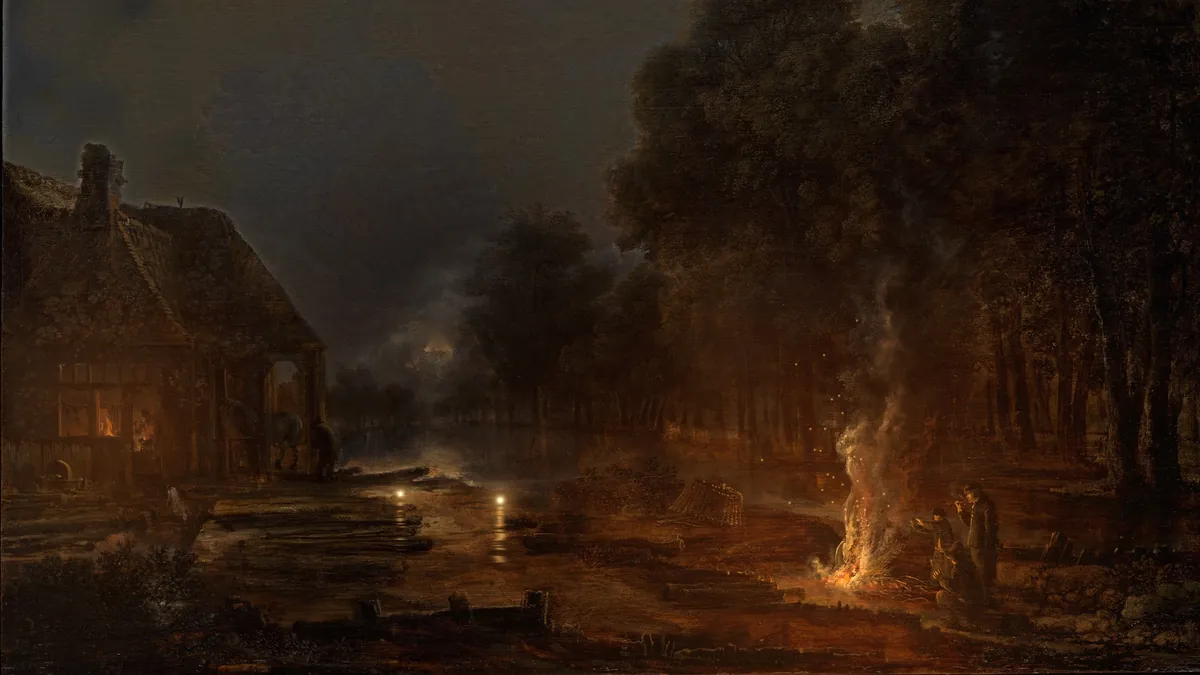
The Rope Ferry
Marr kept the two signal books in the chest under her cot, wrapped in oilskin, with the key on a cord round her neck.
She took them out on the morning of the sixth, as the Kestrel worked north out of Holm Sound with the four supply boats astern, and checked them against each other page by page. One was the chain-house copy she had taken off a dead scout on the steps at Greyhaven. The other was the Swift's, from Colm Doyle's coat on the wharf at Southwick. Both blue canvas covers, both stamped with the Compact anchor, both complete. She had done this every morning for ten days. It was a habit, and she knew it was a habit, and she did it anyway because it settled her. Every copy that had gone astray was in this chest. The big ships trapped at Greyhaven would have burned theirs; the regulations required it, and Compact captains obeyed that regulation if they obeyed nothing else.
She locked them away and went on deck.
The supply boats were broad, slow Southwick traders, deep with flour and salt fish and seed barley. Their masters had come up the Reach by night to meet her at Holm Sound and they were nervous men, and they had reason. By the forenoon watch the Kestrel had sighted the dark.
It stood across the north like the edge of the world. Marr had seen it four times now and it never looked any less wrong. The sea ran on blue and bright for a mile, and then it stopped being blue, and above that line there was no sky.
"Patience," said Tomas Ebb, at her elbow, with Cobley a pace behind him. "It must be. Shelter is off Greyhaven, and the rest are west."
"How do you know where the others are?" Marr asked.
"I don't. I know where they were." He hesitated. "Commander, if it's lying off Carrick, it'll be anchored in a stream. They need moving water for the vanes. Look for it where the tide runs hardest."
"And its door?"
"Under its frame. In its chest, the same as the Lamb's." He swallowed. "I'd keep everybody out of the water."
She thanked him, and meant it, and watched him go below again between his guards.
They went into the dark at noon. The sun went off the sea astern of them like a lamp being shut, and the cold came down. Enoch Garvey lit the binnacle lamp with the air of a man lighting the candles at a wedding.
They raised Carrick's Holm by lantern-light in the evening by the clock.
Isobel Wray had the deck, with Orris at her shoulder telling her every few minutes that she was steering like a drunk bishop, and she was steering very well. Ahead, low on the black, the lights of a village showed on a hillside, few and dim. South of them, half a mile off, hung a cluster of brighter lights low on the water, a great many of them, in a ring.
"That's the engine," Rusk said quietly. "And her tugs round her, and something with a big stern lantern. A brig, I'd say. She's anchored in the south mouth of the sound."
Marr studied the ring of lights through her glass. She could make out nothing but lanterns. Somewhere in the middle of them, she thought, was a frame like the one Nera had drawn, many times larger, behind armor, humming in the dark.
"Could we take her?" she said.
"Tonight? With the brig and four tugs round her, and no notion how she's built?" Rusk lowered his glass. "We'd lose the ship trying, and we'd lose the supply boats. When we go for one of those, Commander, I want to know where to put the iron."
"Darn," Marr said.
"That's where the answers are," he agreed.
A skiff came out to them from the dark under the hillside, pulled by one man. He came alongside and climbed the Kestrel's side without asking, a big sandy-haired man of forty with a fisherman's shoulders and a face hollowed by hunger.
"Tad Sellick," he said. "Pilot, of Carrick. You'll be the Kestrel. We've heard about you from the Orra boats." He looked round the lit deck, at the supply boats lying astern, and his throat moved. "Is that food?"
"Flour, fish and barley," Marr said. "For Carrick."
"Then I'll tell you where to put it, and where not to." Sellick took a breath. "They've the mill, Commander."
They took him below to the cabin, and Hanne Webb put a bowl of Orris's stew in front of him, and he talked while he ate. He ate fast, with his eyes on the bowl.
There were two islands, he said, Carrick's Holm and Little Carrick, with four hundred yards of water between them that the islanders called the sound. The tide ran hard through it. Carrick village stood on the Holm side, on the hill above the sound. On the east shore of the Holm, Mill Creek ran a quarter mile inland to the tide-mill, which stood at the creek's head across its dam with the millpond behind. Every sack of grain on both islands had been carried there to be ground before the dark came.
"Thirty of them came in boats when the engine came," he said. "Living men, Pale Fleet sailors, under a lieutenant named Penrose. They took the mill and the grain in it. They feed the engine's crews out of it, and the tugs. They keep us on a sack a week for the village, which is two hundred people." He put down his spoon. "And they took the wives and children of every pilot on the island. Mine with them. Jenet and the two boys. They hold them at the mill, and they send us out to bring their boats through the islands. We bring the boats safe, and our families eat."
"How many families?" Marr asked.
"Nine," Sellick said. "Twenty-two souls. They're on the grain floor at the top of the mill."
Marr glanced at Rusk. He had not said a word.
"The rope ferry," she said. "The Orra boats spoke of a rope ferry."
"That's ours." For the first time a spark of pride came into the man's face. "They burned our boats on the Holm side, all but the skiffs they let us keep for piloting. So we strung the hauling ropes across the sound the second night, from our landing to Little Carrick. We've three skiffs anchored along it, midstream, so a boat can haul itself from one to the next and never be swept off down the sound. Half the village has gone across to Little Carrick, and we carry over what food we can steal. The garrison don't trouble it at night. They sleep, and they don't like the water in the dark." He paused. "Neither do we, now."
"Will Penrose talk?" Marr asked.
"He'll talk," said Sellick. "He likes talking. He won't give you anything."
Marr met Lieutenant Tobias Penrose at noon on the seventh, in the middle of the sound, on the ferry's midstream skiff.
It was black as midnight. The skiff lay to her anchor with the tide sluicing past. The hauling rope came in out of the dark on one side and went off into the dark on the other, wet and taut and creaking. Two lanterns burned on the skiff's thwarts. Marr had come out from the Little Carrick side with Dunning and Tad Sellick. Penrose came out from the Holm side, hauling his boat hand over hand along the rope, with six of his sailors.
He was younger than she had expected, thirty perhaps, with a western islander's dark face and short-cropped black hair. He came over into the skiff easily and sat down on the thwart opposite her and smiled.
"Commander Marr," he said. "Of the Compact Navy, I'm told. We'd heard there was a Compact ship loose in the Reach. I'd hoped it was a rumor."
"Lieutenant," Marr said.
"You've brought food. I saw it come in." He glanced over his shoulder at the dark, toward the village lights. "That's generous. The village will be glad. I'll see it's shared fairly."
"You'll see nothing of it," Marr said. "I want the mill, the grain, and the pilots' families. Today."
"No." He said it pleasantly. "The families are my surety. While I hold them, the pilots bring the Admiral's boats through these islands safe. Without them the pilots would put every boat I have on the rocks, and I'd not blame them." He spread his hands. "I'm not a cruel man, Commander. Nobody has been hurt. The children are fed better than the children in the village. I see to it myself."
"With the village's grain," Marr said.
"With the Admiral's grain, now." Penrose's smile did not shift. "You have one small ship and perhaps forty people. I have thirty men in a stone mill, and half a mile down the sound I have an engine, the brig Ardent and four tugs. If you try to take the mill, I'll fight. And people will die in the water, Commander. You know what that means here."
She knew. Half a mile south, Patience's lights hung low on the water.
She looked past Penrose at his sailors.
There were six of them in his boat alongside, holding it to the skiff. They were common seamen, western islanders mostly, thin, with salt-cracked hands. They were listening hard. One of them, an older man with a gray stubble, was not looking at his lieutenant at all. He was looking at the supply boats' lanterns over on the Little Carrick shore.
Marr raised her voice without shouting. She pitched it as she had once pitched orders across a crowded deck in a gale, so that it would carry without strain to every man in that boat.
"Then hear my terms, Lieutenant, and your men may hear them too. Any man of your garrison who lays down his arms will be taken to Southwick as a prisoner of war. He'll be fed on the passage, fed in Southwick, and exchanged or released when this is over. He will not be hanged. He will not be put to work. You have my word on it as a Compact officer, and the Commodore at Southwick will stand behind it."
Penrose's smile had gone. "You've no authority to offer that."
"I have a commission from Commodore Petch," Marr said, "and I've just offered it."
The gray-stubbled sailor had turned his head. He was looking at her now, and so were the others.
"Mind your hands on that rope," Penrose said, without turning round. His voice had an edge on it now. "This truce is over, Commander. Go back to your ship. If you come for the mill, come ready to bury people."
He went back over into his boat. His men hauled it off along the rope into the dark. The last Marr saw of them was the older sailor looking back at the skiff over his shoulder, and at the lights of the food.
"You put a hook in that one," Dunning said quietly.
"Perhaps." Marr's hands were cold, and she put them behind her back. "Tell the men the terms, Sergeant. Every one of them. I want them able to shout it in their sleep."
She found Orris that afternoon on the Little Carrick shingle, in the middle of a quarrel.
A crowd stood on the beach by the ferry landing with their bundles. They were families from both islands and further off, waiting for a way south. Most had the gray, pinched look of people who had not eaten properly in a fortnight. A sturdy fishing smack lay off the beach with a lantern in her rigging. On the shingle, at a trestle table with a cash box on it, sat a lean, handsome man of sixty with a gold ring in one ear and a fur collar on his coat.
Orris stood in front of the table, and the two of them were looking at each other.
"Leland," said Orris.
"Orris Fen. Well, well. I'd heard you'd gone respectable and taken up cooking." The lean man grinned, showing a gold tooth. "Commander, is it? Leland Spurr, master of the Merry Thomas. At your service."
"What's the box for, Mister Spurr?" Marr said.
"Passage south, ma'am. To Southwick, through the dark, past the Admiral's patrols. A silver mark a head. Children half price." He spread his hands. "It's a dangerous run. I have a crew to feed."
A woman at the front of the crowd had a baby on her hip and a boy of about seven by the hand. She was holding out a ring. Marr could see it was a wedding ring. Spurr's fingers had been reaching for it.
Orris looked at the ring. Then he looked at Spurr again. He did not raise his voice, and he did not make a speech.
"You'll want the Kestrel to see you past the engine's guard boats," he said. "And past the brig. You'll never get the Merry Thomas out of this sound otherwise, Leland. They'll have you."
"I've got past worse," Spurr said.
"Not with a full hold and a lantern in your rigging, you haven't." Orris put his hand flat on the cash box lid and shut it. "You'll carry them free, and we'll see you through. That's the price."
Spurr studied him. Nobody on the beach made a sound.
"Free," Spurr said.
"Free. And you'll feed them on the way out of your own stores, the way you fed me in the old days when I'd nothing." Orris took his hand off the box. "Then we're square. We were never square before."
Spurr's face did several things in quick order. Then he laughed, short and rueful, and pushed the box away across the table.
"You always were a sanctimonious old pirate," he said. "Put your ring away, mistress. Get the children aboard."
Marr walked back along the shingle. When she looked round, Orris had taken off his coat and was standing knee-deep at the smack's side, handing up bundles. Spurr was on the deck above him taking them, and the two of them were arguing about the stowage like a married couple.
At high water that night, a little after eleven by the clock, the tide stood slack in the sound.
Mill Creek ran a quarter mile into the Holm from the sound, narrow and black, between muddy banks with dead reeds on them. At its head the tide-mill stood across the dam, three floors of stone and timber with a gallery round its top floor overlooking the race. Behind the dam the millpond lay full and still. Below it, the race came out under the great idle wheel and ran down into the creek, deep and dark. At slack water the mill's pond gates were shut and the wheel stood motionless, and the whole creek was silent. Half a mile south down the sound, Patience's lanterns burned in their ring.
They came up the creek in two boats with muffled oars. Marr was in the first, with Dunning and four marines and Tad Sellick at the tiller. Orris was in the second with the other three marines and eight Carrick pilots armed with boathooks, cudgels and fish knives. Out at the north mouth of the sound, Rusk had the Kestrel lying to with every lantern hidden and every crossbow manned, ready to come down if the brig moved.
"One thing," Marr had told them all on the Little Carrick beach before they embarked. "Anybody who goes into the water, ours or theirs, gets pulled out. Alive or dead, but out, and fast. The engine's door is less than a mile away. A man who drowns tonight will be on his feet again before we're back in the boats, and he'll be theirs."
The sentry at the creek's bend was asleep on a coil of rope under a shuttered lantern. Dunning took him before he woke, with a hand over his mouth and a knife at his throat. The man lay trembling under the thwarts with his hands tied behind him and a pilot's knee on his back.
They grounded under the mill wall where a ladder came down to a landing stage. Marr went up first.
At the top of the ladder was the wheel-room door, and it opened as she reached it. A man with a lantern stood there gaping at her. She drove her sword hilt into his face, and he fell back into the wheel-room shouting, and the lantern rolled away across the boards.
"Up!" Marr said. "Up, up, go!"
They poured in. The wheel-room was a great timbered space with the dead wheel's axle running through it and the gear wheels standing in the dark above. Six men came at them out of the lamplight from the stair, half dressed, with cutlasses and boarding pikes. One of them was the gray-stubbled sailor from the ferry skiff. Marr saw his face, and saw him see hers.
"Prisoners of war!" Dunning bellowed. He had a voice that could have carried across a battlefield. "Lay down your arms and you go to Southwick fed! Not hanged! Fed! The Commander's word on it!"
The gray-stubbled man stopped dead on the bottom stair. He looked at the cutlass in his hand.
"Fed?" he said.
"Fed!" roared Dunning. "Put it down, man!"
He put it down. He threw it on the boards with a clatter and stood with his empty hands spread, and the man beside him hesitated and did the same. The other four came on.
Marr met the first on the stair foot. He swung his cutlass at her head, wild, and she ducked under it and cut him across the thigh, and he fell back on the steps. A pike came past her shoulder from the man behind. She caught the shaft with her free hand and pulled, and he came forward off balance onto her point. He went down. Cobley and Bramley drove the other two back with their pikes up the stair, and one of them broke and ran up into the dark, and the last went over the rail of the wheel-pit.
He fell into the race. Marr heard the splash below, and the gasp, and then the thrash of a man who could not swim.
"Get him out!" she shouted. "Sellick! Get him out!"
Two of the Carrick pilots were already at the window that gave onto the race. One of them swung himself out on the wheel's lowest paddle and hung there by one hand, reaching down with a boathook into the black water. Marr heard him swearing in the island dialect. The man in the water came up once, choking, and went under again.
"I've got him! I've got his belt!"
They hauled him in over the sill like a netted seal, streaming, coughing up the race, and threw him face down on the boards. Hanne Webb would have done better, but the pilot thumped him between the shoulders until he vomited water and dragged in a great whooping breath.
"Alive," the pilot said. He was grinning. "Alive, the bastard. You owe me a drink, friend."
Marr went up the stair.
The grain floor was the mill's second story, a long low room under heavy beams, stacked to the ceiling with sacks. Lamps hung from the beams. At the far end, behind a barrier of sacks, the hostages were huddled against the wall: women, children, a pair of old men. She heard a child screaming. Three garrison sailors stood between the barrier and the stair with their weapons out, and Orris came up the stair behind her with his axe, and the pilots crowded after him.
"Jenet!" Tad Sellick shouted. "Jenet!"
"Tad!" A woman's voice, from behind the sacks. "Tad, the boys are here, we're here, we're all here!"
"Prisoners of war!" Dunning roared again, from the stair head. "Fed and not hanged! Lay them down!"
One of the three sailors laid his weapon down at once. Another looked at the first, and at the stair, and at Orris's axe, and laid his down too. The third, a big man with a boarding pike, backed toward the hostages.
Orris went past Marr at a run.
He was nearly sixty and as wide as a door, and he went down that long room like a falling cask. The big man swung his pike round to meet him. Orris took the point on the flat of his axe-head, knocked it aside, and came in under the shaft. He hit the man in the belly with his shoulder. They went over together into the sacks, and the sacks burst, and flour went up in a white cloud. When it cleared, Orris was sitting on the big man's chest with the axe-head under his chin.
"Prisoner of war," Orris said, breathing hard. "Say it."
"Prisoner of war," the man said.
"Good lad. Fed and not hanged." Orris looked round, white to the eyebrows. "Somebody give me a hand up. I've done my back."
The pilots went over the sacks to their families. Marr turned away from it to Dunning.
"Penrose," she said.
"Not here," Dunning said. "The one that ran went up. There's a top floor and the gallery."
The gallery ran round the outside of the mill's top floor, a narrow walk of planks with a waist-high rail, twenty feet above the race. Marr came out onto it through the loft door with a lantern in one hand and her sword in the other, and the night came round her black and cold. Below, the race lay deep and quiet under the idle wheel. Half a mile south, Patience's ring of lights hung on the water.
Penrose was at the far corner with two men and a lantern. One of them was trying to light a signal rocket from it. The fuse caught and sputtered.
Marr dropped her own lantern and went along the gallery at them.
The man with the rocket turned to meet her and she cut his arm. He flinched back from the blade with the rocket spitting in his fist, and the rail took him behind the knees, and he went over it backward into the race. She heard him strike the water, and the rocket hiss out. The second man came at her with a cutlass. The gallery was too narrow to pass. She took his cut on her blade and they were chest to chest against the rail, and she felt it creak. She brought her knee up into him, and he doubled, and Dunning came out of the loft door behind her and caught him by the collar and dragged him back inside.
Then there was only Penrose.
He had his sword out, a good straight blade, and he stood in the corner of the gallery with the lantern at his feet lighting him from below. He was not smiling.
"I'm not going to Southwick, Commander," he said.
"You can," Marr said.
"No." He came at her.
He was quick and well taught, quicker than she had expected. His first thrust came at her face, and she slipped it with her shoulder to the mill wall. His second came under, at her belly, and on that narrow walk she had nowhere to go but back. She felt the blade's edge slide across her coat. The gallery planks were wet and the rail was at her hip. She gave a step. He pressed. She gave another and felt the loft door behind her shoulder, and he came on with his weight forward for the finish.
She let the blade come. She stepped across it to the rail side, so that it went past her into the door frame and stuck there an instant, and in that instant she thrust.
It went in under his arm. He made a small sound. He leaned against her, almost gently, with his face near hers, and she felt the weight go out of him. His sword came free of the door frame and dropped. He went back against the rail, and the rail gave, and he went over into the dark.
She heard him strike the water below.
By the time she reached the broken rail, Sellick's pilots were in the race with lines round them, as they had been once already that night. Two of them were still under the wheel, feeling for the rocket man. It took four of the others and two boathooks and the best part of three minutes. When they laid him on the landing stage below the wheel, Dunning knelt by him with a lantern and felt for his breath, and his pulse, and turned his face to the light.
"Dead before he hit the water, Commander," Dunning said. "Your point was through his heart. There's no water in him."
"Sure?" Marr asked.
"Sure." Dunning closed the man's eyes with his thumb. "He'll not rise."
"The other one," Marr said. "The one with the rocket."
"Sellick's lads can't find him, Commander," Dunning said. "He went under the wheel. The race has him."
Marr stood on the landing stage, looking down at Penrose's dark young face, until Dunning said her name a second time.
"Bury him with his own people," she said. "Properly. And keep a watch on the grave until we're gone."
They were bringing the families down the stair to the landing stage when Sellick's wife screamed.
A man was coming up the ladder from the race. He came slowly, with his hands spread on the rungs, and the water ran off him in sheets, and the lantern on the stage showed Marr his face. She knew it. She had cut his arm on the gallery a quarter of an hour before, and the cut was there, open and bloodless, and the rocket's scorch was on his sleeve.
"Back," she said. "Everyone back up the stair."
He came up onto the planks and stood. He did not look at her. He looked at the children on the stair, and his mouth opened, and the race ran out of it, and nothing else. Then he walked toward them.
Dunning's pike-butt took his knee. Marr took the other. He went down on the planks still reaching for the stair. She stepped over his hands and brought her hilt down on the back of his neck, and again, until it went, and Sellick's boys watched her do it.
Nobody spoke on the way back to the boats. Penrose had died of steel, with no water in him, and lay under a guard. This one had died of water, half a mile inside the reach of the engine's door, and the door had been quicker than the pilots.
By the morning of the eighth they had it. The mill was theirs, and the grain, and twenty-two pilots' wives and children were back with their husbands and fathers. Penrose and four of his men were dead, the last of them buried deep behind the mill under a guard. The rest of the garrison sat in a line on the dam with their hands tied in front of them, eating bread and not looking at the race.
Patience's guard boats had come up the sound in the night when the rocket went into the race, three of them, pulling hard. They had met the Kestrel coming down from the north mouth with her lanterns uncovered and her heavy crossbows bearing, and they had gone back to the engine. The brig had not moved. Rusk said he thought her captain did not care to leave the engine unguarded for the sake of a mill.
The supply boats came round into Mill Creek on the morning flood, and the village came down to meet them.
Marr watched it from the mill dam. People came down the hill from Carrick and across the sound on the rope from Little Carrick. They stood on the creek bank as the first sacks came ashore, and at first they made no sound at all. They simply stood and looked at the flour. Then an old woman began to laugh, and somebody else did, and then it went through the whole crowd.
Enoch had come ashore with Pudding inside his coat. By noon he had a ring of pilots' children round him on the dam, and Pudding was being passed from lap to lap with an expression of martyred patience.
"She's very good with children," Enoch told Marr. "She hates them, but she's very good with them."
That evening Spurr's Merry Thomas went down the sound with eighty refugees aboard and the Kestrel's boats as escort. Orris had worked the loading all through the day and into the night. When Marr came down to the beach at the end of it, she found him sitting on a cask on the shingle beside Spurr, the pair of them black with tar and flour, sharing a pipe.
"He cheated me at cards in nineteen different ports," Orris said, as she came up. "I'm telling you so you know what you're dealing with."
"Twenty," said Spurr. "You've forgotten Casmir."
"I've not forgotten Casmir," Orris said. "I've forgiven Casmir. That's different."
Marr left them to it.
Tad Sellick came to find her on the Kestrel's deck at midnight by the clock. He had another man with him, a gaunt, silent pilot with a scar across his chin.
"This is Tamsin," Sellick said. "He took a boat into Darn for Penrose's people a week since. He was in the yard two nights. You'll want to hear it, Commander. Your shipwright too."
Nera came up from below with a lamp, limping on her bruised hip, and Rusk came from the quarterdeck. Tamsin looked at them all with distrust and spoke to Nera.
"You were Dray's girl," he said. "In the drawing office. I remember you. You were always shouting at somebody."
"I remember you too," Nera said. "You sold us bad pitch. Is he alive?"
"He's alive. They've got him at his table under guard, day and night, drawing for them. The whole drawing office, they've kept it, every sheet. They need it. They've got a new engine on the big slip, nearly done." Tamsin rubbed his chin. "And the yard's full of guards on the harbor side. But not on the timber pond."
Nera's face sharpened. "The pond."
"They've a boom across the log gate and one sentry on it," Tamsin said. "At the top of high water there's three feet over the sill, and a fishing boat with a shallow keel can get through under the boom, if somebody lifts the end of it. Up the log slide from the pond, and you're behind the sawpits. Nobody looks there."
Nera turned to Rusk. Rusk was looking at Marr.
"No new orders," Marr said. "I'll open them after Darn."