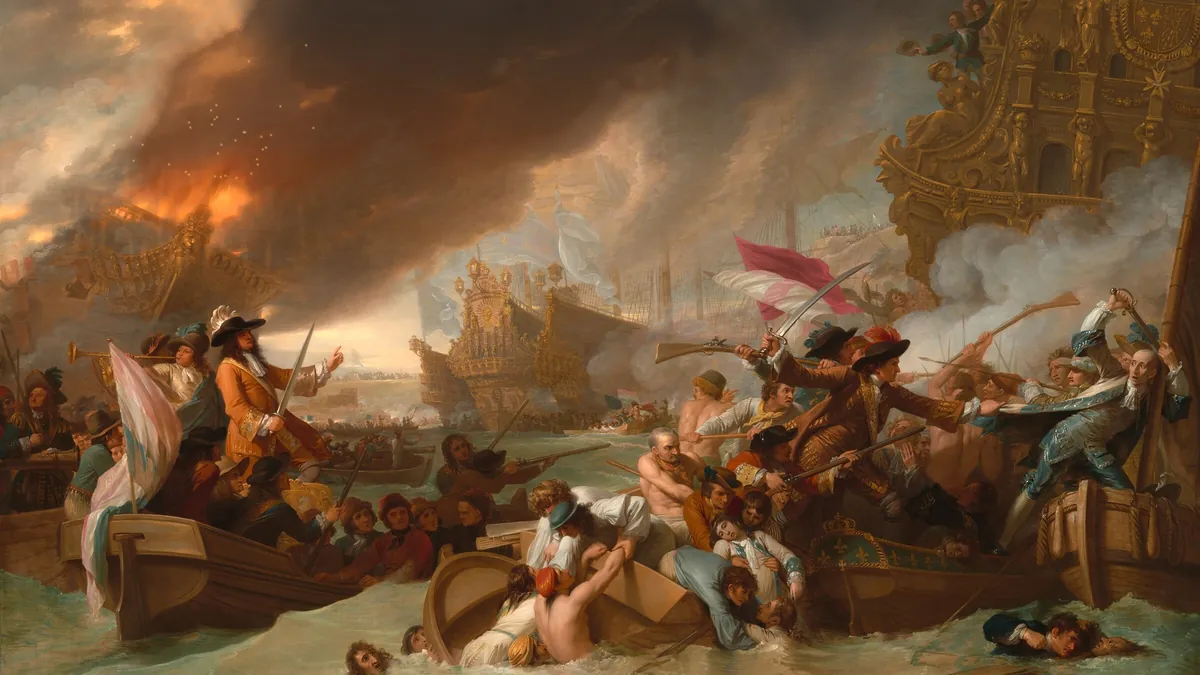
The Counterstroke
The Skerrow came up out of the dawn where Orris had said it would, and it was nearly empty.
Rusk saw it from the quarterdeck in the first gray light of the fourteenth: a broken ring of low islands, black against a paling sky. The southern entrance lay open before the Kestrel's head. Beyond the anchorage the two northern entrances opened on either side of a high hump of rock called the Stack. North of those, a line of outer rocks showed white where the sea broke. That line was the limit. Darn lay to the south-west under its smoke, and Brindle was a dark smudge off to the north-east. The breeze was west-south-west, fresh and steady, and the sun was not yet up.
There should have been eleven ships at anchor in the ring. There were three.
"Drown me," said Orris, at the helm. "They've gone."
"Most of them." Rusk had the glass up. The three that were left were deep-laden transports, getting their anchors in a hurry. Men ran on their decks, and their topsails were dropping from the yards. "Those three are late. The rest sailed in the night."
"The manifest said dawn," Orris said.
"Then the manifest lied." He lowered the glass. "Or somebody made it lie."
He did not like that thought, and he put it away for later. Around the ring the squadron was moving to its places as they had agreed. Gannet was rounding the eastern islands to take the north-east entrance, and Tern was beating up along the west side for the north-west one. Brightwater, with Marr aboard, held the open water east of the ring where she could support either. The Kestrel, the only one of them that could take the shallow southern gut at this state of the tide, went in through it under topsails.
"Crossbows ready," Rusk said. "We'll take the nearest. Tern has the far gate."
The nearest transport had her anchor up and was making for the north-west entrance. The Kestrel came down on her across the anchorage with the breeze on her quarter, and the transport's people saw the crossbows run out along the brigantine's side and lost their nerve. Her master put his helm over and ran her onto the mud under the inner shore, and her crew went over the side into the shallows and waded for the island.
"Leave her," Rusk said. "She's not going anywhere. The next one."
The second transport was halfway to the north-west entrance, and Tern was waiting for her outside it. Rusk watched Strand's ship come round across the gate with her ports open, neat as a drill, and the transport's topsail came down in surrender. That was two. The third was already out of the north-east entrance and running north. Gannet had gone after her, round the far side of the Stack, out of sight.
"That's one too many out of sight," said Orris.
"Pollard's keeping inside the rocks. He'll be back."
"Captain!" Joss Ambry's voice came from the foretop, high and cracking. "Captain! Sail to the north-west! Beyond the outer rocks! Big ship under tow!"
He saw her from the foretop himself a minute later, with the glass braced against the mast and the breeze in his ears.
She was four miles off to the north-west, past the line of breaking rocks, a broad, blunt hull with a stump of a mast, low and heavy in the water. Ahead of her a string of towboats pulled on long hawsers, their sweeps rising and falling. On either side of her an escort brig kept station. One was Ardent, with a new jib bent on and her red paint shining. The other would be Cutwater. They were creeping north, barely making way, at the laboring pace of an engine in tow.
And there was no dark around her.
Rusk held the glass on her. The morning was coming up gold behind him over the Reach, and the light lay on her as it lay on everything else. There was no wall, no black, no canopy. She was a big ugly ship in the sunshine with two brigs to guard her.
"Covenant," he said.
He came down the shrouds to the deck. Orris was waiting at the helm with his white whiskers bristling.
"That's past the rocks," Orris said.
"I know where it is."
"You said it yourself, two nights ago," Orris said. "No ship goes north of the outer rocks for any reason. If something tempting shows beyond them, we let it go. Those were your words. I was at the stove. And I was at the helm when you drove her over the Ram's Gut on your own say, and a man's leg paid for it."
"She's cold, Orris." Rusk kept his voice low. "Look at her. She's out of Darn, and they haven't woken her. The drawings say two hours of steady tow to bring a frame up. They're taking her north to sit on the Halsey lane where Patience was, and they mean to wake her on the way. If we take her now, before she's ever made a minute of dark, she never makes any. We'll never see one cold again."
"Two brigs," Orris said.
"We beat those two days ago. Ardent's still patching her canvas." He looked north-west. Four miles. The Kestrel would make six knots on this breeze, and the engine was making one, by the look of her. An hour to catch her, a little more. "Signal to Brightwater. Engaging engine to the north-west."
"And wait for an answer?" Orris asked.
"There isn't time for one," Rusk said.
Orris turned his head and spat over the lee rail, which was the only argument he had left.
"Hands to the braces," he said. "You heard the Captain. North-west."
The signal went up in the Compact book's flags. Rusk saw it break out at the peak and did not look for a reply. The Kestrel came round onto the new course and went out through the north-west entrance past Tern. Strand was taking possession of her transport, and Rusk saw her turn on her quarterdeck and stare at him as he went by.
Halfway to the outer rocks, he saw Brightwater turn away.
She had been holding her ground east of the ring, as they had agreed, between Gannet's gate and Tern's. He had the glass on her when it began. A hoist broke out at the peak of a brig lying in the north-east gate, where Gannet had been: Compact colors, and a string of flags he could not make out at three miles. Brightwater's answering pennant went up and came down, as the book required, and she was coming round. Her yards swung, her topsails filled, and she bore away to the north-east with the breeze on her quarter and every sail drawing. Away from Tern, away from the Kestrel, away from everything. In a few minutes she was hull-down behind the eastern islands.
"Where's she going?" said Nera. She had come up from below with her sleeves rolled and stood beside him with her eyes narrowed. "That's the wrong way."
"I don't know."
"Did she answer your signal?" Nera asked.
"No. She answered somebody else's." He watched the last of Brightwater's topsails go behind the land. Marr was precise. She did not leave a station on a whim. A brig in Gannet's gate had told her something, in the book, and she had obeyed it. He could not think what a Compact brig would have to tell her that he could not see. "She'll have her reasons."
"I hope they're good ones," said Nera, and went back below to her pumps.
The Kestrel passed the outer rocks with the white water breaking a cable's length on either side. Nobody said anything. Ahead, Covenant labored north in the sunshine, and her two brigs turned toward the Kestrel.
They met Cutwater first. She came down on them from the engine's flank with her crossbows run out, and Rusk let her come. He held his course until he could see faces at her rail.
"Starboard battery. Her rigging. Loose."
The crossbows went off down the side. Cutwater's main topsail split, and her foreyard came down at one end and hung across her deck. She fell away, firing as she went, and two of her bolts came across the Kestrel's waist. One of them took a Carrick man in the shoulder and spun him round.
"Span and load. Ardent next."
Ardent was more careful. She stood off a quarter of a mile and traded bolts from long range, keeping between the Kestrel and the engine, and Rusk had to give her the breeze to get round her. It cost him ten minutes. By then he was a mile from Covenant and gaining fast. He could see the engine plainly now: the black upper works, the stump mast with its signal lamps, men on her deck looking back at him.
They were watching him come, and nobody on her deck was hurrying. Rusk felt the back of his neck go cold.
"Orris," he said. "What time is it?"
Orris pulled out his watch. "Twenty past eight."
Dawn had been at a quarter past six. The engine had been under tow when they first saw her, and she had already come out of Darn and up the west side of the Skerrow. That meant two hours or more, steady at the end of her hawsers, while he chased her past the limit.
"Hells," he said quietly. "They've been waking her all morning."
The sun went out.
It went all at once, over the whole sea. No wall came across the water this time, and no edge showed. The blue sky overhead turned black from horizon to horizon in a single breath, and the light went off the water, and the Kestrel was in the night. Covenant's frame had come up. The dark was hers, five miles round, and the Kestrel lay at the heart of it a mile from the engine. The northern half of the Skerrow lay inside it behind them.
Men cried out on deck. Somebody dropped a bucket.
"Lamps," Rusk said. "Every lamp. Low over the side. Bring her about. Back to the Skerrow."
"She's right there," said Orris. "A mile."
"She's awake. Her fitting holds every dead man they've brought within five miles of her, and now it's dark enough for them to come out. And Tern is alone in the north-west gate with a prize on her hands." He saw it as he said it. Brightwater was gone to the north-east, Gannet was out of sight behind the Stack, and the Kestrel had run miles past the limit after the bait. Each ship of his squadron was alone. "We've been taken apart, Orris. Bring her about."
The Kestrel came round. As she came, Rusk saw lights to the south where there had been none: many lights, coming out from behind the northern islands of the Skerrow where they had lain hidden. Ship's lanterns hung on a tall ship he knew from the Pennant Flats, Resolute, and on four more ships behind her. Low lanterns, too, clusters of them on the water, which were boats.
To the south-west, where Tern had been, a fire bloomed.
He watched Tern burn as he came down on her, and he could do nothing to make the Kestrel go faster.
Under the canopy the flames carried for miles. They lit all of the north-west entrance: the gut, the rocks on either side, the water red and black. Tern lay in the middle of it with flames climbing her rigging and two enemy brigs lying off her, pouring bolts into her. Fire-pots, Rusk thought. They had come in near and thrown fire-pots onto her deck. The prize transport had drifted onto the rocks beside her. Her people were going over the side.
Farther east, by the Stack, he could see Gannet by Resolute's lanterns. The two ships were locked together, and the fight on Gannet's deck was a struggle of small lights and shouting. While he watched, the lights on Gannet's deck went out one by one and the shouting stopped. A new lantern went up at her peak.
"She's struck," said Dunning beside him.
"Yes."
"Pollard was a good man," Dunning said.
"He still is. They take prisoners." Rusk looked away from Gannet. He could not help her. He could see the water off Tern's side now, in the red light, full of heads. Men were swimming. Men were holding on to spars and gratings and each other. Among them, low on the black water, other boats were moving, crowded with pale shapes.
And to his left, coming out of the gut in the firelight with her sails filling, a transport was running for open water. She was one of Vaust's supply ships, laden to her marks. She had been hiding behind the islands with Resolute, and now she was running north for the engine's protection. She was half a mile from the Kestrel, slow and alone and lightly crewed, and her course would bring her right across the Kestrel's head.
"Captain," said Orris. "There's your hawsers and your vanes. Ten minutes, and she's ours."
Rusk looked at the transport, and at the water off Tern's side, where the heads were and where the dead boats were going among them. He saw a man in the water put up an arm, and saw a white hand come down out of a boat and take him by the hair.
"Put her off Tern's quarter," he said. "Between the swimmers and those boats. Every man who can be spared at the side, with lines and boathooks and lanterns. Dunning, your marines on the rail with pike-butts. Anything dead that comes near the swimmers, break it."
"Captain..." said Orris.
"I know what she's carrying, Orris," Rusk said. "Tern's people first."
Orris put the helm over without another word, and the transport went past them into the dark behind.
They came in among the swimmers with the firelight on their sails, and the enemy saw them come.
Rusk laid the Kestrel off Tern's quarter where the water was thickest with heads. Lines went over the side and boathooks after them, and the Kestrel's people leaned out over the rail and pulled men up out of the sea by their collars and belts and hair. Strand's men came up choking and burned and half drowned, with their faces black. Some could climb. Some had to be hauled bodily up the side like sacks. Hanne Webb set up her lamps at the foot of the mainmast and began to work.
A dead boat came out of the dark at the Kestrel's quarter, crowded with pale men, and the marines met it at the rail. Dunning clubbed a dead man down the side with a pike-butt. Joss, at the main chains, got a line round a swimmer and hauled him in as a dead hand caught the man's ankle. Joss hung on, and the dead hand hung on. Enoch Garvey leaned out beside him and struck the dead man's hand off the rail with a belaying pin, and the swimmer came up over the rail and lay gasping on the planking.
"That's the way!" said Enoch. "That's the way, lad. Next!"
Out by the Stack a pinnace pulled into the firelight from Resolute's side, and Rusk knew the figure in her stern: tall, dark, her right arm strapped across her chest. The men in her prow had their crossbows up, and the Kestrel's side was crowded with swimmers and men leaning out to them, a hundred yards off and every one a mark. He saw Venn's left hand come up and push the nearest crossbow down. The pinnace turned away along the edge of the firelight, and he saw her people leaning out over her side, hauling men out of the water as his own were. Prisoners, he thought. But out of the sea.
"Ardent," said Orris. "Off the starboard quarter. And something else."
Rusk turned. Ardent was coming down on them out of the north with her crossbows going, Cutwater limping behind her. And out of the gut, low and broad in the firelight, came a shape he had not seen before. It was a barge, flat and heavy as a raft, pulled by sweeps. On her deck two great bolt-throwers stood on turntables, each the size of a hay cart, with their arms drawn back.
"Starboard crossbows on the barge," he said. "Her sweep-men. Loose as you bear."
The Kestrel's bolts went out. One of the barge's sweeps stopped and dragged. The barge came on anyway, slower, and one of her great bolt-throwers swung round toward them on its turntable.
He heard it go off: a deep thud, like a door slammed in a cellar.
The bolt came across the water too fast to see. It struck the Kestrel's mainmast a man's height above the deck, with a crack that went through his feet and up his spine. Splinters flew. The mast shuddered from deck to cap, and the gaff swung, and the sails shook.
"Clear the waist!" Rusk shouted. "Clear away from the main!"
The second bolt hit it a yard higher.
The Kestrel's mainmast came down over the starboard side in a long, slow, rending fall.
He saw it start. The great spar leaned, and leaned, and the shrouds on the weather side sang and parted one after another with reports like shots. The mast went over with its gaff and its boom and all its sail, and the noise was enormous: timber splitting, canvas thundering, men shouting. It struck the starboard rail and broke it. The heel of the mast kicked up off the deck and came down again across the waist, among the swimmers and the people hauling them in. The swinging gaff struck Rusk on the left shoulder and threw him to his knees.
Then it was done, and the Kestrel lay over to starboard with the whole wreck of her mainmast dragging alongside in the sea. The deck was a tangle of rigging and broken rail. Men were shouting under the canvas.
"Axes!" Rusk was down in the waist without knowing how he had got there. "Cut it away! Cut it free before it drags her over! Joss! Nera!"
Nera came up out of the hatch with an axe in each hand and threw one to Joss. They went at the weather shrouds where they still held the wreck to the ship. Dunning's marines dragged canvas off men and pulled them clear. A bolt from Ardent came across the deck and struck the foremast and stood there quivering.
He found Orris first. The old man lay half under the broken rail with the main boom across his leg below the knee, his face gray and his mouth shut tight.
"Leg," Orris said through his teeth. "It's gone. Never mind me. Get the ship off."
"Dunning!" Rusk shouted. "Two men here. Lift that boom."
They lifted it, and Orris made a sound Rusk had never heard from him. The leg below the knee was crooked in a way legs are not. Two marines got him under the arms and dragged him aft to Hanne's lamps.
Then Rusk found Enoch.
The old bosun lay on his back by the main hatch with the heel of the mast across his body. The spar had come down on him as he leaned out over the rail with his belaying pin. His face was turned up to the lantern-light, and his eyes were open, and he was breathing in small quick breaths.
"Enoch," Rusk said.
"Captain." Enoch's voice was very small. "I can't feel my legs. Is that bad?"
"Lie quiet." Rusk put his shoulder to the spar with Dunning and two marines on the other side. "Now. Lift."
They lifted. The heel of the mast came up off Enoch a hand's breadth, then a foot, and Joss crawled in under it and dragged him out by the shoulders. The marines let the spar go, and it crashed onto the deck where he had been.
Enoch lay in Joss's arms and looked up at him.
"Pudding," he said. "She's in the bread locker. Don't let her out."
"I won't," said Joss. "I won't. Lie quiet, Enoch."
"Hanne!" Rusk shouted.
She came. She knelt by Enoch in the wreckage and put her hands on him and her face did not change, and she said to Rusk, without looking up, "Get us out of here, Captain. I'll do what I can."
The last of the weather shrouds parted under Nera's axe. The wreck of the mainmast fell away from the Kestrel's side and drifted off into the firelit dark, with the main boom and the gaff and all the canvas, and the brigantine came upright with a lurch.
She was a different ship now, with only her foremast standing. She answered her helm late and heavily, and sagged off the breeze whenever the man at the wheel eased her.
"Isobel!" Rusk said. "Take the helm."
Isobel Wray was at the rail with a boathook and a half-drowned man by the collar. She hauled him over and let him fall and went aft at a run to the wheel. Her face was white. She took the spokes.
"Where, Captain?"
He looked round. Tern was burning to the waterline in the gut, and the last heads were out of the water near her, or gone. Resolute's lanterns stood off by the Stack with Gannet in her grip, and to the north Ardent was coming on with her crossbows. The barge was turning her second bolt-thrower toward them, and behind her he could make out the lights of two more enemy brigs coming round. South lay the Skerrow, which was theirs now. North lay Covenant, wide awake.
East-north-east, downwind, lay Brindle and its shoals.
"Downwind," he said. "East-north-east. Run her straight off before it. Put the breeze right astern."
"That's the Brindle shoals," Isobel said. "The Tails. She'll go aground."
"She draws nine feet. Ardent draws thirteen. It's near the top of the tide two days after springs, and the Tails have nine feet on them now, maybe ten in the channels. If we touch, we touch." He put his hand on her shoulder. "An hour to the Tails, Isobel. Covenant's dark ends five miles from her, so we'll be out in the sun before we're on the sand. After that, they'll have to choose."
She looked at him, and put the helm up, and the Kestrel fell off before the breeze, and her one mast took the whole weight of it and leaned, and she began to run.
The Kestrel ran east-north-east in the black under her foresail and foretopsail, slow and heavy, shipping water through the broken rail. Ardent came after her, firing, and Cutwater behind, and for a while the barge too, though the barge soon fell back. Bolts came out of the dark and struck the sea around them, or struck the ship. One went through the foresail and left a hole Rusk could have climbed through. One killed a Tern seaman where he sat half drowned against the rail, and threw the man beside him across the deck. Dunning's marines and the Kestrel's crossbows answered while they could, and then there were not enough hands left to span them. Below, Nera's pumps clanked without pause. She came up once, soaked to the waist.
"The stern seam's working again, and the starboard rail's opened two strakes below the break. I can hold it if the pumps are manned. Not if we're manning the crossbows as well."
"Man the pumps," Rusk said. "Let the crossbows go."
She went. He stood by Isobel at the wheel and watched Ardent's lanterns grow behind them.
Aft, among Hanne's lamps, Orris was swearing steadily and richly as Hanne set his leg. Rusk heard it over the breeze and the bolts: salt and blazes, drown me, rot and damn and blast the lot of them. It was the best sound on the ship. Enoch made no sound at all. Joss knelt beside him with the old man's hand in both his own.
"Captain," said Isobel. "Look ahead."
Ahead, low on the black sea, there was a line of gray.
It grew. It was light, sideways light, coming in under the edge of the canopy across the water from the east. In a few minutes he could see the sea itself under it, gray, then pale, then blue. White water broke on the shoals in long uneven lines, and beyond them rose the wooded hump of Brindle with the morning sun on its trees.
"The Tails," said Isobel. "There's the gut. There's the deep one. I can see the color of it."
"Take her through."
The Kestrel came out of the dark into the morning, and the light lay on the breaking water ahead and showed the shoals under it, pale and shifting. Behind them Covenant's dark stood on the sea like a black cliff, and out of it, a few hundred yards astern, Ardent came running with her red paint glowing in the sun.
Isobel put the Kestrel into the gut.
She struck once, hard, under the forefoot. Rusk felt it through the deck: a long grinding shudder, the whole ship lifting and slewing and checking. Men fell. Something crashed below. She hung there, grinding, with the sea breaking over her quarter and the sand roaring under her keel.
The next sea lifted her. She slid. She struck again, softer, aft, and the rudder kicked in Isobel's hands, and she held it. A third sea came under them, and the Kestrel lifted and went forward and over, and the grinding stopped, and she was floating. She was in deep water in the lee of Brindle with the breakers behind her.
Rusk turned.
Ardent had come up to the edge of the Tails and stopped. He could see her captain on her quarterdeck in the sunlight, looking at the white water and at the Kestrel beyond it. She drew four feet more than the brigantine, and she could not follow. Then she put her helm over and stood away along the edge of the shoals to the north, back toward the black.
The creek opened in Brindle's western shore a mile beyond the shoals, behind a screen of rock and trees: Fallow Creek, narrow and deep and crooked, with oaks hanging over its banks. They came into it on the last of the breeze and warped her up the first bend with the boats, and anchored her in the shadow of the trees where she could not be seen from the sea.
Then Rusk went round his ship.
Nine of the Kestrel's people were dead. They lay in a line on the forward deck under a sail, and he lifted it at each face and put it back. Haddon, one of Dunning's Greyhaven marines, who had never once complained about the fiddle. The two Greyhaven dockers who had worked Nera's pumps since the Swatch. The baker who had come aboard at Greyhaven with a sack of loaves and stayed to haul. Enoch was dying. Orris lay on a grating in the cabin with his leg splinted from knee to ankle and his face set. They had pulled most of Tern's people out of the water, and some of those died before noon. Wenna Strand was among the living, with both hands burned and wrapped in wet linen. She sat on a coil of rope on the forward deck, staring at the creek.
"The signal," she said, when Rusk came to her. "I saw it go up, Captain. You'll want to know."
"What signal?" Rusk asked.
"To Brightwater. From the north-east gate, where Gannet should have been. A brig in Gannet's station, Compact colors, Gannet's number. Then the hoist from the book: enemy transports escaping north-east, Brightwater to chase." Strand looked down at her bandaged hands. "Five minutes after Brightwater went, Gannet herself came back round the Stack, chasing her transport, with Resolute's people all over her. The brig in the gate was one of theirs. They have the book, Captain. Not an old copy. This year's."
"Marr turned because of a signal," Rusk said.
"She was ordered, Captain," Strand said. "I'd have turned. So would you, if it had come from the right ship in the right book."
Later, from the masthead of the foremast, Joss saw the black move. Covenant's dark was drawing away to the south-west, slow, at the pace of a towed engine. The Skerrow came back into the sun behind it, and then the open water south of the Skerrow, and Rusk knew where she was going. The Darn Race, where the stream never quite went slack, where she could anchor and draw on the current and darken Darn and the middle Reach from now until somebody stopped her. That made seven again.
The day went. Enoch did not die. He lay on blankets on the cabin floor, breathing small and quick, with Joss beside him and the cat on his chest. Hanne came and went.
At dusk the breeze dropped, and the creek went still and dark under the oaks, with starlight on the water between the branches. Rusk stood by the stump of the mainmast and looked at it. It came up waist-high out of the deck, splintered white at the top, where it had been the Kestrel's mainmast for twenty years.
"Captain." Dunning's voice was low beside him. "Look at the creek mouth."
Out beyond the last bend, where the creek opened onto the sea behind its screen of rocks, a lantern was moving. It went slowly along the shore, low on the water, in a boat. Then there was another behind it. They stopped and turned back. A third came out from behind the rocks.
They were searching.
"Lamps out," Rusk said quietly. "All of them. No noise. Pass it along."
The Kestrel's lamps went out, one by one, until there was nothing in Fallow Creek but starlight and the smell of tar and blood. Rusk stood in the dark by the broken mast with his hand on the splintered wood and watched the lanterns move along the mouth of the creek. They went slowly, and they did not go away.