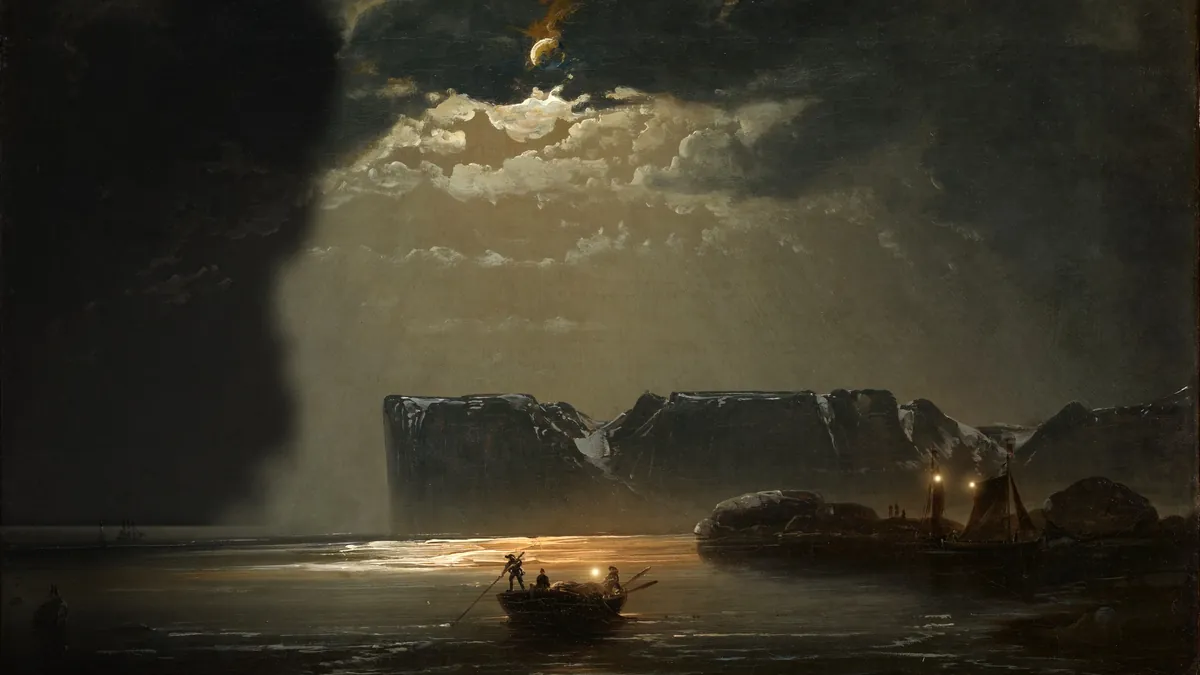
The Road of Small Boats
On the morning after they buried Enoch, the company went three ways.
Marr stood on the bank in the gray early light and watched the boats load. The Kestrel lay at the head of the creek with a spare topmast stepped in the stump of her mainmast, and it made her look like a woman leaning on a stick. Isobel Wray was on the quarterdeck with a slate, taking over a ship with twelve hands and no captain, and doing it without raising her voice.
Rusk's boat went first. It was a Carrick fishing boat with a tanned lugsail, and Ansel Hart had the tiller. Orris sat amidships on a coil of rope with his splinted leg out along a thwart and a blanket over it. He had been swearing since they carried him down the bank, steadily and with invention, and he kept it up when Marr came to the edge of the water.
"Commander," he said. "Tell this lout that a man with one leg can bail."
"You will sit there," said Rusk from the stern, "and you will tell Ansel where the pilots are, and you will be charming to them."
"I've never been charming in my life," Orris said.
"You charmed me on the long wharf," Marr said.
"That was pies. Pies are not charm. Pies are bribery with gravy." Orris shifted the leg and his face went tight. "Salt and blazes. Somebody put a cushion under that. Not that one, it's wet."
Rusk stepped out of the boat and came up the bank to her, carrying his left shoulder stiffly where the gaff had struck it.
"Countersign," he said.
"Enoch's cat," said Marr.
"Pudding," Rusk answered.
"You'll go by the dark," Rusk said.
"Orris says so," Marr said.
"Orris is right," Rusk said. "The Skerrow's patrols hold the open water by day, and by night their boats are combing this whole north shore for us. Inside Covenant's field there's only their guard line off Darn, and Spurr has slipped worse. It's the only road there is."
"It's his road," Marr said.
"It's anybody's road who knows the water." He looked down the bank to where Leland Spurr's lugger lay against the trees, loading people. "Spurr has run that water in the dark for thirty years, with brandy. People are lighter than brandy, and they don't leak."
"They do," Marr said. "Hanne has a dozen of them on stretchers."
He almost smiled. Then he said, "Elske. If it goes wrong, come back. Don't hold the road for the sake of holding it."
He seldom used her name. She decided not to remark on it.
"When the plan says stop, we stop," she said. "I was there when we agreed it."
Spurr's new lugger, bought off a Carrick widow for a price neither of them would name, was called the Fair Return, which Orris said was the only honest thing about her. She had carried a great deal of untaxed liquor under her floorboards in her time. Now she carried the walking wounded from the Tern and the Kestrel, Hanne Webb with her stretchers, and island women and children with nowhere else to go. Carrick's Holm had grain at the tide-mill and roofs over it, a long day to the west, across water Vaust's boats held.
Two Carrick boats made the escort. Lew Farrow had one, with six crossbowmen. A Carrick pilot named Piers Heron had the other, with eight oars and a crew who had pulled together since they were boys. Marr put a Brightwater corporal, whom Lieutenant Kell had lent her with five of his marines, in the Fair Return's waist and kept the stern for herself, beside Spurr.
Spurr was a great deal quieter at sea than ashore. He had charged refugees a silver mark a head at Carrick. Orris had made him stop, and since then he had carried people for nothing and never once mentioned it. Marr was not sure she liked him. She was quite sure of his seamanship.
They went out of the creek on the morning's falling tide and south along the shoals of Brindle under a low gray sky. At noon they saw the dark.
It lay across the sea ahead and to the south-west, a wall of black that went up out of sight. The daylight lay on the water right up to its foot and faded there in a few hundred yards of dimming gray. Covenant lay at the center of it, in the Darn Race. Its field ran five miles every way from the ship. Darn itself, and the islands round it, had lain under that wall or under Patience's for most of a month.
"Fairlow's just inside," Spurr said. "On the north-east side. We'll be there before dark, if you can call it that."
The boy beside Hanne's stretchers was staring at the wall. He was perhaps thirteen, Kit Avery, who had been ship's boy in the Tern. Both his hands were bandaged to the wrist, because he had held on to a burning shroud too long, and he had told Hanne so more than once, as though the fault were his.
"It's just dark, Kit," Marr said. "Lamps work in it. We'll be through it in two days."
"Yes, ma'am." He went on staring. "That's where they come up, though. Isn't it. In there."
She did not lie to him. "Yes. Not out here."
They went in at four in the afternoon. The light went gray and then brown, until there was nothing but the binnacle lamp, shuttered to a slit. The cold came over the boat almost at once, a damp, deep cold with no stir of air in it. Somewhere forward a child began to cry and was hushed.
Fairlow was a village of thirty houses on a low island just north-east of Darn. When Spurr brought the Fair Return in to the landing by lamplight, Marr saw the gardens behind the houses black with frost, and pears rotting in the grass under a bare tree. The houses had one lamp each, or none, and no one came down to meet them.
A woman came down at last, alone, with a lantern held low. She was square and gray-headed, in a man's coat, and she stopped at the head of the landing and looked at the marines in the waist, and at the stretchers.
"We've taken his terms," she said. "The Admiral's. A barge comes every seventh day with flour and oil. We give him our boats when he asks and our men when he asks. In return, nothing comes up out of the water at night and takes our children." She held the lantern a little higher, and Marr saw her face, lined and exhausted and quite unafraid. "I'll not send hurt people away dry. The well's behind the chapel. Fill what you have. Then go, and don't come back this way."
They filled the casks by lantern-light, with two marines at the chapel corner and the village watching from its doors. On the chapel door a printed sheet had been nailed, with the Admiral's seal at the foot of it in red: rations, curfew, the hours when boats might put out. The last line stood apart from the rest, above the seal. Keep these terms and nobody on this coast goes hungry again. Corven Vaust, Admiral. It was clear and fair, and it sounded like a man shouting from a wharf. Marr stood in front of it with the casks filling behind her and wanted it off the door, and left it, because it was keeping those children alive.
She was coming back down the landing when the corporal caught a village boy.
He was eleven or twelve, barefoot, running hard along the shore path toward the point of the island, where a pile of brushwood stood ready on the rocks. The corporal brought him down in the shingle and sat on him. The boy fought like a cat, without a sound.
The woman with the lantern came down the path and took the boy by the collar and pulled him out from under the marine.
"He's my sister's," she said. "He thinks the barge men are kind, because they bring flour. He'd have fired the beacon and they'd have had you by the morning. Go now, Commander. Please. Before I have to choose."
Marr looked at the boy. He glared back at her with his whole face.
"Look after your aunt," she said. "Mister Spurr. We're leaving."
They lay up all the next day in a weedy inlet on an uninhabited rock west of Fairlow, with the boats under nets and no lamps. Under the dark, day and night were only numbers on Marr's watch. She slept two hours and woke cold to the bone, and went round the stretchers with Hanne.
"Most of them will do," Hanne said. "Three won't, unless they're somewhere warm by tomorrow night. The cold's worse than the cuts. The boy's hands are healing. His head isn't."
"Kit?" Marr asked.
"He doesn't sleep. When he does, he wakes up shouting about the water." Hanne snapped her bag shut. "Keep him away from the side, Commander. That's my medical opinion."
At nine in the evening, by the watch, Marr called the boat masters together round the shuttered binnacle.
"The guard boats lie in a line north of Darn harbor, a boat every half mile with a hooded lamp," said Heron. "They listen. Anything that doesn't answer a hail, they ring a bell, and the whole line comes."
"So we ship oars on the last of the falling tide and drift through on it like weed," Spurr said. "They listen for oars."
"And anybody who goes in the water," said Lew Farrow.
They all knew where that stream went. South-west of Darn it ran down into the Darn Race, and Covenant lay at anchor in the Race. Ebb had said a body must drown within a mile of a fitting to rise. He had not said what became of a body that drowned four miles off and then went down on the stream into that mile, under the engine's keel.
"Anybody who goes in the water comes out," Marr said. "Ours or theirs, alive or dead. Corporal, every man has a boathook to hand, not just a pike. I have their hail, from a frightened boy at Southwick three weeks ago. It may be stale. It's what we have."
The ferry lay in the black north of Darn, with Darn's harbor lamps a smudge of yellow low on the port quarter. The guard boats' hooded lanterns made a broken line of sparks across the way ahead. Under them the outgoing tide ran south-west toward the Race, where Covenant lay four miles off with its dark round them all.
Spurr shipped the oars, and the Fair Return began to drift on the stream.
Marr sat in the stern with her sword across her knees and listened. She heard the water talking along the hull, very soft. She heard a child breathing. Ahead, a lantern showed a narrow slit of light, low on the water, three hundred yards off, with another beyond it to the north. The outgoing tide was carrying them between. Her fingers were stiff on the hilt with cold.
Two hundred yards. Lew Farrow's boat was a darker shape in the dark on the left hand, and Heron's on the right. Somebody in the waist coughed, and the sound went out across the water, and every soul in the boat froze.
One hundred yards. The slit of light swung toward them.
"Boat there," called a voice across the water. A western voice, quick. "Gray water."
Marr stood up in the stern. She let her voice come out bored and tired, an officer's voice at the end of a long watch.
"Pale sails," she said. "Guard boat from Darn. Going north to the edge."
The lantern hung there, and she heard men talking low behind it. The shutter opened wider, and a beam of yellow light came across the water and slid along the Fair Return's side and came to rest on the marines' blue coats.
"And the night's word?" said the voice.
She had no night's word. There had been no night's word three weeks ago.
"Pull!" Marr shouted. "Lew! Piers! On them!"
The bell began at once, clanging across the water, and the beam swung wild. Spurr's oarsmen threw their oars out, and the Fair Return gathered way. Lew Farrow's boat went past her on the left with its crossbows up. She heard them loose, the hard clack of the steel arms all together, and a man screamed in the guard boat.
The guard boat was a twelve-oared cutter with eight or ten men in her. She was turning to run north for the rest of the line. Spurr put the Fair Return's stem straight into her quarter, and Heron's boat struck her other side a breath later, hard enough to throw men off their thwarts in both.
The shock threw Marr forward. She caught the stern post and was up on the rail and over, onto the guard boat's after thwarts, with the corporal and two marines behind her.
A man came at her with a short pike. She knocked the point aside with her blade and it went past her ribs, and she cut him across the forearm and he dropped it. Another swung a boat-stretcher at her head. She ducked under it and it caught the marine behind her full in the chest, and the marine went backward over the side with a great splash.
"Hook him!" she shouted. "Hook him out!"
The guard boat rocked wildly. The lantern had gone over and lay in the bilge, throwing light up under everything, and the bell had stopped. A big sailor got his arms round the corporal and they went down together between the oars. Marr cut the sailor across the back of the shoulder, and he let go and rolled away. An officer in a hooded coat stood up in the sternsheets with a sword. She met him across the tiller. He was quick but he was afraid, and his eyes kept going to the water. She swung the tiller bar hard into his knees with her free hand, and when he stumbled her steel was under his chin.
"Strike," she said. "Strike, and nobody else goes in."
He looked at her over the blade. Two of his men had gone over the side already, one hit by a bolt and one knocked off by the rocking boat. She could hear them in the water, thrashing.
"Strike," he said, and threw his sword into the bilge.
"Every man out of the water!" Marr shouted. "Ours and theirs! Out!"
They hauled them out. Heron's men got the bolt-struck sailor by the hair and the collar and dragged him in over the side, and Hanne was already climbing across to him. Lew Farrow's people got the other with a boathook through his belt. The corporal's marine came up blowing and swearing at the end of an oar.
"Both out, Commander," a Kestrel man called. "Both breathing."
"Piers?" Marr called.
Heron was standing in his boat with a boathook, looking down the stream. "Luke Pym," he said. "He went off the stroke thwart when she struck. I had his sleeve." He said it to the water. "I had his sleeve, ma'am."
"Lanterns low," Marr said. "Every hook over the side. Spurr, bring your boat round."
"Commander." It was Hanne's voice, from the Fair Return, and it was not loud. "The boy."
Kit Avery was standing up in the waist, among the stretchers, looking over the side. The fallen lantern in the guard boat threw its light across the water there, and in the light, a yard from the Fair Return's hull, a face had risen out of the sea. It was white and slack-mouthed, with the hair floating out round it, and water ran out of its mouth when it spoke.
"Kit," it said. "Kit, lad. Give us a hand up."
The voice was a man's, hoarse and kindly, with the Tern's flat Southwick vowels in it. Marr had never heard it before. The boy had.
"Jude?" Kit said. "Jude, you went in. I saw you go in."
"Give us your hand, lad," the voice said. "It's cold."
Kit put out his bandaged hand to it, and went over the side.
Marr had her sword belt and coat off before he struck the water, and she went in after him.
The cold took the breath out of her. She went down into black water so cold it felt like fire. She came up gasping ten feet from the boat, and could see nothing but the glow of the lantern over the rail and the black hull under it. The outgoing tide had her. She felt it pull at her legs, steady and strong, south-west.
"Kit!"
Something thrashed in the water to her left. She struck out toward it and her hand hit cloth, and she grabbed it and pulled, and it was the boy. He was going under and coming up, choking, beating at the water with his bound hands. She got her arm round his chest from behind and kicked, and his head came up beside hers.
"Lie quiet," she said into his ear. "Don't fight me. That wasn't him."
He fought her, and she held on. The Fair Return was further off now, the stream taking them both away from her. She heard Spurr roaring and saw a line come snaking across the water. It fell short.
Then something took hold of her ankle.
It was a hand, and she felt the fingers lock round the bone, cold and soft and far too strong, and it pulled her down. The water came over her face. She kicked with the other foot and struck something yielding. The grip held. She came up again with the boy in her arm, and she drew breath, and it pulled her down again.
She thought, very clearly: not like this, not with the boy.
She let go of nothing. She kicked again, downward, as hard as she had ever kicked anything, and felt her heel strike a face, and the hand slipped an inch.
A boathook came down out of the dark past her head into the water. She heard it strike, and strike again, and heard the corporal grunt with the effort. The grip broke all at once. A second hook caught in the back of her shirt and hauled. Hands had her under the arms. Somebody had the boy. She came up over the rail of Heron's boat and lay in the bilge, coughing up sea, and heard Kit Avery coughing beside her.
"Its arm," the corporal was saying, somewhere above her. "I broke its arm, ma'am. At the elbow. It went down."
Marr got up on her knees. She was shaking so hard her teeth knocked.
"The boy," she said.
"He's breathing," said Hanne Webb. She had come across from the guard boat and was kneeling over him with her own coat round him. "He's breathing, and he's swearing, which I approve. Get her a blanket. Get her two."
"He called me," Kit said, between coughs. "Ma'am. He called me by name. It was Jude's voice. Jude the cook. I saw a boat take him at the Skerrow. I saw the hands."
"I know," Marr said. She did know. The dead boats at the Skerrow had not been for killing. They had been for carrying men alive to the water under the engine's keel, where a drowned man gets up, and the thing beside the boat had learned the boy's name by the Tern's galley fire. "It wasn't him, Kit. It had his voice. That's all it had."
Down the stream, the lanterns had gone low over the water and the hooks were out. Marr stood up in Heron's boat in her blanket.
"We pull down the stream," she said. "All three boats. Hooks over the side, lanterns low."
"Commander," said Spurr. "The line's moving."
She looked north. Out along the guard line, other lanterns had begun to swing, and she heard oars. The bell had done its work. And south-west, four miles down the stream, the Race, and Covenant in it.
"Three hundred strokes," she said. "Then we go west."
They pulled down the stream for three hundred strokes, with the lanterns low and every hook over the side, and found nothing. Marr counted the strokes aloud, because somebody had to decide when to stop. At three hundred she said, "Way enough," and no one in the boats looked at her.
"West," she said. "Take the prisoners and their boat. Leave nothing else in the water."
They put in at Brannick's Ness, west of Darn, in the black middle of the next day by the watch, because three of the stretchers would not last the crossing without warmth. The Ness people had not taken Vaust's terms, and they had not refused them. They put out their lamps when the barge came and went into the caves under the headland, and had never been found at home. They slept now in a long stone barn above the sea cave, the whole village together, with one wick burning in a dish of fish oil on a beam. The last of their flour came out of the bin, scraped, and was divided among strangers and village alike in pieces the size of a man's palm.
A girl of five or six came and stood in front of Marr, stepping on everyone to get there.
"Are you from outside?" the girl said.
"Yes."
"Did you see the sun?" the girl asked.
"Two days ago," Marr said.
The girl thought about this. "Is it hot?"
"It's warm," Marr said. "It's very bright. You can't look straight at it."
"Mam says it's like the lamp, only big. In the sky." The girl looked up at the beam, where the single wick burned in its dish, and then at Marr again, doubtful. "I don't remember it."
"You will," Marr said. "It's still there. It's only behind the dark."
The girl decided this was an adult saying a thing adults said, and went back to the heap of blankets by the lamp. Marr sat with her bread in her hand.
At Ember Roads she had been in the boat with thirty men from the Halcyon, pulling away from the fire. She had seen the Osprey half a mile off with a cargo net over her side and islanders climbing it. Children, mostly. She had hated the sight with her whole body, for three years. She tried now for their faces and could not get them, only the net, and the ship that should have been in the line. She looked at the heap of children by the lamp, and ate her bread.
Kit Avery was asleep on a stretcher by the wall with Hanne's coat over him. It was the first time she had seen him sleep.
They crossed to Carrick's Holm that night under a sky full of stars. Half the people in the Fair Return stood up to look at them, and Spurr cursed them all for trimming his boat by the head. At first light they were in the Mill Creek, with the tide-mill turning and smoke going up from Carrick's chimneys, and men running down the bank to take the stretchers.
The prisoners went into the Carrick lockup, the one with the bolt in his shoulder among them. Every man who had gone into the water had come out of it but one. Marr wrote Luke Pym's name in her notebook, in a hand that still shook, and under it the name of the boat he had pulled in, and the stream that had taken him. Then she slept fourteen hours in a miller's loft.
Spurr took her back east along the north shore the next night, outside every field, with Lew Farrow's boat for company. The searchers had found the wrecked pinnace under Brindle's north point, combed that shore for three days, and given it up for empty. They came into Fallow Creek in the gray before dawn on the twenty-first. The Kestrel was where they had left her, with her stick of a mast and her lamp shuttered. Isobel met the boat on the bank.
"Messages, Commander," she said. "Two. One from the Captain by Ansel's brother, yesterday. One from Nera by a Darn timber boat, an hour ago." She held them out. "And the cat's eaten one of Joss's boots."
Marr unfolded Rusk's first. It was four lines in his square hand.
"The pilots will come. Not cheaply. One of them is a woman I had fined fifteen years ago for running brandy, and she remembers it to the penny. Orris is being charming. Tide help us all. Pudding."
She smiled at the last word, and unfolded Nera's.
It was on a scrap of drafting paper, written fast in carpenter's pencil, the letters big and square.
"In the yard. Dray alive. Moll's people with us. The wardwrights they made build Covenant are held in the pumping house by the dry dock, with their families, under guard. Four wardwrights. One of them is a woman who knows the gate wards. Dray would know her, but they've shut him in the office since our raid and I can't get near him. Moll doesn't know her name. Pumps drain the dock on the falling tide and the outfall runs loud. I think we can get them out. Send Dunning back and tell me who she is. N."
Marr stood on the bank with the paper in her hand and the cold light coming up through the trees.
"Where's Ebb?" she said.
Tomas Ebb was in the Kestrel's cable tier, where he slept under guard, with a candle and his drawings. He stood up when Marr came down the ladder, and it looked like a flinch.
She held out Nera's note.
"Four wardwrights in Darn's pumping house," she said. "One of them knows the gate wards. Who?"
Ebb held the paper near the candle and went over it slowly, his lips moving. When he looked up, he looked frightened, and something besides.
"Annet Sorn," he said. "It has to be. She did the harbor wards for half the coast, before. The Greyhaven gates. The Wendle sluices. She cut the plates for them herself, thirty years ago." He swallowed. "They took her husband and her daughter, and they put her in the drawing office, and she wouldn't speak to me. Not once in two months. She called me the Admiral's clockwork."
"Why would they want a gate warder at Darn?" Marr asked.
"I don't know. They never told me." Ebb looked down at the note again, at the big square letters. "I never asked, Commander. That's the truth of it. I built the frame I was told to build, and I never asked what the gates were for."
"Does she know?"
"If anyone knows what the gates are for," Ebb said, "she does."