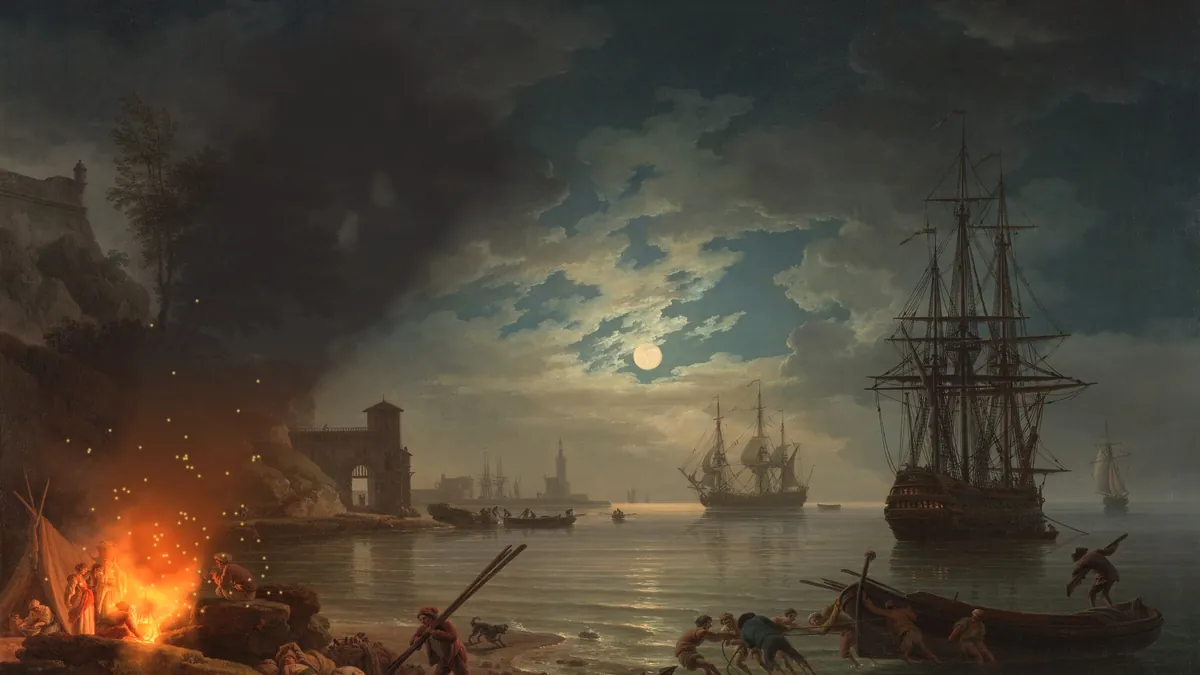
Southwick
They raised Southwick at dusk on the twenty-fifth, after twelve hours of a fitful land breeze and a hundred people being sick over the rail. Marr stood at the quarterdeck rail and watched the port come up out of the evening. She saw the long breakwater with its beacon lit, and the granaries standing along the waterfront like barns, and the anchorage crowded with grain ships. Above it all the sky was going violet, and the first stars were out, and she could not stop looking at them.
The guard boat came out to meet them under the breakwater, and Marr told the young officer in it what she carried. He disbelieved her until his lantern fell on the Wolfhound's gilded wolf's head and the battened hatch over her well. After that he pulled for the shore as if the harbor were on fire.
They put the passengers into a granary on the Long Wharf that had been half emptied for the purpose. There were too few blankets and too little bread, and the town's people stood at the doors staring at the newcomers. Marr saw the last of them in, and Ingram carried up to the church under a flag, and then she went to report.
Commodore Harlan Petch kept his office in the old customs house at the head of the harbor, in a room full of lamps and paper. He was a big, tired, gray man in a coat that needed brushing. He had a pen in his hand when she came in and another behind his ear, and he listened to her for twenty minutes without putting either down.
"A ship," he said at the end. "One ship, putting out the sun over Greyhaven."
"One ship at the center of it, sir," Marr said, "very large, with tugs round her. Captain Rusk believes the dark moves with her. I believe he is right."
"And the dead walk," Petch said.
"Yes, sir," Marr said. "I have fourteen of them in a sealed hold in the harbor, if you would care to see."
He put the pen down at last and rubbed his eyes.
"I have twenty-two grain ships in this harbor and forty more on the coast between here and Halsey," he said. "I have six warships to guard them. And I've just been told that the greatest port on this coast has gone dark with the Admiral in it. I'll see your hold tomorrow, in daylight. Tonight I'll take your word. Where is Rusk?"
"Aboard the Kestrel, under guard," Marr said. "He expects a cell."
"Is he any good?" Petch asked. "As a seaman. I want your judgment, not his reputation."
"He is the best seaman I have sailed with, sir," Marr said. "That has never been the charge against him."
"No." Petch turned the pen in his fingers. "I have two captains in this port fit to command a squadron, and one of them has the gout. And I have a man who can take a condemned ship out of a dark harbor full of corpses and bring a prize home. His hearing is deferred. He remains a prisoner of the Admiralty court, in your custody, and I will need him. This is necessity, not acquittal, Commander, and he is to understand that."
"He will, sir."
"There are men in this port," Petch said, "who were at Ember Roads."
"I was at Ember Roads, sir," Marr said.
"I know," said Petch. "That's why I'm telling you."
They opened the Wolfhound's well at ten the next morning in full sun, with the boarding boat warped against the Long Wharf and half the waterfront crowded on the stones to watch. Marr put the marines round the hatch with pikes reversed. Petch stood back by the bollards with two of his officers. Rusk was there under guard, with Orris and Hanne Webb, and Nera Pell had come up from the Kestrel's bilge with her sleeves black to the shoulder.
"It knocked until about seven yesterday," Orris said. "Then it went quiet. I sat on that hatch an hour after and never heard a sound."
"Lift it," said Marr.
Two marines put bars under the cover and heaved, and the sunlight went down into the well. It was a deep square tank half full of sea water the color of weak tea, and the dead lay in it. There were fourteen of them, men and two women, tumbled at the bottom of the tank and floating in the water with their eyes open. None of them moved. The sun lay on them, and after a while one of the marines let out his breath and lowered his pike.
"Hook one out," Marr said.
They laid him on the stone, a young man with a seaman's tattoo on his forearm. Hanne knelt and lifted his eyelid, and pressed his chest, and felt at his throat.
"Drowned," she said. "A week ago, by the look of him. As dead as any man I've laid out." She sat back on her heels. "Whatever drove them let go once we were out of the dark."
"That's how it seems," said Marr.
"Seeming's cheap," Nera said. She stood at the edge of the hatch with her arms crossed, frowning down into the tank. "I'm less sure it's how it is."
"Explain, Mistress Pell," Marr said.
"We were out of the dark at six yesterday morning, and Orris says they knocked until seven," Nera said. "And that hold was battened. It was as black down there as the dark we came out of. If it's the dark that drives them, they were in the dark that whole hour and they're in it today, and they ought to be knocking yet. And if it's daylight that stops them, the daylight never touched them in there." She pointed down into the well. "Something let go of them at about seven, a few miles south of Kettle Head, with the sun on the deck and the hatch shut. I don't know what. I'd like to."
The water slopped against the timber. One of Petch's officers cleared his throat.
"It was the dark," he said. "Or something in it. They were carried out of it, and it let go."
"Perhaps," said Nera. "I've seen a plank look sound for ten years with rot in its heart. I'd want to see this one again before I built on it."
Petch had the dead buried that afternoon in the old plague ground behind the granaries, in quicklime, with a priest and a marine guard. Ingram they buried in the churchyard with the marines round him in their blue coats. His sister came, a big red-faced woman in black. Marr gave her his pay and his clasp knife and told her he had held the steps at the chain house so the boat could get away, which was true.
Marr questioned the prisoners in the guardhouse at the end of the Long Wharf, one at a time, with Petch's clerk writing it down.
Lieutenant Garrow Aske came in with his hands bound and sat across the table from her like a man calling on a neighbor. He had shaved. Someone had lent him a razor.
"Commander," he said. "You're looking better."
"Your name, rank and ship, for the clerk," said Marr.
"Garrow Aske, lieutenant, Pale Fleet, commanding the Wolfhound. I'm told your sailors call her the Second Chance now." He smiled faintly. "I don't think the joke is on me."
"Who commands the Pale Fleet?" Marr asked.
"The Admiral. Corven Vaust." He said the name as a man might name a saint. "He commanded the defense squadron in the islands for twelve years. He wrote to your Admiralty nine times asking for help against the corsairs. You sent him Ember Roads, and after that you sent him nothing. I was at Sallow when it burned, Commander. I was seventeen."
She kept her face as it was. "And the ship that makes the dark?"
"The engine." He seemed to weigh how much to say and to decide it hardly mattered. "There's more than one. They're ships built round a machine. Where the engines go, the dark goes. You saw one off Greyhaven. Shelter, they call her."
"How many others?"
"Enough," Aske said. "If you mean to go west, Commander, Patience is working the middle of the Reach. She doesn't sit still."
"And the dead?" Marr asked.
When he spoke again, the lightness had gone out of his voice.
"That's the Undertide. It's out in the west, past the islands, where the seabed drops away into the deep. It moves the drowned. It isn't ours, Commander. We don't command it. The Admiral has an agreement with it." He looked down at his bound hands. "I don't like them either, if you want to know. But they don't tire and they don't starve, and you left us nothing else to fight with."
"Your man on the Kestrel's deck said a word," Marr said. "Orra."
"Orra holds the only deep channel through the Bar. Our heavy ships must come through it. There's an old woman in the lighthouse there who sank two hulks in the channel to stop them. She's been holding the tower for a week with lamp-keepers and fishermen." He shrugged. "Very brave. She'll be out of oil soon, and out of food after that. The Admiral offered her terms, and she declined. He'll offer again. He's a courteous man."
The others knew less. A frightened boy of sixteen named Sim Harker gave up the challenge and reply the Pale Fleet's patrol boats used in the dark. Gray water, and Pale sails. He begged her not to tell the lieutenant.
The last of them was a hard, lean young man with black hair cropped short and a white scar through one eyebrow. The others called him Colm Doyle. He sat across the table from her with his bound hands folded and gave her nothing, not his name, not his ship, not a word. He watched her through a dozen questions as if measuring her for something.
"Take him out," she said at last.
At the door he turned his head and looked back at the clerk's papers. Then the marines took him away.
Petch moved the prisoners after dark, up from the waterfront guardhouse to the town gaol on the hill behind the granaries.
Marr walked with them along the Long Wharf. Dunning was at the head of the line, with four marines along the flanks and two of Petch's watchmen behind with lanterns, and nine prisoners shuffling between them in a chain. They passed the Kestrel's berth, where Nera had unbent the old sails that afternoon for the sailmaker. The canvas lay stacked on the stone beside the ship in a great pale heap.
They were halfway past it when Doyle moved.
She heard the chain clink as it fell and a watchman shout. When she turned, Doyle had the man's lantern in his hand. He swung it, and the glass burst on the stacked sails, and the oil went over them in a sheet of flame. Old canvas burns like paper. The heap went up with a roar, and the light leaped up the Kestrel's side to her yards, and every man on the wharf turned toward it.
Doyle went the other way.
"Dunning, the ship!" Marr shouted. "Water on her! Hold the rest!" She was already running.
He ran for the fishing boats at the end of the wharf, saw a watchman coming down from them with a lantern, and swerved. A flight of wooden stairs climbed the side of a warehouse to a loading door, and he went up it three at a time. Marr went up after him.
The loft inside was black as a sack. She heard him cross it, and a shutter bang at the far end. Ten feet below the shutter lay the roof of the next warehouse, a long slope of slates gleaming in the firelight, and he was running along its ridge.
She dropped onto the slates. They were wet with dew, and she slid and caught the ridge with her left hand, and felt the old burn scar on its back stretch and sting. She got her feet under her. Doyle was forty yards ahead with his arms out for balance, and the wharf below was all red light and shouting.
The roof ended at a gable over the water, and a hoist platform jutted from it under a crane jib. It was a narrow ledge of planks with a rail on two sides, and the third side open to the drop. Doyle went off the ridge onto it and turned there, because there was nowhere else to go. He had a long, thin, dirty knife in his hand, and she knew at once who had lent Aske his razor.
"Commander," he said. His voice was quiet and level, with the islands in it. It was the first she had heard of it. "You should have let me go."
"You can give yourself up," she said.
"No," he said. "I can't."
She came down off the ridge onto the planks with her point between them, and he came at her.
He was fast and low, with the knife held wide, feinting for her eyes and waiting for her to glance at the drop. She kept her eyes on his. He went high and then low at her legs, and she stepped back along the rail and cut, and her point opened his forearm. He hissed and shifted the knife to his other hand. She lunged. He swayed back from it over the open edge, impossibly, and came in along her blade and slashed at her face, and the knife went past her eye by the width of a finger. She drove her sword hilt into his chest and he went back against the far rail and stood there, with blood running down his arm.
The tide was out. Forty feet below, black water lapped the stone beside a moored lighter. Behind her on the wharf she heard Dunning's voice and running feet, and lanterns were coming along the stones.
"Give me the knife," Marr said. "You'll be held with the others, and fed. When this is over, you'll be exchanged."
"When this is over," Doyle said, "there'll be none of you left to exchange me." He glanced down at the water and back at her, and for the first time his calm cracked. "Tell your keeper on Orra she should have taken the terms."
He went backward off the platform.
She lunged and caught a fistful of his coat, and the cloth tore in her hand. She heard him strike the lighter's rail below with a sound like an axe going into wood, and then the splash.
"Lights!" she shouted. "He's in the water! By the lighter!"
They had him out in four minutes. Dunning went in himself with a line round him and brought him up from under the lighter's stern among the mooring chains. Hanne came running from the infirmary and knelt over Doyle in the lantern light. She pressed on his chest and breathed into his mouth and turned him to let the water run out, and kept at it a long time. At last she sat back.
"He's gone," she said. "The rail broke his head, I think, before the water had him. I'm sorry, Commander."
Marr knelt and went through his coat. In the inside pocket, in a packet of oilcloth sewn shut with sail twine, she found a book. She cut the twine with her sword point. Inside was a blue canvas cover stamped with the Compact's anchor, as like the chain-house copy as two pins.
"Hells," she said quietly.
Dunning sat by the body all night in the boat shed with a pike-butt across his knees, in case. It never moved.
"Swift," said Petch the next morning, with the book open under the lamp at the flyleaf, where the guard cutter's stamp was.
"She came in from the west on the afternoon of the twenty-fourth, sir, just ahead of the dark," Marr said. "She'd have been at her mooring in the outer harbor when it came down. Aske admits Doyle went into the harbor that evening with the first boats, and came back to the Wolfhound before she sailed. They must have boarded Swift at her mooring and taken her book." She laid the chain-house copy beside it. "That's two copies taken, and two recovered."
"And you're going to ask me whether we change the book," Petch said.
"Yes, sir," Marr said.
"The book is standard across forty ships on this coast and in the south. Every signal, every private signal, every recognition number. I can't reissue it in a week, or in a month. If I changed it now, half my escorts would be signaling in a book the other half had never seen, and we'd lose ships to our own confusion." Petch tapped the blue covers. "What else was in Greyhaven harbor?"
"The guard ship, the big grain ships and the Admiral's flagship," Marr said. "They'll all have had copies."
"And regulations require a ship in danger of capture to burn her book before anything else," Petch said. "Every captain on the coast knows it. They'll have burned them, Marr, the first thing in the dark. I would. So would you."
Marr looked down at the two books. It was a good rule, and every officer she had served with knew it.
"Yes, sir," she said. "They'll have burned them."
"Then we keep the book. Take both copies with you. The Kestrel has no book of hers, and you'll need one where you're going." Petch pushed a scrap of paper across the table. "And now there's this."
It was a fisherman's sheet, written over in pencil capitals and smudged with salt.
THERE ARE PEOPLE HERE. WE ARE HOLDING THE DOOR. OIL AND FOOD LOW.
"Orra," Petch said. "The keeper flashed it with her shutters to a fishing boat lying off the island in the dark. That boat passed it to another off Tull, and that one to another. Five boats, and every one repeated it a dozen times to be sure. It's two days old."
Marr went over the capitals again. They were very neat.
"Holding the door," she said.
"I know what Orra is, Commander," Petch said. "I've a meeting with the Speaker at noon. You'll come."
Speaker Aldous Brennan was a lean, careful grain merchant in a black coat. He heard Marr out in the council room above the market hall with his fingers pressed together.
"I'm sorry," he said at last. "I mean that. But there are twenty thousand people in the Wendle Levels and thirty thousand in this town, and their grain comes south from Halsey by the outer lane, and Greyhaven's gone. The Commodore has six warships, every one guarding a convoy. If I send them west to a lighthouse and the dark comes down on the lane, we lose a convoy. Lose two, and people starve here before midwinter. I can't do it, Commander."
"There are people at Orra, sir," Marr said.
"There are people here," Brennan said.
It was a fair answer, and she hated it.
"Then give me the Kestrel," she said.
Brennan's eyebrows rose. Petch turned from the window.
"She's a Compact ship, condemned or not, and I brought her out," Marr said. "She's guarding no convoy. Give me a commission to take her west and see what's there. Reconnaissance only. If I can get food and oil into Orra, I will. If I can't, I'll come back and tell you why, and you'll know more than you know now."
"With what crew?" said Petch.
"Volunteers, sir. I won't press a man."
"And who sails her?" Petch asked.
"Captain Rusk, under my command," Marr said. "I'll hold the commission and the formal command. He'll have charge of her sailing and her fighting. I've seen what he can do with her. Nobody on this coast could do better."
"A reconnaissance," he said. "Not a relief. You'll avoid any fight you can avoid, and you'll report back. And you'll keep him on a short rope."
"I've kept him on one for five weeks, sir," Marr said.
She asked for volunteers that evening at the foot of the Kestrel's gangway, by a lantern on a pole. She told them what it was: a condemned ship, a reconnaissance into the dark, navy pay if the navy ever paid it, and no promise of coming back. Forty or fifty people stood on the wharf in the lantern light and glanced at one another.
Orris Fen stepped out first.
"I'm coming," he said. "Somebody's got to feed you. And somebody's got to navigate, because he can't. He only thinks he can."
"Orris," said Rusk from the gangway.
"Ask anybody." Orris turned to the crowd. "Who else? Come on. I've a town to rob for provisions."
Enoch came down the gangway with Pudding on his shoulder. "She's my ship," he said, as if that settled it. "And Pudding's on the books. She's been ship's company longer than any of you." The cat yawned.
Dunning stepped forward with his seven marines behind him in a line, and stood there. Joss came, red in the face. Hanne came with her bag. Isobel Wray came alone, very pale, because her father's hip would not stand another night like the last one. Lew Farrow came. After him came dockers and fishermen from Greyhaven, a few Southwick men and two old navy hands, thirty-odd in all.
Nera Pell came last, through the crowd from the back, and stopped in front of Marr.
"I'll come," she said. "Not for the glory. Nobody else alive can keep that stern dry, and I'd as soon not hear she sank under you because some fool forgot to tighten a wedge."
"Thank you, Mistress Pell," said Marr.
"Get me a grid and a low tide and twelve hours," Nera said, "and I'll give you a ship."
She got her grid, a frame of great timbers on the mud at the inner end of the harbor. They floated the Kestrel onto it at dawn on the twenty-eighth. When the tide dropped, she settled with a groan and stood propped and dripping with her bottom bare to the morning sun.
Marr went down to watch. She had expected hammering. Instead, for the first hour, Nera did almost nothing but look. She walked the length of the seam three times. She pressed the planks with her hands and knocked on them and listened with her ear to the wood. She had Joss hold a lantern inside the hull while she watched from outside for where the light came through.
"There," she said at last, tapping a plank. "That's where it starts. Not where it leaks. Everyone patches the leak, Commander, but the leak's only where the water gets out. You have to go to where the strain is."
After that the work went fast. They cut out the worst of the seam and drove new oakum and payed it with hot pitch. They drew the rotten knee with tackles and wedges and a great deal of swearing. Nera fitted a new one from a baulk of seasoned oak she had argued out of the yard officer in a quarter of an hour. Marr held a lantern for her in the black wet space under the after deck while she drove trenails home and talked to the timber under her breath. Split and rot you. That's it. That's my girl.
"You talk to it," Marr said.
"Everyone talks to it. I listen as well."
While the ship stood on the grid, Petch's yard sent down twelve heavy crossbows on their carriages and four swivel bolt-throwers for the rails. Rusk mounted the first of them with Enoch and laid it and sighted along it, and moved on to the next.
Orris went into the town with a purse of Petch's money, a handcart and Joss. He came back three times with the cart heaped with salt pork and biscuit, casks of lamp oil, onions, a crate of hens and a cheese the size of a wheel. When he handed back the purse there was money left in it.
"How?" said Marr.
"I knew a man who knew a man," said Orris. "Trust me, Commander. You don't want the rest."
Lew Farrow said goodbye to Bett at the head of the grid that afternoon. The child stood holding her aunt's hand and did not cry. She looked up at the Kestrel standing on her timbers.
"Is the cat going?" she said.
"The cat's going," said Lew.
"Then you'll be all right," said Bett, and let her aunt take her away.
They floated off the grid on the evening tide with the new knee in her and the seam dry, and sailed at dusk with forty-five souls aboard. The breeze was a fresh north-wester, foul for Orra, and Rusk beat out past the breakwater into it.
Marr kept the middle watch under the stars, with the commission in her coat and the two signal books locked in the chest under her cot. Reconnaissance. A short rope.
At first light Isobel Wray was at the masthead, where Orris had sent her, and her voice came down thin and clear.
"Deck there! Darkness! Darkness to the north-west, away to starboard!"
Marr took the glass and went up the shrouds herself. Far off on the edge of the morning lay a wall of black, sheer from the sea into the sky, where the fishing boats had reported open water two days before.
"That's not Shelter," said Rusk on the deck below her. "That'll be the Patience that Aske spoke of. And she's under way."