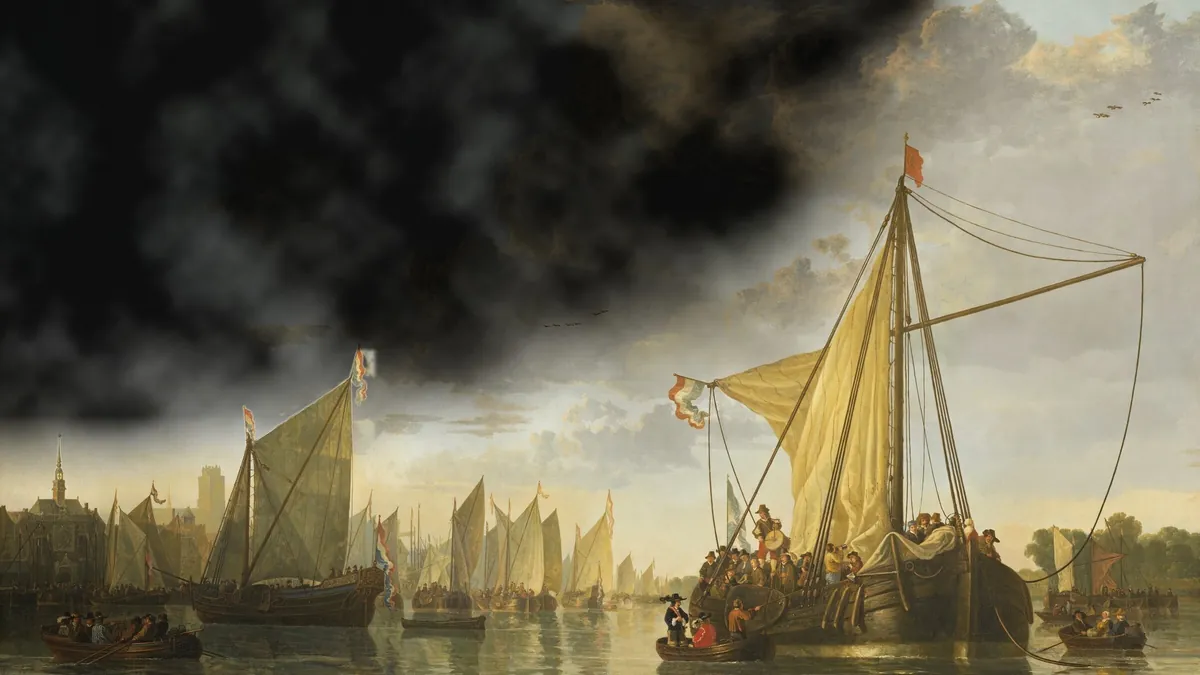
The Convoy Battle
The grain ships were where the fishermen had said they would be. The breeze was not.
It had died at midnight. By sunrise on the twelfth of October the Reach Water lay like poured glass, and the Kestrel's sails hung from her yards in long dead folds. Rusk stood at the quarterdeck rail with a mug of Orris's coffee going cold in his hand.
The convoy lay scattered across the flat water to the north, twenty-two deep-laden ships with their canvas slatting. Far off to the north-east, a smudge of black stood on the sea where Shelter's dark hid Greyhaven. To the north-west stood the other wall. It rose from the water straight and featureless into the morning sky, and it was moving. Patience was under tow inside it, coming down on the lane. The daylight between the two engines' fields was all the clear water the convoy had, and it was narrowing by two miles an hour. Away to the south-west, Tull lay low and blue on the edge of the sea, with Sandle Bay in its northern shore.
"They're asleep," said Orris, at his elbow. "Twenty-two masters and not one with the wit to put his boats ahead and tow. Salt and blazes, I could walk across to them on the hatch covers."
"They're waiting for a breeze," Rusk said.
"They're waiting to be eaten." Orris squinted at the black wall. "How long?"
"At this rate the edge is on them before noon."
"And if they run south?" Orris asked.
"They can't run. They can drift." Rusk raised his voice. "Isobel. What's the tide doing?"
Isobel Wray was at the taffrail with a float on a line over the stern, watching it with her father's narrow attention. She answered without turning her head.
"High water within the hour. Then the falling tide sets south-west along the Tull shore. At springs it'll run near two knots by mid-morning."
"Low water slack?" Rusk asked.
"A quarter to two," Isobel said. "Give or take."
Marr had come up from her cabin with the signal book under her arm and her hair wet from a bucket. The cut on her cheekbone from Venn's sword had scabbed black. Rusk turned to her.
"Commander. We have a problem and about six hours to solve it."
The convoy's senior master was a broad, sunburned man who came across in his gig and climbed the Kestrel's side as if he owned her, and he did not like what he found there: a condemned brigantine, a woman from the Navy, and a man he had heard of.
"We go south," the master said. "Southwick wants the grain. The first breeze that comes, we go."
"The first breeze may come at noon," said Rusk. "By noon that dark will be on top of you. It's not the dark that will take your ships. It's what comes in it."
He pointed north-west. "That engine holds the drowned. Her dead can walk anywhere within five miles of her, and any man who drowns within a mile of her gets up and joins them. Their boats will come at twenty-two ships from every side in open water, with living men steering them. I can't defend that. Sandle Bay has one mouth, half a mile wide, between two points of rock. Ride the falling tide down to it, anchor at the back in a crowd, and anything that wants you has to come past me."
"With that thing following," the master said.
"It has to follow," Rusk said. "They want your grain, so they have to bring the engine within five miles to put the dark over you. An engine under tow has its towboats a quarter of a mile ahead on long hawsers, and the towboats are small. At slack water there's no stream for her vanes, so they have to keep her walking. Cut the tow at slack and she stops. Then she has twelve minutes of dark left in her, and after that she's a ship in the sun."
"Twelve minutes," the master said. "Who says so?"
"Her builders," said Marr. "We have their drawings."
He chewed it over. He was no fool. He turned and looked at the black wall.
"Damn it all," he said. "Sandle Bay. My boats are out before I'm home."
Nobody sailed that morning. The ships went south-west on their own boats' towlines, on sweat, and on the sea moving under them.
The Kestrel put out her sweeps and walked herself down the convoy's flank while the grain ships' boats strung out ahead of them on towlines. The falling tide came as Isobel had promised, and took hold of everything at once. Rusk felt it in the ship before he saw it, a faint new stiffness, bubbles sliding past her side toward Tull. The whole mass of shipping began to move with the water at a walking pace, while the boats pulled at their heads to keep them from fouling one another. At ten a light westerly came over the water in dark patches, and the topsails filled and fell and filled again.
Behind them the wall came on, a little faster than they did. By eleven Rusk could see a string of small yellow lights at the foot of it: Patience's towboats, each with a lantern at the stern. Behind them a broad blur of light marked the engine ship herself. Two higher lights kept to her flanks.
"Two escorts," said Marr, with the glass to her eye. "Brigs. One has a great deal of red paint."
"That's Ardent. The Carrick men told us about her. The other will be Cutwater." Rusk took the glass and swept it along the bottom of the black. Lower down, behind the escorts, low shapes crawled in the dark without a single lamp. "And those are the dead."
Enoch Garvey had come aft to fuss with a sweep that was chafing in its port. Pudding rode on his shoulder like a fat orange epaulette, flicking her tail in his ear.
"She's been sulking since the black came up," Enoch said.
"She's a sensible cat," said Rusk.
"She's a coward, Captain. Hid in the bread locker at Orra and ate half a loaf." Enoch scratched her chin. "Don't you listen to him, my duchess. You'll go below with the bread, and I'll come and tell you when it's over."
"Enoch," said Orris, from the helm. "If you've finished courting, that sweep wants a new leather."
"Bless my boots, the man's a slave driver." But he went off grinning, with the cat swaying on his shoulder.
Sandle Bay opened at half past twelve. It was a deep notch in Tull's north shore, a mile long. Its mouth lay between a low black point on the east called the Cran and a higher one on the west called the Horn. The grain ships came in on the last of the falling tide and anchored in a crowd at the back of the bay, with Brede bellowing at them from his poop.
The Kestrel anchored last, across the mouth. Rusk put a spring on her cable, a second line from the anchor to her quarter. By hauling or easing it he could swing her broadside to face anything coming in. Six heavy crossbows lay along that side, spanned and loaded, with their crews kneeling by them. Dunning's marines had the swivels at the rail.
At a quarter to one the island boats came out of the Horn's lee. There were eight of them, Carrick and Tull fishing boats with their masts down and six or eight oars apiece. Ansel Hart had the first, his broad face sunburned and serious. Leland Spurr had the second, and was already telling the Carrick men in it how to sit. Isobel had the fourth. She sat at the tiller among Carrick fishermen twice her age, and Rusk could see her knuckles from the quarterdeck.
"The Calf Rocks," he said down to them. "Three miles north. Lie in their lee with your lamps out. If I'm right, they'll walk her past you on the slack. Let the engine go by. Take the towboats from astern and cut every hawser. When she's lying dead in the water, Isobel shows red over white from her masthead, three times. That's when my watch starts."
"And if they get another tow on her?" said Ansel.
"Then you cut that one too," Rusk said.
"And if you're wrong about where they bring her?" Ansel asked.
"Then pull after her," Rusk said, "and I'll see you at supper."
Ansel laughed. Isobel was mouthing it to herself: red over white, three times.
"Pilot," Rusk said. "Nobody drowns. If a man goes in near that engine, you have him out before he stops breathing, whoever he is. Theirs too. A man who drowns out there gets up again a few minutes later."
"I know, Captain," Isobel said.
"I know you know," Rusk said. "I'm saying it so the Carrick men hear it."
The boats pulled away north across the flat water. He watched them until the black took the first one.
"You've put a girl of twenty-four in charge of the signal that decides this," said Marr.
"I've put the best pair of eyes we have where the signal has to be made." He kept his gaze on the black. "Orris trained her. He'd have my hide if I gave it to anyone else."
Marr thought about that. "I'd have done the same," she said. "I'd have liked to be asked."
The dark came over Sandle Bay at a quarter past one.
The afternoon sun lay warm on the deck and gold on the bay. The black edge came down across the Calf Rocks and over the open water, and the gold went out of the sea a mile at a time. It took the Horn. It came over the Kestrel from her masthead downward, a shadow without a cloud, and they were in the night.
Every lamp in the squadron was already lit. Along the Kestrel's side and the grain ships' sides, lanterns hung low on spars rigged out over the water, each throwing a yellow pool on the sea beneath. At the back of the bay the convoy was a floating town of light. Beyond the Kestrel's lamps there was nothing at all.
Rusk took his watch out of his coat and held it open in his hand by the binnacle lamp. It was twenty-eight minutes past one.
At twenty to two they heard sweeps out in the black to the north, then the creak of blocks as the escorts found the breeze and set sail. Two sets of lights came out of nowhere with the shapes of brigs under them, Ardent to the north-west and Cutwater to the north-east, closing on the mouth from either side. Between them they heard oars knocking in their tholes, many oars, uneven, pulled by hands that did not tire.
"Here they come," said Dunning.
"Crossbows on Ardent," Rusk said. "Her helm and her headsails. I want her steering. Ease the spring."
The Kestrel swung, and her broadside came round to the north-west. Ardent was four hundred yards off, her red paint shining in her lamplight.
"Loose."
The heavy crossbows went off down the side in a long ragged thump. Out in the dark he heard the bolts strike: a crack of timber, a scream, the flap of loosened canvas. Ardent's jib came down in a white tangle, and she fell off the breeze.
"Span and load. Quickly now."
The dead boats came into the lamplight. There were six of them, heavy pulling boats crowded with pale men sitting shoulder to shoulder at the oars. In each stern stood one living man with a shuttered lantern. The light fell on white faces and sodden clothes. The first boat struck the Kestrel's side below the waist, and the dead stood up in it and began to climb.
"Boathooks!" Enoch's voice came from the waist. "Hand-spikes! Knock their hands off, lads!"
A white hand came over the rail by the mainmast, then a head with sodden hair and eyes full of water. Joss Ambry hit it full in the face with a hand-spike, and it went back down into the boat. Dunning's marines swung their pike-butts down along the rail, breaking hands and arms against the ship's side. A swivel bolt took the living steersman through the chest. His lantern went into the sea, and the dead in his boat kept climbing without him.
Out in the dark to the north, very small, a light showed. Red over white. It went out. Red over white again, and again a third time.
Rusk looked at his watch. Two minutes past two.
"Minute nought," he said loudly. "Patience's dead in the water. Twelve minutes, and the sun comes back. Pass it along."
"Twelve minutes!" Orris roared from the helm. "Hold on for twelve, lads, and it's daylight!"
It went down the deck and across the water to the grain ships, shouted from rail to rail. Somebody at the back of the bay began to cheer.
"One," Rusk said.
Ardent had got her head round, stung but not crippled, and came on for the mouth with her crossbows going. A bolt struck the rail beside Rusk and stood there humming. On the far side, Cutwater had slipped past the Cran into the bay. She was making for the Prosper, which lay at the eastern edge of the crowd.
"Two."
Two more dead boats came at the Kestrel's quarter. Marr was at the taffrail with her light sword, cutting at the white fingers on the rail. She did not try to kill them. She cut the fingers that held on, and the dead fell back. One came over the stern beside her, whole and dripping, and she put her point through his knee. Dunning's pike-butt took him under the ear, and he went slack.
"Three. Crossbows on Ardent. Loose."
The bolts went out. Ardent's foretopsail split from head to foot. She sheered away from the mouth, and her lights swung round toward the north.
"She's going back," said Marr. She had come up beside him, breathing fast, with her sleeve wet to the shoulder. "Why?"
"For Patience." Rusk could see it as if it were drawn on a chart. Patience was lying dead in the water to the north, with the island boats among her towboats. If Ardent took the engine's head and pulled, the vanes would turn again. Inside twelve minutes, that would fill the reserve, and there would be no daylight today. "Four. Slip the cable and buoy it. Sweeps. We're going after her."
"And leave the mouth?" Marr asked.
"Cutwater's already inside," Rusk said. "The tow matters more. Enoch! Slip! Orris, give me her head north. Topsails!"
The cable roared out through the hawse and splashed into the dark. The Kestrel came round under her topsails with the sweeps biting, a dead boat still hanging on her side and its dead climbing as she moved. Joss and two Carrick men fought them at the rail.
"Five."
Ardent was half a mile ahead, a cluster of lamps on a brig's shape, and drawing away. Rusk felt the Kestrel through his feet and knew she was too slow. The breeze was light and her topsails were small. Ardent would reach Patience first.
"Six."
"Kestrel!" Isobel's voice came across the black water from the north, high and hoarse. "Kestrel!"
A boat with a lantern came out of the dark under their head, pulling hard. Isobel was in the stern. Four men were pulling and three were bailing, and another lay in the bottom with his arm wrapped in a shirt.
"We cut them all," she shouted up. "The towboats are adrift. But there's a brig coming..."
"Ardent," Rusk called. "I know. Which way is Patience's head pointing?"
"East-north-east!" Isobel shouted.
"Then Ardent has to come round under her stern to take her head," Rusk said. "Get every boat you have between them. Foul her. Throw nets, lines, oars into the water. Make her lose a minute."
Isobel stared up at him. Then she put the tiller over, and the boat went off at a slant into the black, and he heard her voice carry ahead of her, shouting for Ansel and for Spurr.
"Seven," Rusk said.
On the deck behind him the fight had turned sour.
A second dead boat had joined the first on the Kestrel's side, and there were dead on deck now, moving among the crossbow carriages. The crews were fighting them hand to hand. A dead man had one of the Carrick hands by the throat and was dragging him toward the rail. Enoch Garvey put a capstan bar across the backs of its knees and dropped it, and the Carrick man rolled away gasping.
"They're only dead, lads!" Enoch bellowed. "They're not clever!"
Another came at Enoch's back. Nera Pell broke its leg with her caulking mallet and stood back with her braid coming loose and her face white in the lamplight.
"Good girl," Enoch panted. "Keep the knife. You've earned it."
"Eight," said Rusk.
"Cutwater's alongside the Prosper," said Marr. "They're boarding."
Across the bay, in the convoy's light, Cutwater lay against the Prosper's side. Living men were going over with swords and lanterns, and the dead were coming up the Prosper's other side out of the water. He could hear the shouting, thin and far. He could do nothing for her. He had chosen.
"Hold the deck," he said. "Four left."
"Four minutes is a long time on the Prosper," Marr said.
"Yes," he said. "Nine."
Ahead, Ardent's lights had slowed and were swinging. Beyond her stood a broad, high shape lit all along its side: Patience, a great clumsy box of a ship, with her loose towboats drifting before her. Small boats with lanterns darted in the water between the brig and the engine. Isobel's boats.
"Ten."
Ardent's lamps stopped swinging. Across the half mile he heard shouting from her and the crash of oars against timber. One of the small boats went under her forefoot. Something was fouling her rudder. She lay wallowing, pointing nowhere.
"Eleven. Hold on."
A big boat pulled out from Ardent's side toward Patience's head, eight men at the oars and a coil of hawser in the stern sheets. If they got a line on the engine and a turn on Ardent's bitts, they could drag her through the water and wake her. Rusk watched it go. He could not reach it. He stood at the rail with the watch in his hand and the lantern on its face.
"Twelve."
Nothing changed. The black stood over them as it had for an hour. On the deck the dead were climbing. Across the bay the Prosper's people were screaming. The second hand went round past the twelve.
"Captain," said Marr quietly. "The drawings..."
"I know what the drawings said," Rusk said.
He heard Ebb's voice on the slip at Orra: a quarter hour of charge, maybe more. He had chosen to trust the drawings over the frightened man who had built the thing. Twelve minutes and twenty seconds. Ardent's boat had reached Patience's head, and men were standing in it to pass the hawser up.
At twelve minutes and forty seconds, the sun came back.
It came all at once: afternoon light on Sandle Bay and the Calf Rocks and the open Reach, and the lamps along every rail small foolish flames in it. Rusk threw an arm over his eyes, and then made himself look.
The dead on the Kestrel's deck had stopped. The nearest was a gray-bearded man in a fisherman's smock, with one hand on a crossbow carriage. The hand slid off the iron, and he went down after it. Across the bay, the living boarders on the Prosper's deck found themselves alone in daylight among the people they had come to kill.
Enoch Garvey sat down on a crossbow carriage and said, "Bless my boots," in a small voice, and began to laugh.
"Orris, put her alongside Patience," Rusk said. "Dunning, a boarding party. Commander..."
"I'm coming," said Marr.
"With my maul," said Nera, already going down the deck. "And bring Ebb. He'll know where they've put the trunk on a ship this size."
Ardent did not stay. Her captain cut the hawser his boat had just passed up, left the boat's crew to swim for it, and ran north-west under every rag he had left. Cutwater pulled away from the Prosper with half her boarders left behind, and followed. Rusk let them go. Two brigs could not tow an engine in daylight past the Kestrel's crossbows, and they knew it.
Patience lay dead in the water in the afternoon sun, and the Kestrel came alongside. Seen from below she was enormous: broad as a barge and blunt, with black upper works and decks ten feet above the Kestrel's. She had only a stump of a mast for signals and lamps, for she was never meant to sail. She went where she was towed, like a dead whale.
Her living crew met them at the rail, twenty or so seamen and engine-men and a pair of officers in western coats. They fought hard for a minute. Marr went up the side first with Dunning behind her and Rusk behind him, and the first man to meet her went back over the hatch coaming with his sword arm cut through. Rusk came over the rail into a press of bodies and took a blow on his hanger that jarred him to the elbow. A man came at him with a boarding pike. Rusk caught the shaft and pulled, and the man came onto his fist. Dunning's marines came over behind them in a solid shove. Then an officer threw his sword on the deck and shouted in the island speech, and it was over.
"Below," said Ebb, at Rusk's elbow. The wardwright was gray-faced and sweating, with a marine's hand on his collar. "The frame compartment is amidships, under the main hatch. The fitting is in a sea-chest beneath it, with its trunk just aft of the hatch on the starboard side. Bolted. And Captain, there will be dead in the holds. They keep them below in daylight."
"How many?" Rusk asked.
"Many," Ebb said.
"Lanterns," Rusk said. "Pikes, butts first. Dunning, the hatch."
They went down into Patience's dark with lanterns on poles.
The holds were deep and black and stank of tar and bilge and wet canvas. Out of the black came a soft shuffling, many bare feet on the planking at once. Beyond the pools of lantern-light, pale faces showed, and more behind them. These dead had never been in the sun. Patience's fitting was intact, and they were inside its reach.
"Legs," said Dunning. "Necks. Together."
The marines went forward in a block with their pike-butts, and the dead came on into them. It was slow work in a crowd, and terrible. Rusk swung his hanger flat, at knees and necks, and the dead went down in front of him. A dead man got a grip on his coat and dragged at him until Marr's blade took it at the elbow. Bramley went down under three of them at once. The marines beside him hauled him out by the ankles, and he lay where they put him against the ship's side. In the middle of the hold a great bulkhead of black timber and iron loomed up out of the dark, with a studded door barred across.
"The frame room," said Ebb behind them. His voice shook.
Nera went past him with her maul, two marines holding the dead off her with their pikes. She struck the bar on the door, and struck it again, and it bent. She got her iron bar into the gap and threw her weight on it, and the door came open with a scream of metal.
The frame filled the compartment from deck to deck. Rusk had seen the Lamb's in pieces on the slip at Orra. This one was whole and many times larger, a lattice of dark bronze and black wood. Its rods and plates were graven with marks that seemed to move at the edge of the lantern-light. The air near it was cold, and it gave off a faint ticking, like a cooling stove.
"Is it running?" Rusk said.
"No," said Ebb. "It ran down. If they get her moving, it will take two hours of steady tow to bring it up."
"Then it doesn't get two hours," said Nera, and swung her maul.
She broke it at the joints where the load came together, one after another, with her feet planted and her whole body behind each blow. The bronze rang like a bell. The black wood split. Struts came away, and the marks on them went dull. Rusk stood in the doorway with Marr and Dunning and held the dead off her back, and listened to her swear in rhythm: rot it, split it, rot it.
"The trunk, Captain," Dunning said between blows.
It was where Ebb had said, a square shaft of heavy timber on the starboard side, its cover bolted down with iron. Two marines put bars to the bolts and heaved, and a third put his shoulder in with them. The first bolt sheared with a crack like a shot, then the second. The lid came up on black water: the sea-chest, open to the ocean under the ship. In the water, on a cradle of iron, lay a knot of dark metal wrapped round a lump of black stone, the size of a man's fist and gleaming wet.
Nera levered it up out of its cradle with her iron bar. It rolled onto the deck in a spreading puddle.
"That's the door," said Ebb, very low.
Nera lifted the maul and brought it down. The black stone cracked. She struck again, and it split, and the metal round it burst. All around them in the dark of the hold, the shuffling stopped. Rusk heard bodies fall, one after another, heavy and loose on the wet planking. Then there was only the water slopping in the bilges and their own breathing.
Dunning lowered his pike.
"That's one," he said.
He took a lantern back along the hold to where Bramley lay. The young marine's neck was broken. Rusk remembered him on the Greyhaven wharf, flinching when the drowned woman called for Tom, and holding the line anyway. Dunning knelt and shut his eyes with a thumb and stayed there on one knee with the lantern on the planks beside him, and nobody hurried him.
They burned Patience at sunset. Her people were taken off first, and the dead were laid in boats to be buried on Tull. The Kestrel's boats towed her clear of the bay, and they fired her with tar and oakum. She burned for an hour on the evening water, a great slow pyre, with her frame smashed and her fitting in pieces in a bucket on the Kestrel's deck. Six engines were left.
The convoy had lost two ships. Cutwater's people had fired the Prosper's hold before they left, and she burned to the waterline beside Patience. The Hollin had dragged her anchor in the first confusion, gone onto the Cran, and opened her bottom on the rocks. The rest rode at anchor in Sandle Bay with grain in their holds. The senior master came across in his gig to shake Rusk's hand, and for once could find nothing to say.
The Kestrel had lost two Carrick hands, and Bramley. Isobel had lost a boat under Ardent's forefoot and pulled every man of it out of the water alive. Ansel had a broken hand. Spurr had put his boat across Ardent's rudder and lost it, and came up the side soaked to the skin to take a cup of rum from Orris.
"You were late," Orris said.
"I was early. You were slow." Spurr drank. "Good rum. Where'd you steal it?"
"Same place as always," Orris said.
At dusk three sails came up from the south: Compact escorts with the blue flag at their peaks. Commodore Petch had sent them north to meet the convoy, and they arrived, as Orris said loudly, in excellent time to help with the washing up. Their captains came across to look at the burning engine ship. The Tern was Captain Wenna Strand's, a square, steady woman with a sailor's hands, and the other two came in her boat.
"Two ships lost out of twenty-two," said Pollard, of the Gannet, a lean, quick-talking man. "And an engine. Petch will want to know how."
"Twelve minutes," said Marr. "Captain Rusk will tell you."
Nera found the manifest. She went through Patience's master's cabin before the burning, looking for drawings, and came back with a canvas satchel of papers instead.
They spread them on the Kestrel's cabin table that night, with the three captains crowded round and Orris's stew going cold on the stove. Most of it was ship's business. One sheet made Marr sit up.
"A supply convoy for the engines and their escorts," she said. "Eleven ships. Bread, salt meat, pitch, spare vanes, hawsers. Assembling at the Skerrow." She turned the sheet to the light. "Sailing at dawn on the fourteenth."
"The Skerrow?" said Merrick, who had Brightwater, and was young for it.
"A ring of low islands north-east of Darn," Rusk said. "A good anchorage in the middle, one entrance from the south, two from the north. A night's sail from here."
"And no engine over it," said Marr. "Patience was the engine for the middle Reach, and Patience is burning. Shelter is off Greyhaven, well east of the Skerrow. Vigil is off Orra. Tomorrow night there's nothing over that anchorage but stars. If we sail tomorrow evening, we're there at dawn on the fourteenth, before they weigh. We take or burn what we can and come away."
"You're proposing we attack," said Pollard.
"I am," Marr said.
The three captains looked at one another and then at Rusk. They knew who he was: the man from Ember Roads who had not kept his station.
"It's a good plan," Rusk said. "Their engines need those hawsers and vanes, and their escorts need the bread. If the Skerrow's bare, it's the best chance we'll get this month. One condition."
"Name it," said Marr.
"A limit," Rusk said. "The anchorage and no farther. No ship goes north of the Skerrow's outer rocks for any reason. If the convoy's gone, we come away. If something tempting shows beyond the rocks, we let it go. We meet at the southern entrance by noon, whatever happens."
Marr held his eyes across the table. "Agreed. No ship goes north of the outer rocks. Captain Strand?"
"Agreed," said Strand, and the others after her.
"I'll shift to the Brightwater, if Captain Merrick will have me," Marr said. "Someone has to keep the escorts together, and the Kestrel has a captain."
"She has a sailing master who'll have something to say about that," said Orris from the stove.
"She has a sailing master who will do as he's told for once," said Marr. Orris laughed out loud, and the cabin was warm for the length of it.
The prisoners from Patience were in the forward hold under guard. Late that night Rusk went down to them with Dunning and a lantern.
One was awake: a young engine-man with a bandaged head and a frightened, clever face, who had asked three times for water. Rusk gave him the cup himself and squatted beside him.
"What's your name?"
"Eli Heddle," the young man said. "From Lisk. Captain, are they going to hang us?"
"You'll go south with the grain and be fed. That's the Commander's word, and she keeps it." Rusk watched him drink. "Tell me something, Eli. Your admiral had seven engines this morning. Now he has six. Will he stay at six?"
The young man's eyes went to the lantern and away.
"Eli," Rusk said.
"There's a new one at Darn," Eli Heddle said. "On the big slip. Covenant. The yard men said she was finished yesterday, frame and fitting and all. They'd been hanging her vanes day and night since your raid. She's only waiting for her escorts." He swallowed. "She'll be out of Darn within days, Captain. Any day now."
Rusk went up on deck. To the north, beyond the Horn, the Reach lay open under the stars. Somewhere up there a new engine sat on a slip with its frame in and its fitting in, waiting for its towboats, and tomorrow night he would be sailing north with four ships to burn the bread it needed.