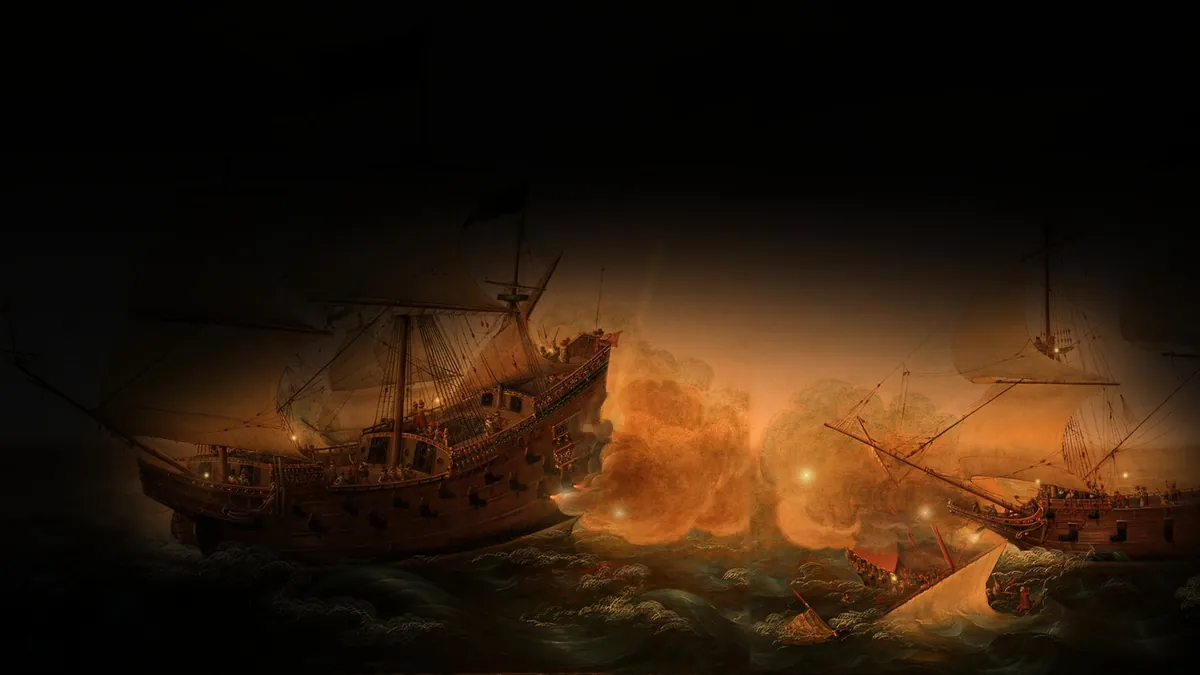
The Channel Opens
At four in the morning the stars went out over the Kestrel, a handful at a time, from the west.
Rusk stood by the wheel and watched them go. The fleet was standing north-west across the Reach Water in two long lines, with Holm Sound five miles astern and Orra eight miles ahead in the dark. Somewhere beyond Orra's black shoulder lay the three ships they had come for. Mercy was anchored just inside the eastern mouth of the deep channel. Crown lay behind her, west of the Throat, waiting for the spring flood to give her water over the hulks. Northward was moored three miles west of the tower, in the approach. Their fields lay over the strait like three coins dropped on a chart, and the Kestrel had just sailed under the edge of the first of them.
The sky showed no line, no sign of it at all. The stars over the masthead simply stopped being there. Rusk looked astern and saw them still burning over Holm Sound, low and cold and very clear. Ahead there was nothing. The breeze held steady out of the north-north-west, and the ship went on into the black with her lamps shuttered and her people quiet.
"That's Mercy's dark," said Orris. "I'd know it anywhere. It smells of wet iron."
"That's your pipe," Rusk said.
"I put that out an hour ago," Orris said, "out of respect for the occasion."
The old man sat in a chair lashed to the deck beside the wheel, with his splinted leg stuck out in front of him on a coil of rope and a blanket over his knees. Hanne Webb had told him twice that he would sit below or she would tie him there herself. He had told her that a sailing master who could not see the sails was a lump of beef with opinions, and that he would sit where he could see them. In the end Rusk had settled it by having the carpenter bolt the chair down.
Isobel Wray had the deck. She stood at the weather rail with her hand on a backstay and her face turned up to the sails she could not see, listening to them. She was twenty-four, and six weeks ago she had been frightened of the size of the ship. She called the course to the helmsman now over her shoulder, and the helmsman answered her the same way.
"She's sailing well," Rusk said.
"That's Isobel," Orris said, loud enough to be heard. "And a little too free. Bring her up a point, girl. You're giving away ground we'll want later."
Isobel brought her up a point. She did not argue. Rusk had noticed that she argued with Orris only when she was certain, and that she was usually right when she did.
The fleet came to its stations an hour before dawn, two miles off the eastern mouth, with Orra on the starboard hand and the Brack somewhere to port.
Rusk kept the Kestrel hove to with her foresail aback and her lamps hooded, and listened. Sound carried a great way in the canopy. He could hear the sea working along the Brack rocks, and somewhere ahead the clank of a capstan and a voice calling a heave. That was Mercy, or her tugs. Farther off, on the very edge of hearing, men were hammering on iron in the channel.
"Clearance boats," said Ansel Hart. "They're marking the hulk ground for Crown. Laying buoys on the edges of the deep water, so her tugs can keep her in it."
Ansel leaned on the rail in his patched blue coat, squinting into the black. Since Wickmouth he had taken the Kestrel through four channels that no chart showed and won most of Joss Ambry's pay at dice. He had also taught Joss to whistle through his fingers, which nobody aboard had forgiven him for.
"You're sure of the set at the Throat?" Rusk said.
"North on the flood, Captain, till the last hour," Ansel said. "Then it swings and runs straight through. Everything that goes into the water there on the flood ends up on Orra's side of the hulks."
"South," said Orris from his chair. "It sets south, on to the Brack. Every pilot in the Reach knows that."
"Then they've all got it backward, Master Fen," said Ansel. "Since they sank the hulks, the water goes round the north end of them. I've watched it for three nights."
Orris grunted. He sat for a while with his chin in his whiskers. Then he said, "North, is it."
"It is," Ansel said.
"Then lay your hawsers north," Orris said, "and drown me if I say another word."
Joss laughed out loud on the tow deck forward and turned it into a cough. Ansel grinned in the dark. Rusk had sailed with Orris Fen for twenty years and had heard him give way on a point of pilotage perhaps three times.
Nera came up out of the main hatch with Annet Sorn behind her. They had spent the night below with the Darn men, checking the ward-breakers for the hundredth time. The iron wedges lay in canvas rolls on the hatch cover, each as long as a man's forearm. Their faces were cut with lines of counter-ward that Sorn had etched. Six were for Crown's frame, and two more, heavier, for the sluice drum in her forward hold.
"Well?" said Rusk.
"They're as ready as I can make them," Nera said. "Which is another way of saying I want two more days and a forge."
"You have three hours and a boat."
"Then I'll take the boat," Nera said.
Sorn kept her peace. She had sat for an hour on the hatch with a lamp, filing a burr off one wedge's edge that nobody else could see.
The dawn came up behind them at a quarter to seven, and nobody aboard the Kestrel could stop looking at it.
They were still inside Mercy's field, three miles from its eastern edge. Overhead the dark was absolute. But astern, low on the sea, a grayness came onto the water and spread. It was the edge of the canopy, lit from outside. The sea beyond it turned from black to slate to a cold silver. Then the sun came up somewhere over the mainland and laid a path of gold across the Reach Water, and the path ended three miles off in a wall of nothing. Rusk could see whitecaps out there, and a gull. He could see the masts of the rescue boats waiting at the edge, small and sharp in the sunlight, and the light did not reach one foot farther toward him.
"Look at it," said Joss, coming aft. "Just look at it, sitting there."
"Get back to your deck, Mister Ambry."
"Aye, Captain," Joss said.
He went. The tow deck was his. Rusk had given it to him at Darn, with the new bitts and the bridle and the great coils of hawser, and the boy had slept beside it every night since.
By the time the light outside was full, Rusk could hear Mercy plainly. She had weighed. Her tugs were moving her east into the mouth of the channel on the flood, a mile and more ahead in the dark, a huge black shape picked out by her deck lamps. Behind her, small and far, more lamps were moving along the line of the hulk buoys. That was Crown coming up to the Throat.
Rusk took out his watch and held it to the binnacle lamp. Isobel stood beside him with hers. At eight by both, he nodded.
"Now," he said. "Make the signal."
Three red lanterns went up the Kestrel's foremast, one above the other. A mile off to starboard, Brightwater showed the same. The fleet unhooded its lamps all at once, and the black sea was suddenly crowded with lights.
The boats went in first, as they had drilled, and the Kestrel went in behind them toward the eastern mouth with the breeze on her starboard beam.
Rusk could see the whole first stage from his quarterdeck by the lamps. Ahead and to starboard was Mercy, entering the channel under tow, with two escorts on her flanks. Marr was going for her with Brightwater and the two Southwick ships, and as he watched, the escorts turned out to meet them. Ahead and to port, along the Brack side of the channel, ran the island boats. There were thirty of them, fishing boats and pinnaces and pulling boats, with booms of lashed timber and coils of weighted cable in their waists. Ansel Hart had the Kestrel's longboat among them, with Lew Farrow at the stroke oar and two island men. Their task was to get past Mercy into the channel and lay their booms and fouling hawsers across the deep water ahead of Crown's tugs. Crown had to come east. Whatever was in the water in front of her, her tugs would have to tow straight through.
The Kestrel's task was to see that the boats lived long enough to do it.
The first enemy that came at them was the escort Steadfast, which had been lying at the mouth of the channel as a guard. She came out from behind Mercy under topsails, a ship as big as the Kestrel and heavier, and she went straight for the boats.
"There she is," Orris said. "Going for the small fry. As I would."
"Isobel," Rusk said. "Bring her round to meet that ship. Put us between her and the boats."
"Aye, Captain," Isobel said. "Helm up. Stand by the foresail."
The Kestrel turned. She came round with the breeze on her quarter and gathered speed, and the gap between the two ships closed. Rusk walked forward along the line of heavy crossbows. Their crews were crouched by the carriages with the bolts laid ready and the cranks drawn back.
"Rigging and quarterdeck," he said. "Not the hull. I want her helm and her sails. Wait for the word."
Steadfast's crossbows went first. Rusk saw the flicker along her side and heard the bolts come over, a hard rising hum. One struck the foremast with a crack like an axe. One went through the foresail. One took a man at the second carriage off his feet and threw him against the hatch, and he lay there with the heavy bolt standing in his chest.
"Steady," said Rusk. "Steady. Now."
The Kestrel's broadside went off down the line, six heavy bolts at sixty yards, and every one of them went high, as he had told them. He saw Steadfast's fore-topsail split from head to foot. He saw her quarterdeck rail burst into splinters, and men there fall. Her helm went over, hard, and she came up into the breeze with her sails thrashing.
"Again," Rusk said. "Same mark. Swivels, sweep her waist."
They cranked and loosed again. The swivel bolt throwers on the rail were cracking now, quick and light. Steadfast's crew were trying to get her head round. A boarding party had gathered in her waist with grapnels, meaning to come across, and the swivels caught them there in a clump and they broke apart. The ships were drifting together. Steadfast's side came looming out of the dark at twenty yards, then ten, and a grapnel came over and caught in the Kestrel's main shrouds.
"Boarders!" Dunning roared. "Marines, on me!"
Six men came over Steadfast's rail onto the Kestrel's waist. They had cutlasses and hatchets. The first was a big westerner with a bare head, and he cut down the man at the third crossbow before anybody could reach him. Dunning met the second with a pike and put him back over the side between the hulls. Rusk drew his hanger and went at the big man. The westerner swung at his head. Rusk took it on the hanger's guard, felt the blow go down his arm to the shoulder, and drove the heavy blade into the man's side under his raised arm. The westerner went down on one knee. Joss hit him across the back of the head with a belaying pin from behind.
It was over in less than a minute. Two of the boarders were dead on the deck. Three had gone back over the rail. One sat against the mainmast with his hands up and his cutlass a yard away, saying something in the western-islands tongue over and over.
"Cut that grapnel," said Rusk. "Isobel, take us off her."
Joss cut it with one blow of a hatchet. The Kestrel fell away. Steadfast drifted on into the channel mouth with her helm shot away and her sails in rags, out of the fight for an hour at least. Behind her the island boats were through, pulling hard along the Brack side into the dark of the channel, past Mercy, toward the Throat.
Rusk looked at the man with the bolt through his chest by the hatch. It was Matt Corrie, a Southwick deckhand who had joined at Darn. Hanne was kneeling by him. She shook her head without looking up.
"Get him below," Rusk said. "Out of the way of the carriages. Gently."
Soon afterward Rusk saw fighting on the top of Orra, two miles off in the dark.
The Kestrel was standing off and on in the mouth of the channel, covering the boats' rear, with Mercy a quarter mile away to the north. Brightwater was alongside her. Rusk could see it in the lamps: the two hulls locked, and men going up Mercy's side, and crossbow fire flashing along her rail. Marr was in there somewhere. He did not let himself look at it for long.
He looked up at Orra instead. The island stood over the channel like a black cliff, with the dead tower on its crown. There had been no light on it for two nights. Now lights were moving on the south slope, small and quick, a dozen of them climbing. Crossbows flashed. A lamp went over a terrace edge and fell, turning, and went out halfway down. He heard, very faint, a man screaming, and the clash of steel coming down to the water.
"She's on the south stair," Orris said. "Up the old cliff stair from the cove. Salt and blazes, she's sixty years old."
"Fifty-six," Rusk said.
"She'll take that as a kindness from you," Orris said, "will she?"
The lights stopped climbing. For a minute nothing moved on the crown. Then a single lamp showed on the signal terrace, and went dark, and showed again. It began to talk.
Isobel had the slate. She called the letters as they came, and the signal boy wrote them down.
"T, E, R, R. Terrace. Held. Then the countersign, Captain. Saltgrass."
"Acknowledge," Rusk said.
The Kestrel's own lamp answered. Up on the crown the shutter went on, steady and patient. Marietta had a portable station up there, a box lamp and a shutter and a boy to work it, and she had sixty island crossbowmen holding the terrace round it. From that height she could see the lamps of the whole strait at once: Northward to the west, Crown in the Throat, Mercy at the mouth, and every boat between. It was all she was for. She could tell them what was happening. She could not tell any ship what to do about it, and nobody had pretended otherwise.
"Northward," Isobel said. "Resolute engaging Northward. Boats at her cages. Then: Crown's tows doubled. Four tugs on her now."
"Vaust's seen the boats," Rusk said. "He's putting more weight on the lines to drag her through before they can foul them."
"There's more." Isobel's pencil moved. "West. Leary engaged western tows. Vigil stopped. Bounty's tow cut. Two boats lost. Saltgrass."
Rusk let his breath go. Out there, eleven miles and more to the west, Leary's fishing boats were doing what they had sworn at Southwick to do. They were going in under the towboats' prows with grapnels and cutting knives, in the dark, against crossbows. Two boats lost. He did not know whose. Leary had stood up at Southwick before every master in the port and asked Marr why any honest man should sail behind Tavin Rusk. Rusk had heard it from Leary himself at Holm Sound, and had not argued, because the question was a fair one. And Leary had come anyway.
"Captain." Isobel was still writing. "Providence. That's the supply ship, lying inside the mouth on the Orra side. Her escort's left her. Gone to Mercy. She's lying alone."
Rusk turned and looked. He could see her lamps: a deep, broad-beamed store ship at anchor in the north edge of the channel, a quarter mile inside the mouth, with nothing near her now but her boats. Her escort was pulling hard across the channel to Mercy, crowded with marines.
"She'll be full," Orris said. "Powder and bread and spare vanes, like as not. Lying there for the taking."
"Yes."
"Every boat in the fleet will have seen her," Orris said.
"Yes." Rusk watched the escort reach Mercy's side and her marines start up it. That was where they had gone: to hold Mercy against Marr. Vaust had looked at his position and seen what mattered, and thrown away what did not. He had given his enemy a ship full of stores to fight over in the middle of a battle. It was what Rusk would have done.
"Isobel," he said. "Signal the fleet. Providence is not to be taken. Any boat that goes near her goes on to the Throat. Repeat it twice."
He felt Orris look at him. The old man said nothing. He settled his chin in his whiskers and put his eyes back on the sails.
Then the Kestrel went into the channel after the boats, with the breeze on her beam and the black bulk of Orra sliding by to starboard.
The channel was six hundred yards wide, and in the dark it felt narrower. Rusk kept her down the Brack side, where the rocks broke white along the edge of the lamplight. Ahead, a mile and more, Crown's lamps filled the Throat from side to side. He could make out the shape of her now: a vast, broad, high-sided ship lit along her whole length, her masts struck down to stumps, coming east at a crawl. Four lines of light ran ahead of her through the dark. Those were the tugs, each under sweeps and a scrap of sail, each with its towline running back taut to Crown's prow. Smaller lamps moved about them: her escort boats, and the clearance craft, and the island boats among them all, darting in and out.
"There's the first boom," said Isobel. "Laid. And there's another."
He saw them: two long dark shapes in the water across the line of the tugs, heaving on the flood. The leading tug saw them too, and sheered off. The second ran full into a boom, and Rusk heard the timber crack from a mile away. Her towline went slack and dragged. Crown's whole vast shape seemed to check in the water and swing.
"She's slowed," Orris said. "Look at her. She's slowed."
"She'll come on," Rusk said. "She has three more."
He was looking for the longboat. He found it by Ansel's lantern, which hung from a short pole at her stern as they had agreed, so the Kestrel could find her. She was a quarter mile ahead, hard in on the north side of the deep water, pulling hard across the path of the leading tug. A hawser was paying out over her stern: a long, heavy cable with iron weights along it, meant to sink across the channel and be swept up by the towline. Ansel had laid it north of the hulks, as he had said. The flood was carrying it up against the line of the tugs just where the tugs had to pass.
The leading tug's crew saw it coming. Somebody on her deck shouted, and lamps swung toward the longboat. Crossbows flickered.
"Isobel," Rusk said. "Take us up to them. Starboard carriages, on that tug. Now."
The Kestrel heeled and drove forward. Rusk watched the longboat. He saw Lew Farrow straining at his oar, and the two island men, and Ansel standing in the stern with the hawser running through his hands, guiding it, his face turned to the tug. A bolt hit the water beside the boat. Another hit an island man and threw him across his thwart. The longboat lurched. Ansel did not look round. He was watching the tug's towline come down on his cable. When it came he let the last of the hawser go with a heave of both arms, and the weighted line ran away into the dark water.
The tug's towline swept it up. Rusk saw the line jerk and snatch, and saw the tug stagger as if she had struck a rock. The cable had fouled.
A bolt took Ansel Hart in the chest and knocked him backward over the stern into the sea.
"Swivels!" Rusk shouted. "Clear that tug's rail!"
The swivels cracked. The Kestrel's starboard carriages went off together at a hundred yards, and the tug's deck house burst into splinters, and her crossbowmen dropped behind her rail. Rusk was already at the side.
"Lew! Lew Farrow! Get him out of the water!"
Crown's fitting lay under her keel a quarter mile off. A man who drowned in that water had a minute, perhaps, before it stopped being Ansel Hart in the water.
Lew had shipped his oar. He was over the stern of the longboat to the waist with an island man holding his belt. He had Ansel by the collar. Something pale moved in the water a few yards beyond them, then another, coming up through the lamplight from below. They were the drowned that the tug carried in her flooded hold, slipping out to defend her. Lew heaved. The island man heaved. Ansel came up over the stern in a rush of water and fell into the bottom of the boat. The island man struck at a white hand on the rail with his boathook and broke the fingers, and the hand fell away.
"Pull!" Lew was screaming. "Pull for the ship!"
The Kestrel came down on them. Rusk had a line thrown, and they caught it, and the longboat came in under her side. They got Ansel up on deck. Hanne was there with a lamp.
He had been dead before he hit the water. The bolt had gone through his heart. His face was calm and surprised, and seawater ran out of his black hair onto the deck. Hanne put her hand on his throat and held it there, and then took it away.
"He was gone in the boat, Captain. It wasn't the sea."
Rusk knelt beside him. Ansel had died of a bolt, then. He would not rise. It was a strange thing to be glad of.
"Lay him aft," Rusk said. "Cover him. Lew. Lew, are you hurt?"
Lew Farrow was sitting against the rail with water running out of his clothes. He shook his head. He looked at Ansel's face and then away.
"He laid it," Lew said. "Right where he said. North of the hulks."
"I saw," Rusk said.
"He said every pilot in the Reach had it backward," Lew said.
"They had," said Rusk.
An hour into the fight, Rusk stood at the rail and took stock of the strait.
Mercy was behind him at the eastern mouth, locked to Brightwater, and the fight on her deck had not stopped. Northward was out of sight beyond Orra, and Resolute was somewhere at her. All three fields were up, and nothing that anybody had done yet had lifted one corner of the dark. Leary was holding the four in the west. That was all that could be said.
In front of him, in the Throat, two of Crown's tugs were fouled. One lay across the channel with the boom tangled in her towline. The other was snubbed down by the prow on Ansel's hawser, her crew hacking at it with hatchets. But the other two were still pulling. Crown had let go of the fouled lines, and she was coming on. She was slower now, with her two good tugs straining east under sweeps and sail and her lamps blazing along her side. Every minute she came another fifty yards. When she was through the Throat she was in the Reach, and the Reach was forty miles of open water to the Wendle Levels. She would have the top of the tide at half past twelve, and her drum would have the gates.
Orris was looking at him from his chair.
"Well, Captain?"
"Joss," said Rusk. "Get the bridle up on deck and the grapnels ready. Dunning, your men at the rail. Nera, Mistress Sorn, have your people at the hatch with their tools." He turned. "Isobel. Lay me alongside that ship."
Isobel swallowed. Then she put the helm over herself, and the Kestrel turned her prow toward the lights in the Throat.