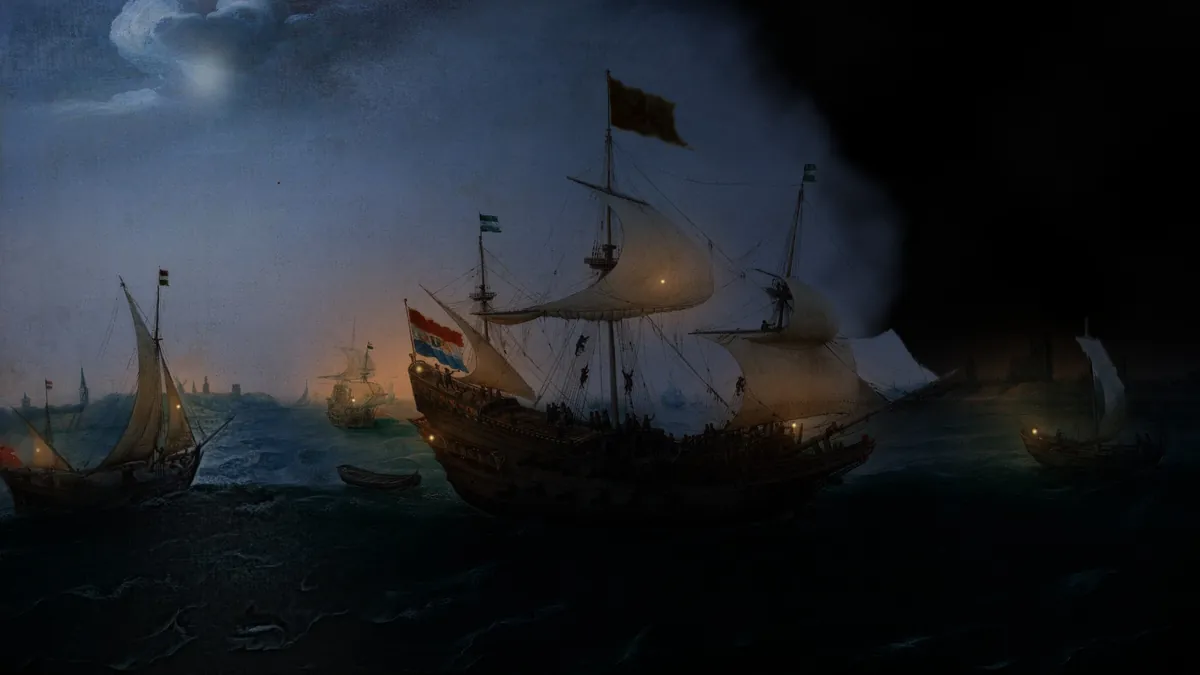
The Fleet in the Dark
By the afternoon of the eighth of November, Holm Sound was full of ships, and Elske Marr stood on Brightwater's quarterdeck in the sunlight and looked at what she had.
The sound lay among a scatter of low green islands in the middle of the Reach Water, twelve miles east-south-east of Orra and outside every field. To the west, beyond the last of the islands, the dark stood on the sea like a cliff. It was the edge of Northward's field, ten miles off and rising black out of the bright water until it went up past seeing. Behind it, somewhere, Orra was fighting.
On this side of it the sun shone, and the sound was crowded. Brightwater lay at anchor in the middle with Fulmar and Halberd on either side of her, Petch's three warships, plain and businesslike. Round them lay the Southwick traders, a dozen of them, with Leary's Thrift among them, low and handy. Beyond those the boats filled the sound from shore to shore. Fishing luggers had come from Southwick and Holm Ennis and Carrick, and Mother Quenby's twelve tarred pilot boats from Gull Ness, and Hugh Stannard had brought Greyhaven lighters and ferries down the coast. Sixty boats. Seventy. Marr had given up trying to count them at noon.
Resolute had come in at two, from the channel, low in the water with forty-one wounded from Orra under her hatches. Hanne Webb had come up out of her hold looking ten years older, and had said only that the keeper was on the island yet, and the Kestrel with her.
At four, Spurr's lugger came in from Darn, and Nera Pell stood up in the stern and waved.
She came aboard Brightwater with a wooden crate on her shoulder and set it down on the quarterdeck. Annet Sorn came up the side behind her, and Tomas Ebb behind Sorn, thin and nervous, carrying a second crate in his arms as if it held eggs.
"Ward-breakers," Nera said. "Twenty-four of them. Sorn etched every one of them before we went to Greyhaven."
She knocked the lid off. Inside, packed in straw, lay iron wedges as long as Marr's forearm, black and heavy, with fine bright lines cut deep into both faces. They were patterns like the ones on the Greyhaven ward plates, but reversed. Marr took one out. It was colder than iron had any right to be, and it made her fingers ache.
"Drive it into a joint of the frame lattice," Sorn said. "Where the wards cross. One good blow with a maul. The counter-ward splits the lattice along the grain of the ward, and the frame cracks. The field fails at once. No twelve minutes. No reserve."
"And the fittings?" Marr asked.
"Those you smash yourselves," Sorn said. "You know how by now."
Marr put the wedge back in the straw. She looked at Nera. "Greyhaven?"
"Gates shut and chained, plates off. Brewer's men are on the wall." Nera wiped her face. "Any word from Orra?"
"Resolute brought the wounded out at noon. The rest come tonight, by the Kittle." Marr looked west at the black wall. "If they come."
Vaust's terms came at sunset. A cutter came out of the dark under a white lantern at her masthead, pulling slowly through the islands toward Brightwater, with a flag of truce at her stern. In her stern sheets sat a young officer, a tall fair man in Pale Fleet blue-gray, with a sealed letter in his hand. He came up the side alone, saluted the quarterdeck correctly, and introduced himself as Lieutenant Tobin Rook, of the flag.
"From the Admiral," he said, and held out the letter.
Marr took it. She broke the seal and went through it standing, in the last of the light, with Nera and Venn and Leary and Lieutenant Kell round her.
It was a short letter in a fine, clear hand, and it wasted nothing on compliments. The Compact had sent the west fine words for twenty years, Vaust wrote, and he had no more use for them. He offered the Reach a place under his protection. The islands and the coast would keep their ships and their laws and their trades under the peace of the Pale Fleet, as the west had been promised and never given. He regretted the loss of life at Greyhaven and Darn. He noted that he held forty-three persons of the islands, taken from boats leaving Orra and from Holm Ennis, and that their welfare would depend on the conduct of their kin. He asked for an answer by morning.
Marr folded it and handed it to Venn.
Venn studied it, and handed it on. "That's his hand," she said. "He means every word of the first part."
"And the second?" Marr asked.
"He means that too," Venn said.
Marr turned to Rook. "The answer is no," she said. "No protection and no peace on those terms. You may tell the Admiral so, with my respects." She paused. "But I hold prisoners too. Forty-three officers and men of the Pale Fleet, from the garrisons at Darn and Greyhaven. I will exchange them, name for name, for the forty-three islanders he holds."
Rook's eyes flickered. "I have the Admiral's authority to agree an exchange."
"Then agree it," Marr said. "The sandbar off the Brack's eastern tail, at the morning low water. Half past four. Each side brings its prisoners in two boats and lands them on the bar. They cross in pairs, one of yours for one of mine. Twenty armed men aside, no more, and they stay on the crest of the bar."
"Agreed," said Rook.
He went down into his cutter. They watched its white lantern go away west through the islands toward the dark.
"He agreed that fast," Leary said.
"Yes," said Marr.
"The Brack bar will be inside Mercy's field by morning," Nera said. "She's coming in under tow south-west of Orra tonight. That bar's under her dark. Anything of hers already dead in that water can walk up onto it."
"So we'll have company," said Leary.
"Yes, Captain." Marr looked at Dunning, who had been standing at the rail with his arms behind his back. "Sergeant. Twenty marines. Pikes and mauls, not swords. And I want two rescue boats lying off each side of the bar with every lamp they have."
"Expecting trouble, Commander?" Dunning said.
"Expecting Lieutenant Rook," said Marr.
The Brack's eastern tail ended in a long bar of sand that dried at low water. It ran out a quarter mile south-east from the last bare rock, three miles east of Orra's tower. At half past four in the morning of the ninth, Marr stood on it in the dark with the sea hissing on either side.
She could see nothing beyond the reach of the lamps. Mercy's field covered all this water, and Mercy itself lay at anchor four miles and a half to the west, south of Orra's western mouth, waiting for the flood. Anything of Vaust's already risen in this water was Mercy's to move. A man who drowned here tonight, more than four miles from any fitting, would stay drowned. No moon showed, no star, nothing above at all. The sand underfoot was hard and ribbed and cold. On the crest of the bar, twenty marines stood in a line, Dunning's eight and a dozen from Southwick, with their pike-butts grounded and lanterns on poles. Off the north side of the bar, Angove's two boats lay on their oars with their lamps lit. Off the south side lay two of Tregear's.
The enemy boats came out of the dark from the west, two big launches pulling slowly under lanterns. They grounded on the western end of the bar, and people climbed out onto the sand: islanders in fishermen's smocks and women's shawls, some of them children, herded along by twenty Pale Fleet marines. Lieutenant Rook walked at their head.
Behind Marr, her two boats had grounded at the bar's eastern end, and the Pale Fleet prisoners came ashore under the guard of Corporal Maddox, a square, slow man with a voice like a gate: forty-three men in blue-gray, unarmed, looking about them in the lamplight.
The two lines faced each other across sixty yards of wet sand.
"Commander," Rook called.
"Lieutenant," Marr called.
"We begin?" Rook asked.
"Yes," Marr said. "One of mine to one of yours. In pairs. Maddox."
Maddox sent the first prisoner forward, a Darn garrison sergeant with his hands loose at his sides. From the other side, a marine pushed forward an old man in a fisherman's smock. They walked toward each other across the sand. They passed in the middle without looking at each other. The old man reached Marr's line, and Dunning took him by the arm and passed him back to the boats, and he was sobbing.
The second pair crossed, and the third, and Marr watched the water.
It lay flat and black, hissing on the sand at the bar's edges, and the tide had turned and was coming back. In an hour the bar would be awash.
The pairs went on crossing. A woman came over with a baby, and then a boy of about ten who walked the whole sixty yards with his eyes shut tight. Marr watched the water. By the twenty-first pair they were halfway.
Something moved in the shallows on the south side of the bar.
It was only a ripple, at the very edge of the lamplight, where the water ran up over the sand. But the tide was flooding from the west, and the ripple went the wrong way.
"Dunning," Marr said quietly. "South side."
"I see it," Dunning said.
"Angove's boats to the north side," Marr said. "Tregear's to come in nearer. Pass it on, quietly."
The twenty-second pair started across, a girl of fifteen from Rook's side and a young garrison marine from Marr's. They were halfway across when the sea came up out of the sand on both sides of the bar.
They had been lying in the shallows, under a foot of water, all along both edges of the bar. Thirty of them. More. White faces broke the black water, and white hands, and sodden bodies stood up dripping, all along the bar's edges. They walked in from both sides at once toward the middle, toward the people crossing, toward the islanders waiting on Rook's side, toward Marr.
The girl in the middle screamed and ran, and a drowned man caught her by the shawl.
"Pikes!" Dunning roared. "Line, pikes! Legs! Get the people behind you!"
Rook had his sword out, and so had his marines. They came across the sand at Marr's line in a rush, behind the dead.
Marr met Rook in the middle of the bar, in the wet sand, with the sea coming up round their ankles.
He was good. He was young and fast and tall, and he came at her high, cutting at her head with a long heavy blade. She took the first cut on her sword near the hilt, and the jar went up her arm into her shoulder. She gave ground. He came on, cutting, and she gave ground again, feeling for the sand behind her with her heel. The third cut she let go past her. She stepped inside it and hit him in the face with her guard.
He reeled but kept his feet, and swung back at her, wild and furious, and she took it on her blade and turned it down into the sand. Then she put her point through his sword arm above the elbow.
Rook's sword fell in the sand, and he went down on one knee, holding his arm.
"Stay down," Marr said.
All round her the bar was a mass of noise and lamplight and struggling bodies. The dead were coming in from both sides, and Dunning's marines were breaking them, pike-butts swinging, legs and necks. The islanders on Rook's side were running toward Marr's line in a crowd, and the dead were among them, catching at them. A boy went down in the shallows on the south side with a drowned woman's hands in his collar, and she was dragging him under. A marine went in after him up to his chest and beat the woman's grip loose and hauled the boy out by his belt.
"Boats!" Marr shouted. "Angove! In! Get them into the boats!"
Angove's luggers came in through the shallows on the north side and grounded hard, and her people jumped out and began throwing islanders over the rails. Tregear's boats came in on the south side through the dead, with their crews laying about with oars and boathooks. The Pale Fleet marines had stopped. Some of them were fighting Dunning's men. Most of them were standing in the wet sand staring at the dead, who did not care whose side anyone was on, and who were dragging at their legs as well.
A Pale Fleet marine threw down his sword and ran toward Marr with his hands up, shouting. Two more followed him.
"Down!" Marr told them. "Down on the sand, hands on your heads! Maddox, take them!"
It lasted perhaps ten minutes. When it was over, the dead lay broken all along both edges of the bar, and the tide was running in over them. The last islanders were in the boats. The Pale Fleet launches were pulling away west into the dark, half empty.
Marr stood in the water to her shins and counted. Forty-three islanders, every one, though the girl in the shawl had a broken wrist and two old men had to be carried. Twenty-two of her prisoners had crossed to Rook's side before the trap was sprung. The other twenty-one were on her side of the bar yet, sitting in the sand under Maddox's guard. Some of them had fought the dead beside her marines.
"We lost two marines into the water," Dunning said, breathing hard. "We got them both out. One's breathing. The other isn't." He looked down at the water running in over the sand. "At least he'll lie quiet."
"Thank you, Sergeant."
"And these." Dunning jerked his head at three Pale Fleet marines sitting with their hands on their heads, and a dozen of the prisoners who had not crossed. "They're asking about Greyhaven, Commander. They want to know if it's true it's free. One of them says his wife's in the Basin."
Marr went over to them. The marine who had thrown down his sword first was a big, fair, frightened man.
"Is it true?" he said. "The gates? Greyhaven?"
"Yes," said Marr. "The gates are shut and chained, and the plates are off them. The town is free. Anyone in the Basin can walk out on the causeway. Anyone outside can walk in."
The man put his face in his hands.
Rook was sitting on the sand with his arm bound and two marines over him. He looked up at her.
"Ask me whose order it was," he said.
"No," said Marr. "I'll ask him."
The Kestrel came into Holm Sound at nine in the morning of the ninth, out of the dark and into the sunlight, with six island boats in tow and her deck crowded with fighters.
Marr watched her come in from Brightwater's rail. She watched the people on the Kestrel's deck lift their faces to the sun as she came out from under the edge, and saw one or two of them sit down where they stood. Rusk was at the wheel. Orris sat on a cask beside him with his leg up. Isobel had the deck. In the waist, among the fighters, sat a gray-haired woman with both hands bandaged and a book held against her chest, not looking at anything.
When the Kestrel anchored, Marr had her boat lowered and went across.
Marietta Voss stood up when she came aboard, and the two women looked at each other. Then Marr held out both her hands, and the keeper took them, bandages and all, and held on hard.
"The lenses?" Marr said.
"Broken," said Marietta. "Every ring. I've only the one book left to keep." She let go. "Where do you want me?"
They met at noon in Brightwater's great cabin, round the chart.
Lieutenant Kell had set every chronometer and watch in the fleet by the sun at noon, on Brightwater's deck, with the masters coming up one by one to have them set. Now the cabin was crowded. Rusk stood at the chart table's foot, with Orris in a chair beside him and his leg on a stool. Venn stood at the head. Nera and Sorn were on one side, Marietta and Leary on the other, and the rest of the room was full of masters and pilots and marines, standing where they could.
On the table lay the chart of the strait, and on the chart lay three dice.
They were Enoch Garvey's dice. Joss had kept them in his pocket since Fallow Creek, and when Marr had asked for something to mark the engines with, he had set them on the table and stepped back. Orris looked at them, and then away. Four pebbles from the beach lay farther west, off the chart's edge, on the bare wood.
"Three engines," Marr said. She put her finger on the first die, west of Orra at the western approach. "Northward. At anchor here since the third. It's the western wall of the dark." The second die lay in the deep channel at the Throat. "Crown. Tomorrow on the flood her tugs bring her into the Throat, and she creeps across the hulk ground as the tide rises. High water is half past twelve. She's over by then, or she waits two weeks." The third lay at the channel's eastern mouth. "Mercy. She draws less, so she goes through ahead of Crown tonight and waits at the eastern mouth to go out into the Reach."
She looked round the room. "Those three fields overlap over the whole strait. Break all three, and the strait is in daylight. That's the work."
"And those?" Leary pointed at the pebbles.
"Vigil, Bounty, Shelter and Covenant, at anchor in Lisk's approaches, eleven to fifteen miles west," Marr said. "If we break a field, he'll want to bring one of these up to fill the gap, and the nearest can do it by noon if its tugs start at eight. Captain Leary, that's yours. You and the fishing fleet go out through the Kittle tonight and west into the approaches. Every towboat you cut or foul or burn is an engine that can't come."
Leary looked at the pebbles, then nodded. "Then they won't," he said.
"Northward." Marr turned. "Captain Venn."
"Resolute sails at one o'clock," Venn said. "North round the top of the Bar, and down the outside in the dark, and off Northward by seven." She smiled for the first time Marr had ever seen. "They'll take her for what she was. Not a soul out there has been told I've changed sides, Commander. Not officially."
"Mistress Angove goes through the Kittle with four boats and fouling hawsers, and meets you off Northward," Marr said. "Foul its vanes, hold its vane room so the spares can't be shipped, and when the field fails, smash the fitting."
"Twelve minutes," Venn said. "I can count to twelve."
"Mercy is mine," Marr said. "Brightwater, Fulmar and Halberd, with Corporal Maddox's section and the Southwick marines. We lie east of the channel mouth in the dark, inside Mercy's field, and take it where it lies. Its escorts too. Mistress Pell's drawings show Mercy's hull, and the frame compartment, and the maintenance port." She did not say more about the port. She had studied it until she saw it in her sleep.
"And Crown," said Rusk.
"Crown is the Kestrel's. She goes in past Mercy along the Brack side while we have Mercy's escorts busy, and takes Crown in the Throat. Tregear's harpoon boats and the Holm Ennis luggers go with you, with fouling hawsers for her vanes and hatchets for her towlines. Sergeant Dunning and ten marines hold the passages. Mistress Pell, Mistress Sorn and the Darn men go below." She looked at Nera. "The sluice drum first. Then the frame."
"It has to be," Nera said. "If we break the frame first and the drum's whole, somebody tows her off in the daylight and fits a new frame and comes back next spring."
"And Orra," said Marietta.
"Orra is yours, Keeper," Marr said. "You land in the cove at eight and go up the old cliff stair to the signal terrace with sixty island crossbows. Take it, hold it, and set up the portable shutters. You talk to the boats. You tell them where the gaps are and where the people are in the water."
"I can't tell the warships anything," Marietta said.
"No," Marr said. "The terrace is for the boats. The warships keep to the plan."
"Now the rules," Marr said.
She put her hand flat on the chart.
"Clocks first," Marr said. "Every watch in this fleet was set at noon today on this deck. We enter the dark at four tomorrow morning, behind Brightwater, and at eight o'clock by your watch everybody attacks at once. Brightwater and the Kestrel will hoist three red lanterns, but don't wait to see them. The clock is the signal. By eight the sun's been up an hour outside the canopy. When a field falls, the light comes in. I want it there."
"Next, signals," Marr went on. "Lamps and shutters, nothing else. Any signal that changes anyone's orders ends with the countersign, and tomorrow's countersign is SALTGRASS. The ship receiving it sends SALTGRASS back, the same word both ways, before she acts. No countersign, no change. If you see a signal that changes your orders and it doesn't end with SALTGRASS, it's not from us. You ignore it and keep to the plan."
"Saltgrass grows on the cliffs under my tower," Marietta said.
"That's why I chose it," said Marr.
"If your lamps are shot away and the terrace never talks, you keep to your task until your clock says otherwise," Marr said. "When a field falls, the sky will tell you."
"And if Venn doesn't break Northward?" said Leary.
"Then the strait stays dark on its western side, and we break the other two under Northward's field," Marr said. "It's harder, and we can bear it. No ship leaves her target to help another. That's how Tern burned."
The cabin was silent at that.
"If Crown gets over the Throat before the Kestrel boards her," Marr went on, "Brightwater leaves Mercy to Fulmar and Halberd and goes after her with the Kestrel. A lugger runs for Greyhaven to warn the gates."
"And if it all goes wrong?" Rusk said.
"Then I make the signal for general withdrawal, and I alone can make it. Three long flashes, three times over, ending SALTGRASS, from Brightwater. You answer and break off. We rally here, at Holm Sound." Marr looked down the table at him. "And if Crown's field is standing at two o'clock, I'll make that signal whatever else is happening. After two the tide's falling, Crown is either across or aground, and we'll fight her in the Reach on another day. When the plan says stop, we stop."
Rusk held her eyes down the length of the table. "Agreed," he said.
"Last." Marr straightened. "Every boat not assigned to an engine pulls people out of the water. Ours, theirs, anyone's. Every one we leave in the water, we fight again at noon." She looked round the cabin. "Questions."
The fleet ate that evening at its moorings in Holm Sound, in the last of the sun.
Orris cooked on the Kestrel's deck, sitting on his cask beside the galley stove, because there was no stopping him. It was fish stew with too much pepper, enough for a hundred, and boats came across from all over the sound to fetch it in buckets. Rescue crews went from boat to boat with lists. Nera went over every fouling hawser in the fleet with Sorn behind her, and found three she did not like and had them remade. Dunning played his fiddle for the Southwick marines. It was as bad as ever, and the marines sang along to drown it.
At sunset the master of a Carrick lugger came across to Brightwater and stood on the quarterdeck with his cap in his hands. He was a broad gray man. He had drilled his crew for six days at Southwick with a fouling hawser and a tar barrel for an engine, and had been in the boats at the long wharf.
"I'm taking her home, Commander," he said. "Tonight. Before you sail."
Marr waited.
"My brother's boy was in the water at the wharf. We got him out. He's lying in my boat with his lungs full, and he looks at me." The man turned the cap in his hands. "I've six men with wives, and I've seen what gets up out of that water. You said at Southwick a master could withdraw before the fleet sailed, and not be called a coward for it. Not in your hearing."
"I said it," Marr said.
"Then I'm asking," the master said.
Leary was at the rail ten feet off with his back half turned, listening with all of it. Dunning was looking at her.
"You drilled your crew better than half this fleet," Marr said. "You went in at the long wharf when the Southwick boats hung back. Take your boy home, Captain, and take my thanks with him. The clause stands."
He looked at her as if he had come ready to argue and found nothing to argue with. He put his cap on and went down the side. His lugger's sail went up against the red sky and stood away east out of the sound, alone, and every boat in the anchorage watched it go.
"He'll not be the last," Leary said.
He was. No other master came across, that night or in the morning, and by dark every boat in the sound knew that one had asked and been let go with thanks.
At dusk a boat came in out of the west under a white lantern, with six Pale Fleet sailors in it. They had slipped away from the escorts off Orra. They had heard from the exchange boats that Greyhaven was free and the Basin open, and two of them had families there. Marr had them fed and put under a light guard, and sent word to Stannard.
When it was dark, she went across to the Kestrel.
Rusk was on the quarterdeck alone, at the taffrail, looking west. The black wall of the canopy was invisible now against the night, but he was looking at where it would be. She came and stood beside him.
"Leary told me what you said to him at Southwick," Rusk said, without turning. "About the case being open."
"It is open," Marr said.
"Yes." He was quiet. "I won't ask you to shut it."
"I won't. When we're done, I'll testify. All of it. The six hundred, and the hundred and forty, and the gap, and why. And all of this, too." She looked west with him. "The harm with the rest. I won't arrange anything for you, Captain."
"I'd think less of you if you did," Rusk said.
She leaned on the rail. Her hands hurt yet from Southwick. "I'm giving you Crown because of what you've done since the chain house, and because the plan is good. Not because Ember Roads was right."
"It wasn't right," Rusk said. "It was a choice. I'd make it again. I've thought about it every night for three years, and I'd make it again, and men would die again for it, and I'd have done it." He turned his head to look at her. "That doesn't put anything back."
"No."
"Edwin Mallory was a good captain," Rusk said.
"He was," Marr said. "He went into the fire trying to fill your gap with the Halcyon. I'll say that at your hearing too."
"Say it," said Rusk.
He looked at the dark.
"Bring her back," Marr said at last. "The Kestrel. Nera will never forgive either of us if she's sunk."
"I will."
She went down into her boat and back to Brightwater, and did not sleep.
At half past two in the morning on the tenth of November, the fleet weighed in the dark and stood out of Holm Sound in two long lines, Brightwater leading one and the Kestrel the other.
The breeze was moderate and steady from the north-north-west, a workable breeze, the best they could have asked for. The tide was still falling, and the flood would make by six. The stars were out over the Reach Water, thick and cold. Ahead, to the west, there were no stars.
Marr stood on Brightwater's quarterdeck with her watch in her hand. At four o'clock, five miles out of the sound, she saw the edge come over them. No line showed. The stars ahead simply went out, a band at a time, as the fleet sailed under the canopy. Then the stars overhead went too, and the stars astern. The night closed down round Brightwater until nothing was left in the world but her lamps, and the lamps of the ships behind her strung out across the black water, each following the one ahead.
It was eight miles to Orra, and four hours to eight o'clock.