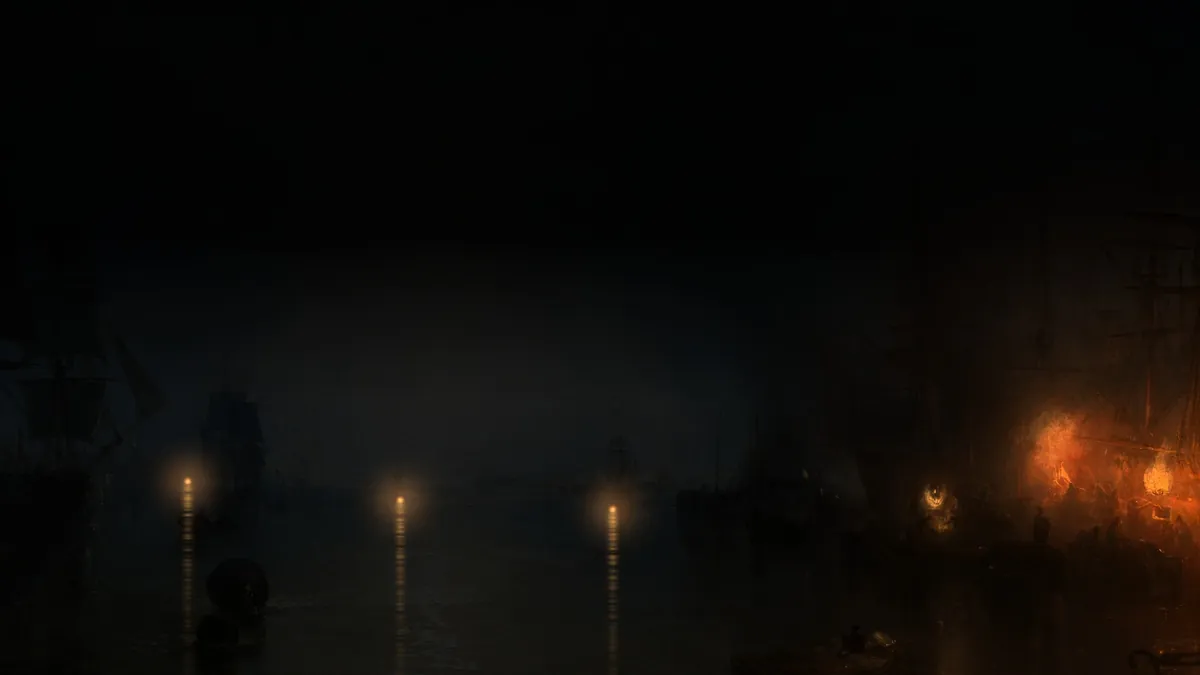
Darkness at the Chain
The Admiral's secretary was a long, pale man, and he had spent twenty minutes explaining to Elske Marr why a prisoner of the Admiralty court could not be held in a harbor guardroom overnight.
"The regulations are perfectly clear, Commander. A prisoner awaiting the full court is to be held in the Admiralty cells, under the marshal's hand, with a surgeon's visit daily and a copy of the charges posted on the door."
"The cells are full of drunks," Marr said.
"Then the drunks must be moved," the secretary said.
"Then move them. I'll wait." Marr stood square in front of his desk. She had been standing for most of the afternoon, and her feet hurt in her good shoes, and she was aware of being unreasonable. She hardly cared. "Captain Rusk was attacked on the long wharf this morning by a man with a bale hook. The chain house is a stone tower with old men in it. I want him somewhere with a door that locks and guards who are awake."
"The chain house is a naval post," the secretary said.
"The chain house is a museum with a winch in it," Marr said.
The secretary opened his mouth to answer, and the light went out of the room.
It went as lamplight goes when somebody turns down the wick. But this was the sun, pouring through the tall windows behind the secretary and lying in long gold bars across the floor, and it dimmed and thinned and was gone. Marr turned to the window. Down below, the harbor lay in a strange brown dusk. The water was darkening from the west. She saw it happen. A line came across the harbor from the mouth, sharp as a cloud's shadow on a summer field. Behind the line everything was black: the sands, the mole, the chain house, the ships at the outer wharves. The line swept up the harbor toward the town. It crossed the inner basin and the ropewalk roofs. It came up the ridge, and it came over the Admiralty House, and she was looking at nothing.
The secretary made a small noise in the dark.
Somewhere outside, a woman began screaming, high and steady, on one note. A dog barked, and a door banged. Marr stood motionless and let her eyes find whatever there was to find. At first she found nothing, until a spark of light in the street below: somebody's window, a lamp lit. Then another. Across the harbor, the riding lights of the ships at anchor came out one by one, like stars at dusk, except that there was no dusk. Above them, where the sky should have been, there was no sky. She could not see the shape of a cloud or the glimmer of a star. The dark went straight up from the rooftops without end.
She had served on ships in fog so thick she could not see the prow from the helm. This was no fog, for the air was clear. She could smell the harbor and the bread ovens on Ropewalk Street. She could hear the sea on the mole as plain as at noon. Simply, no light came from above at all.
"Light a lamp," she said. Her voice came out quite level.
He fumbled with a tinderbox. The flame jumped up and caught the wick, and the room came back round them, yellow and ordinary: the desk, the papers, the secretary's white face. The lamp burned exactly as a lamp should.
"It's the thing," the secretary said. "It's the thing the fisherman said."
"Yes," Marr said.
"What is it?" the secretary asked.
"I don't know." Marr was already going for the door. "Find the Admiral. Tell him every boat on the sands will be coming in blind, and he needs lights on the mole and the chain house and every wharf head, now. Where are my marines?"
"In the guard room, I think, below. Commander, what about the prisoner?"
"He is in a stone tower at the harbor mouth," Marr said, "and that is where I'm going."
Sergeant Dunning had the marines on their feet before she reached the stair. Eight men in blue coats, with pikes and short swords, standing in the lamplit hallway with their faces turned to her, waiting. Dunning had lit two lanterns and lashed them to the heads of a pair of boarding pikes, and he handed one to her without a word.
"Harbor," she said. "The chain house. At the double."
They went down Ropewalk Street at a run, in the dark, with the lanterns swinging on their poles and their shadows leaping huge along the house fronts. The town was coming out of its doors. People stood on their steps with candles, staring up. A man was on his knees in the middle of the street, praying aloud. Children were crying everywhere. At the corner where the street turned down to the harbor, a cart had run into a wall. The horse was down in the shafts and kicking, and its owner was holding its head and weeping. They went round it. Somebody caught at Marr's sleeve and asked her what it was, what it was, and she shook them off and ran on.
At the bottom of the hill the harbor opened in front of them, and she stopped.
The whole fishing fleet was coming in.
She could see them by their lamps: forty, fifty boats, a great crowd of small lights pressing in through the harbor mouth from the sands. They had been out on the North Sands at the turn of the afternoon. When the dark came they had done what any fisherman would, and run for home. Now they were coming in blind through a gap four hundred yards wide with the outgoing tide running against them. The ferries were coming in too, and the lighters from the outer wharves. She saw two lights meet and heard the crash across the water, timber on timber, and shouting. A lantern went into the sea and went out. A ferry bell was ringing and ringing.
On the mole, men were running with torches to light the beacon at the end. Somebody had lit the cresset on the chain house roof, and it burned red and smoky on the point. In its light she could see the chain house door, and men on the steps.
"Commander," said Dunning.
"I see them."
"Those aren't our people," Dunning said.
"No," said Marr.
There were a dozen of them, perhaps more, in dark clothes, with dark hoods. Each of the leaders carried a lantern with its shutter half closed, so that it threw a narrow beam forward and no light on the man who held it. They were at the chain house door, and they were working at it with something heavy.
And between the marines and the chain house, all along the south wharf, things were climbing out of the harbor.
She saw the first of them come up the steps by the fish market. It was a man. He came up out of the black water onto the wet stone, slowly, with his hands on the steps, and stood up. He was barefoot. His clothes hung on him dark and streaming, and his face was white as a peeled stick, and his hair was plastered down over his eyes. He stood in the light of the fish-market lamp, swaying, with water running off him in sheets. After that he walked to the nearest mooring post where a fishing boat had just tied up, and took a knife from his belt and began sawing at the rope.
The fisherman on the boat shouted at him. The man from the water never looked up.
Behind him a second came up the steps, and a third. Along the wharf face, at the foot of every ladder, she could see pale shapes in the water, climbing. A boat was lying against the steps at the end of the fish market with nobody at her helm. She was low in the water, her sail in rags, her name in white letters on her quarter: Bonny Kate. Marr knew that name. It had been cried in the harbor for a week, a fishing boat lost with all four hands off the western banks. Two more boats had come in among the ferries, low and wallowing, with water slopping over their sides, and dead men were climbing out of their holds.
They were dead. She knew it as she would have known a dead man on a deck after a fight. It was in their color and in how they moved: patient and heavy and wrong, with no breath in them at all.
A fisherman's wife on the wharf ran at the one cutting the rope and hit him with a boathook. He took the blow on his shoulder without a stagger, turned, caught the boathook, pulled her to him, and walked off the edge of the wharf into the harbor with her in his arms.
The splash was loud. Her scream stopped under the water.
"Dunning," Marr said. "With me."
They went down the south wharf at a run in a tight wedge, two pikes forward, with the lanterns high. The first dead man came at them out of the dark between two stacks of crates. The front marine, a big Southwick man named Ingram, put his pike into the man's chest and drove him back. The pike went in to the cross-guard. The dead man kept walking. He walked up the shaft toward Ingram with the point coming out of his back, and his white hands reached for the marine's throat.
Ingram yelled and let go. Marr cut at the dead man's neck from the side, and her blade bit and stuck, and he turned his head toward her with the sword in it. She saw his eyes. They were open and gray and full of harbor water.
Dunning swung his pike like a quarterstaff and took the man across the knee with the butt.
The leg folded, and the dead man went down on the stones, still reaching. Dunning stepped in and brought the butt down again, very hard, on the back of the man's neck, and the body flattened on the stones. Its hands went on scraping at the stone, and then they stopped too.
Dunning stood over it, breathing hard, and turned to Marr.
"Legs," he said. "Legs and necks, Commander. He doesn't care about the rest."
"Pass it on," Marr said.
"Legs and necks!" Dunning bellowed. "Break their legs! Ingram, get your pike back. Butts, not points. Legs, then necks. Go!"
They went on. Two more of the dead came at them by the ice house, and the marines broke their legs with pike-butts and clubbed them down, and Marr felt sick, and kept going. A dead man had an old fisherman by the collar at the edge of the wharf and was dragging him toward the water. Marr cut the dead man's hand off at the wrist, and the old fisherman fell back sobbing onto the stones, with the white hand gripping his collar yet. She didn't stop to help him.
The chain house was fifty yards off now. The hooded men had seen them coming. Three of them turned from the door with swords out, and the rest kept at it. They had a timber baulk and were swinging it against the planks. She could hear the iron straps of the door groan.
These were living men. One of them shouted an order in the western-islands accent, flat and quick. The dead on the wharf behind the marines turned at the sound and came toward them all together.
"Ingram, Cobley, Bramley, hold the rear!" Marr shouted. "Legs! The rest on me!"
She went up the chain-house steps at the three swordsmen with Dunning on her left.
The first one was quick and very good. He had the higher step and the longer reach, and he came down at her with his blade high. She cut at his forward knee instead, and he skipped back up a step out of her reach before her point got there. She heard him laugh, and came on. He cut at her head and she let the blade go past her and stepped inside it, and put her hilt into his face, and as he reeled she cut him under the arm. He fell against the wall. His lantern rolled down the steps and lay on its side, throwing its narrow beam across the wet stone.
The second one Dunning killed. The third threw down his sword and ran, and a marine knocked him flat with a pike shaft as he went.
The men at the door dropped their baulk. There were seven of them, and they came at the marines all together. For a minute the steps were nothing but steel and lantern-light and shouting, and a man screaming somewhere below. Marr killed one with a thrust through the body. A blade opened her sleeve and slid off the bone of her forearm without cutting, and she hit that man in the throat with her guard and he went down choking. The four left standing broke off and ran, out along the dark point toward the sea wall. The dead behind them stopped where they were, as if waiting to be told something.
"Let them go," Marr said. "Hold the door."
She stood on the step with her chest heaving. The hooded man she had cut under the arm was lying against the wall. He was young, with a short brown beard, and he was looking up at her. She thought he would speak, but he died.
On his belt was a leather satchel. She cut it loose. Inside was a book with a blue canvas cover, stamped with the Compact's anchor. She knew it at once. It was the Compact signal book, the same as the copy locked in the chest in her own cabin on every ship she had ever served in. The chain-house copy was always kept in the winch room, by the signal lamps. He had not been carrying it in. He had known where to look.
She pushed it into her coat and hammered on the door with the hilt of her sword.
"Open the door," she shouted. "Commander Marr, Compact Navy. Open it."
Inside, the chain house was a cave of lamplight and smoke. The harbor guard were old men, six of them, with a corporal named Lindley who was sixty and had served in the Compact since before Marr was born. They had barred the inner door and piled the powder-store bench against it and stood behind it with half-pikes, and they had held. One of them had a gash in his scalp, and blood ran down into his eyes.
"They came in the dark," Lindley said. "As soon as it went dark. They were in the winch room before we knew it. Two of them. We got them out again. We got the door shut." He stopped. "They took the book."
"I have it," Marr said.
"They went straight to it," Lindley said. "Straight to the shelf, Commander, like they knew where it lay."
"They knew," Marr said. "Where's the prisoner?"
They had forgotten him. She went down the narrow stair to the guardroom with a lantern, and drew the bar, and opened the door.
Rusk was kneeling by the door with a bent iron nail in his fingers and the lock of his irons in front of him. He glanced up in the lantern light.
"Commander," he said. "You'll forgive me. I thought you'd all left."
"I see you'd found a way to pass the time," Marr said.
"It's a poor nail." He got to his feet. "What's happening out there? I heard fighting on the steps."
She told him in a few words: the dark, the boats coming in blind, the dead coming up the ladders, the men in hoods at the door. He listened without moving. When she told him about the dead, his face never changed.
"The fishing boat," he said. "Treen's Davy."
"Yes," said Marr.
"How many?" Rusk asked.
"I don't know. Dozens along the south wharf alone. More coming in on the boats." She drew a breath. "And the hooded men are living. Islanders, by their speech. They came for the chain, Captain. They meant to have the winch room and raise the chain across the mouth. I don't know why."
"To shut the harbor," Rusk said at once. "Raise the chain and nothing gets out. Every ship in Greyhaven is caught in here in the dark with those things coming up the ladders. Whatever's behind them comes in afterward and takes what it likes." His eyes went past her up the stair, as if he could see through the stone to the harbor. "Is the Admiral getting the big ships off?"
"I don't know. It's low water in two hours. The grain ships are on the mud already, or near it."
"Then they're caught," Rusk said. "They draw fourteen feet. The Kestrel draws nine. She's lying on the naval basin wharf, two hundred yards from here, stern-to, with her sails bent on and her rigging slack and that old fool Garvey aboard. She can come off at any state of the tide. She can carry a hundred people, if they stand near together. Somebody has to take her out."
Marr said nothing. She was thinking about the regulations. A prisoner awaiting the full court was to be held in the Admiralty cells, under the marshal's hand. A prisoner was never to be armed. A prisoner was never, under any circumstances, to be given command. They were good regulations. She had seen what happened when one captain thought he knew better than the plan, and a hundred and forty men had burned and drowned for it.
She thought about the fisherman's wife going off the wharf in the dead man's arms. And she thought about the chain house. Eight marines could hold this tower, or they could hold a wharf while a ship filled. Not both.
"Hold out your hands," she said.
He held them out. She took the key from her coat and unlocked his irons, and they fell on the stone floor with a clatter.
"Listen to me," she said. "This is not a pardon, and it is not a parole. You are still a prisoner of the Admiralty court, and you are under my orders. You will sail that ship. I command her. You will go where I say and fight when I say, and when this is over you will stand your trial. If you run," Marr said, "I will hang you myself, from her own yard."
Rusk rubbed his wrists and studied her in the lantern light.
"Understood, Commander," he said. "Shall we go?"
The Kestrel lay where Rusk had said, at the outer end of the old naval basin, moored stern-to the low wharf with her yards squared and her sails furled on them. A lamp was burning on her deck. As they came along the wharf with the marines, Marr heard voices aboard: a man's, rough and cheerful, and a woman's, low and fierce.
"I'm not leaving her," the man was saying. "I've been aboard her eleven years. I'm not leaving her to drown in the dark, with things climbing up out of the water and cutting her lines."
"Nobody's asking you to leave her," the woman said. "Hold the lamp lower."
"Then what are you doing down in her bilge?" the man demanded.
"Measuring," said the woman's voice. "For my report. I'll not have Spane find some drunk to sign his patch while my back's turned."
"In the dark?" the man said. "With dead men on the wharf?"
"The dark doesn't make that knee any less rotten," the woman said. "Lower, Enoch."
Rusk went up the gangway at a run. Marr followed him. The deck was bare and gray and smelled of tar and cat. Enoch Garvey was kneeling by an open hatch abaft the mainmast with a lantern held down into it, and the orange cat sat on the hatch coaming beside him, watching. Down in the hatch, a tall young woman stood up to her waist in the hold, with a measuring rod in her hand and a lantern in her other.
Nera Pell looked up at them. She took in Rusk with his hands free, and Marr with her sword drawn, and the marines on the wharf with their bloody pike-butts. Her eyes went wide, and then narrowed.
"What," she said, "is going on?"
"We're taking her out," Rusk said. "Now. With as many people as she'll carry. Mister Garvey, I want every sail she has loosed and ready, and the shore lines singled up. Mistress Pell, how is the seam?"
Nera stared at him. "You're taking her to sea?"
"Yes."
"With that seam?" Nera asked.
"Yes," Rusk said.
"No," Nera said. She came up out of the hatch in one long movement and stood on the deck with the rod in her fist. She was nearly as tall as Rusk. "No, you are not. Not with a hundred people aboard. Not in the dark. The minute she rolls in a seaway with that weight in her, she'll work, and that knee will pull the seam open, and you'll have the sea coming in under the people's feet in the pitch dark. I didn't condemn her for amusement, Captain Rusk."
"I know you didn't," Rusk said. "How long to make it hold?"
Marr saw her think: really think, fast, with her eyes going down to the deck as though she could see through it to the stern.
"Twenty minutes," Nera said. "Twenty minutes and a man to help. I can drive oakum in from inside and nail a patch of sheet copper over the worst of it, and shore the knee against the frame with a timber so it can't work. That's a patch, Captain, not the repair I'd need to see before I signed for her. It'll keep the water out long enough to get clear of the harbor and down the coast, if the weather stays moderate. The repair is a new knee and a day on a grid, and she'll not get that tonight."
"Do it," Rusk said.
"I'll need copper," Nera said. "There's sheet in the naval stores at the head of the basin, the long shed, the left-hand bay."
"Garvey knows the stores," Rusk said. "Garvey, go with her. Take a lantern. Go."
Enoch stood up. "You're the Captain," he said. He scooped up the cat and handed it to Marr, quite naturally, as he passed her, and she was left holding a warm, heavy orange animal that looked at her with deep contempt. "Her name's Pudding. Don't let her near the water."
He was gone down the gangway after Nera with the lantern. Marr stood on the deck of the Kestrel with a cat in her arms and her sword in her other hand, and heard the screaming in the harbor.
She put the cat down the hatch and went to the gangway.
"Twenty minutes, Captain," she said. "I'll give you twenty minutes on that wharf."
The wharf head was the narrow place where the naval basin's wall met the south wharf. It was ten yards across, with the water of the basin on one side and the harbor on the other, and a stack of old spars and a capstan in the middle. Anything coming along the south wharf to the Kestrel had to come through it.
Marr put her marines across it, four in front with pike-butts and four behind with points, and stood in the middle with Dunning.
They came at once.
The hooded men had seen where the marines went. Four of them came along the wharf with their narrow lanterns and their swords, and behind them came the dead, ten or twelve, walking steadily in a loose crowd with the water running off them, never hurrying, never shouting. One of them was a woman in a sodden blue dress, barefoot, with long hair hanging down over her face. As she came she was saying something over and over in a soft, cracked voice, and as she came nearer Marr made out the words.
"Tom? Tom, love? Is that you, Tom?"
The marine beside Marr, a young man named Bramley, made a sound in his throat.
"It's not her," Dunning said. "Whoever she was. It's not her. Legs, Bramley."
They hit the line together.
The dead had no skill. They came on into the pike-butts and took the blows and kept coming, reaching, grabbing, pulling, and they kept on when they were hurt. They only stopped when they were broken. The marines learned it in the first minute and did it, with sweat running into their eyes, with the dead clutching at their pikes and their coats and their ankles. Break a knee. Break the other. Break the neck. A dead man got his hands round Ingram's throat and would not let go, even with both his legs smashed, and it took Dunning and Bramley together to drag him off.
The hooded men stood behind the dead and waited for a gap.
Marr waited for the gap too. When it came, one of them came through it fast, a big man with a cutlass, and she met him in the middle of the wharf head among the spars. He was strong, and he hammered at her and she gave ground, one step, two, until she felt the capstan at her hip. She went round it. His next cut came over the drumhead after her and bit deep into the oak, and while he wrenched at the blade she ran him through.
He went down across the capstan. The man behind him stopped.
"Who are you?" Marr said to him, across the body.
He watched her over his narrow lantern beam. He was older than the others, with gray in his beard and a weathered islander's face.
"Nobody you ever wrote to," he said. "You'll meet the man you wrote to." His eyes went to the Kestrel. "Fill your boat, Commander. We filled ours off Sallow, what was left of us, and no one came to hold a wharf for it."
He stepped back into the dark beyond his lantern and was gone. The dead in front of the marines stood swaying, and turned and walked away along the wharf, and one by one they went down the steps into the harbor and under the black water, and stayed under.
Dunning let his breath out.
"They'll be back," he said.
"Yes," Marr said.
"Why'd they stop?" Dunning asked.
"Because he wanted them to," Marr said. "Or something did." She wiped her blade on the coat of the man across the capstan. Her hand was shaking, and she put it behind her back.
Behind her, she heard the sound of a maul driving copper nails, hard and steady, deep in the stern of the Kestrel.
The people came down the wharf while the maul was going.
The first of them was a boy of about nineteen with a handcart. He came at a run from the direction of the ropewalk, pushing the cart in front of him, with a coil of new rope stacked on it higher than his head. He had a torch tied to the cart's handle. When the marines' pikes came down in front of him, he stopped and stood panting.
"Rope," he said. "From the ropewalk. The master says, anybody getting out, take it. I'm Joss. Joss Ambry. I can splice."
"Get aboard," Marr said. "Find the shipwright."
Then came Orris Fen from the waterfront, at the head of a crowd. Twenty or thirty people came with lamps and bundles, and men carrying a door with a hurt woman on it, and more being helped along. Beside Orris walked a gray-haired woman with a leather bag who was giving orders to everyone, Orris included.
"Hanne Webb," Orris said, to Marr. "Harbor physician. These are from the waterfront. The things came up into the Lantern and Oar, Commander. Up through the cellar trapdoor, from the river." His face was gray under the whiskers. "I've two of my lads dead in there."
"Get them aboard. Where's the Captain?"
"Aboard, and hollering for hands," said Orris. "I heard him from the end of the street. I'd know that holler anywhere." He gave Marr a sharp glance. "You let him out."
"Yes."
"Good," Orris said, and went past her up the gangway, bawling at the people behind him to keep their bundles off the hatches.
After that they came in a stream: dockers and their wives, fishermen off the boats that had made the inner harbor, a baker with a sack of loaves. Two old women from the almshouse on the wharf, holding each other up. Children, a great many children, carried and dragged and crying. A pilot boat came round from the harbor and up alongside the Kestrel, a lantern at her prow. A lean old man with a limp sat at her tiller, and a young woman worked her sheet. The old man was the pilot Marr had seen that morning behind the fisherman's chair.
"Saul Wray," he called up. "And my daughter, Isobel. If you're going out, you'll need the channel sounded. I've sounded it for thirty years."
"Come aboard," Rusk called down.
"No," Saul said. "I'll go ahead of you, in the boat, and sound. Isobel will keep the lamp. You follow our light."
Marr let them all through the wharf head and counted them as they passed, without meaning to. A hundred. A hundred and ten. The Kestrel's deck was a mass of people, standing, sitting on the hatches, crowding the rails. Orris was moving among them pushing them down, making them sit. Hanne Webb had turned the cabin into a surgery. Somewhere a child was singing, thin and high and out of tune, and somebody hushed her.
The maul stopped.
Nera Pell came up out of the after hatch with tar to her elbows and sweat running down her face, and the maul in her hand. She looked round at the crowded deck, and at Rusk on the quarterdeck, and spoke loud enough for Marr to hear on the wharf.
"She'll hold for the coast. Don't ask her for a gale."
"That's all I asked," Rusk said. "Thank you."
Nera held his eyes, nodded, and went forward, wiping her hands, and began helping Joss with his rope.
"Commander!" Rusk called. "Bring your people aboard! We're casting off!"
Marr turned to call the marines in. And from along the dark wharf, at a stumbling run, came one of the old men from the chain house: the one with the cut scalp, his face black with blood in the lantern-light.
"Commander," he gasped. "Commander, they're back. A lot of them. Corporal Lindley says he can't hold. And they've got the winch. They're raising the chain."
Out in the harbor mouth, very faint over the sea and the screaming, Marr heard it: a deep, slow, grinding clank, and then another. The great iron chain was coming up off the bottom of the harbor, link by link, to shut them in.
She looked up at the Kestrel. Rusk was at the rail, looking down at her. He had heard it too.
"I'll take the marines in your boat," she said. "I'll hold the winch room. You bring her out."
"There'll be a hundred and ten people on this deck going past a chain that's half up," Rusk said. "If you're not there to drop it, we'll lose her on it, and every one of them with her."
"I'll be there," Marr said. "Bring her out, Captain."
She went down the steps into the Kestrel's boat with Dunning and the marines behind her, and they pushed off into the black harbor toward the red glow of the chain-house cresset. She kept her eyes on the cresset. Rusk had the ship. She had the chain.