Knocking
The lightning hit Grandpa's barn at ten past eleven. Josie saw it from the bedroom window: a white crack down the middle of the sky, a bang that rattled the glass in its frame, and then the hayloft roof folding in on itself like a wet hat.
She had just finished the list.
Every night since they had come to stay at Grandpa's farm, Josie wrote the list on the back page of her school notebook. At the top, in capitals, it said EVERYONE. Underneath were the names. Mum. Dad. Baby. Grandpa. Toby. She ticked each one with a short pencil she kept for the job. If every name had a tick, everyone was safe. That was the rule, and she did not lie down until the last tick was done.
"Was that us?" said Toby, from the other bed.
"It was the barn," Josie said.
Toby was out from under his blankets and kneeling on the windowsill before she could tell him not to. Toby Tuttle was eight, two years younger than Josie, and he went towards things the way water goes downhill. The next flash lit the whole farmyard white. In the middle of it, up to her ankles in mud, stood Gertrude the goose. Her neck was stretched as high as it would go, and she was hissing at the sky.
"She thinks she can make it stop," Toby said.
"Get off the sill."
"In a minute."
The bedroom door opened. Grandpa stood there in his nightshirt with a lamp in one hand. He was a tall old man with a white moustache and a left knee that made a noise on the stairs. He looked past them both at the barn.
"Roof's gone," he said. "Nothing to be done about it till it's light. Back to bed, the pair of you."
"What about the cows?" Toby asked.
"The cows are in the long shed. The cows are drier than you are." Grandpa looked at the window, where Toby's nose had left a mark on the glass. "Bed."
He went. The lamplight went with him, along the landing and down the stairs, and the house was dark again except for the lightning. Josie lay down. Then she sat up, found the pencil by feel, and put a second tick next to Grandpa.
They were only at Grandpa's because of the baby. She had come early, and very small, and Mum was in the hospital in town with her until she was big enough to come home. Dad was away at sea on a cargo ship and would not be back till August. There was one telephone in the whole village, and it lived at the post office. On Sundays Mum rang it from the hospital, and Josie and Toby took turns shouting into it. The baby did not have a name yet. Mum said they were waiting until she was big enough to suit one.
The storm walked away over the hills. The rain stayed. It came down on the roof and in the gutters and on the broken barn, and after a while it was the only sound there was.
Toby did not go to sleep. He lay on his back and listened to the rain, and somewhere in the middle of it, long after midnight, he heard something else.
Knock. Knock. Knock.
He held his breath. Nothing. Rain.
Knock. Knock. Knock.
It came from outside, from across the yard, from the direction of the barn. It was not the wind, and it was not a shutter. Toby counted. Three knocks, a wait, and three more.
"Josie," he whispered.
Josie was asleep with the notebook under her cheek.
Toby got out of bed. He found his boots by falling over them. On the landing, Grandpa kept a lantern on a hook and a box of matches on the shelf beside it, and Toby lit it on the third match and turned the flame down low. He put Grandpa's old coat on over his pyjamas. It came down to his boots. He went down the stairs on the edges of the steps, where they did not creak, and he let himself out of the kitchen door into the rain.
Josie woke up when the kitchen door banged.
She looked at the empty bed. She looked out of the window. A small, bobbing light was crossing the farmyard towards the barn, and Gertrude was following it, honking.
Josie said a word she had heard the blacksmith use. Then she pulled her raincoat on over her nightdress and went after him.
The barn smelled of wet hay and cold stone. Rain came through the hole in the roof in long grey ropes and splashed on the floor. Toby stood in the middle of it with the lantern held up, and the light made the hanging rafters look like the ribs of something very large.
"Toby Tuttle," said Josie from the doorway, "you come back to bed this minute."
"Listen," said Toby.
"I'm not listening. I'm taking you back."
"Josie. Listen."
She listened. In the lantern light his face had gone very still.
Knock. Knock. Knock.
It came from above them. From the hayloft. From the far end, where the roof had come in and torn a great ragged bite out of the top of the end wall.
"That's a bird," said Josie.
"Birds don't knock in threes."
"A woodpecker."
"In the rain? At night?" Toby was already at the ladder. Half its rungs were still there. The other half were somewhere under the fallen roof. He put the lantern handle between his teeth and started to climb.
Josie grabbed his ankle.
"Let go," said Toby, around the lantern.
"No."
"I'm only going to look."
"You're not going to look. Grandpa said bed. The roof's fallen in, Toby, it could fall in again, and you'll be under it, and then what do I tell Mum?"
"Then come too," said Toby, and climbed.
Josie did not let go. She climbed after him, one hand on the ladder and the other wrapped round his boot, so that Toby went up the last six rungs with one leg dragging behind him like a sack. At the top he hauled himself onto the loft floor and Josie came up after him, still holding on.
"You can let go now," said Toby.
"I'll decide that."
The loft was half open to the sky. Rain blew in sideways. Hay bales had burst and spilled, and the floorboards were dark with water. At the far end, the end wall stood up against the night with its top bitten away, and in the stones just below the bite there was a gap where some of them had shifted and slipped.
Knock. Knock. Knock.
It came from inside the wall.
Toby took the lantern out of his mouth. Josie let go of his ankle. Neither of them said anything. They walked together across the wet boards, keeping to the side where the beams looked strongest, and they stopped in front of the gap.
The stones round it were not like the other stones. The rest of the wall was rough, and the mortar between the stones had crumbled to sand. Here the mortar was smooth, as if someone had pressed it flat with their hand a long time ago and left it to set.
Toby put his palm on the stone at the edge of the gap.
"It's warm," he said.
"It can't be warm. It's raining."
"Feel it."
Josie felt it. The rain was cold on the back of her hand. The stone under her palm was warm.
Toby set the lantern down on a beam and began to pull at the loose stones. The first one came away easily. So did the second. Josie held her breath and watched the hole get bigger. Then she started pulling stones out too. Behind the stones was a space, a kind of shelf built into the thickness of the wall, and on the shelf was a bundle.
It was wrapped in a blanket. The blanket was grey wool with a red stripe along one edge. It was damp on the outside and dry in the folds. In one corner someone had stitched a number in red thread, with words underneath, stitched smaller and faded almost to nothing.
Josie bent close to the lantern. "Eleven forty-two," she read. "And then something something. And then Foot."
"Foot?" said Toby.
"Soldiers who march are called Foot," said Josie. "Foot soldiers. It's the name of a regiment. It's an army blanket."
"What's it doing in a wall?"
"I don't know."
Together they lifted the bundle out. It was heavy, as heavy as a full bucket of water, and they had to use both pairs of arms to bring it down onto the floorboards without dropping it. Toby turned back the corners of the blanket one at a time.
Inside was a stone.
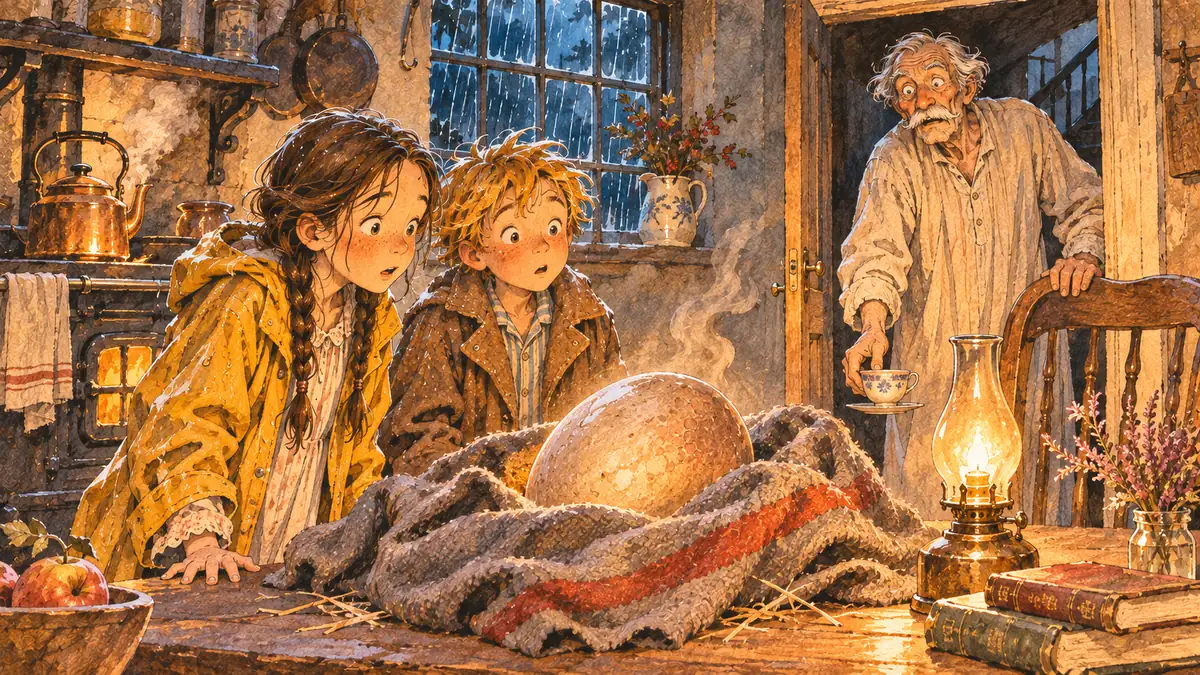
It was round and smooth and about the size of a pumpkin, the grey-brown colour of a river pebble, and there was not a crack or a scratch on it anywhere. Steam rose off it gently in the cold air. When Josie touched it, it was warm all the way through, warm as a loaf just out of the oven.
"It's a stone," she said.
"It knocked," said Toby.
"Stones don't knock."
Toby put his ear against it, as if he were listening to a shell for the sea. He knelt there with his eyes shut and his hair dripping onto the blanket.
Knock. Knock. Knock.
He felt it through his cheek, small and steady, like a heartbeat.
Toby opened his eyes. He curled his hand into a fist and knocked on the stone with one knuckle. Once. Twice. Three times.
The rain went on. Josie did not breathe.
From inside the stone came three knocks back.
"It answered," said Toby. His voice had gone very small. "It answered me."
"Toby," said Josie. "Come away from it."
"It knocked back to me. Not to you. Me." He put both arms round the stone, blanket and all, and held on.
Knock-knock-knock-knock-knock. Fast now, not in threes, over and over, like someone hammering on a door to be let out.
Above them, something creaked.
It was a long, slow creak, like a rope pulling tight. Josie looked up. One of the rafters that had held up the roof was hanging by a single peg, and as she looked the peg slid out of its hole.
She did not think. She took hold of Toby by the collar of Grandpa's coat and pulled. Toby came backwards across the floor on his bottom with the bundle clutched to his chest, and the rafter came down where he had been kneeling. It hit the boards with a crash that shook the whole loft. Splinters flew. The lantern jumped on its beam and swung, and the shadows swung with it, and for a moment there was nothing but the noise of the rain and the two of them breathing.
The rafter lay across the place where the bundle had been. It was as thick as Josie's waist.
"Right," said Josie. Her voice came out higher than she meant it to. "Right. We're going in. Now."
Toby did not argue.
Getting the bundle down the ladder took both of them and a great deal of whispering. In the end Josie went first, backwards, and Toby knelt at the top and lowered the stone to her in the blanket like a baby in a sling. She took the weight on her shoulder and nearly went over. Toby came down after her with the lantern. Between them, with the blanket tied in a knot at the top so they could each hold a corner, they carried it out of the barn and across the yard.
Gertrude met them halfway. She came out of the dark with her wings half open and her neck low, the way she came at the postman, and she hissed at the bundle. It was a long, furious hiss. Then she stopped, and put her head on one side, and looked at the bundle with one eye.
"Go away, Gertrude," said Toby.
Gertrude followed them all the way to the kitchen door, honking.
They got inside. They shut the door on the goose and the rain. They carried the bundle across the kitchen, dripping on the flagstones, and set it down on the big table in a puddle of its own. Toby untied the knot. The blanket fell open. The stone sat in the middle of it, steaming gently, as if it had always lived on the kitchen table and was waiting for breakfast.
Only then did Josie notice that the kitchen was not dark.
The lamp on the dresser was lit. The kettle was on the range, just beginning to sing. And Grandpa was standing in the doorway to the hall, in his nightshirt, with a cup of tea in his hand.
He was not looking at them. He was looking at the blanket. He looked at the grey wool and the red stripe and the red number in the corner, and his face did a thing Josie had never seen it do before. It went quite still, and then it went quite pale, and he stood like that for so long that the kettle began to whistle properly and nobody moved to take it off.
Grandpa bent and set his teacup down on the edge of the dresser. He did it so slowly that the cup made no sound at all when it touched the wood.
"Where," he said, "did you get that?"