Put It Back
At three o'clock in the morning Grandpa was still sitting at the kitchen table with both hands flat on the stone, as if it might roll away.
Josie and Toby sat across from him in towels. Each of them had a mug of cocoa they had made themselves. Grandpa had not moved since he sat down. The kettle had boiled dry and been taken off. The rain had stopped. Outside, Gertrude was walking up and down past the kitchen window, complaining.
"Tell me again," said Grandpa.
"It knocked," said Toby. "So I went out. It was in the wall. In the hayloft, the end wall, where the roof came down. It knocked three times and I knocked back and it knocked back to me."
"And the rafter came down," said Josie. "Right where he'd been."
Grandpa said nothing for a while.
"Put it back in the wall," he said.
Josie put down her cocoa. "The wall's fallen down."
"Then we'll build it up again."
"But it's warm," said Toby. "If you put it back, it'll go cold."
"Yes," said Grandpa. "That's the idea."
He took his hands off the stone, wrapped the grey blanket round it again with the red number on the inside, and stood up. His knee cracked. He picked up the lamp.
"Bed," he said. "We'll see to it in the morning."
In the morning he did not see to it.
Josie came down at seven and found the stone exactly where they had left it, on the kitchen table, in its blanket. Grandpa was already out in the yard. She watched him through the window. He went into the broken barn and stayed there a long time. When he came out, he did not go to the cows. He stood in the middle of the yard with his hands in his pockets, and Gertrude stood beside him, and the two of them looked at the hill.
When he came in for breakfast, he sat down, and buttered his toast, and did not eat it.
"Keep it warm," he said.
Josie stopped with the teapot in the air. "You said put it back."
"I've changed my mind. Keep it warm. Warm, mind. Not hot. Not in the oven, not on the range. Warm as a hen would keep it." He pointed his knife at both of them. "And tell nobody. Not Mrs. Figg. Not the blacksmith. Not your mother on the telephone."
"Is it an egg?" said Toby.
Grandpa put down the knife.
"It's a stone that knocks," he said, and went out to the cows.
After breakfast Josie went back to the barn by herself. In daylight it looked worse. The roof lay across half the floor like a fallen tent, and the rafter that had come down in the night had split a floorboard clean in two. She climbed the ladder slowly, testing every rung, and walked along the strong side of the loft to the hole in the end wall.
The shelf inside was empty now. The stones they had pulled out lay in a heap. Josie looked at the smooth mortar round the edge of the hole, the part that had been pressed flat by somebody's hand. Something small and bright was pushed into it, just at the top, like a seal on a letter.
She picked at it with her fingernail. It came out with a little shower of grit.
It was a thimble. Silver, worn thin at the top, with a pattern of tiny forget-me-nots round the rim.
She took it to Grandpa in the cowshed. He was milking, with his cheek against the cow's side. She held it out on her palm.
"It's a thimble," she said. "It was in the wall. Somebody pushed it into the mortar."
Grandpa looked at it. He went on milking for a while. The milk rang in the pail.
"Your grandmother's," he said.
That was all he said. After a minute Josie closed her hand round the thimble and went back to the house.
"Right," said Josie. "Here's the plan."
She had the hatbox from the top of Grandma's wardrobe. It was round and deep and covered in faded striped paper. She had Grandma's brown knitted cardigan, which still smelled faintly of peppermints. She had six bricks from the pile behind the woodshed, and the kitchen range, and Toby.
"One," said Josie, holding up a finger. "The cardigan goes in the bottom of the box, folded double. Two. Two bricks go in the box under the cardigan, and the other four sit in the oven door getting warm. Three. Every hour we swap them, cold ones out, warm ones in, so it stays the same all the time. Not hot. Warm as a hen."
"What about at night?" said Toby.
"Four. At night we take turns."
"You said three."
"I've got four now."
Toby was not listening. He was sitting at the end of the table with a blue exercise book that was meant for spelling. He had crossed out SPELLING on the cover. Underneath he had written THE BOOK OF, and then stopped. He did not know yet what came next.
He opened it to the first page and licked his pencil.
"Fact," Toby said, writing it as he said it. "It knocks."
They lifted the stone into the hatbox together, blanket and all, and laid the warm bricks underneath the cardigan, and put the box on the dresser at the warm end of the kitchen, near the range. Josie put the lid on. Then she took it off again and left it a finger's width open, so the stone could breathe, if stones breathed.
They stood and looked at it.
From inside the hatbox, very faintly, came a sound like a bee in a jar.
"It's humming," said Toby.
"Stones don't hum," said Josie.
The hatbox went on humming.
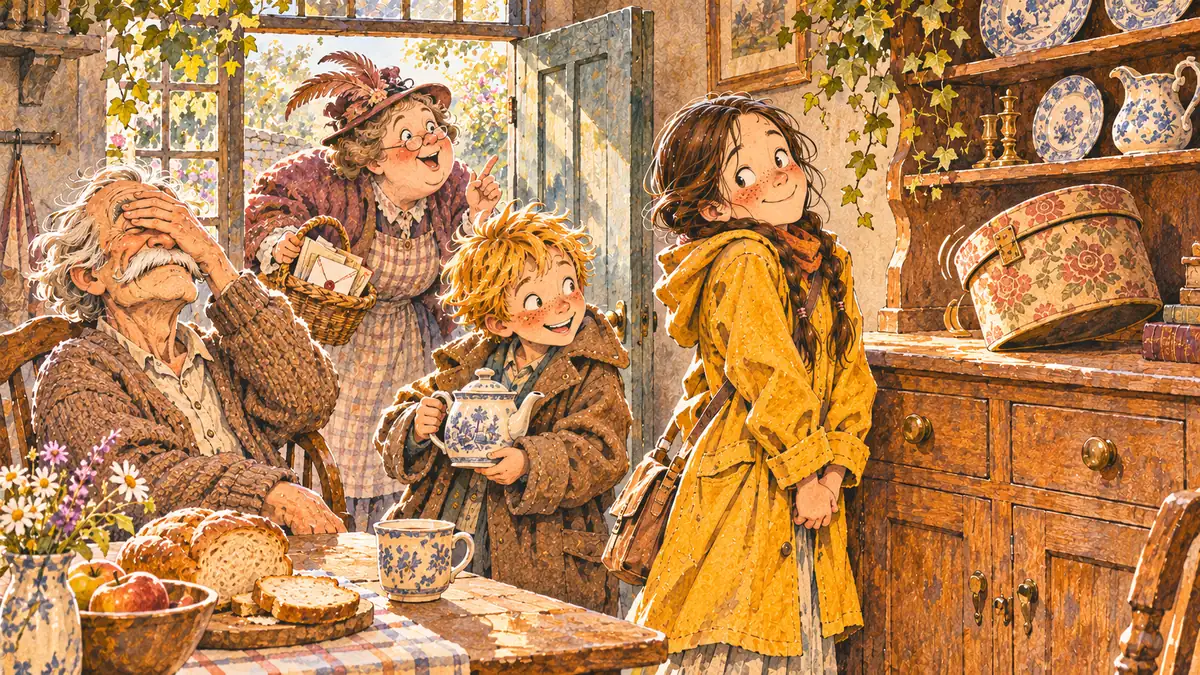
Mrs. Figg came the next morning.
She came on her bicycle, which had a basket on the front and a bell she rang all the way up the lane. Mrs. Figg ran the post office and the shop, which were the same room, and she brought the post up to the farms herself, and she read all of it on the way.
She came straight into the kitchen without knocking. She smelled very strongly of lavender water.
"Parcel for your grandfather," said Mrs. Figg. She read the label aloud. "Mister W. Tuttle, Top Farm, Thistlecombe. From the seed merchants in Greyford." She turned it over and read the postmark. "Posted Tuesday. Took its time. Is he in?"
"He's with the cows," said Josie.
"I'll leave it, then." Mrs. Figg put the parcel on the table. She did not leave. She looked round the kitchen like a hen inspecting a yard, at the dishes and the range and the two damp raincoats on the hooks. "Terrible thing about the barn. I said to the blacksmith, I said, that'll be the Tuttles' barn, you mark my words. Was anyone hurt?"
"No," said Josie.
"Well, that's a mercy." Mrs. Figg's eyes went to the dresser, and to the hatbox on it, and stopped there.
The hatbox was hissing.
It was a low, steady hiss, like a cat behind a sofa. It had started the moment Mrs. Figg came through the door. Josie had heard it begin, and so had Toby, and now so had Mrs. Figg.
"Your hatbox," said Mrs. Figg, "is hissing."
Josie went very calm. Her voice came out polite and clear, the way it did when a teacher asked who had broken a window.
"It's the bricks, Mrs. Figg," she said. "We're airing Grandma's hats. There's a hot brick in with them, for the damp, and it hisses when it cools."
Mrs. Figg looked at the hatbox. The hatbox hissed.
"I never heard of a brick that hissed," she said.
"They do when they're wet," said Josie. "From the storm."
Toby was looking hard at the ceiling. Mrs. Figg picked up her bicycle clips from the table.
"I'm only saying," said Mrs. Figg, and went.
They listened to her bell going away down the lane. When it had gone, the hatbox stopped hissing. A moment later it began, softly, to hum again.
"It doesn't like her," said Toby.
"It's a stone. It doesn't like anybody."
"It doesn't like how she smells." Toby wrinkled his nose. "She smells of lavender. Like the soap at the dentist's."
He opened the blue exercise book and wrote that down too, but he did not put Fact in front of it.
On Sunday at four o'clock, when Mum always rang, they walked down to the post office.
The telephone lived on the wall behind Mrs. Figg's counter, between the jars of peppermints and the stamp drawer. When it rang, Mrs. Figg answered it in a voice she did not use for anything else, then held it out over the counter to Josie and did not go away.
"Josie?" said Mum, very small and crackly, from the hospital. "Are you being good?"
"Everything's fine," Josie said.
"The baby's feeding better. The doctor's pleased. She's still very little." The line crackled. When Mum's voice came back it sounded tired. "But she's getting stronger. They say perhaps the end of the summer. Josie? Are you there?"
"Everything's fine here," said Josie. "Here's Toby."
She held the trumpet out to Toby before Mum could say anything more.
Toby took it in both hands. "The barn fell down," he said.
There was a pause. Then a great deal of crackling. Mrs. Figg leaned across the counter to listen.
"Nobody was in it," said Toby. "Josie pulled me out."
Josie took the telephone back and spent the next three minutes explaining. Then Mum's coins ran out at the hospital end, the line clicked and went dead, and Josie hung it back on its hook. Mrs. Figg was still leaning on the counter.
"Pulled him out of what?" said Mrs. Figg.
"Out of bed," said Josie. "Good afternoon, Mrs. Figg."
That night it was Josie's turn to change the bricks at midnight. She came downstairs in her socks and found all four spare bricks stone cold in a row on the hearth, where Toby had left them instead of putting them back in the oven door. She went to look for the stone hot-water bottle in the back kitchen, where Grandpa kept things he never used.
There was no hot-water bottle in the back kitchen. There was a tin bath, and a broken chair, and under the window a long wooden chest with brass corners. It was not locked. Josie lifted the lid.
Inside, under a folded red coat that smelled of mothballs, lay a small cardboard box. In the box was a medal on a striped ribbon. It was round and dark, with a king's head on one side.
Josie turned it over. On the back, in tiny stamped numbers, it said 1142.
"Eleven forty-two," she said aloud, to nobody. "Same as the blanket." She looked at the red coat. "It's Grandpa's number."
She stood in the back kitchen holding it. Then she heard something from the kitchen.
Someone was whistling.
It was a marching tune, very quiet. Four quick notes going up, and one long note coming down. Then the same again. Josie put the medal back under the red coat, closed the lid, and went to the doorway in her socks.
Grandpa was sitting by the range in his nightshirt, on the low chair, with the hatbox on his knees. He had the lid off. He was looking down into it and whistling, very softly, as if to a dog a long way off.
And from inside the hatbox, in the dark of the kitchen, the stone hummed it back, not quite in tune.
"There you are, then," Grandpa whispered. "You remember."
Josie did not move. After a while she crept back up to bed and lay and looked at the ceiling. She did not know what time it was when she heard Grandpa come up.
At supper the next evening, Grandpa did not say anything about the medal or the tune, and neither did Josie. He ate his stew. Halfway through, he stopped, and put down his spoon, and rubbed his left knee with the heel of his hand.
"Thunder tonight," said Grandpa.
Toby looked out of the window. The sky over the hill was the colour of old custard, and the air in the kitchen had gone thick and still.
"How do you know?" said Toby.
"Knee knows," said Grandpa.
On the dresser, all by itself, the hatbox rocked.