Nettlebury Fair
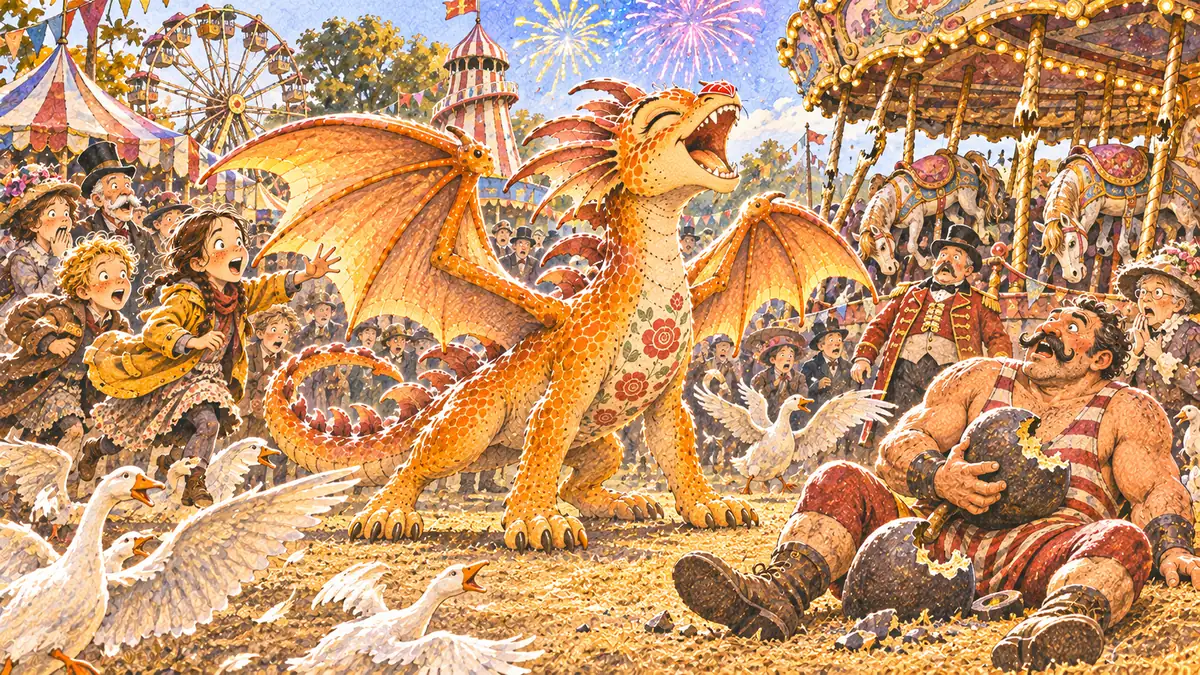
Nettlebury Fair filled the whole of the long meadow below the town. There was bunting strung between the trees, red and white and blue. There were striped tents and stalls selling toffee apples and hot pies and ribbons, and a coconut stall, and a carousel with painted wooden horses going round and round to the wheezing music of a steam organ. There were hundreds of people.
And in the middle of it all, on a wooden platform with a sign that said THE MIGHTY BARTHOLOMEW, a strongman with a moustache like a broom was lifting a great iron weight over his head.
It was a bar with a black iron ball on each end, each ball as big as a man's head. The strongman held it up high with both arms shaking. The crowd clapped. The strongman smiled.
Then the crowd stopped clapping. Something was coming through it, low and fast, with a grey blanket flapping from one back leg.
People jumped out of the way. A woman dropped her toffee apple. A man shouted, "Mind the calf!" Biscuit went between a hundred legs like a dog through long grass, took the steps of the platform in one bound, stood up on her back legs in front of the Mighty Bartholomew, and bit the iron ball off the left end of his weight.
The strongman's arms tipped sideways. He staggered. Before he could get his balance, Biscuit bit the ball off the right end too.
The Mighty Bartholomew stood on his platform, holding a bare iron bar over his head, while a calf-sized dragon sat at his feet with its cheeks bulging.
"Biscuit!" shouted Josie, pushing through the crowd.
Biscuit swallowed. She looked at the bar. She took that too, out of the strongman's hands, and ate it from one end like a stick of candy.
Josie and Toby and Grandpa had come up the towpath and over a stile and into the bottom of the fairground, all three of them out of breath. Now they could not get near. The crowd round the strongman's platform had become a ring, and everyone in it was talking at once.
"It's a costume," said someone. "It's a calf costume. There's two men in it."
"Calves don't have wings," said somebody else.
"Costume ones might."
Biscuit jumped down off the platform and went straight for the carousel.
The carousel was still going round. Its wooden horses went up and down on twisted iron poles, with children on their backs. Biscuit ran alongside it and, as each horse came by, she bit a mouthful out of its pole. The horses did not fall off. They sagged, one after another, slowly, until they were going round tilted sideways with their noses almost on the floor, and the children riding them slid gently down their necks and sat there holding on to the ears, too surprised to cry.
"Grandpa!" said Toby. "Do something!"
"I'm seventy-nine," said Grandpa, who was holding his knee. "You do something."
By now the crowd had stopped laughing. The carousel man came out of his booth with a coil of rope. Two farm boys ran up with an empty sack held open between them. The Mighty Bartholomew climbed down off his platform, rolling up his sleeves, and the three of them began to close in on the dragon from three sides.
Toby ducked round the outside of the crowd and came out on the far side of the carousel just as Biscuit finished the last pole and turned to find herself cornered: rope on one side, sack on the other, and the strongman in front.
Behind her was a long low pen of wooden fencing, with a painted sign on it: GOOSE RACE, 3 O'CLOCK, ALL WELCOME. Inside the pen, packed tight, were fifty geese.
"Biscuit," said Toby. "No. Not that way. Come here."
Biscuit backed away from the strongman, step by step. Her tail swung. It knocked against the fence of the goose pen, and two panels fell flat.
Fifty geese came out.
They came out all at once, in a white wave, with their wings open and their necks out, and every one of them was honking.
Biscuit turned round and saw them.
Josie had seen her afraid of Gertrude. That was one goose. This was fifty. Biscuit's ears went flat against her head. Smoke poured out of her nostrils. She tried to run, and the crowd was in the way, and the geese were coming, and there was nowhere to go.
So she went up.
She opened her wings and beat them, hard and clumsy and fast, and her feet left the ground. It was not like the glide down the Seven Steps. It was ugly and frantic and nearly upside down. She went up over the heads of the crowd, flapping wildly, with the grey blanket still caught round her back leg and streaming out behind her. People ducked. Hats blew off. She cleared the coconut stall by inches and a toffee stall by less, and came down with a crash on the roof of the bandstand in the middle of the meadow.
The bandstand was round, with a pointed roof and an iron railing all the way round the top. Biscuit clung to the railing with all four feet and her wings spread, panting. Below her, in a ring round the bandstand, fifty geese stood and honked up at her.
Then she sneezed.
Underneath the bandstand roof, on the floor of the bandstand, the men from the town council had spent all morning setting out the fireworks for that night. There were rockets in rows, and Roman candles in buckets of sand, and Catherine wheels nailed to the posts. They were meant to go off at nine o'clock.
The sparks from Biscuit's sneeze went down through a gap in the roof boards.
There was a pause, just long enough for a man in a council hat to say, "Here, what's that smell?"
Then the fireworks went off. All of them. At four o'clock in the afternoon.
Rockets went up from all sides of the bandstand at once, screaming, and burst overhead in red and green and gold. Catherine wheels whirled round on the posts, throwing out sparks. Roman candles went pop, pop, pop, sending up balls of coloured fire. The geese scattered in every direction. The crowd screamed, and laughed, and screamed again. And in the middle of it all, on the roof of the bandstand, with rockets bursting round her head and the light of them flashing on her scales, Biscuit stood up.
She lifted her head, and she roared.
Nobody in that meadow had ever heard anything like it. It was not loud the way a shout is loud. It was deep. It was so deep that people did not hear it so much as feel it, in their feet and their chests and their teeth. Every piece of iron on the fairground began to hum with it: the railings of the bandstand, the bars of the toffee stall, the shoes on the horses tied up by the gate. The steam organ gave a long sick wheeze and stopped.
And over on his platform, holding nothing at all, the Mighty Bartholomew sat down in the sawdust.
The roar went on. It went on long past the last rocket. Josie stood in the crowd with her hands pressed over her ears, staring up at the bandstand, and for the length of that roar the thing on the roof was not Biscuit. It was something old and enormous, from a long time ago, and it did not belong to anybody.
Then the roar stopped.
Biscuit hiccupped. A small round puff of smoke came out of her nose. She looked down at the crowd, and the geese, and the smoking bandstand, and all at once she was a calf-sized dragon clinging to a railing, shaking, very much wanting to come down.
Somebody was standing at the bottom of the bandstand steps.
He had a long brown coat with a great many pockets, and he was holding a net. It was a big throwing net on a short handle. He had it ready. Biscuit was right above him, on the edge of the roof, close enough to touch, and she was looking at the crowd and not at him.
It was Moss.
Josie saw him. She saw him look up at Biscuit, and feel the weight of the net in his hand, and swing it back.
He did not throw it.
He stood there with the net hanging from his hand, looking up at the dragon, for what seemed to Josie a very long time. Then he lowered it, and stepped back into the crowd, and was gone.
Josie pushed through to the bottom of the bandstand steps and looked up at the roof.
"Biscuit," she called. Her voice came out small in all the noise. Biscuit did not hear.
So Josie whistled.
She had never whistled it before. She did not even know she knew it. Grandpa's tune. She whistled it again, louder.
Biscuit's head came round. Her ears came up. She hummed it back, very softly, the same tune. Then she let go of the railing and slithered down the slope of the roof, and dropped onto the bandstand steps, and came down them on her stomach, and pushed her head under Josie's arm.
The blanket slid off her back leg on the top step and stayed there.
Grandpa was there now, with his red coat off, and he threw it over Biscuit's back and wings. "Canal," he said. "Now. Walk, don't run. Walk as if she's a calf."
They walked. Through the crowd, still staring at the sky. Past the carousel, with its horses all leaning sideways. Past the strongman, who was still sitting down. Out through a gap in the hedge at the bottom of the meadow and onto the towpath, where the Plum Duff had come up level with the fair and Captain Lumb was waiting at the tiller with the rope already in her hand.
They were halfway down the towpath when Toby stopped.
"The blanket," he said.
"Leave it," said Josie.
"It's Grandpa's. It's got the number on it." Toby was already running back. "It's hers. She can't sleep without it."
"Toby!"
Toby got back to the fair gate just as the carriage arrived.
It was a small, shiny carriage, painted lavender, with a lavender-coloured horse that was really grey but had been brushed until it looked silver. It stopped at the fair gate. A footman got down from the back and opened the door. And out stepped a gentleman in a pale lavender coat and very white gloves, with a silk handkerchief held to his nose.
He did not look at the crowd, or the smoke going up from the bandstand, or the geese. He walked straight across the trampled grass to the bandstand steps without asking anyone the way, and looked down at the grey blanket lying on the top step.
He did not pick it up with his hands. The footman handed him a pair of long silver sugar tongs, and with them he lifted one corner of the blanket and turned it over, so that the stitching in the corner showed.
Toby was standing ten feet away, behind the coconut stall. He could hear every word.
"Eleven forty-two," said the gentleman softly. He held the corner up close to his handkerchief and read the faded words under the number, moving his lips. Then he smiled.
"So that's who it was," he said.
The footman held out a flat wooden box lined with velvet. The gentleman laid the blanket in it, using only the tongs, folded it once, and closed the lid. The footman snapped the catch shut.
Then he looked up.
He looked straight past the coconut stall, straight at Toby, as if he had known all along exactly where Toby was standing. His eyes were pale, and quite friendly, and they did not blink.
"Hello, small one," said Lord Harrowgate.
Toby ran.