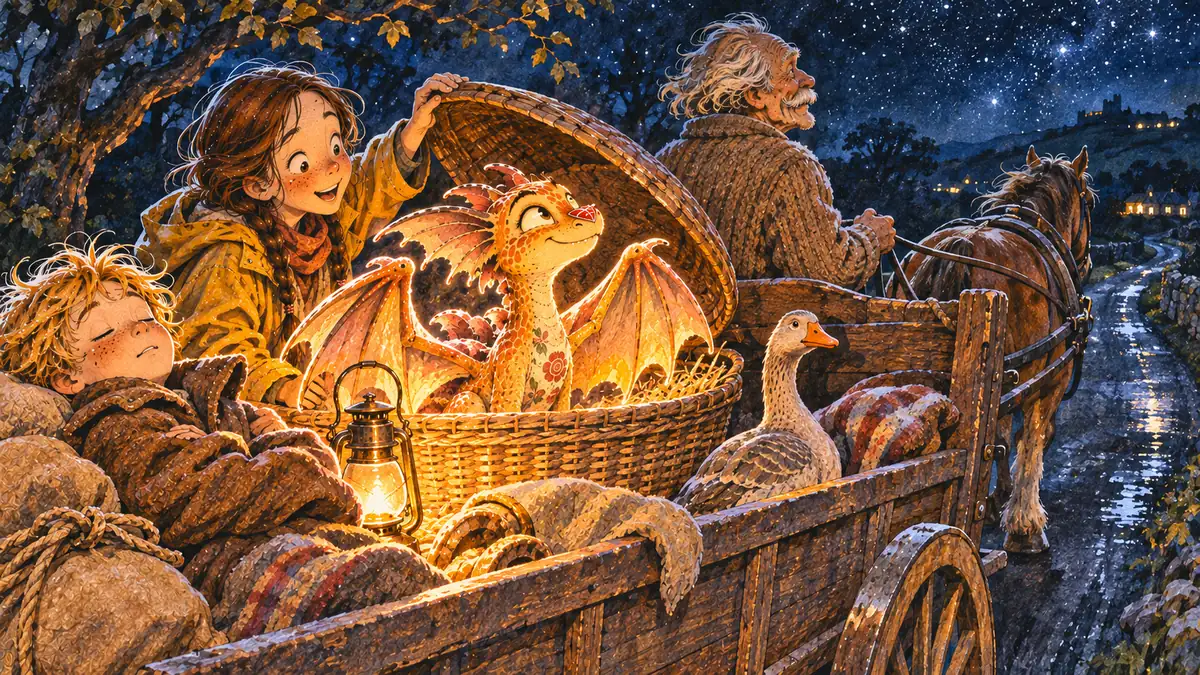
The Long Road North
They left at midnight, in Grandpa's cart, with the old mare between the shafts and the laundry basket under a heap of hay in the back.
Gertrude saw them off. She stood in the middle of the yard in the dark and honked at the cart all the way out of the gate, and down the first bend of the lane, and round the second. When they could no longer see her they could still hear her.
"Who's going to feed her?" said Toby.
"The cowman from the bottom farm," said Grandpa. "I left him a note and the key." He shook the reins. "Gertrude will be fine. Gertrude has never been anything but fine."
The cart creaked. The mare's hooves went clop, clop on the stones. Toby and Josie sat in the back on either side of the laundry basket, with their feet in the hay and their coats buttoned to the chin. Inside the basket, under the grey army blanket, Biscuit was asleep. Every few minutes the lid lifted slightly and settled again as she breathed.
They went down through the village without a light. Every house was dark, even the forge. Nobody looked out. At the bottom of the street Grandpa turned the mare onto the high road, and the village fell away behind them.
"Where are we going?" said Josie.
"The canal, first," said Grandpa.
"And then?"
"And then north."
"North where?"
"North," said Grandpa, and shook the reins.
The high road ran between dark fields. There was no moon. After an hour Toby stopped looking at the stars and started looking at the basket.
"She ought to have a disguise," he said.
"She's under the hay," said Josie.
"Under the hay is hiding. That's different. If someone stops us and looks in the back, they'll find a basket, and then they'll look in the basket, and then they'll find a dragon." Toby sat up. "But if she was dressed up as something, they'd look right at her and think she was something else."
"Like what?"
"A goat," said Toby. "She's about the size of a goat. We could give her a beard. Out of string. And some horns. Out of twigs."
Josie looked at him.
"No," she said.
"Why not?"
"Because she'd eat the string and set fire to the twigs. And goats don't breathe smoke."
"They might," said Toby. "You don't know every goat."
"No goats," said Grandpa from the front, without turning round.
Toby lay back in the hay and folded his arms.
The basket had begun to rustle. Biscuit did not like the jolting of the cart, and every few minutes the lid shifted and a cross little grumble came out from under it. Grandpa began to whistle his old marching tune, very quietly, over his shoulder. Over and over. The grumbling stopped. The basket went still.
Josie lay with her head on her arm and listened, and after a while, without meaning to, she was humming it too, under her breath, in time with the hooves.
Once in the night another cart came the other way: a man on a big farm wagon, half asleep, who slowed down to call across.
"Late to be out, Walter!"
"Early," said Grandpa. "Market."
"Which market's this, then?"
The basket hiccupped. A small round cloud of grey smoke came up through the hay and drifted across the road between the two carts, where everybody could see it in the light of the wagon's lamp.
Josie put her elbow on the basket lid and leaned on it.
"Pipe," said Grandpa calmly. He took his own pipe out of his top pocket, empty and cold, and put it in his mouth. "Can't drive without it."
The man on the wagon looked at the pipe. He looked at the little cloud of smoke floating away over the hedge. Then he yawned, and lifted his whip, and drove on.
Grandpa took the pipe out of his mouth and put it back in his pocket. It had not been lit in twenty years.
It was some time after that, near the end of the night, that Toby heard the other sound.
It came from behind them. It came from the hedge on the left side of the road, keeping pace with the cart. It was a small sound, soft and quick, like someone chuckling with their mouth shut.
Dook-dook-dook.
Toby sat up. "Josie," he whispered.
She had heard it too. They both turned and looked back along the empty white road.
Dook-dook-dook.
"It's the ferret," said Toby. "Zip. Moss's ferret."
"Then where's Moss?" said Josie.
The sound came once more, further back. Then it stopped.
"Grandpa," said Josie. "Something's following us."
"I know," said Grandpa. "It's been following us since the village." He flicked the reins, and the old mare picked up her feet a little faster. "Nothing to be done about that tonight."
At some point Josie fell asleep against the side of the cart, and when she woke up the sky was going pale and the cart was making a new noise.
It was a grinding, scraping noise, and it came from underneath them, and it was getting worse. The cart had begun to lean to one side. Grandpa was looking back over his shoulder with a frown.
"What's that?" said Josie.
Toby was already leaning over the back of the cart, looking down at the wheels.
"Josie," he said. "The tyres have gone."
The back wheels of the cart were made of wood, with a rim of iron round the outside to keep them from wearing away on the road. At least, they had been. The iron rim on the left-hand wheel was gone. Most of the iron rim on the right-hand wheel was gone too. What was left of it stuck out from the wood in a jagged curl. As they watched, a small biscuit-coloured head came out between the boards at the back of the cart, leaned down, took the end of the curl in its teeth, and pulled. The iron came away from the wheel with a long squeak, like a nail coming out of a plank.
"Biscuit!" said Josie.
Biscuit looked up at her with the rim halfway into her mouth. Then she went on eating.
"How long has she been doing that?" said Grandpa.
"Don't know," said Toby. "All night, maybe."
The bare wooden wheels groaned. The cart lurched. Grandpa pulled the mare to a stop just as the left wheel gave a great crack and split down the middle, and the whole back of the cart settled slowly sideways into the mud of a grassy bank.
They sat in the tilted cart without moving.
Grandpa climbed down, looked at the wheel, and gave a short laugh.
"Well," said Grandpa. "She's got us here, at any rate."
Josie looked up from the wheel.
The grassy bank ran along beside a stretch of still green water, as straight as a ruler, with a path along the edge of it. It went away in both directions as far as she could see, through the fields and under a little stone bridge and on into the morning mist. It was a canal. And moored to the bank, not twenty yards away, with smoke coming out of a crooked chimney on its roof, was a boat.
It was the longest, thinnest boat Josie had ever seen. It was painted red and green, with yellow diamonds along the side and roses on the doors, and on the front, in curly white letters, it said PLUM DUFF. A big brown horse was grazing on the path beside it, still in her harness, tied by a long rope to the front of the boat. A brass plate on her collar said DUMPLING.
On the roof of the boat, on an upturned bucket, sat a very large woman in a man's jacket and a straw hat, drinking tea out of a tin mug. Her name was Dimity Lumb, and she was the captain of the Plum Duff, and Grandpa had bought cheese from her at market for thirty years.
She had watched them arrive. She had watched the wheel break. She had not got up.
"Morning, Walter," said Captain Lumb.
"Morning, Dimity," said Grandpa. "Are you going north?"
"Nettlebury by Friday," said Captain Lumb. "Cheese." She tipped her mug at the cart. "What've you got?"
"Two children," said Grandpa. "One old man. One basket."
The woman looked at the basket. The lid lifted, and Biscuit put her head out, and looked back at her, and swallowed the last of the wheel rim.
"I don't carry goats," said Captain Lumb.
"She isn't a goat," said Toby.
Captain Lumb looked at Biscuit for a while longer. A little curl of smoke came out of Biscuit's nose and drifted away over the canal. Captain Lumb poured herself a second cup of tea from a big brown pot beside her on the roof.
"Well," she said, "that's all right, then."
The Plum Duff was a narrowboat. Captain Lumb explained it while she helped Grandpa unload the cart.
"Canal's a road made of water," she said. "Flat and slow, all the way north. Horse walks on the path, that's the towpath, and pulls the boat on the rope. Nobody hurries on a canal." She looked at the broken cart. "Except you, by the look of it."
The inside of the boat was one long narrow room, like a corridor with a roof. At the back was a tiny cabin with a stove, two shelves for beds, and a table that folded down from the wall. The rest was the hold, and the hold was full of cheese: great round cheeses wrapped in cloth, stacked in rows, smelling strongly of cheese.
Grandpa gave a boy at the bridge farm a shilling to take the old mare home and send someone for the cart. Then they carried the laundry basket on board between them and set it down in the hold between two rows of cheeses, and Captain Lumb untied the rope.
"Walk on, Dumpling," she said to the big brown horse.
The horse leaned into its harness. The rope went tight. And the Plum Duff slid away from the bank so quietly that the ducks did not even move.
All that day they went north. The canal went through fields and woods and under little bridges where Josie could have touched the stone. Toby walked on the towpath beside Dumpling and asked Captain Lumb so many questions that in the afternoon she gave him a job, and his job was to say "Walk on, Dumpling" whenever the horse stopped to eat the hedge.
Biscuit stayed in the hold, in the basket, between the cheeses. She did not eat anything. She lay in the basket with her eyes half shut and her breath coming fast.
By evening she was hot. Not warm, as she always was. Hot. When Josie put a hand on her side, she pulled it back again.
"She's ill," said Josie.
"She's growing," said Grandpa. But he went down into the hold three times that night to look at her, and Josie heard him.
Josie did not sleep much either. She lay on the bottom shelf in the tiny cabin with Toby on the shelf above her, and listened to the water lapping on the side of the boat, and to the basket in the hold. All night it rustled and creaked. Twice Biscuit made a small, high sound that Josie had never heard her make before.
At first light Josie got up and went into the hold. The cheeses stood in their rows in the grey light. The basket lid was pushed half off.
She lifted it the rest of the way.
Biscuit was asleep, curled tight, too hot to touch. And on her back, where the two little stubs had been, there was something new, folded flat against her sides, wet and crumpled like a butterfly just out of its case. Josie reached out one finger and touched the edge of it. It was as thin as paper, and under her finger it gave a tiny twitch, and slowly, by itself, began to unfold.
A wing.
Two wings.