The Kilns
At the back of the first cave there was a second doorway, and beyond it, a passage going down into the dark.
Grandpa could not come. His knee had swollen up in the night like a loaf, and he sat against the wall with it propped on a rolled-up blanket, and Moss sat beside him whittling a new stick. But Grandpa gave Josie the lantern, and he gave Toby a box of matches, and he told them which way to go.
"Keep left," he said. "Always left. The deep ones are at the bottom. Don't go past the last one. There's nothing past the last one."
"How do you know?" said Toby.
"I looked," said Grandpa. "When I was nineteen."
So the two of them went down, with Biscuit between them.
The passage went down and down in a slow curve, like the inside of a shell. The walls were black and glassy and gave back the lantern light in a hundred little gleams, so that it seemed they were walking down a tunnel full of stars. The first cave had been warm all through, but the further down they went, the colder it got. Down here the mountain's heat had gone out long ago. Frost grew in white feathers on the walls.
The carvings went on all the way down, and Toby read them as they went, holding the lantern up to each one.
"The dragons are hungry," he said. "They're eating ploughs. And that's a bridge."
It was a long bridge, made of criss-crossing bars, across a river. There were dragons all over it, and the bridge was getting smaller from one picture to the next, until in the last picture there was only a river with two stone towers sticking up out of it, and no bridge at all.
"They ate a whole bridge," said Toby, with deep respect.
Then came soldiers with spears, marching up the mountain. Josie walked past them quickly.
The next was the biggest carving of all. It covered the whole of one curved wall of a room, from the floor to as high as the lantern could reach. And it was full of dragons.
They were all rising into the air together. Big ones and small ones, dozens and dozens of them, their wings spread, all going the same way, up and away across the top of the wall. And in front of them, leading them, in a long pointed line like the head of an arrow, flew a flock of birds.
"Geese," said Toby. "Those are geese."
Underneath the dragons, at the bottom of the wall, there was a smaller picture. It showed some little dragons cowering behind a rock with their heads down, while a few geese stood about near them. And beside that, the same little dragons, grown big, flying up to join the line.
Toby traced it with his finger.
"The little ones are scared of the geese," he said slowly. "Like Biscuit. But the big ones aren't. The big ones follow them." He moved the lantern up, along the long line of flying dragons, to the far end of the wall. There, the carving showed water, with waves, and beyond the water a row of islands. The beaches of the islands had been coloured in with something red that was still bright after all the years.
"The book at school says the King's soldiers drove them out," said Toby. "But they're not running. They're all going together." He turned round to Josie. "They weren't driven out. They chose to leave."
Josie said nothing. She was looking at a little dragon at the very bottom of the wall, hiding behind its rock.
"Do you think they're still there?" said Toby. "On the red islands?"
"No," said Josie. It came out too fast. "It was two hundred years ago, Toby. They'll all be gone by now. There's only her."
Toby looked at her, and then back at the islands, and said nothing.
They found the red stone in the next room down.
There was a hollow scooped into the floor at one side, like a nest, and in the bottom of the hollow, half buried in black grit, were stones. They were about the size of hen's eggs, rough, and a deep dark red, like old bricks. When Josie held the lantern close, a faint glow came out of the cracks in them, slowly brightening and fading, like a lamp turned very low.
Biscuit had smelled them before they did. She went past Josie and put her whole head down into the hollow.
"Wait," said Josie.
Biscuit did not wait. She took one of the red stones in her teeth, lifted her head, and crunched it.
For a moment nothing happened.
Then she began to change.
It started at her nose and went backwards down her body like a wave. The faint stripes from the rails she had eaten on the moor burned off. The dull brown of her scales went too. Underneath, coming up through them as if a lamp had been lit inside her, was a colour Josie had never seen on her before. Copper. Bright red copper, glowing from inside, the colour of a new penny held up to the fire.
And she was hot.
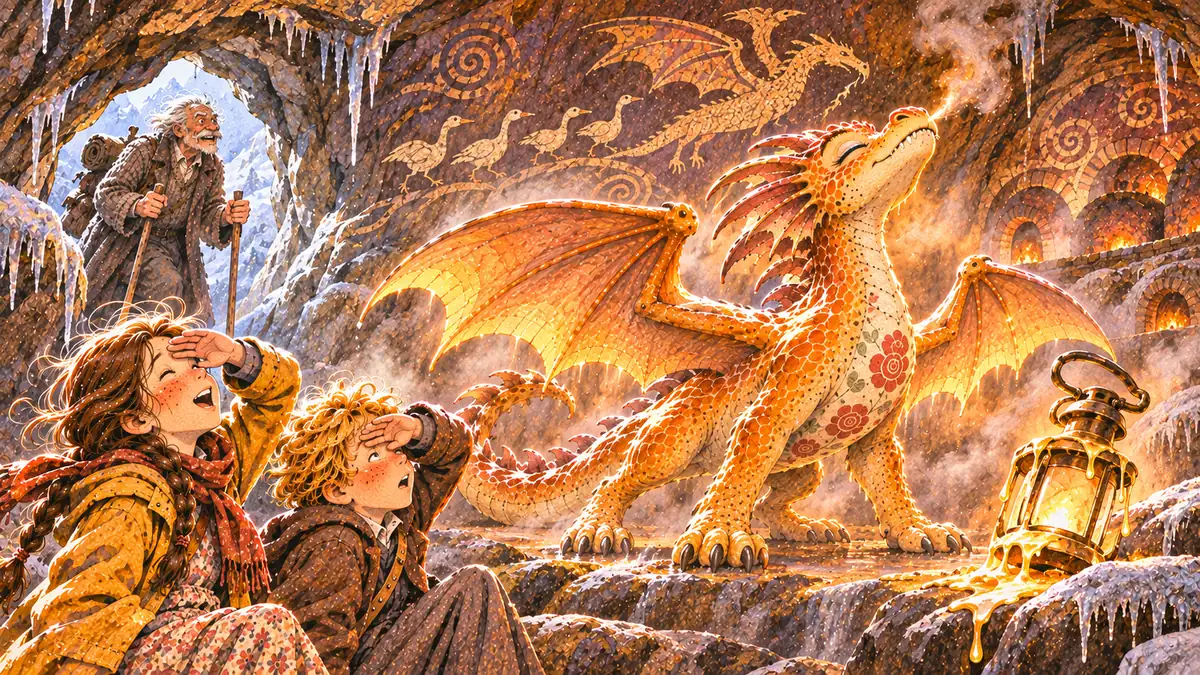
They felt it on their faces like the heat from an open oven. The frost that had been growing in feathers on the cold black walls of that deep room began to melt, and then to steam, so that the whole room filled with mist. The rock under Biscuit's chin, where she had laid her head down, glowed a dull dark red. And in the corner, lying on its side where somebody had dropped it a long time ago, there was an old brass miner's lamp. As Josie watched, it began to sag. It went soft at the top. It bent over slowly, like a candle left on a sunny windowsill, and dripped onto the floor.
"Toby," whispered Josie. "Look at the lamp."
Toby was not looking at the lamp. He was looking at Biscuit.
She stood in the steam with her head up and her wings half open and the glow coming out of her in waves, and Josie could not take her eyes off her.
It lasted for perhaps five seconds.
Then the glow went down. The copper faded. Slowly, as if they had only been waiting, the rail-stripes crept back along her sides, until she was her ordinary brown again, a little brighter than before. She sneezed. She looked at the children as if they were the ones behaving oddly.
On the floor, the brass lamp was a puddle, already going hard.
Toby let out his breath.
"Red stone," he said. "Like the mothers." He crouched down at the hollow and began to fill his coat pockets with the stones, as many as they would hold, until his coat hung down heavy on both sides. "We have to take some. For when she needs it."
Josie watched him do it. She did not help.
On the way back up, Toby found the scale.
It was in a small side-hollow, off the passage, that they had walked past on the way down. Toby only saw it because the lantern caught something red-gold on the floor. He went in to look.
The hollow was warm. Not warm like the rest of the mountain. Warm like a chair someone has just got up from.
And on the floor lay a scale. One single scale. It was shaped like Biscuit's scales, round at one end and pointed at the other. But it was red-gold all over, and it was as big as a tea tray.
Toby picked it up. It bent a little in his hands. It was not old and dry and stiff, like something that had lain in a cave for two hundred years. It was supple, like new leather, and it smelled of smoke.
He held it up so that Josie could see it in the lantern light.
"Somebody's been here," said Toby.
Josie reached out and touched the edge of it. It was warm under her fingers, as if it had only just come off. She took her hand back and put it in her pocket.
"Last night," said Toby. "I didn't tell you. At the mouth of the cave. Something went across the moon. Out over the sea. Something big, with wings."
Biscuit had come into the hollow behind them. She put her nose to the scale in Toby's hands and sniffed it, very carefully, all over. Then she lifted her head and looked north, at the black wall of the cave, as if she could see straight through it.
Toby carried the scale back up the passage in both hands, and when they reached the first cave he showed it to everybody: to Grandpa, who went very quiet, and to Moss, who whistled through his teeth. He did not hide it. He wrapped it in his scarf and put it in the bottom of his bag, on top of the blue book.
That night, when the fire was down to embers and the others were asleep, Josie lay awake.
She was thinking about the brass lamp gone soft like a candle in the sun, and about Biscuit standing in the steam, copper-red and blazing. And she was thinking about what Grandpa had said by the fire.
Toby was asleep on his back with his mouth open and his coat over him. The pockets of the coat were lumpy and heavy.
Josie sat up. She moved very quietly. She slid her hand into the first pocket and took out the red stones, one by one, and put them into the pocket of her own coat. Then the second pocket. Toby did not wake. When she had finished, his coat lay flat, and hers was heavy, and the stones in it were warm against her side.
She lay down again next to Biscuit, who was asleep in the middle of the floor, and put one arm round her neck.
She held one of the stones in her other hand, inside her pocket, warm in her fist, for the rest of the night.