Things Made of Iron
Gertrude got as far as the porch step. Biscuit woke up, rolled over onto her feet, and found herself nose to beak with a goose.
For a moment neither of them moved. Then Gertrude opened her wings wider than the porch, stretched out her neck and honked. Biscuit shot between Grandpa's boots, skidded across the hall, and was gone into the kitchen before the honk had finished.
When they got there, only her tail was showing. It hung down out of the kitchen chimney, swinging. The rest of her was somewhere up inside, out of reach, and Gertrude had followed them in and was standing on the hearth with her neck stretched up into the dark, honking, and every time she honked a little more soot came down like black snow.
"Get that bird out of my kitchen," said Grandpa.
It took both children and a broom. Gertrude went out backwards, hissing at the broom the whole way. Then Josie stood on a chair and Toby stood on the table, and they coaxed Biscuit down with a bent nail on a piece of string. She came down black from nose to tail, sneezed a shower of sparks into the empty grate, and ate the nail.
After that, Toby kept the blue book on the kitchen table and wrote in it every day.
He tried Biscuit with everything in the house, one thing at a time, and read each result out as he wrote it down.
"Bread. No. Cheese. No." He held out a penny. Biscuit sniffed it and turned her head away. "Copper. No." He held out a brass curtain ring. Biscuit took it into her mouth, held it there with a puzzled look, and spat it across the kitchen. It hit the dresser with a ping. "Brass," said Toby, writing. "Pah."
Iron was a different matter. Iron she ate.
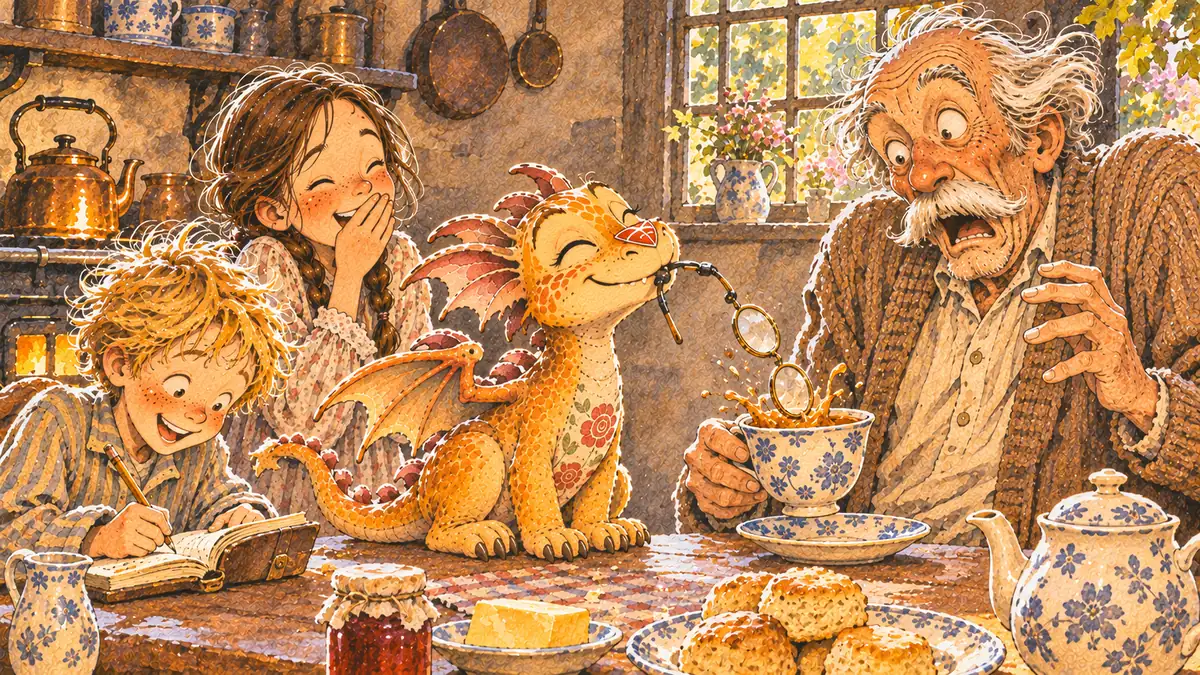
On the Wednesday, Grandpa was reading the newspaper aloud at breakfast, holding it at arm's length. Biscuit put her front feet on his knee and neatly bit both hinges off his spectacles. The lenses fell into his tea one after the other, plop, plop, in the middle of a sentence about the price of wool.
Grandpa looked at the dragon over the empty frames.
Biscuit got down off his knee, lay on the floor, and put her chin on the toe of his boot. She stayed there, looking up at him.
"Is that sorry?" said Grandpa.
"That's sorry," said Toby.
Grandpa fished his lenses out of his tea with a spoon. "Well," he said. "I suppose it'll have to do."
On the Thursday, Josie shut Biscuit in the larder.
It was only for a minute, while she swept up the last of the soot. She dropped the iron latch, leaned on the door, and picked up the broom.
Crunch.
The larder door swung open behind her. Biscuit was sitting in the doorway with her chin up and the latch going down inside her, looking very pleased with herself.
Josie shut her in the back kitchen instead.
Crunch. The back kitchen door swung open.
"Leave the doors open," said Grandpa from behind his newspaper. "It's cheaper."
She grew. Within a week she had outgrown the hatbox. Soon she was the size of a spaniel, and slept on the rag rug in front of the range under the grey army blanket. If anybody took the blanket off her, she growled.
When Toby threw corn for Gertrude in the yard, Biscuit pressed her nose against the kitchen window and watched, and when he came back in she sat on his feet and would not get off.
She sneezed sparks at the soap, and at the sun when it came in the window, and at Gertrude through the glass. But however much she ate, the sparks stayed sparks. Toby lit a candle and held it out and asked her to blow on it. She blew, and the candle went out.
"Will she ever breathe proper fire?" said Toby.
"Not on what she's getting," said Grandpa. "Fence nails and bucket handles. That's old iron. Rusty scrap. You'll get sparks out of scrap and nothing else."
"What would she need, then?"
"Better iron than that," said Grandpa. "New iron. And a great deal more of it than we've got." He went back to his newspaper, but he did not turn the page.
The one thing Biscuit could not do was go outside. Grandpa was firm about it. The yard could be seen from the lane, the lane went down to the village, and in the village lived Mrs. Figg.
"She's never been out properly," said Toby at bedtime. "Not in daylight. Not to look at anything."
"She ate the gate," said Josie.
"That was in the dark. She's never even seen the stars."
"She's a dragon, not an astronomer. Go to sleep."
The cold woke Josie.
The window was wide open, and the curtain was blowing in. Toby was sitting up in bed with his blanket round his shoulders. Biscuit had come up the stairs some time in the night and slept on the end of Toby's bed. Josie could see the dent she had left there, and the grey army blanket trailing off it onto the floor.
The dent was empty.
"Where is she?"
"The window blew open," said Toby.
"The window doesn't blow open. It's got a catch."
"It blew open," said Toby again, and looked at the floor. "She went out onto the back-kitchen roof. And then she jumped down. And then she went down the lane."
"You stay here," said Josie. "In case she comes back. Don't move."
She pulled on her raincoat and her boots and went out into the dark.
The lane down to Thistlecombe was a mile long and had no lamps. The hedges were black on both sides, and something in them kept rustling, and every time it rustled Josie stood still and whispered, "Biscuit. Biscuit."
Nothing came.
At the bottom, outside the church gate, the iron boot-scraper had gone. There was a neat bite-mark in the stone where it had been fixed.
Further along the street was the blacksmith's. The big doors of the forge were shut, but under them, where they did not quite meet the ground, came a dull red glow. And with the glow came a sound Josie knew: crunch, crunch, crunch, like someone eating toffee in the next room.
She lay down on her stomach and wriggled under the doors.
Inside it was warm and smelled of hot metal. In the middle of the forge, curled up in the warm ashes, was Biscuit. In front of her a wooden keg lay on its side, and all round the keg were horseshoes, dozens of them, new and shining. Biscuit was working her way through them one at a time, with her eyes half shut.
"Biscuit," whispered Josie. "Come here. Now."
Biscuit opened one eye. She ate another horseshoe.
Upstairs, a floorboard creaked.
A light came on above Josie's head, yellow through the cracks in the ceiling. Footsteps crossed the floor. Someone began to come down the stairs at the back of the forge, heavily, one step at a time.
"Who's there?" said the blacksmith's voice. "I've got a poker. I'm warning you."
Josie climbed onto the edge of the forge. The ashes were hot through her boots. She got both arms under Biscuit and lifted. Biscuit was heavier than she remembered, hot as a brick from the range, and full of horseshoes. She kicked and squirmed and blew smoke into Josie's face.
The lamp came round the bottom of the stairs.
Josie went the other way, behind the bellows, to the little back door where the coal came in. It had a latch. Biscuit put her head down and ate it. The door swung open, and Josie was through it and running before the blacksmith had found the bottom step.
She did not stop until she was halfway up the lane.
She did not go to bed. She sat on the rag rug in the kitchen with her back against the warm range and Biscuit in her lap, too heavy and too hot, and she held on with both arms.
"Nobody goes anywhere," said Josie, into the top of the dragon's head. "Do you hear me? Nobody."
Toby came down in his blanket and sat in the doorway. Josie did not look at him. After a while he fell asleep against the doorframe.
When the sky began to go grey, Josie took the notebook out of her raincoat pocket and turned to the list. Under Toby's name, on the empty line, she wrote BISCUIT in capitals. Then she ticked it.
At breakfast Biscuit sneezed.
It was not sparks. It was a single bright orange flash, like a match being struck, and it left a brown scorch mark the size of a coin on the tablecloth.
Everybody looked at the scorch mark.
"New iron," said Toby. "It's the new horseshoes."
Toby stood at the end of the table.
"It didn't blow open," he said. "The window. I opened it. I wanted to show her the stars."
Grandpa looked at him over the tops of his spectacle frames, which were mended now with string. "And did you?"
"For a minute," said Toby. "Then she went."
Josie buttered her toast. She buttered it right to the edges, very carefully, and ate it, and did not say one word. In the end Toby sat down.
"I saw your list," he said quietly. "You put her on it."
Mrs. Figg came up at eleven with the post.
There was no time to move Biscuit. She was asleep on the bench beside the range, a heap under Grandma's brown cardigan. Mrs. Figg came in without knocking, as she always did, put the letters down, and sat down to get her breath back.
She sat on the cardigan.
Josie stopped breathing. Toby dropped a spoon.
Mrs. Figg wriggled. "This is a very warm cushion," she said. "Lumpy, too. What have you got in it, Walter, hot-water bottles?"
"Something like that," said Grandpa.
Under Mrs. Figg, Biscuit did not move. A corner of the cardigan had slipped, and on the bit of flank that showed, faint and grey on the biscuit-coloured scales, were rows of tiny horseshoes, like spots on a pony. Josie took a tea towel off the rail and dropped it over them as if by accident.
"Every horseshoe in the smithy," said Mrs. Figg. "Every last one. And his back door with the latch chewed off. And the boot-scraper at the church."
A thin curl of smoke rose from under Mrs. Figg's skirt.
Grandpa got up and rattled the poker in the range. "Chimney's drawing badly," he said. "It's the damp."
"I've written to the newspaper," said Mrs. Figg, sniffing. "Somebody ought to know."
She got up at last, and went, and never looked back at the cushion.
The newspaper came to the post office from Greyford on the afternoon carrier's cart, and the next Saturday Mrs. Figg read it aloud to whoever was in the shop. That was the blacksmith, two farmers, the vicar's wife, and Josie, who had been sent down for candles.
Mrs. Figg read her own letter first, all of it. Then she turned the page.
"And what's this? There's a notice." She cleared her throat. "REWARD. Lord Harrowgate of Harrowgate Hall will pay one hundred gold crowns for any sign of a living dragon. Apply in writing to His Lordship's agent."
There was a silence. Then the blacksmith laughed, and after him everybody did. The vicar's wife had to hold on to the peppermint jars.
"Dragons," said the blacksmith. "There's been no dragons for two hundred years."
"His Lordship collects," said Mrs. Figg. "Things there's no more of. I took a parcel up to the Hall once, and the butler let me look. Glass cases, floor to ceiling, all down a long room, and half of them kept cold. Bert the iceman takes a cartload up there every morning at five, on his own since his boy went to sea. A stuffed bird with a crest like a feather duster. A bottle of lemonade nobody's allowed to open. And at the very end, the biggest case of all, polished like a mirror, with nothing in it. Nothing at all. Just a little brass plate on the front." She sniffed. "Living Specimen, it said."
Everybody laughed again.
Josie paid for the candles and walked home up the lane. All the way up, she could see it, as clearly as if it were standing in the hedge: a long glass case, clean and empty, with a brass plate on the front, waiting for something to be put inside.