The Seven Steps
On the third morning the canal came to the foot of a hill and climbed it.
It did it in seven great steps, one above the other, like a staircase built for giants. Each step was a lock: a long stone box of water with a pair of heavy black gates at the bottom and another pair at the top. White water poured over the top of every gate and down the face of it, so that the whole hillside roared. Beside the locks, a little stone channel ran down the hill, carrying spare water from the top to the bottom, frothing and jumping over its own small falls.
"The Seven Steps," said Captain Lumb. "Takes half a morning. Mind your fingers."
Biscuit had been in the hold since the wings came. They were still soft. She held them pressed flat against her sides most of the time, but every so often, when she thought nobody was watching, she opened them a little way and looked at them over her shoulder, first one and then the other, as if she was not sure they were hers.
"Stay down there," Josie told her, through the hatch. "There's people about. Stay down, and stay quiet."
Biscuit gave a long sigh through her nose and lay down between the cheeses.
There was a lock-keeper at the bottom of the hill, in a little white house with geraniums in the window. He was old and bent and had a great many opinions about boats, and he came out in his slippers to work the gates. Toby went with him.
"Every lock's a box," said the lock-keeper. "Boat goes in the bottom. You shut the gates behind her. Then you let water in from the top, and the box fills up, and the boat goes up with it, like a cork in a bucket. When she's level with the next bit, you open the top gates and out she goes."
"How do you let the water in?" said Toby.
The lock-keeper showed him. At the bottom of each gate, under the water, there was a little hidden door called a paddle. You could not see it. You opened it from the top of the gate, by fitting an iron handle onto a spindle and winding it round and round. The handle was shaped like a crank and was called a windlass, and the lock-keeper carried his in his belt.
"Wind her one way, the paddle opens. Wind her the other way, she shuts." He handed it to Toby. "Slow, mind. You open a paddle quick, and the water comes in like a bull through a gate."
Toby wound. It was heavy. The water in the lock began to boil and churn, and the Plum Duff rose up past the wet black stones, and Captain Lumb leaned on the long wooden tiller and talked to her boat the whole way up.
"Steady, old girl. Steady now. Up you come."
By the third lock Toby could do it on his own. By the fourth he was faster than the lock-keeper. At the fifth, while the water was filling, he walked over to read the notices pinned on the door of the lock-keeper's hut.
There were two. The first was the same one as in the newspaper, about Lord Harrowgate and his hundred gold crowns. The second was newer, on stiff white paper with a crest at the top, and it was nailed up with four bright tacks.
Toby read it aloud, slowly, the way he read things he wanted to remember.
"By order of the Royal Menagerie. Any animal that has died out everywhere else, if found, must be brought to the Royal Menagerie, where it will be kept safe. Signed, O. Pye, Keeper."
Josie had come up behind him.
"Died out everywhere else," said Toby. "Like dragons."
"Kept safe," said Josie. "In the Menagerie. In a cage."
"It doesn't say cage."
"It doesn't have to."
Toby took out the blue book and copied the notice into it word for word.
The top lock was the biggest. Its gates were taller than a house. Toby walked up to it with the windlass in his hand, ahead of the boat, and stopped.
Somebody was sitting on the top gate.
He sat on the broad wooden beam at the top of it, with his legs hanging down over the white water, and he was whittling a stick with a small knife.
"Now then," said Moss.
He looked very comfortable. He did not look like somebody who had walked thirty miles in three nights behind a cart and a boat. He looked like somebody who had always been sitting on that gate, and would go on sitting there until it suited him to stop.
Toby stood still.
The Plum Duff came nosing into the top lock behind him. The lock-keeper shut the bottom gates. Captain Lumb, at the tiller, looked up at the man on the top gate, and her face did not change at all.
"Morning, Captain," said Moss. "Morning, Walter."
Grandpa was on the towpath with the horse. He said nothing.
"I wondered," said Moss, "if I might step aboard. Just for a moment. Have a look at your cheeses."
"My cheeses are for Nettlebury," said Captain Lumb.
"Just a look." Moss folded his knife and put it away. He swung his legs over, stood up on the beam, and walked along the top of the gate to the side of the lock, as easily as walking down a lane. Then he stepped down onto the stone edge beside the boat, right next to the open hatch of the hold.
Josie was standing in the hatch. She did not move out of the way.
"Excuse me," said Moss.
"There's nothing down here," said Josie, "but cheese."
"Then you won't mind me looking."
He leaned towards the hatch.
Something came up out of the dark of the hold behind Josie. It came up fast. It was a long biscuit-coloured head on a neck that seemed much longer than it had been a week ago, and it stopped a hand's width from Moss's face. Its mouth was open. Every one of its small white teeth was showing, and between them came a sound like a saw going through a wet log.
Moss did not move.
Neither did Josie. She had never heard Biscuit make that sound. She had never seen her look like that, with her eyes gone small and hard as two gold nails. For a moment Biscuit did not look like a pet at all. She looked like something that could take the hand off a man.
"Easy," said Moss, very quietly. He did not step back. He did not step forward either.
Toby was standing on top of the gate above them with the windlass in his hand.
He fitted it onto the spindle of the paddle. He looked down at Moss standing on the narrow stone edge with his back to the water. He remembered what the lock-keeper had said about a bull through a gate.
He wound the paddle open as fast as he could.
The water came in like a bull through a gate. It burst up out of the bottom of the lock in a great boiling hump, and the Plum Duff bucked like a horse and swung her back end away from the wall. The edge of her roof caught Moss behind the knees. Moss sat down, very suddenly, on nothing, and went backwards into the lock with a tremendous splash.
"Toby!" shouted Josie.
Toby wound the paddle shut again, fast. The water settled. Moss came up gasping by the far wall and grabbed hold of a rusty chain that hung down the stonework. His hat was floating away. He was saying something that Josie was glad she could not hear.
Then he stopped saying it, and slapped at his coat.
"Zip," said Moss. "Where's Zip?"
The pocket on the lower left side of his coat hung open and empty.
Everyone looked at the water.
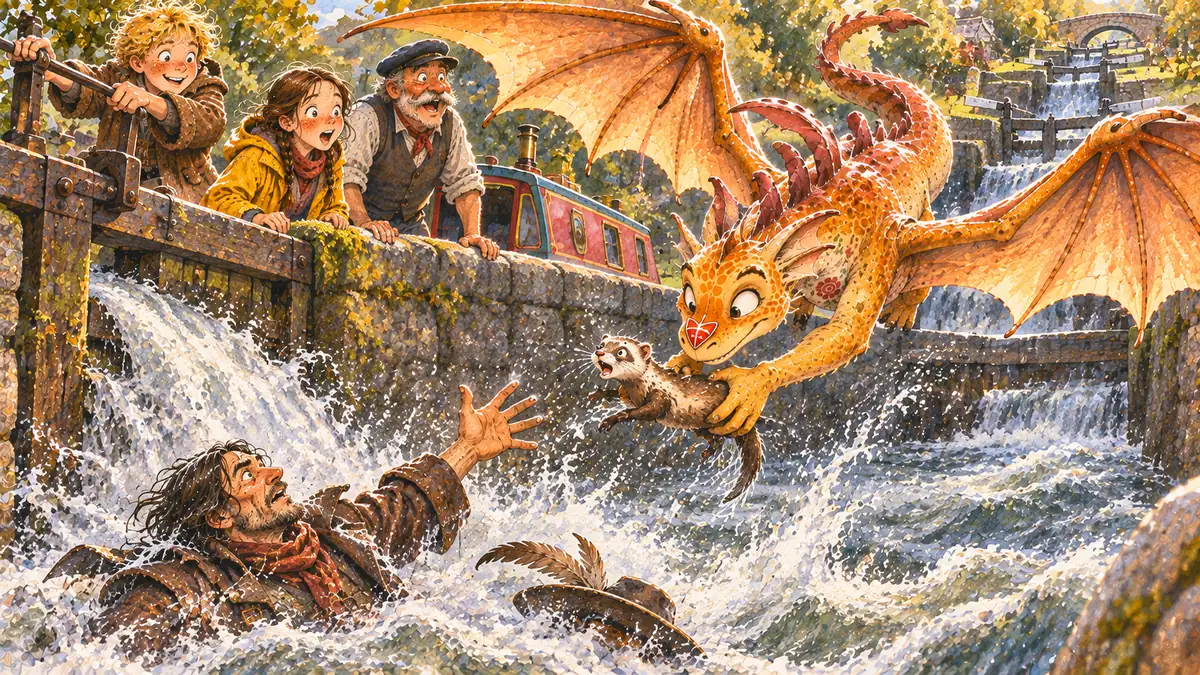
There was a small pale shape in it, near the top gate. It was spinning. The rush of water from the paddle had pulled it along the wall to the corner, where a hole in the stonework let the spare water out into the little stone channel that ran down the hill beside the locks. The pale shape went round once, twice, and was sucked into the hole.
Josie ran to the edge. On the other side, the channel went down the hill in a long white rush, leaping over its little falls, all the way to the bottom of the Seven Steps. Halfway down it, bobbing and rolling, went the ferret.
"He'll drown," said Toby.
Something pushed past Josie's legs.
Biscuit came up out of the hatch, scrambled onto the roof of the boat, and stood there for a moment on the very end of it, with her claws dug into the paint. She looked down the hill. Then she opened her wings. They were wider than Josie had thought. They had never been all the way open before. They were thin and brown and the light came through them, and the wind coming up the hill filled them like sails.
She jumped.
She did not fly. She fell, and then she stopped falling. She went down the hillside in one long slanting glide, low over the water, past the sixth lock and the fifth and the fourth, with her wings stiff and her legs stuck out in front of her. The lock-keeper dropped his pipe. At the bottom of the hill, where the little channel spilled into the wide water below the first lock, she came down with a great splash, put her head under, and came up again.
The ferret was in her mouth.
She was holding it the way a cat carries a kitten, by the scruff of the neck, so gently that it hung there quite still and looked surprised.
It took Biscuit a long time to walk back up. Her wings would carry her down a hill, but not up one. She came up the towpath beside the seven locks at a trot, dripping, with the ferret dangling from her jaws, and at the window of the white house with the geraniums, the lock-keeper's whole family stood with their mouths open.
At the top, Moss had climbed out of the lock on the far side, the side away from the boat. He was standing on the towpath with water running out of his sleeves.
Biscuit walked up to him and put the ferret down at his feet.
Zip shook himself. He looked up at Biscuit. Then he climbed up Moss's trouser leg and coat and into his pocket, and turned round, and put his head out to look at her again.
For a moment the dragon and the man looked at each other. Then she turned her back on him, walked across the gate and climbed onto the boat, and went down into the hold.
Moss did not follow her.
He stood on the far side of the lock while the top gates were opened and the Plum Duff slid out onto the high level of the canal, and he did not follow then either. When Josie looked back from the tiller, he was still standing there with his hands in his wet pockets, getting smaller.
Toby sat on the cabin roof with the blue book on his knees.
He wrote: "Fact. Moss is a baddie."
He looked at it for a while. Then he crossed it out.
They gave the lock-keeper back his windlass at the top. He took it, and looked at Toby, and looked down into the dark of the hold, and decided not to ask.
"You'll be going on to the junction, then," he said to Captain Lumb.
"Tomorrow," said Captain Lumb.
"Then you'll want to know. There's a lady at the junction tomorrow, all the way up from the capital. From the Menagerie. The Keeper herself, they say. She's stopping every boat that comes through, and looking in every hold." He tapped the new white notice on the door of his hut with one finger.
"With nets," said the lock-keeper.