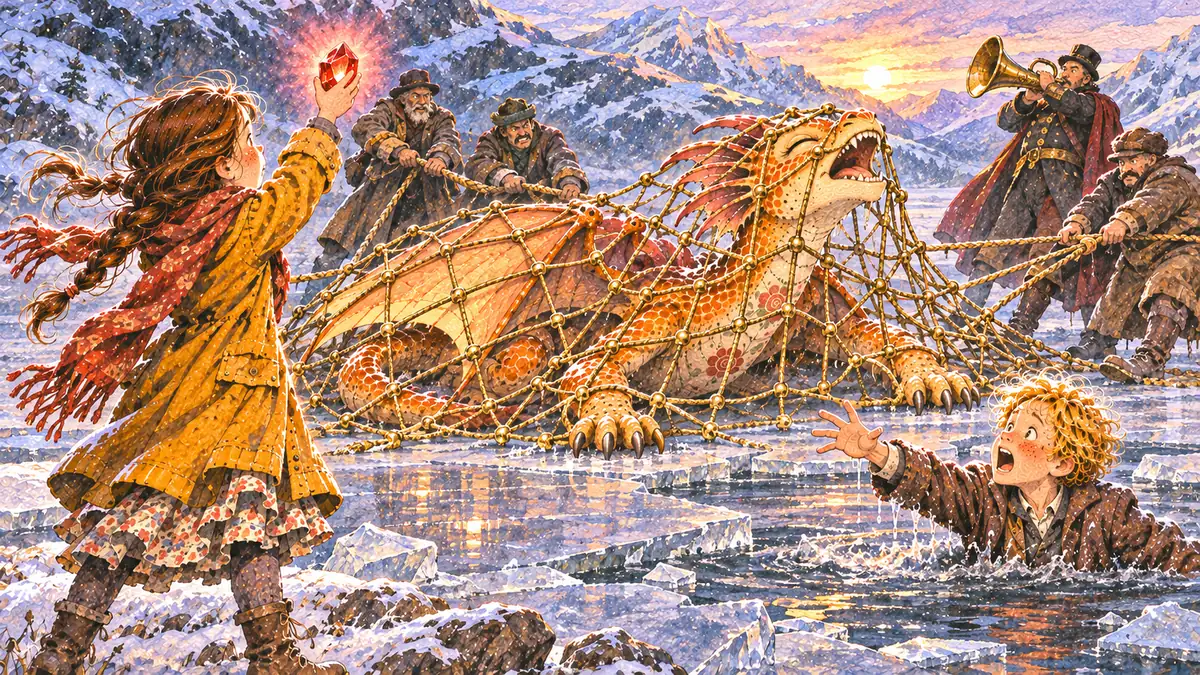
The Brass Net
Toby turned out every pocket he owned on the cave floor, again and again.
Coat pockets. Trouser pockets. The little pocket inside his jacket where he kept a pencil stub. He shook out his bag. He shook out his blanket. He went back along the floor of the first cave on his hands and knees, looking in the cracks.
"They were here," he said. "They were in my coat. Both pockets. They were so heavy I could hardly sit down."
"Maybe they fell out," said Josie. She was rolling up her blanket, with her back to him. Her own coat was hanging on a rock by the fire, and she did not look at it.
"All of them?"
"On the way up. In the dark. Maybe."
Toby sat back on his heels. He looked as if he might cry, and then he looked as if he had decided not to.
"Then I'll find some more," he said.
But it was not only the stones he was thinking about. All morning he kept taking the red-gold scale out of his bag and looking at it, and putting it back.
Somebody had shed it. Somebody big. Somebody who had flown across the moon. And somewhere on this mountain, there might be a footprint, or a claw mark, or a place where they had landed.
Below the ledge, at the bottom of a steep slope of black rock, there was a tarn: a small round mountain lake, in a hollow all of its own. Even in June it was frozen over. Grandpa said it was always frozen, that it was the one cold place on Old Smoke, because the steam never reached it. The ice on it was white and old, and round its edges was a rim of snow.
If anything big had landed on the mountain, thought Toby, it would have left tracks in that snow.
He did not tell Josie. He slung his bag over his shoulder, and whistled the tune very softly, and Biscuit got up from the warm floor of the cave and followed him out.
The snow round the tarn had no tracks in it except their own.
Toby went all the way round one side, looking. Biscuit went with him, sniffing at the snow and eating a rusty bolt she found in it. There was nothing. No claw marks. No footprints bigger than his.
On the far side of the tarn the ground rose to a long ridge. Toby climbed up onto Biscuit's back, the way he had done once or twice in the cave when she let him, so that he could see over the ridge. She stood quite still and let him.
And then he heard it.
It was a long way off at first. A honk. Then another. Then a great many, all together, a clattering, gabbling, furious noise, getting louder.
Biscuit's ears went flat.
Over the top of the ridge came geese. Dozens of them. Fifty, or more, a white flood of them pouring over the black rock, wings half open, necks out, honking. And behind them, walking steadily with long sticks in their hands, driving the geese on, came men. Five men, in brown tweed coats and caps. The one in front had a brass horn on a strap round his shoulders. He lifted it to his mouth and blew one short note.
Biscuit bolted.
She did not go back the way they had come. The geese were on that side. She went the only way that was open. She went straight out onto the ice.
Toby grabbed her neck with both arms and held on.
The ice took her weight. For three running strides it held.
Then the ice made a sound like a door being opened very slowly somewhere underneath them. Toby held on.
A crack ran out ahead of them, black and zigzag, across the white. Another ran out to the side. Biscuit's feet slid. She spread her wings and beat them, hard, and her front feet lifted off the ice, and her back feet scrabbled, and they were half flying and half running. The ice behind them broke with a noise like a plate dropped on a stone floor, and dark water came up through it. Biscuit beat her wings again. She was too heavy with a boy on her back. She could not get up. She could only skim, and skid, and flap, with her claws scraping and Toby's legs bumping on her sides and the black cracks racing them across the tarn.
She reached the far shore. Her claws hit rock. She hauled herself up out of the slush onto the snow with Toby still on her back.
And the snow rose up in front of her.
It was a net. It had been lying flat under a thin covering of snow, and two men on the far side of it had been waiting, holding the ropes. They pulled. The net came up out of the snow in a great shining sheet and fell over Biscuit's head and wings and back. Toby was thrown sideways off her neck and landed in a drift.
The net was made of brass.
Josie heard the geese from the cave.
She knew what the sound was before she had even stood up. She ran out onto the ledge and saw them all at once, far below: the white swarm of geese on the black ridge, the men with sticks, the cracked and broken ice of the tarn, and on the near shore something shining, heaving, struggling under a net. And a small figure in the snow beside it, getting up.
She did not remember going down the slope. She remembered arriving at the bottom, running round the edge of the tarn, and stopping.
She stopped ten feet from the net.
Biscuit was on her side under it, with her wings pinned. The net was fine brass mesh, as shining as a new trumpet, and it was pegged down all round. She had got her head round to the front of it. Her mouth was right at the mesh, open. She was breathing on it. Fire came out of her mouth, but it was thin and smoky and weak, the colour of a candle, and where it touched the brass it left only a black smudge. She breathed again. Another smudge. The brass did not even get warm.
"Brass," said the man with the horn. He stood a little way off with his cap pushed back, watching her as if she were a bonfire on the far side of a field. "She can't eat it. She can't burn it. His Lordship was very particular about that." He nodded at the geese. "He's read all the old books. Dragons go back to where their eggs were laid, he said, and young ones run from geese, and the tarn's the only flat ground on this mountain for a net. So we brought the geese, and we laid the net, and we waited."
Josie's hand was in her coat pocket.
Her fingers had closed round one of the red stones. It was warm. She took it out, and held it in her fist down by her side, where nobody could see. Ten feet. Biscuit's open mouth was ten feet away. Josie could throw a stone ten feet with her eyes shut. One stone into that mouth, and the copper would come up through her scales, and the heat would roll off her, and the brass would go soft and bend over and drip, like the lamp.
She lifted her arm.
And in her head, as clearly as if he were standing behind her, she heard Grandpa's voice by the fire. Once she's had her own mountain's food, she'll be ready to go.
Josie stood with her arm half raised and the warm stone in her fist.
Biscuit's eye found her through the mesh. It was gold, and very wide.
Josie lowered her arm. She did not throw.
Biscuit roared.
It was not like the roar at the fair. That had been fright. This came up from the bottom of her and went out across the tarn and hit the far side of the hollow and came back, and the whole frozen lake split from one shore to the other with a crack like the sky breaking. Slabs of ice reared up and fell back. Water slapped over the edges.
The men holding the ropes let go of them. They backed away. One of them sat down in the snow. Even the man with the horn took two steps back, and his face had gone white.
The roar stopped.
In the silence afterwards, everybody heard it.
It came from very far away, from the north, from over the sea. It was faint, and low, and long. It was not an echo. It went on too long to be an echo, and it was not quite the same note.
The man with the horn took off his cap and held it in his hands.
Nobody moved until it had died away completely. Then the man with the horn put his cap back on, and cleared his throat, and when he spoke his voice was quite gentle.
"Right, lads," he said. "Pick her up. Careful with her. His Lordship wants her perfect."
They had a cart. It was waiting on the old track below the ridge, with two horses, and in the back of it was a cage of brass bars with clean straw in the bottom. The men rolled Biscuit into the cage in her net, carefully, four of them lifting at once, and shut the door, and locked it with a brass padlock. They were not rough with her. They talked to her the way men talk to a frightened horse.
Biscuit lay in the straw and did not struggle any more. She looked out through the bars at Toby and Josie.
Toby stood in the snow with his bag in one hand and Biscuit's rope harness, which had come off in the net, in the other. He was wet to the waist, and shaking, and he did not seem to notice.
Moss came down the slope from the cave, running. He stopped at the edge of the track. He looked at the cage, and at the men, and at the man with the horn. The man with the horn nodded to him as if he knew him.
Moss did not say anything to the children. He did not look at them. He walked down the track after the cart.
The driver flicked the reins. The cart began to roll, slowly, down the old mine track towards the moor, with the brass bars shining in the sun, and the geese wandering about behind it in the snow, honking at nothing.
Toby watched it until it went round the shoulder of the mountain. Then he turned round to his sister.
Josie opened her hand.
The red stone was in her palm. And when she took her other hand out of her pocket, there were more in that, a whole handful, dark red and faintly glowing.
Toby looked at them for a while.
"You had them," he said.